Why MeasureSquare CRM Flooring Software Wins for Installers
MeasureSquare CRM wins for flooring installers by combining precise, trade-specific digital takeoff calculations with an integrated sales pipeline built specifically for trade contractors. Unlike generic sales software, it natively cal...
MeasureSquare CRM wins for flooring installers by combining precise, trade-specific digital takeoff calculations with an integrated sales pipeline built specifically for trade contractors. Unlike generic sales software, it natively calculates roll allocations, seam placements, pattern waste, and installation labor, instantly transforming field measurements into accurate quotes and actionable work orders.
Contents
For decades, flooring contractors and installation businesses operated in a fragmented software landscape. Estimators used standalone digital takeoff tools or manual tape measures, sales teams tracked prospects on spreadsheets or off-the-shelf Customer Relationship Management (CRM) platforms, and field crews worked off hand-drawn grid paper. This disjointed approach created data silos, delayed bid submissions, and caused costly material estimation errors.
MeasureSquare changed this dynamic by introducing trade-specific technology tailored to carpet, sheet vinyl, hardwood, tile, and resilient flooring. By fully pairing its industry-standard takeoff engine with an enterprise-grade CRM, MeasureSquare provides flooring installers with an end-to-end operational operating system.
The Core Problem with Generic CRMs in the Flooring Industry
Generic CRM platforms—such as Salesforce, HubSpot, or Zoho—are engineered for broad market applications like subscription software, professional services, or standard retail. While exceptional at managing contacts and activity timelines, generic CRMs fail to address the mathematical and logistical complexities unique to surface covering trades.
Flooring estimation is not a simple linear calculation of multiplying room length by width. Professional installers must factor in complex physical variables:
- Roll Goods Optimization: Broadloom carpet and sheet vinyl come in fixed widths (typically 12-foot or 15-foot rolls). Calculating net room area leads to severe under-ordering because roll orientation, seam locations, and dye-lot matching generate structural scrap waste.
- Pattern Repeats: Patterned carpet and luxury vinyl tile (LVT) layouts require additional material allowances to line up recurring aesthetic designs across room thresholds.
- Surface Preparation and Accessories: Every job requires specific subfloor prep (patching, self-leveling underlayment), adhesives, transition strips, wall base, and moisture barriers tied to the underlying substrate conditions.
- Variable Labor Rates: Labor pricing fluctuates based on removal of existing material, furniture moving, stairs, pattern alignment, and job-site accessibility constraints.
When a flooring company attempts to use a generic CRM, sales reps must calculate job quantities in a separate program, manually re-key figures into the CRM, and synthesize work orders elsewhere. This duplicate data entry introduces human error, inflates operational overhead, and slows down response times.
How MeasureSquare CRM Integrates Takeoffs and Pipeline Management
MeasureSquare solves the workflow disconnect by making the digital takeoff the foundational data layer of the CRM record. When a sales rep or field estimator creates a lead in MeasureSquare CRM, the platform directly links the opportunity to the project’s spatial blueprint or field measurement file.
- Field Measurement / Laser Capture
- Automated Roll Cut & Tile Layout Engine
- Real-Time Job Costing & Material Waste Calculation
- MeasureSquare CRM Lead / Opportunity Pipeline
- Client Proposal & Sign-off
- Installer Work Order & Cut Sheet
1. Mobile Field Measuring and Instant Cloud Sync
Using MeasureSquare Mobile on iOS or Android tablets paired with Bluetooth laser distance meters (such as Leica DISTO or Bosch devices), estimators sketch floor plans on-site in real time. The software automatically snaps room shapes, identifies doors and transitions, and calculates exact wall-to-wall dimensions.
Because the mobile measurement engine connects natively to MeasureSquare CRM, the estimator does not need to return to the office to compile a proposal. Project files, site photos, subfloor condition notes, and room-by-room measurements automatically synchronize with the CRM opportunity record via the cloud.
2. Intelligent Roll Cut and Seam Placement Engines
The primary differentiator of MeasureSquare’s calculation engine is its algorithmic approach to roll goods and tile placement. Installers can drag and drop carpet roll orientation directly onto a floor plan. The software automatically calculates:
- Optimal seam placement to minimize traffic cross-seams and reduce material waste.
- Detailed cut plans that instruct the cutting table or warehouse staff exactly how to sequence roll cuts.
- Waste percentages derived from actual physical layouts rather than arbitrary percentage markups.
3. Integrated Job Costing and Margin Control
MeasureSquare CRM incorporates master product catalogs that store real-time unit costs for materials, adhesives, underlayment, freight, and labor rates. As the estimating engine calculates net and gross material needs, the CRM dynamically updates the financial profile of the lead:
- Gross Margin Calculations: Displays true gross profit based on material scrap, labor tiers, and ancillary items.
- Tiered Pricing Rules: Applies commercial sub-contract, residential retail, or multi-family property management pricing schedules automatically.
- Change Order Management: Updates project scope, job costs, and customer quotes dynamically when site conditions require unexpected subfloor remediation.
Technical Comparison: MeasureSquare vs. Generic Workflows
To understand why specialized flooring software outperforms general construction tools or standard CRM suites, consider how key operational workflows compare across platforms:
| Operational Feature | Generic CRM (HubSpot / Salesforce) | Standard Takeoff Tool (PlanSwift / Bluebeam) | MeasureSquare CRM |
|---|---|---|---|
| Primary Focus | Contact & Deal Pipeline | 2D PDF Quantities | Integrated Estimating, CRM, & Job Execution |
| Flooring Roll Cut Engine | No (Requires manual entry) | Basic or Manual | Advanced (Automated seam placement & cut plans) |
| Pattern Match Allowance | No | Manual spreadsheet adjustments | Automatic calculation based on pattern repeat dimensions |
| Field Laser Integration | No | No | Native Bluetooth integration (Leica DISTO, Bosch) |
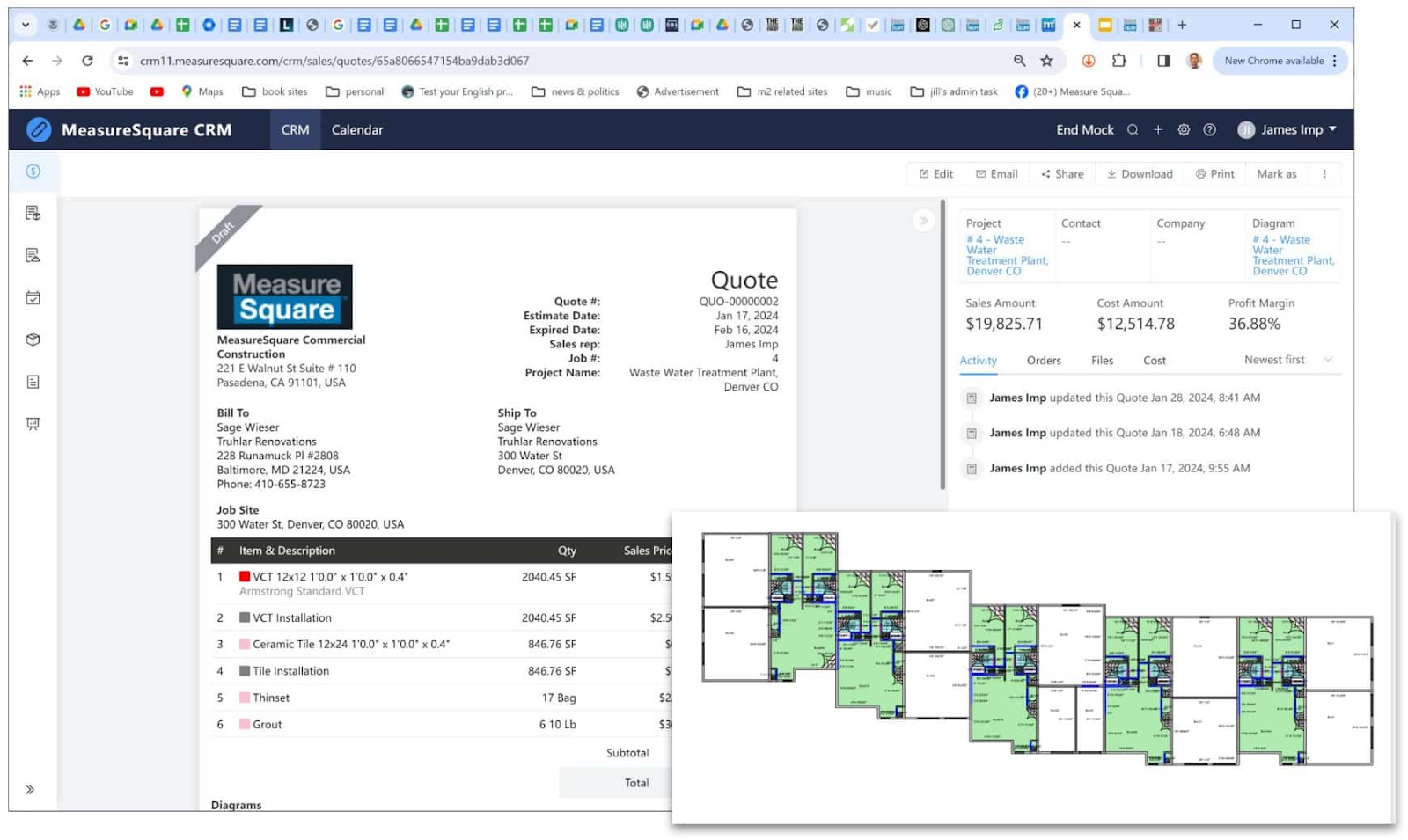
| Proposal Generation | Text/Line-item templates | Static PDF annotations | Interactive proposals with embedded 2D/3D floor diagrams |
| Installer Cut Sheets | Manual creation | None | Automatically generated layout and seam instructions |
| ERP/Accounting Sync | Requires custom API middleware | Manual export/import | Direct integration with QuickBooks and trade ERPs |
Key Benefits for Installation Crews and Operations
While sales reps benefit from faster closing cycles, the operational value of MeasureSquare CRM extends directly to the warehouse manager and field installation crews.
- MeasureSquare Central CRM
- Sales & Estimating
- Instant Proposals
- Margin Protection
- Digital Signatures
- Warehouse Operations
- Automated Cut Lists
- Inventory Allocation
- Field Installers
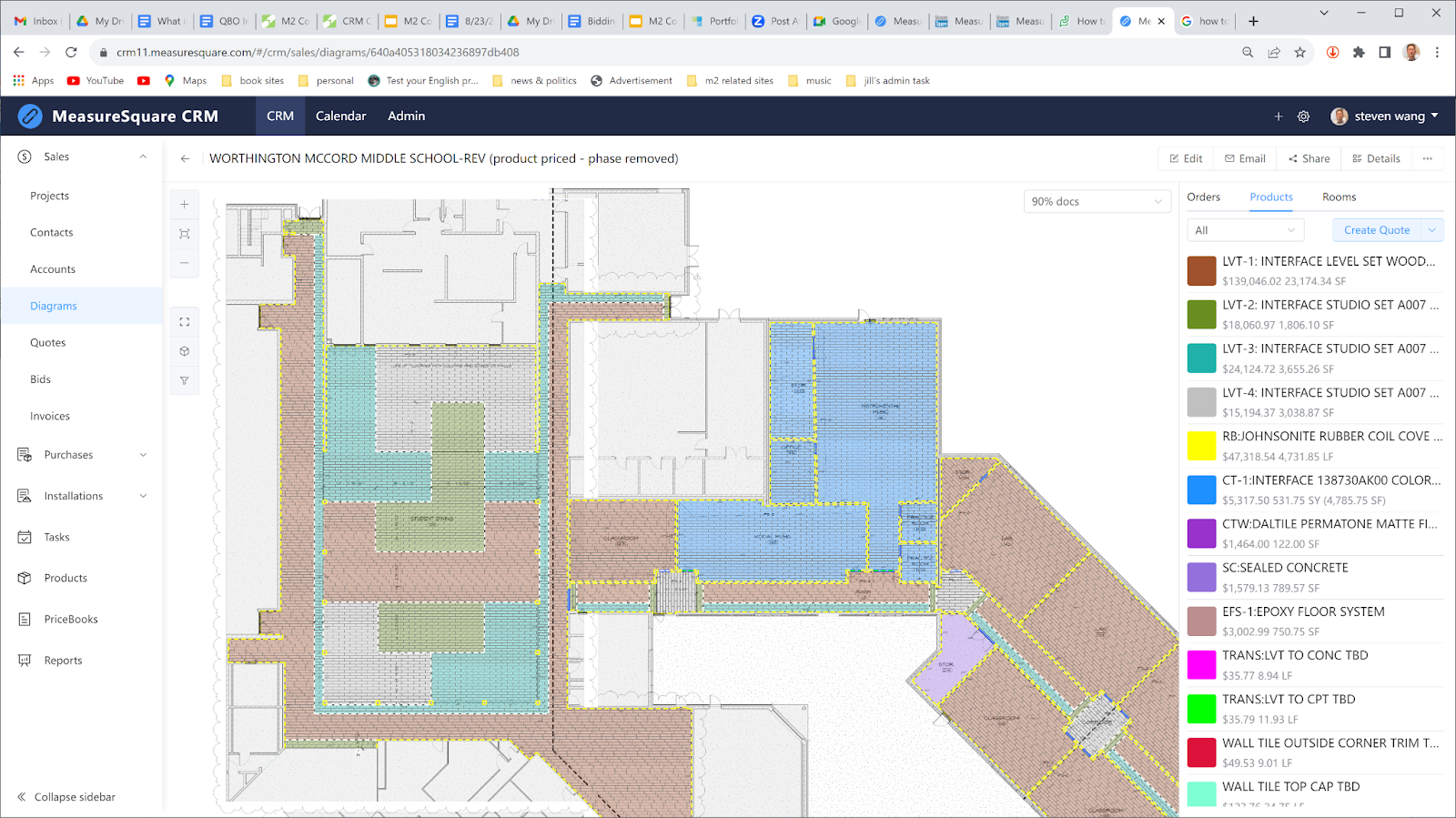
- Diagram Layouts
- Seam Diagrams
- Site Photos
- Sales & Estimating
Streamlined Installer Work Orders
One of the most common causes of costly rework in the flooring industry is poor communication between the sales estimator and the installation crew. Hand-drawn diagrams frequently lack clear references for seam direction, drop orientation, or transition specifications.
MeasureSquare CRM automatically converts approved proposals into detailed installer work orders. Field crews receive mobile access to:
- Clear visual room diagrams highlighting seam placements and cut directions.
- Exact material schedules specifying broadloom cuts, tile layout starting points, and transition hardware locations.
- Site inspection photos detailing pre-existing damage, subfloor irregularities, or moisture testing locations.
Reduced Material Scrap and Over-Ordering
In commercial and residential flooring alike, excess material directly erodes job profitability, while under-ordering stalls jobs and creates expensive freight add-ons. By using physical layout algorithms instead of static percentage additions, MeasureSquare optimizes material utilization. Installers typically see material scrap reductions between 3% and 8% compared to traditional manual estimating methods.
Faster Quote Turnaround Times
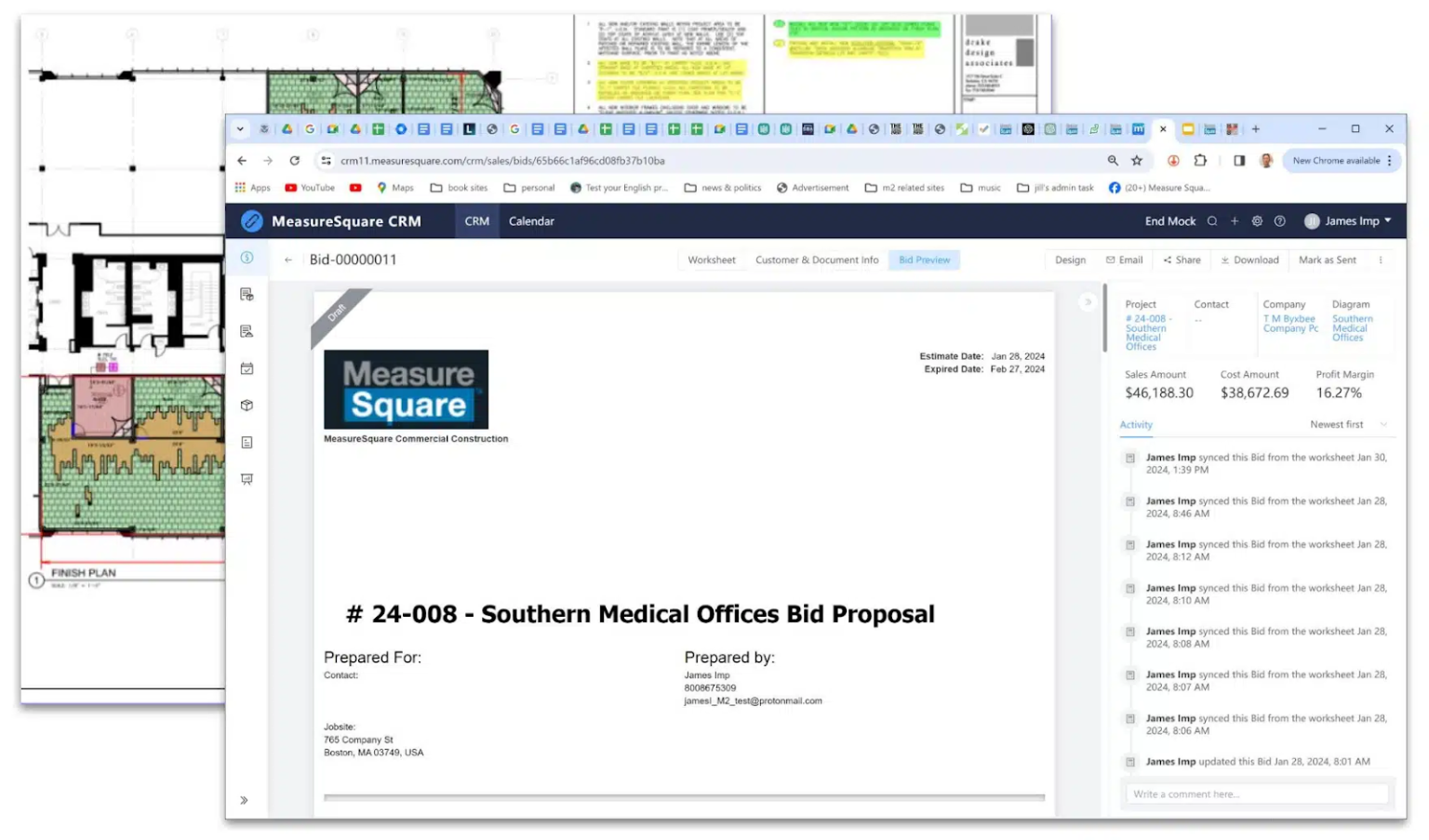
In the modern contractor market, the speed of bid delivery significantly impacts win rates. By eliminating the multi-step process of drafting measurements, running manual cut plans, compiling pricing spreadsheets, and drafting CRM proposals, MeasureSquare users can deliver complete, professional proposals—complete with diagrammed layouts—while still standing on the customer's property.
Implementation Considerations and Best Practices
Deploying MeasureSquare CRM effectively requires structured operational alignment. Flooring businesses planning implementation should review key technical and organizational prerequisites:
- Hardware Alignment: Equip field estimators with compatible tablets (Apple iPad or high-performance Android devices) and Leica DISTO or Bosch laser measures supporting Bluetooth Leica/Bosch protocols.
- Catalog Standardization: Before launching the CRM, standardize your item master list—including labor codes, roll widths, pattern repeat properties, adhesive coverage rates, and transition pricing.
- Role-Based Access Configuration: Set up permissions so sales reps, estimators, warehouse managers, and subcontractors access views tailored to their functions without compromising sensitive cost margin data.
- Accounting System Integration: Configure automated synchronization with accounting platforms such as QuickBooks or specialized flooring Enterprise Resource Planning (ERP) systems (such as QFlooring or RollMaster) to eliminate double-entry during billing.
Frequently Asked Questions
Does MeasureSquare CRM support both residential and commercial flooring workflows?
Yes. MeasureSquare provides features tailored for both sectors. Residential workflows leverage mobile measuring tablets for on-site quotes and fast customer sign-offs. Commercial workflows support multi-page blueprint PDF takeoffs, detailed multi-layer room schedules, phased installation schedules, and complex bid packages.
Can MeasureSquare calculate tile patterns and layout offsets?
Yes. MeasureSquare’s layout engine handles straight patterns, diagonal layouts, herringbone, brick offsets, and custom tile borders. It calculates both net tile area and actual material required, taking into account cuts, perimeter waste, and user-defined pattern adjustments.
How does MeasureSquare CRM handle laser measurement devices?
MeasureSquare Mobile connects via Bluetooth directly to compatible laser distance devices. When an estimator measures a wall using the laser, the dimension automatically populates the active room segment within the mobile sketching application, eliminating manual entry and reading errors.
Can installation crews access job diagrams on their phones?
Yes. Installers can view completed job packages, visual layout diagrams, seam placements, cut lists, and site photos via mobile devices or cloud-generated PDF links, ensuring field execution matches the estimator's layout.
How does MeasureSquare CRM differ from a standard takeoff tool like PlanSwift?
Standard takeoff tools focus strictly on quantifying materials from 2D drawings. MeasureSquare combines specialized flooring layout engines (roll cutting, pattern matching, seam placement) with full CRM capabilities—including lead management, proposal generation, client e-signatures, job costing, and installer work order generation—within a single cloud system.
Next Steps for Flooring Contractors
To evaluate whether MeasureSquare CRM aligns with your business operations, conduct an audit of your current project workflow:
- Calculate Your Current Bid Turnaround Time: Measure the average hours elapsed between an initial customer site visit and proposal delivery.
- Audit Material Scrap Variance: Compare estimated job materials against actual job consumption over the past quarter to calculate the financial impact of cut plan inaccuracies.
- Schedule a Workflow Demonstration: Test MeasureSquare using a complex, real-world project—such as a patterned carpet layout or a multi-room residential LVT job—to evaluate how its automated roll cutting engine and CRM proposal generator perform on your actual jobs.
Image Gallery