How to Use Brand Lift Questions to Measure Advertising Effectiveness
Brand lift questions serve as a specialized survey mechanism designed to quantify the incremental impact of a digital advertising campaign on consumer perception. By presenting short, targeted questions to a test group exposed to your...
Brand lift questions serve as a specialized survey mechanism designed to quantify the incremental impact of a digital advertising campaign on consumer perception. By presenting short, targeted questions to a test group exposed to your ads versus a control group that has not seen them, marketers can statistically isolate the influence of their media spend on key performance indicators like ad recall, brand awareness, brand favorability, and purchase intent.
Contents
The Purpose of Brand Lift Measurement
In a complex media landscape, standard metrics like clicks and impressions often fail to capture the qualitative shifts in consumer mindset. Brand lift studies bridge this gap by moving beyond behavioral data to measure psychological change. When you deploy these questions, you are essentially asking your audience if your advertising has successfully influenced their perception or future behavior.
The primary objective is to determine the "lift"—the difference in positive responses between the group that saw your advertisements and the group that did not. This data is essential for justifying budget allocation, optimizing creative assets, and proving the value of top-of-funnel brand awareness campaigns that do not necessarily lead to immediate, trackable conversions.
Essential Prerequisites for Implementation
Before configuring your first question set, you must ensure your campaign meets the technical and strategic requirements necessary to produce statistically significant results.
1. Minimum Reach and Impression Thresholds
Brand lift studies are sampling-based. If your campaign reach is too low, the sample size of survey respondents will be insufficient to yield a statistically significant lift. Most major advertising platforms, such as Google Ads or Meta Ads, require a minimum budget or a minimum number of impressions over a specific timeframe to ensure that enough survey responses are gathered to reach a confidence interval that is actionable.
2. Clear Campaign Objectives
You must define what "success" looks like before launching. Are you trying to boost product awareness, or are you trying to sway sentiment toward a specific brand attribute? Choosing the right metrics dictates the type of questions you should ask.
3. Proper Campaign Structure
Your campaign must be structured to allow for a split between a control group (unexposed) and a test group (exposed). Platforms usually handle this automatically by withholding ads from a small percentage of your target audience to serve as the control.
Crafting Effective Brand Lift Questions
The efficacy of a brand lift study depends entirely on the clarity and neutrality of the questions asked. Avoid leading questions that might bias the respondent’s answer.
Types of Metrics You Can Measure
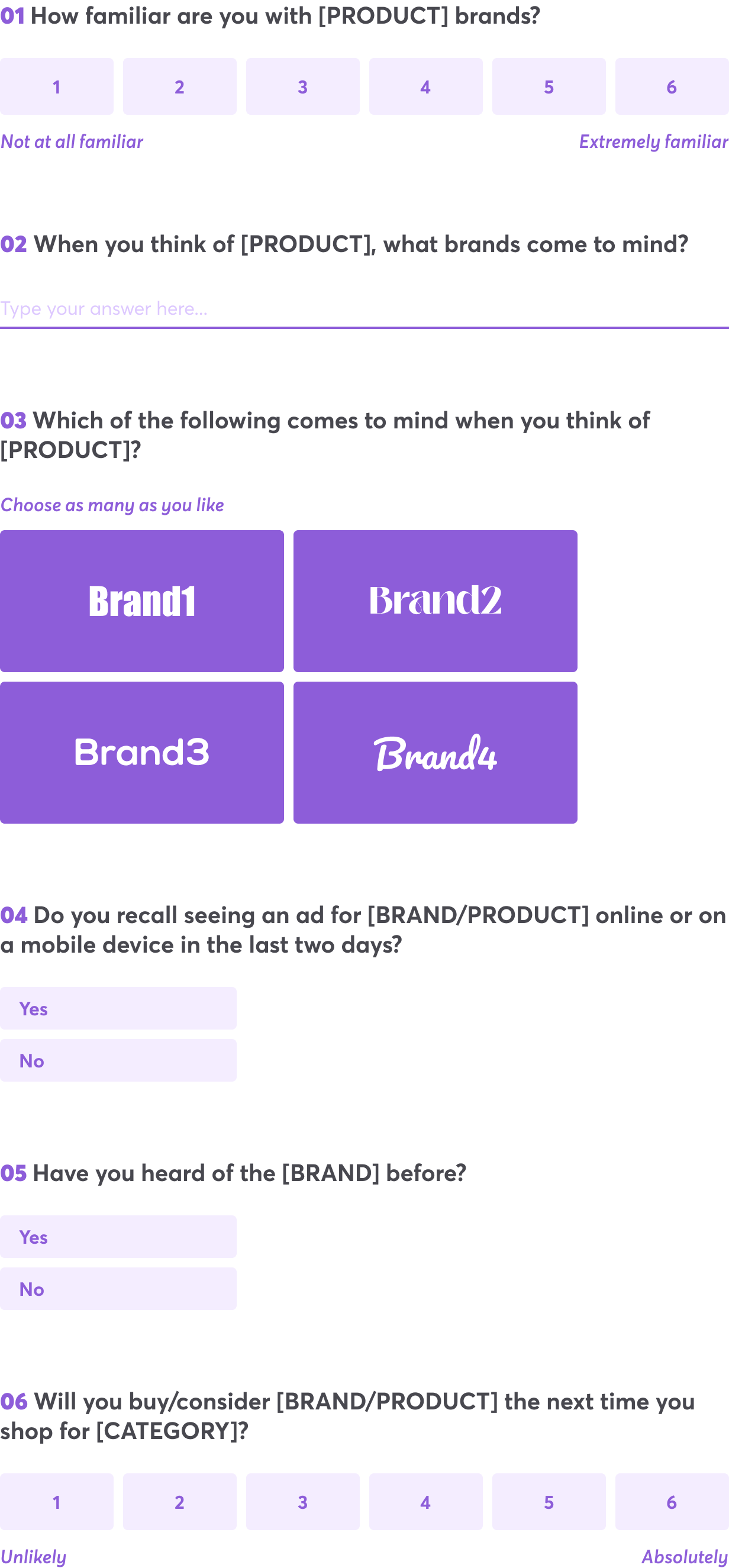
- Ad Recall: "Have you seen an ad for [Brand Name] online in the past week?" (This is the most common metric).
- Brand Awareness: "Which of the following brands have you heard of?" (Tested in a multi-choice format).
- Brand Favorability: "How would you describe your opinion of [Brand Name]?"
- Purchase Intent: "How likely are you to consider purchasing from [Brand Name] the next time you are in the market for [Product Category]?"
Best Practices for Question Design
- Keep it Brief: Respondents are typically interrupted while browsing. Use no more than one or two questions per survey.
- Maintain Neutrality: Ensure the question does not favor your brand over competitors in the phrasing.
- Standardize Options: Use consistent rating scales (e.g., 1–5 or Definitely/Probably/Maybe) to make data aggregation easier.
- Brand Placement: Always include your brand name alongside relevant competitors to assess competitive landscape movement rather than just isolated growth.
Strategic Comparison of Lift Metrics
The following table outlines common metrics and the specific business questions they help resolve.
| Metric | Business Goal | Typical Use Case |
|---|---|---|
| Ad Recall | Visibility | Measuring the memorability of a specific video or display creative. |
| Brand Awareness | Recognition | Assessing market penetration during a new product launch. |
| Favorability | Sentiment | Determining if a PR campaign or influencer series improved brand perception. |
| Purchase Intent | Sales Readiness | Gauging the effectiveness of mid-funnel content in driving future demand. |
Execution Workflow: From Setup to Analysis
Step 1: Configuration
Within your advertising dashboard, navigate to the brand lift or brand measurement section. You will be required to define your brand name and select the appropriate product category. Providing these details helps the platform's algorithm serve relevant questions.
Step 2: Deployment
Link the brand lift study to your specific campaign. Ensure that the campaign has enough "velocity"—meaning a steady flow of impressions—to ensure the survey questions are served consistently throughout the duration of the campaign.
Step 3: Monitoring for Significance
Do not look at the data until the platform indicates that the study has reached a baseline level of statistical significance. Evaluating incomplete data often leads to "false positives" or misleading trends.
Step 4: Optimization
Once the study concludes, use the data to optimize your creative assets. If one video creative shows high ad recall lift while another shows low favorability, you have concrete data to justify pivoting your creative strategy toward the high-performing asset.
Common Pitfalls and Troubleshooting
Sample Bias
If your campaign targets a very narrow niche, your survey results may be skewed by the specific demographics of that group. Always verify that your survey respondents mirror the target audience you intended to reach.
Survey Fatigue
If you serve too many questions to the same user across different platforms, you risk annoying the customer and potentially hurting the brand image you are trying to lift. Stick to single-question surveys per user interaction.
Misinterpreting "No Lift"
A "no lift" result is not necessarily a failure of your advertising; it can be an indicator that your brand is already at market saturation or that the messaging was misaligned with the audience's current needs. Use the result as a diagnostic tool to re-evaluate the creative premise rather than simply discarding the campaign.
Frequently Asked Questions
What is the difference between brand lift and conversion tracking?
Conversion tracking measures direct actions like purchases or clicks. Brand lift measures the mental state of the consumer, identifying the long-term impact on brand health that often precedes direct conversion actions.
Why does a brand lift study require a control group?
A control group is necessary to provide a baseline. Without it, you cannot determine if a consumer’s positive perception of your brand is due to your advertisement or simply existing brand loyalty.
How long should a brand lift study run?
Most studies require at least 4 to 8 weeks to gather enough data for statistical significance, depending on your daily budget and total reach. Avoid stopping the study early, as the data will likely be noisy and unreliable.
Can I run a brand lift study with a small budget?
While possible, it is often discouraged. Platforms generally require a minimum spend to ensure that the survey reaches enough unique users. If your budget is below the platform's recommended threshold, consider consolidating your spend into a shorter, more concentrated burst.
Is brand lift data actionable for immediate sales?
Brand lift data is primarily a long-term strategic tool. While it informs your path toward sales, it does not provide the immediate "last-click" attribution data that performance marketers rely on for daily optimization.
Next Actions
To begin, verify that your campaign budget meets the minimum requirements established by your chosen advertising platform. Once you have confirmed eligibility, select one core metric—such as ad recall—as your primary indicator of success. Launch your campaign with a clear, neutral survey question and commit to letting the study run until the platform confirms that the data has reached statistical significance before making any strategic adjustments to your creative or media buying.
Image Gallery