What Does IDK and TBH Mean in Texting
IDK stands for "I don't know," and TBH stands for "to be honest." Both are foundational shorthand acronyms in digital communication, designed to speed up typing and reflect casual, conversational tones across text messaging, social med...
IDK stands for "I don't know," and TBH stands for "to be honest." Both are foundational shorthand acronyms in digital communication, designed to speed up typing and reflect casual, conversational tones across text messaging, social media, and online gaming platforms.
Contents
Digital communication relies heavily on speed, efficiency, and tone replication. Because typing on mobile keyboards can be cumbersome, internet users developed a rich vocabulary of initialisms and acronyms to streamline conversations. Among the most enduring and universally recognized text abbreviations are IDK and TBH. Understanding their precise definitions, nuances, and proper contexts prevents misunderstandings and helps decode the often fast-paced world of digital dialogue.
The Origins and Evolution of Text Slang
Text messaging slang did not emerge overnight. Its roots stretch back to the early days of electronic communication, including Internet Relay Chat (IRC), Usenet message boards, and early mobile phones that relied on numeric keypads (T9 predictive text). When character limits were strict—such as the 160-character ceiling on early SMS text messages—and typing required multiple keystrokes per letter, users naturally sought ways to compress sentences into a few keystrokes.
Acronyms like IDK and TBH transitioned from niche subcultures inhabited by computer programmers and early chatroom users into mainstream vocabulary. Today, they appear everywhere from casual group chats between family members to professional Slack channels and brand marketing campaigns on social media platforms like TikTok, Instagram, and X (formerly Twitter). Their survival and continued relevance speak to a fundamental human desire for conversational efficiency and stylistic informality in digital spaces.
Deconstructing IDK: Definition and Usage
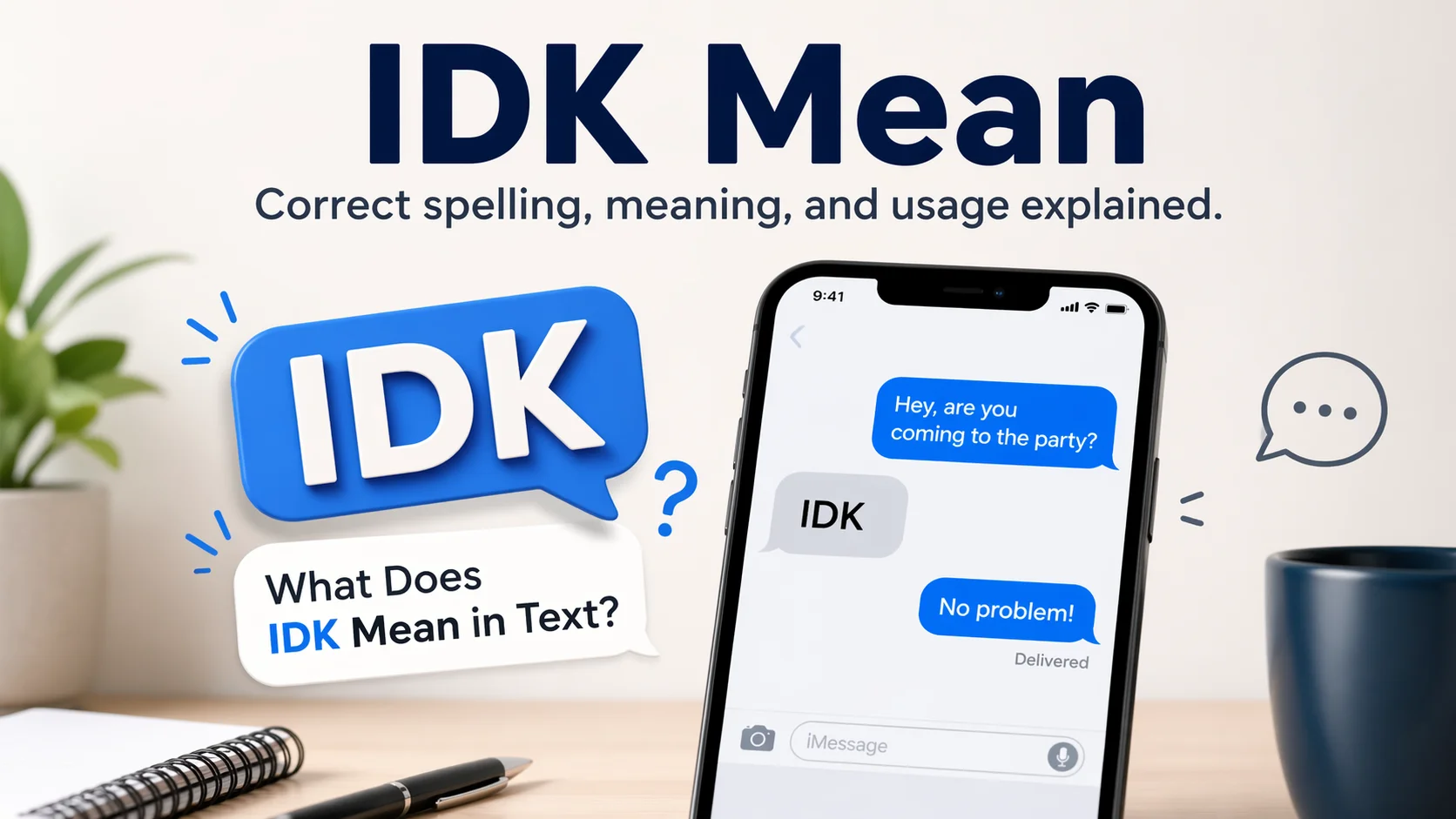
The acronym IDK stands for "I don't know." It serves as a direct, functional substitute for the full phrase, allowing the sender to admit a lack of information or uncertainty with minimal effort.
When and How to Use IDK
IDK is most frequently deployed in response to direct questions where the sender genuinely lacks the answer. For example, if someone asks, "What time are we meeting tomorrow?" a standard text response might be, "IDK, let me check my schedule."
Beyond simple factual uncertainty, IDK can also convey a sense of indifference or indecisiveness when making plans. If a group chat cannot decide on a restaurant, replying with "IDK" can signify that the user has no strong preference and will defer to the group's collective choice.
Tone and Etiquette Considerations
While IDK is universally understood in casual contexts, its brevity can occasionally be misinterpreted as bluntness or apathy. Because text messages lack vocal inflection and facial expressions, a single-letter response or a standalone "IDK" might make the recipient feel dismissed. To soften the tone, texters often pair IDK with punctuation, emojis, or supplementary clauses, such as "IDK tbh" or "Idk, what do you think?"
Deconstructing TBH: Definition and Usage
The acronym TBH stands for "to be honest." Unlike IDK, which addresses a gap in knowledge, TBH is a discourse marker used to introduce a candid opinion, a confession, or an authentic reaction to a statement.
When and How to Use TBH
Texters use TBH to signal that what follows is an unfiltered personal viewpoint or a vulnerable admission. For instance, a person might text, "TBH, I didn't really like that movie," or "TBH, I'm feeling pretty tired today."
In the mid-2010s, TBH also evolved into a standalone social media game or prompt on platforms like Facebook and Instagram, where users would post "like for a tbh," obligating the poster to write a brief, honest assessment of anyone who liked their post. While that specific trend has waned, the core function of TBH as a marker of sincerity remains deeply embedded in everyday texting.
Tone and Etiquette Considerations
Depending on the context, TBH can carry different emotional weights. It can introduce a mild confession, a compliment ("TBH you looked great tonight"), or a critique. Because it explicitly claims "honesty," it sometimes primes the recipient to expect a potentially controversial or critical remark, though it is just as frequently used for positive affirmation.
Common Variations and Combinations
As digital slang evolved, users began combining IDK and TBH with other common acronyms to express layered emotional states. Understanding these combinations expands conversational fluency:
- IDK TBH: Translates to "I don't know, to be honest." Used when expressing uncertainty about a complex topic while maintaining total candor.
- TBH IDK: A slight variation meaning "To be honest, I don't know." It emphasizes that the admission of ignorance is genuine and deliberate.
- SMH TBH: "Shaking my head, to be honest." Used to express mild disapproval or disbelief regarding a situation or statement.
- IMO / IMHO: "In my opinion" or "In my honest opinion," which frequently accompany TBH statements to reinforce personal subjectivity.
Comparison of Digital Acronyms
To better understand how IDK and TBH fit into the broader landscape of digital communication, the following table compares them with other common text abbreviations based on function, primary intent, and appropriate context.
| Acronym | Full Phrase | Primary Intent | Typical Context | Formality Level |
|---|---|---|---|---|
| IDK | I don't know | Expressing uncertainty or lack of information | Answering direct questions; casual planning | Casual / Informal |
| TBH | To be honest | Introducing a candid opinion or confession | Sharing personal views, reviews, or feelings | Casual / Informal |
| IMO | In my opinion | Offering a subjective viewpoint | Debates, discussions, giving advice | Casual / Semi-formal |
| AFAIK | As far as I know | Sharing information with acknowledged limits | Providing factual updates with caution | Casual / Semi-formal |
| TMI | Too much information | Rejection of overly graphic or personal details | Halting uncomfortable or excessive sharing | Casual / Playful |
Cultural Impact and Generational Shifts in Texting
The use of text acronyms often sparks generational commentary. While older generations sometimes view shorthand like IDK and TBH as a degradation of formal language, linguists view it as a dynamic adaptation of written communication. Texting bridges the gap between written and spoken language; because we cannot use tone of voice or body language in a text message, acronyms and punctuation choices serve as proxies for human emotion and pacing.
Furthermore, capitalization and punctuation usage significantly alter how IDK and TBH are perceived. Typing "idk" in all lowercase letters often signals extreme casualness, relaxation, or indifference. Conversely, typing "IDK!" with capitalization and exclamation points can suggest playful emphasis or heightened energy. While younger demographics often lean toward lowercase typing to convey a nonchalant tone, older demographics may use traditional capitalization, illustrating how digital dialects vary across age groups.
Frequently Asked Questions
Are IDK and TBH appropriate for professional emails?
Generally, no. While modern workplace communication on platforms like Slack or Microsoft Teams has become increasingly informal, acronyms like IDK and TBH are still viewed as too casual for formal client emails, official documentation, or professional correspondence. It is best to spell out "I don't know" or "To be honest" (or rephrase entirely) in professional settings.
Do IDK and TBH always mean the exact literal phrases?
Yes, their core definitions remain consistent across platforms. However, like much of language, their pragmatic meaning depends heavily on context. "TBH" can range from a playful joke to a serious expression of vulnerability, depending on the sentence that follows it.
Can IDK and TBH be capitalized in a sentence?
They can be written in lowercase (idk, tbh) or uppercase (IDK, TBH). Lowercase is more common in rapid text messaging because it saves the user from hitting the shift key, whereas uppercase is often used for emphasis or at the beginning of a sentence.
How did these acronyms become so widespread?
They gained popularity due to the physical constraints of early mobile technology, such as character limits on SMS messages and slow typing speeds on numeric keypads. Once established, they persisted because they enhance the conversational, rapid-fire rhythm of digital chat.
Conclusion and Next Actions
Mastering text abbreviations like IDK and TBH allows for smoother navigation of everyday digital interactions. Recognizing that IDK expresses uncertainty while TBH introduces candor ensures that messages are interpreted with the correct tone. When communicating in professional or unfamiliar environments, default to spelling out phrases in full, but feel free to embrace these classic acronyms in casual conversations with friends, family, and peers to match the natural speed of modern digital dialogue.
Image Gallery