Understanding the Long Call and Put Options
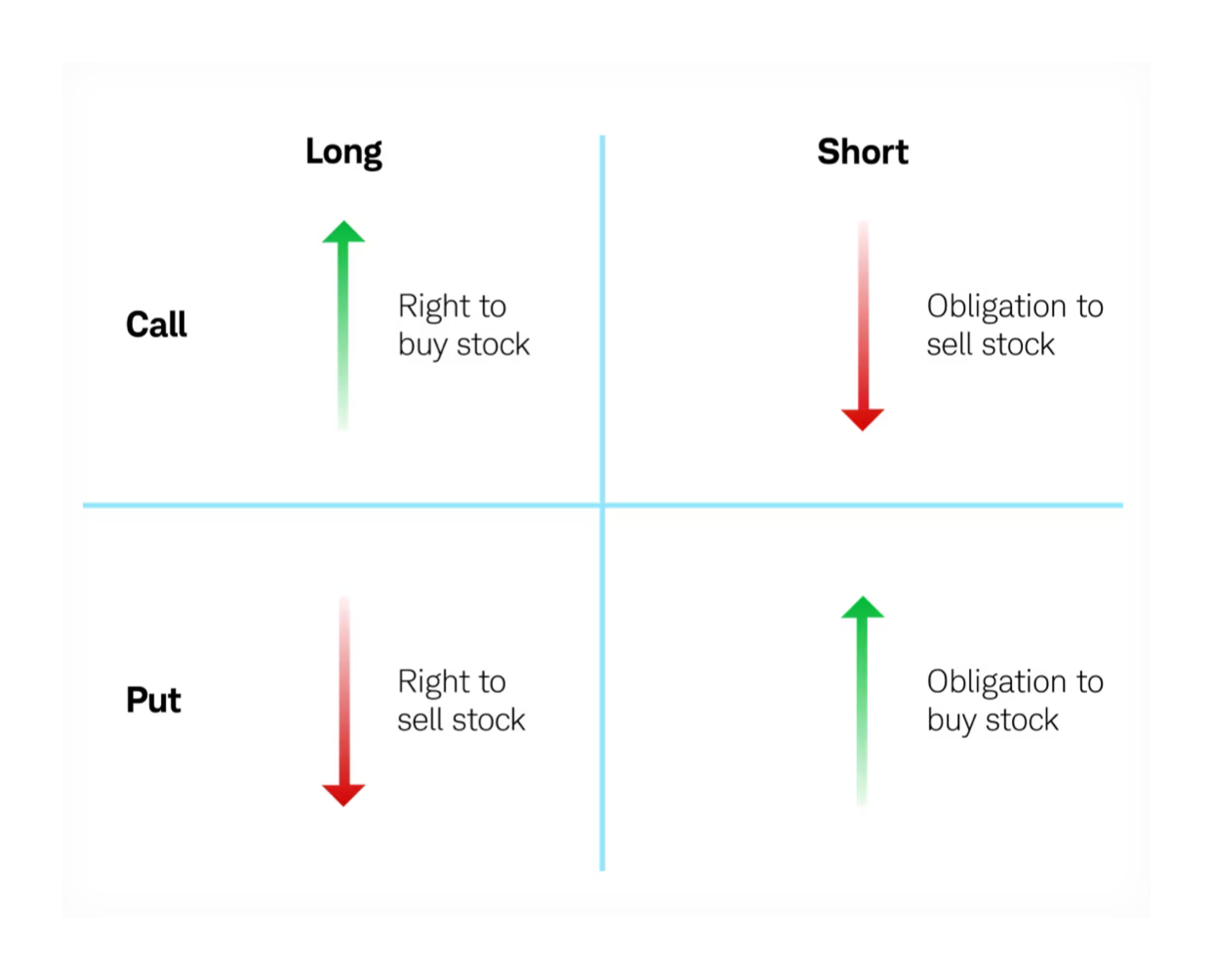
A long call or put option position gives an investor the right, but not the obligation, to buy or sell an underlying asset at a predetermined strike price within a specific timeframe. Opening a "long" options trade means purchasing an...
A long call or put option position gives an investor the right, but not the obligation, to buy or sell an underlying asset at a predetermined strike price within a specific timeframe. Opening a "long" options trade means purchasing an option contract to open, establishing directional exposure while limiting downside risk strictly to the premium paid to acquire the contract.
Contents
Options trading offers retail and institutional market participants a versatile toolkit for capital appreciation, hedging, and income generation. Among the fundamental strategies available to traders, establishing a long position in calls or puts serves as the bedrock for directional speculation and risk management. Mastering these foundational contracts requires a firm grasp of mechanics, pricing dynamics, time decay, and strategic execution parameters.
Disclaimer: Options trading involves substantial risk and is not suitable for all investors. Certain complex options strategies carry additional risk. Before trading options, please read the Characteristics and Risks of Standardized Options, published by the Options Clearing Corporation.
The Mechanics of Options Contracts
An option is a derivative contract derived from an underlying asset, typically a publicly traded stock, an exchange-traded fund (ETF), or a market index. Unlike owning shares of stock, which grants fractional ownership and voting rights, purchasing an option contract purchases a conditional claim over a specific block of shares—usually 100 shares per standard contract.
Options contracts do not represent equity ownership. Instead, they are wasting assets with a finite expiration date. The buyer of the contract pays a cash amount known as the premium to the seller (or writer). In exchange, the buyer acquires a specific contractual privilege defined by the contract type: a call option or a put option.
Core Terminology
- Strike Price: The fixed price at which the underlying security can be bought (in the case of a call) or sold (in the case of a put) if the option is exercised.
- Expiration Date: The exact date and time when the option contract ceases to exist. If unexercised by this deadline, an out-of-the-money option expires completely worthless.
- Premium: The market price paid by the buyer to the seller for the option contract. This cost is quoted on a per-share basis but is multiplied by 100 to reflect the total cash outlay for a single standard contract.
- In-the-Money (ITM): An option that possesses intrinsic value based on the relationship between the underlying asset's market price and the strike price.
- Out-of-the-Money (OTM): An option that has no intrinsic value because exercising it right now would result in a financial loss.
- At-the-Money (ATM): An option whose strike price is identical or exceptionally close to the current market price of the underlying asset.
Anatomy of a Long Call Option
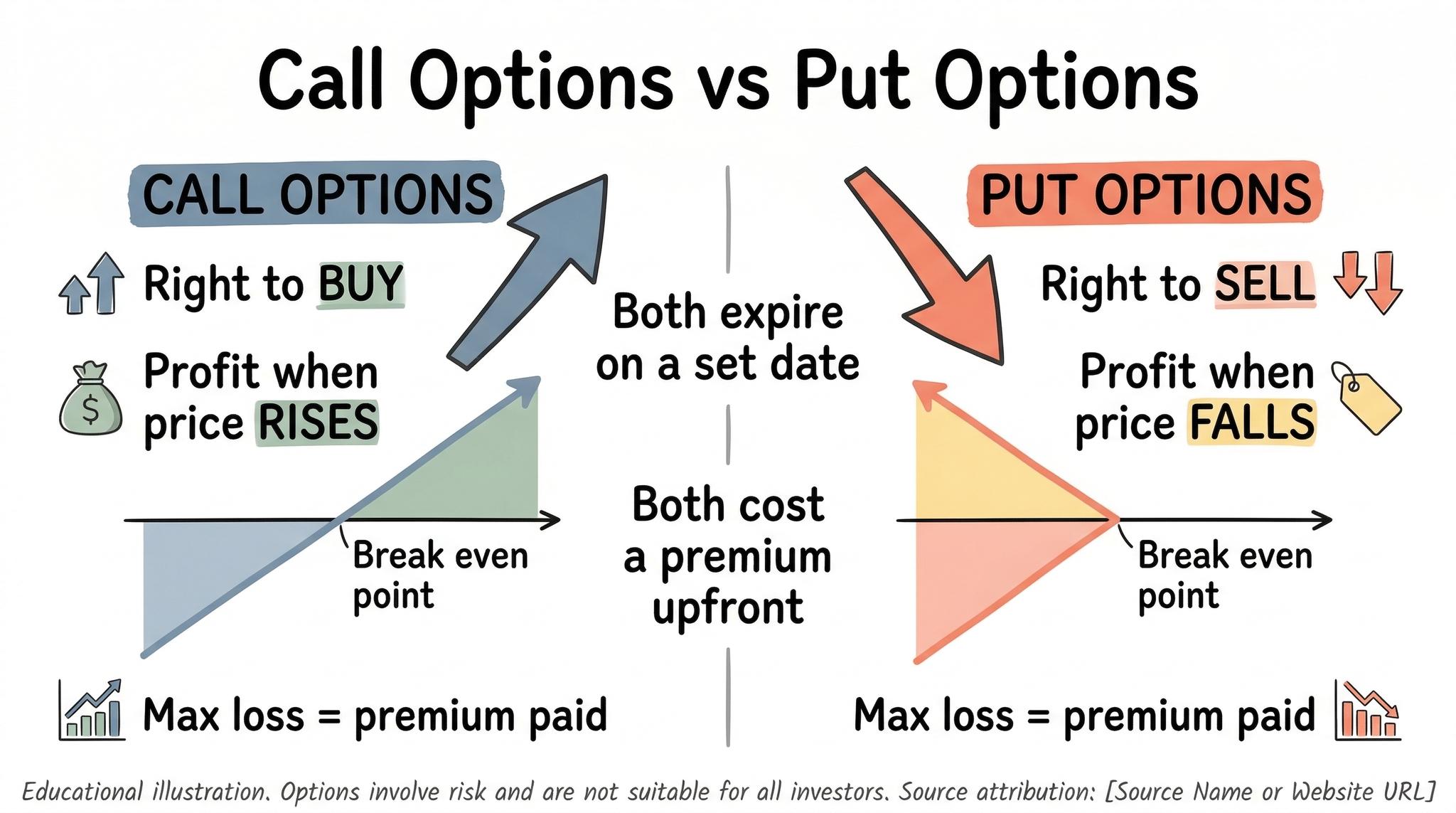
A long call option is a bullish strategy utilized when an investor anticipates that the price of the underlying asset will rise significantly before the contract expires. By purchasing a call option, the buyer secures upside exposure without needing the capital required to purchase 100 outright shares of the stock.
Risk and Reward Profile
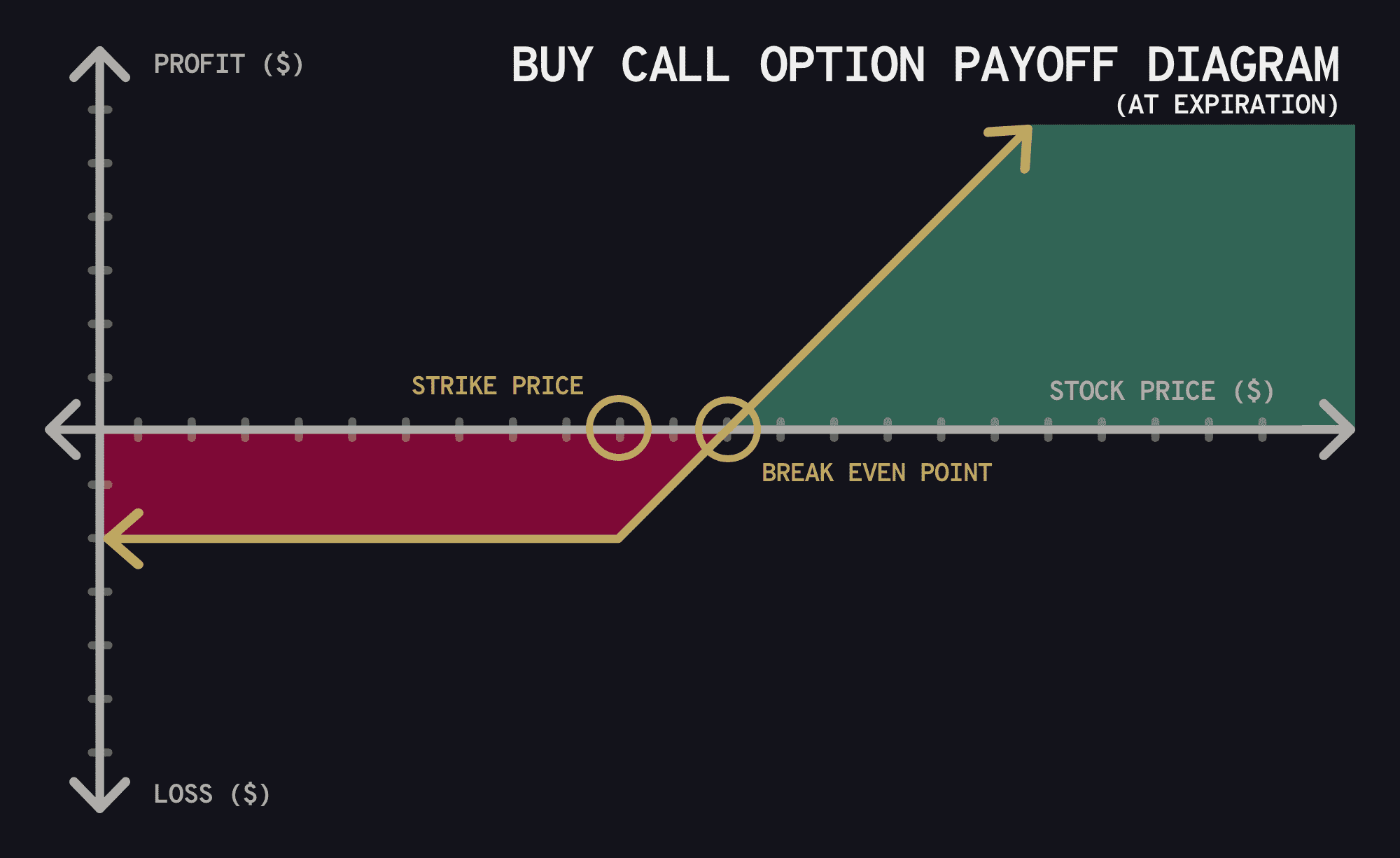
The maximum profit for a long call is theoretically unlimited. As the price of the underlying asset climbs higher and higher past the strike price, the intrinsic value of the call option expands proportionally.
Conversely, the maximum potential loss is strictly capped at the exact amount paid for the premium. If the underlying asset drops in price, stagnates, or fails to rise above the strike price plus the paid premium by expiration, the buyer simply lets the contract expire, losing 100% of the invested capital.
Example Scenario
Imagine stock XYZ is trading at $100 per share. An investor is bullish and buys one 6-month call option with a $105 strike price for a premium of $3.00 per share. Because each contract controls 100 shares, the total capital outlay (cost) of the trade is $300, excluding broker commissions.
- Break-Even Point: To calculate the break-even price at expiration, the buyer must add the strike price ($105) to the premium paid ($3.00), yielding a break-even price of $108.00 per share.
- Profitable Scenario: If stock XYZ surges to $120 before expiration, the option has an intrinsic value of $15 per share ($120 market price minus $105 strike). Subtracting the initial $3.00 premium yields a net profit of $12.00 per share, or $1,200 total for the contract.
- Losing Scenario: If stock XYZ falls to $95 or remains flat at $100 at expiration, exercising the option makes no financial sense. The option expires worthless, and the investor absorbs a $300 loss.
Anatomy of a Long Put Option
A long put option is a bearish strategy employed when a trader expects the underlying asset’s price to decline. Purchasing a put option grants the buyer the right to sell 100 shares of the underlying asset at the predetermined strike price, regardless of how far the market price plummets.
Risk and Reward Profile
The maximum profit for a long put is substantial, limited only by the scenario where the underlying asset’s price drops to zero. As the stock price falls, the value of the put option increases.
The maximum risk is limited to the premium paid to open the trade. If the underlying asset rises or remains stable, the put option loses value and eventually expires worthless, resulting in the loss of the initial premium.
Example Scenario
Consider stock ABC trading at $50 per share. A risk-conscious investor anticipates downward pressure and buys a 3-month put option with a $45 strike price for a premium of $1.50 per share. The total cash outlay is $150.
- Break-Even Point: The break-even price for a long put is calculated by subtracting the premium ($1.50) from the strike price ($45), resulting in $43.50 per share.
- Profitable Scenario: If negative earnings reports cause stock ABC to crash to $35 per share, the $45 put option allows the investor to sell shares at $45 that are only worth $35 on the open market. This generates an intrinsic value of $10 per share. Subtracting the $1.50 initial premium yields a net profit of $8.50 per share, or $850 total.
- Losing Scenario: If stock ABC rallies to $55 by expiration, the put option expires worthless, and the investor loses the initial $150 premium.
Comparing Long Calls and Long Puts
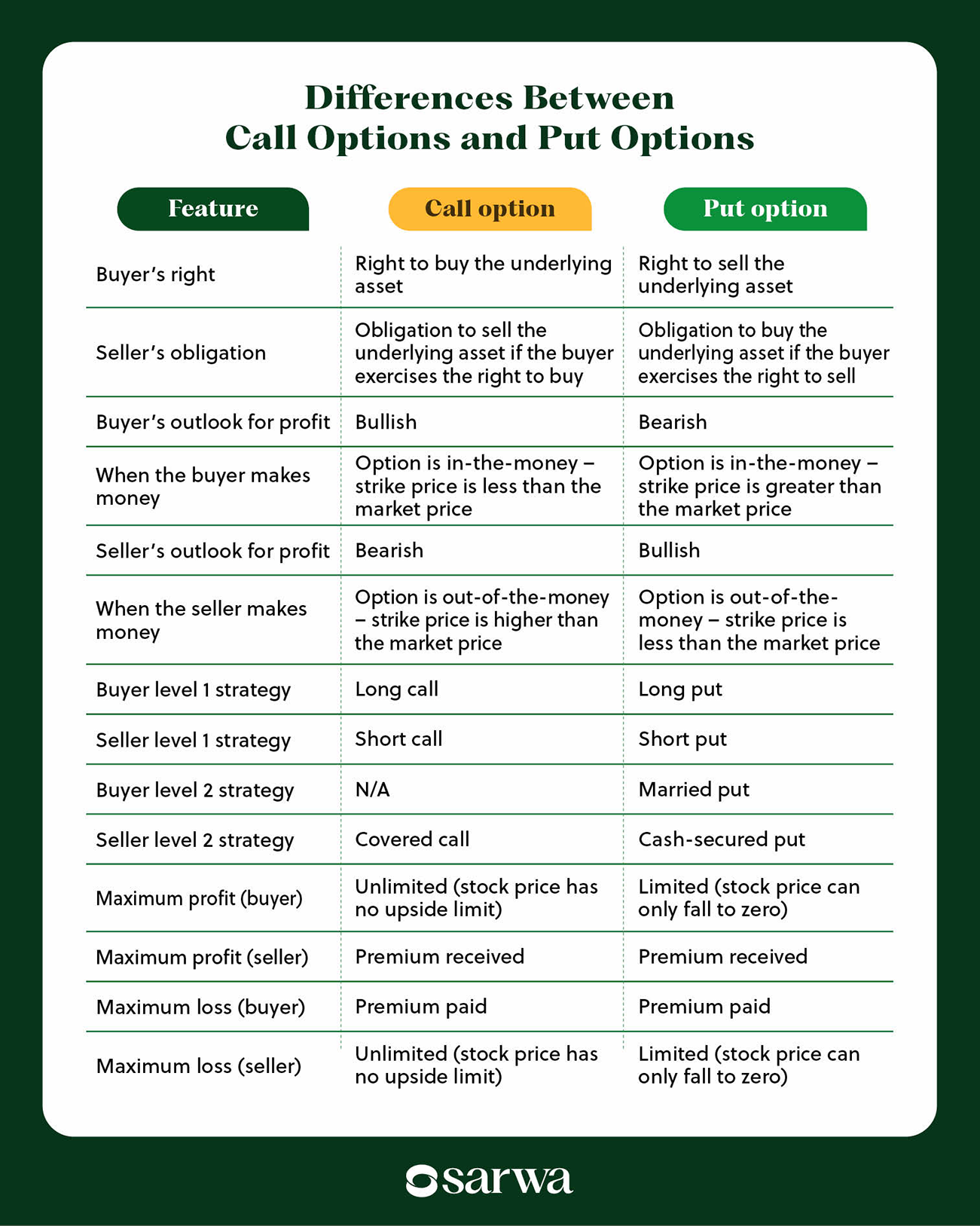
Evaluating the structural differences between long calls and long puts helps clarify when to apply each approach based on market outlook.
| Feature | Long Call Option | Long Put Option |
|---|---|---|
| Market Outlook | Bullish (Expecting price to rise) | Bearish (Expecting price to fall) |
| Right Acquired | Right to buy the underlying asset | Right to sell the underlying asset |
| Maximum Profit | Theoretically unlimited | Substantial (Limited by asset price dropping to zero) |
| Maximum Loss | Limited to premium paid | Limited to premium paid |
| Break-Even Calculation | Strike Price + Premium Paid | Strike Price - Premium Paid |
| Primary Use Case | Leveraged growth, upside speculation | Downside portfolio hedging, directional shorting |
The Impact of the Greeks on Long Options
Options pricing is not solely determined by the movement of the underlying asset. Price fluctuations are governed by mathematical derivatives known as "the Greeks." Understanding delta, theta, and gamma is essential for managing long options positions successfully.
Delta ($\Delta$)
Delta measures the expected change in an option's price per $1.00 move in the underlying asset.
- Call options have positive deltas ranging between 0.0 and 1.0. An option with a delta of 0.50 will theoretically increase in price by $0.50 if the underlying stock rises by $1.00.
- Put options have negative deltas ranging between 0.0 and -1.0.
- Delta also loosely approximates the probability of an option finishing in-the-money at expiration.
Theta ($\Theta$)
Theta measures time decay, representing the dollar amount an option's premium declines each day as it approaches expiration, assuming all other variables remain constant.
- Long option buyers are net sellers of time; theta works directly against them.
- Time decay is non-linear. It accelerates rapidly during the final 30 days before expiration, making holding out-of-the-money options near expiration a high-risk proposition.
Gamma ($\Gamma$)
Gamma measures the rate of change in an option's delta for a $1.00 move in the underlying asset. High gamma occurs in near-term, at-the-money options. This means that small favorable moves in the stock price can cause rapid increases in option delta and explosive gains in option value.
Strategic Advantages and Limitations
Purchasing long calls and puts presents a distinct risk-reward profile compared to trading underlying equities directly. Weighing these operational parameters helps determine appropriate position sizing.
Advantages
- Defined Risk: The absolute maximum loss is capped at the initial premium paid, eliminating margin calls or the risk of owing capital beyond the initial investment.
- Leverage: Options allow traders to control a large number of shares with a fraction of the capital required to purchase the stock outright, magnifying percentage returns on winning trades.
- Hedging Efficiency: Long puts can serve as portfolio insurance, protecting existing long equity holdings from steep market corrections without requiring the liquidation of core stock positions.
Limitations
- Wasting Assets: Unlike stocks, which can be held indefinitely, options have a strict expiration date. Even if a bullish thesis is ultimately correct, being early can result in total loss if the move happens after expiration.
- Volatility Crushes: Options pricing incorporates implied volatility (IV). If market volatility drops sharply immediately after purchasing an option (such as after an earnings announcement), the option price can decline even if the underlying stock moves in the anticipated direction. This phenomenon is known as an IV crush.
Brokerage platforms generally require retail traders to apply and secure options trading approval levels before executing long contracts. Depending on the institution, approval tiers typically range from Level 1 (covered calls) to Level 2 (long calls and puts), requiring verification of financial standing, investment objectives, and trading experience.
Frequently Asked Questions
What happens if I hold a long option past its expiration date?
If an option expires out-of-the-money, it becomes entirely worthless and disappears from your brokerage account automatically. If an option expires in-the-money, most retail brokerage firms automatically exercise the contract on your behalf, provided you have sufficient capital or shares to complete the transaction. To avoid unintended settlement obligations, traders frequently close their contracts manually prior to expiration.
Do I need to own 100 shares of stock to buy a long call or put?
No. One of the primary benefits of buying a long option is that you do not need to own or purchase the underlying 100 shares to establish the position. You only pay the premium required to buy the contract itself, which grants you the contractual right associated with those shares.
Why did my option lose value even though the stock price moved in my favor?
This scenario typically occurs due to rapid time decay (theta) or a significant drop in implied volatility (volatility crush). If an option is close to expiration or if market-wide volatility expectations contract rapidly after a major news event, the premium can drop even if the underlying asset moves slightly in your favor.
Can I sell a long option before expiration, or do I have to exercise it?
You do not have to hold an option until expiration or exercise it to realize gains. You can sell your long option back into the open market at any time before expiration by entering a closing sell order, capturing any remaining intrinsic and time value.
What is the difference between buying a put and shorting a stock?
Shorting a stock involves borrowing shares from your broker and selling them, exposing you to theoretically unlimited risk if the stock price rallies indefinitely. Furthermore, short sellers must pay borrow fees and cover dividend payments. Buying a long put option provides the same bearish directional exposure with strictly capped, predefined risk limited to the initial premium paid.
Practical Next Steps
To build practical competence with long calls and puts, begin by utilizing a paper trading (simulated) account provided by your brokerage. Track how option premiums fluctuate in response to changes in underlying stock prices, implied volatility shifts, and daily time decay. Always verify your broker's assignment and exercise rules before trading live capital, and maintain strict risk management by limiting position sizing to capital you can afford to lose entirely.
Image Gallery