How Insurance Brokers Provide Life Insurance Coverage Without a Medical Exam
Insurance brokers facilitate no-medical-exam life insurance by leveraging two primary mechanisms: accelerated underwriting and simplified issue policies. By using digital data sources like prescription histories and motor vehicle recor...
Insurance brokers facilitate no-medical-exam life insurance by leveraging two primary mechanisms: accelerated underwriting and simplified issue policies. By using digital data sources like prescription histories and motor vehicle records, brokers can bypass traditional fluid samples and physical exams, providing applicants with faster approvals and streamlined access to coverage in 2026’s high-tech insurance market.
Contents
The Evolution of No-Exam Life Insurance Through Brokerages
For decades, the standard procedure for obtaining a life insurance policy involved a "paramedical" exam. This required a nurse to visit the applicant's home to collect blood and urine samples, measure height and weight, and record blood pressure. However, as of 2026, the landscape has shifted dramatically. Life insurance brokers now have access to sophisticated platforms that allow them to offer substantial coverage amounts—sometimes up to $3 million or more—without requiring a single needle poke or physical check-up.
Brokers act as intermediaries between the consumer and multiple insurance carriers. Their ability to offer no-exam options stems from their access to "Accelerated Underwriting" (AU) programs. Unlike older "guaranteed issue" policies that were limited to small death benefits, modern AU programs use algorithmic risk assessment to provide high-value term or whole life insurance to healthy individuals in a fraction of the time.
The role of the broker is to identify which insurance companies have the most favorable algorithms for a specific client’s profile. Because each carrier uses a different proprietary model to evaluate risk, a broker's expertise lies in knowing which "no-exam" path is most likely to result in an approval at the lowest possible price.
Understanding the Three Core Types of No-Exam Policies
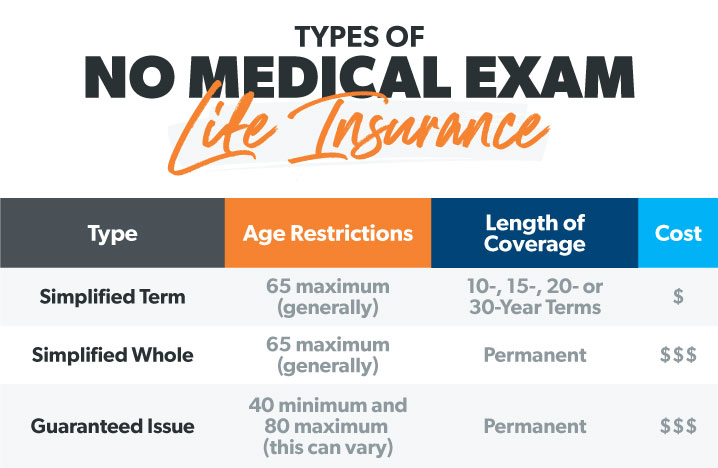
When a broker discusses life insurance without a medical exam, they are generally referring to one of three distinct product categories. Understanding the nuances between these is critical for both the broker’s strategy and the client’s expectations.
1. Accelerated Underwriting (AU)
This is the "gold standard" for no-exam coverage in 2026. Accelerated underwriting is not a specific product but a process. If an applicant is generally healthy and within certain age limits (typically 18 to 60), the broker submits a digital application. The carrier’s system then pulls real-time data to verify the applicant's health. If the data matches the application and meets the risk criteria, the medical exam is waived entirely. The best part for the consumer is that the pricing is usually identical to a fully underwritten policy.
2. Simplified Issue Life Insurance
Simplified issue policies are designed specifically to omit the medical exam. Instead of a deep dive into big data, these policies rely on a series of detailed health questions on the application. Brokers often recommend these for clients who may have minor health issues that might trigger a manual review in an AU environment. While approvals are fast, these policies are often slightly more expensive than AU policies because the insurance company is taking on more "unknown" risk.
3. Guaranteed Issue Life Insurance
This is the "no questions asked" option. Brokers use guaranteed issue policies as a last resort for clients who are uninsurable through other means due to severe chronic illnesses or advanced age. There are no medical exams and no health questions. However, these policies have low coverage limits (usually under $50,000) and often feature a "graded death benefit," meaning the full amount isn't paid out if the insured dies within the first two or three years of the policy.
The Data Sources: How Brokers Replace the Medical Exam
The primary reason brokers can offer these policies is the availability of massive amounts of personal data that serve as a proxy for a physical exam. When you submit an application through a broker, you provide consent for the insurance company to access several key databases.
- MIB Group (formerly Medical Information Bureau): The MIB acts as a clearinghouse for insurance companies. It contains records of previous insurance applications and any medical conditions disclosed during those processes. If an applicant tells a broker they have never had heart issues but the MIB shows a disclosure of a murmur three years ago, it will trigger a red flag.
- Prescription History Databases (Rx Reports): Services like Milliman IntelliScript or LexisNexis provide carriers with a history of every medication prescribed to the applicant over the last 7 to 10 years. In 2026, these reports are incredibly accurate. If a broker sees a client is taking a specific blood pressure medication, they can steer the client toward a carrier that is more "lenient" with that specific drug.
- Motor Vehicle Records (MVR): Insurance companies view reckless driving or multiple DUIs as a significant mortality risk. A broker’s software can pull these records instantly to ensure the client meets the "no-exam" criteria.
- FCRA-Compliant Consumer Data: This includes credit-based insurance scores. While not a direct measure of health, statistical evidence shows a high correlation between financial responsibility and longevity.
| Feature | Accelerated Underwriting | Simplified Issue | Guaranteed Issue |
|---|---|---|---|
| Medical Exam Required? | No (for qualified applicants) | No | No |
| Health Questions? | Full Health Questionnaire | Limited Health Questions | None |
| Coverage Limits | High ($500k - $3M+) | Moderate ($50k - $500k) | Low ($5k - $50k) |
| Approval Time | Instant to 3 Days | 24 - 48 Hours | Near Instant |
| Cost | Lowest (Standard/Preferred) | Moderate | Highest (per unit of coverage) |
| Best For | Healthy individuals | Minor health issues | Serious health issues/Seniors |
The Broker's "Field Underwriting" Process
A skilled broker does not just "submit and pray." They perform what is known as "field underwriting" to determine if a no-exam option is truly viable. This process involves a pre-screening interview where the broker asks specific "knock-out" questions.
Knock-out questions are designed to identify conditions that would immediately disqualify an applicant from a no-exam pathway. Common examples include:
- Have you ever been diagnosed with cancer, heart disease, or stroke?
- Are you currently hospitalized or using a wheelchair?
- Have you ever been declined for life insurance in the past?
By performing this pre-screening, the broker protects the client's "insurance record." In 2026, multiple declines can make it harder to get coverage later. The broker's goal is to place the client with the carrier whose "no-fluid" (no blood/urine) threshold most closely matches the client’s actual health status.
Why Brokers Are Essential for No-Exam Coverage
While some "direct-to-consumer" websites offer no-exam life insurance, working with an independent broker provides several distinct advantages:
Access to Multiple Proprietary Algorithms
Each insurance company has a unique "appetite" for risk. One carrier might allow a no-exam policy for someone with controlled Type 2 diabetes, while another might strictly require an exam for any diabetic. A broker uses specialized software to compare these underwriting guidelines across 20 or 30 different companies simultaneously.
Handling the "Pivot"
Sometimes, an application for accelerated underwriting is "flagged" by the carrier's system. This doesn't necessarily mean a decline; it means the system couldn't verify enough data to skip the exam. A broker can help the client "pivot"—either by providing the necessary medical records to satisfy the underwriter or by moving the application to a simplified issue carrier that doesn't have the same data requirements.
Avoiding "Adverse Selection" Pitfalls
Insurance companies are wary of "adverse selection," where people who know they are sick try to buy insurance without an exam to hide their condition. Brokers help legitimate applicants present their case clearly, ensuring that the lack of an exam isn't seen as an attempt to hide health data, which can lead to claims being denied later during the "contestability period."
Potential Drawbacks and Limitations
Despite the convenience, no-exam life insurance isn't always the best choice. Brokers have a professional responsibility to explain the trade-offs.
1. Higher Costs for Non-AU Policies: If you don't qualify for Accelerated Underwriting and must use a Simplified Issue policy, you will likely pay a higher premium. The carrier charges a "convenience fee" of sorts to cover the risk they are taking by not seeing your lab results.
2. Lower Coverage Caps: While AU limits are rising, many no-exam policies still cap out at $1 million or $2 million. If a client needs a $10 million policy for an estate plan or business buy-sell agreement, a broker will almost certainly have to schedule a traditional medical exam.
3. The Risk of Non-Disclosure: If an applicant hides a condition that would have been found in a blood test, and then dies within the first two years of the policy, the insurance company can investigate and potentially void the policy for material misrepresentation. Brokers emphasize that "no exam" does not mean "no honesty."
Frequently Asked Questions
Can I get a no-exam policy if I have a pre-existing condition?
Yes, but it depends on the condition. For minor issues like well-controlled high blood pressure or cholesterol, you may still qualify for Accelerated Underwriting. For more significant issues like a past cancer diagnosis, a broker might suggest a Simplified Issue policy or a Guaranteed Issue policy, depending on how long you have been in remission.
How much more expensive is no-exam life insurance?
If you qualify for Accelerated Underwriting, it usually costs the same as a traditional policy. However, Simplified Issue and Guaranteed Issue policies can be 20% to 50% more expensive per thousand dollars of coverage because the insurer has less data to work with.
How fast is the approval process through a broker?
In 2026, some brokers can secure an "instant decision" while you are still on the phone or in a Zoom meeting. On average, Accelerated Underwriting takes 24 to 72 hours, whereas traditional underwriting often takes 4 to 6 weeks.
Will the insurance company still check my medical records?
Yes. Even without a physical exam, insurers will often request an Electronic Health Record (EHR) or an Attending Physician Statement (APS) if the digital data sources show any inconsistencies. The broker facilitates this by obtaining your digital signature for HIPAA-compliant releases.
Is there an age limit for no-exam policies?
Most Accelerated Underwriting programs are capped at age 60 or 65. For seniors over 70, brokers usually shift toward Simplified Issue or Guaranteed Issue products, as the statistical risk of undiagnosed conditions is much higher in older age groups.
Final Recommendation
When seeking life insurance without a medical exam, the most effective strategy is to engage an independent broker rather than applying directly to a single carrier. A broker can evaluate your health profile against the latest 2026 underwriting algorithms to determine if you qualify for Accelerated Underwriting—the lowest-cost, no-exam option. If you do not qualify for AU, they can navigate the Simplified Issue market to find a policy that balances speed and cost without requiring a physical exam. Always ensure you are transparent about your medical history to protect your beneficiaries from future claim denials.
Image Gallery