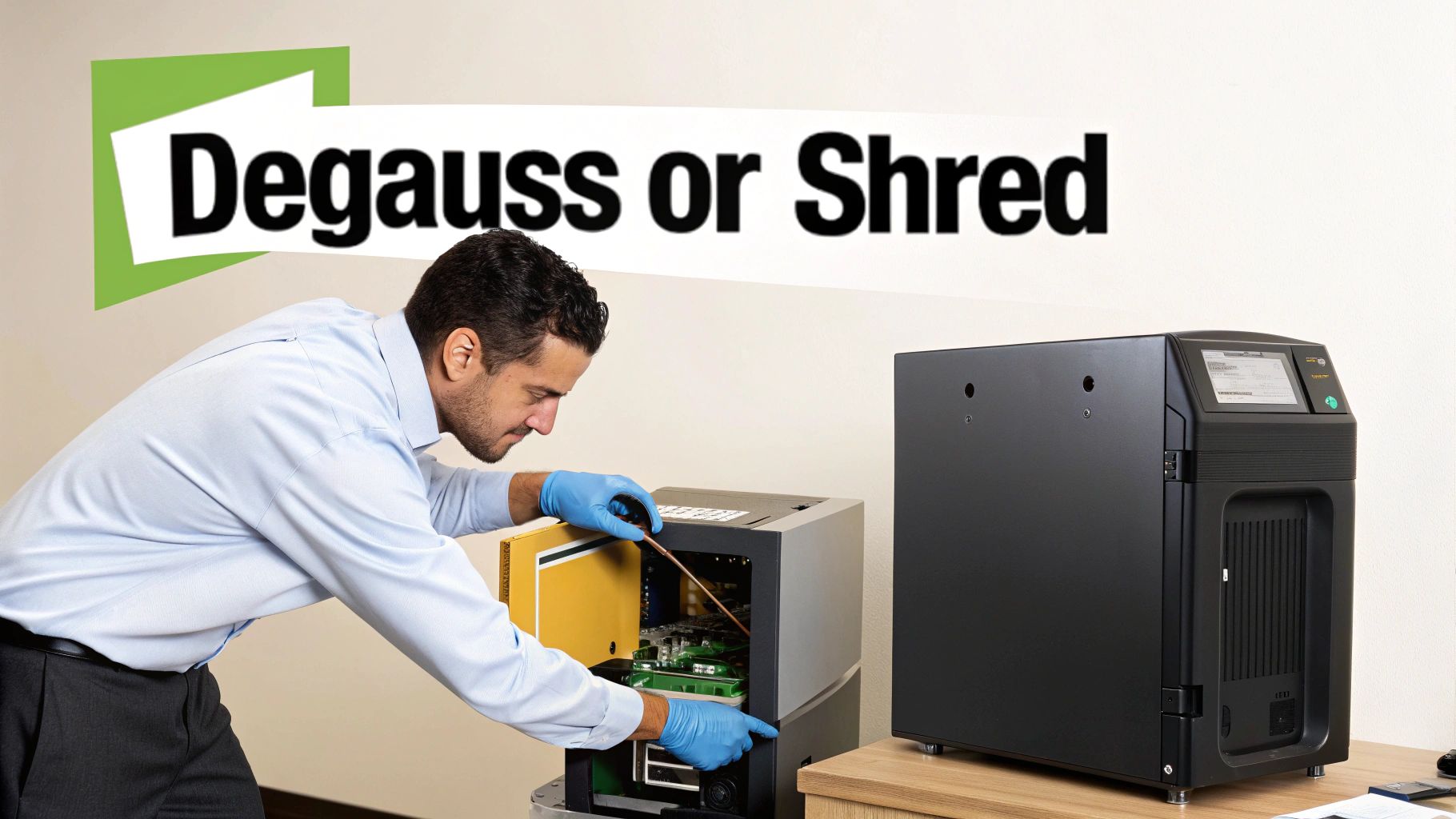
Why Degaussing Services Matter for Data Security in Enterprise Risk Management
Degaussing services play a vital role in enterprise data security by using high-intensity magnetic fields to permanently demagnetize hard drives and magnetic tapes. This process completely neutralizes stored data and low-level formatti...
Degaussing services play a vital role in enterprise data security by using high-intensity magnetic fields to permanently demagnetize hard drives and magnetic tapes. This process completely neutralizes stored data and low-level formatting, rendering magnetic media unreadable and unrecoverable to protect organizations against data breaches, regulatory non-compliance, and chain-of-custody failures during IT asset disposition.
Contents
Understanding Degaussing: The Science of Magnetic Data Erasure
Degaussing is a data sanitization process that exposes magnetic storage media to a powerful, controlled magnetic field. The term originates from Sir William Thomson (Lord Kelvin) and Carl Friedrich Gauss, referring to the reduction or elimination of an unwanted magnetic field. In modern digital security, degaussing alters the magnetic domains of storage media, returning the alignment of microscopic magnetic particles to a completely random state.
Magnetic storage media—such as hard disk drives (HDDs), linear tape-open (LTO) tapes, and digital linear tapes (DLT)—store digital data as binary code (1s and 0s) by magnetizing small regions on a coated substrate. A degausser generates a magnetic force measured in Oersteds (Oe) or magnetic flux density measured in Gauss. When this external magnetic force exceeds the drive’s inherent resistance to demagnetization—known as its coercivity—the recorded magnetic patterns are wiped instantly.
- Ordered Magnetic Domains (Data Present)
- Exposed to High-Intensity External Field (> Coercivity)
- Random Unaligned Domains (Data Permanently Destroyed)
Crucially, degaussing destroys not only user data and file systems but also the factory-written servo tracks embedded on hard drive platters. Servo tracks guide the read/write heads to exact locations on the platter. Because degaussing destroys these underlying tracks, the hard drive can never be reformatted or reused. This permanent disruption guarantees that data recovery is impossible, even using advanced laboratory techniques or magnetic force microscopy.
The Technical Distinction: Magnetic Media vs. Solid-State Storage
A common misconception in enterprise IT asset disposition (ITAD) is that degaussing is a universal erasure method for all modern hardware. Understanding the physical limitations of magnetic erasure across different storage architectures is critical for maintaining robust security posture.
| Storage Architecture | Primary Media Types | Degaussing Effectiveness | Primary Mechanism |
|---|---|---|---|
| Magnetic Storage | Enterprise HDDs (SATA, SAS), Magnetic Tapes (LTO, DLT), Floppy Disks | 100% Effective | Realigns magnetic dipoles to random state via high Oersted exposure. |
| Solid-State Storage | NVMe SSDs, SATA SSDs, M.2 drives, Flash Drives, SD Cards | 0% Effective | Ineffective. Data is stored in NAND flash memory chips via electrical charges. |
| Hybrid Drives (SSHD) | Drives containing magnetic platters alongside NAND cache | Partially Effective | Clears magnetic platters but leaves data stored in the solid-state cache intact. |
Solid-State Drives (SSDs) do not contain magnetic platters or servo tracks; instead, they store binary states as electrical charges within non-volatile NAND flash memory cells. Exposing an SSD to an external magnetic field, no matter how powerful, does not alter these electrical charges. Applying degaussing to solid-state drives leaves sensitive enterprise data entirely exposed.
For enterprise fleets containing hybrid storage environments, professional degaussing services perform media classification before execution. Solid-state devices are isolated for cryptographic erasure, software-based purging, or high-density physical disintegration, while magnetic media are funneled to degaussing systems.
Core Security & Business Benefits of Professional Degaussing Services
Enterprise organizations handle massive volumes of proprietary, financial, health, and personal data. Retiring old server racks, desktop hard drives, or tape archives without verified sanitization presents massive operational risk. Professional degaussing services provide structural risk mitigation across several key operational dimensions.
1. Absolute and Irreversible Data Destruction
Unlike basic disk partitioning, low-level reformatting, or standard software wiping, degaussing operates at the physical layer of the magnetic medium. Software overwriting can fail due to bad sectors, hidden drive partitions, firmware corruption, or host protected areas (HPAs) that software utilities cannot access. Degaussing penetrates the entire physical platter, ensuring that shadowed sectors, damaged tracks, and unallocated space are neutralized simultaneously.
2. Mitigation of Insider Threats and Asset Leakage
The window between retiring an IT asset and its ultimate disposal represents a prime vulnerability for physical theft or unauthorized access. Professional degaussing services often provide onsite sanitization, deploying mobile, high-field degaussing units directly to data centers or corporate facilities. By degaussing drives before they exit secure facilities, organizations eliminate the risk of sensitive data exposure during transport.
3. Comprehensive Chain-of-Custody Documentation
Professional degaussing vendors utilize specialized tracking systems to record the serial number, asset tag, media type, and timestamp of every processed drive. Following sanitization, the vendor issues a audit-ready Certificate of Destruction. This legal document proves that media were sanitized according to institutional policies and standard operating procedures, protecting organizations during internal audits, external compliance evaluations, or litigation discovery.
4. Eco-Friendly E-Waste Recycling Readiness
Once a hard drive has been degaussed, its raw materials—aluminum platters, neodymium magnets, steel casings, and circuit board components—can be safely handed over to certified electronics recyclers (such as R2v3 or e-Stewards certified facilities). Because the data is already destroyed, the physical components can enter standard metal shredding and commodity recovery pipelines without compromising data privacy.
Comparing Data Sanitization Methods
Organizations evaluating IT asset disposition must align their chosen data sanitization methods with their security policy, environmental goals, and hardware budget.
| Method | Applicable Media | Reusability of Hardware | Destruction Speed | Regulatory Level (NIST SP 800-88) |
|---|---|---|---|---|
| Degaussing | Magnetic HDDs, Magnetic Tapes | No (Hardware rendered unusable) | Very Fast (Instantaneous field discharge, ~1–5 sec per drive) | Purge (For magnetic media) |
| Software Wiping / Overwriting | Functional HDDs, SSDs (via ATA Secure Erase) | Yes (Hardware remain fully functional) | Slow (Takes hours per drive depending on capacity) | Clear / Purge (Depending on overwrite passes & protocols) |
| Physical Shredding / Disintegration | HDDs, SSDs, Tapes, Optical Disks | No (Physical particle destruction) | Fast to Moderate (Depends on industrial shredder throughput) | Destroy (When reduced to required particle size) |
| Cryptographic Erasure (CE) | Self-Encrypting Drives (SEDs), SSDs, HDDs | Yes (Drive can be reused with new key) | Near Instantaneous (Keys deleted instantly) | Purge (If cryptographic keys are reliably sanitized) |
Regulatory Frameworks and Compliance Standards
Degaussing is recognized globally by regulatory agencies and standardization bodies as an authoritative method for clearing and purging confidential data from magnetic media.
NIST SP 800-88 Rev. 1 Guidelines for Media Sanitization
Published by the National Institute of Standards and Technology, NIST SP 800-88 Rev. 1 sets the global benchmark for media sanitization. It categorizes sanitization into three progressive levels:
- Clear: Overwriting storage spaces using logical interface commands to protect against simple non-invasive data recovery techniques.
- Purge: Executing physical or logical interventions that render target data recovery infeasible using state-of-the-art laboratory techniques. Degaussing is explicitly classified as an approved Purge method for magnetic media.
- Destroy: Physically altering the media (e.g., melting, incinerating, shredding) to prevent execution or reconstruction.
NSA/CSS Evaluated Products List (EPL)
The National Security Agency/Central Security Service (NSA/CSS) maintains an Evaluated Products List for Degaussers. For top-secret and classified government data, organizations must use high-coercivity degaussers tested and certified by the NSA. These heavy-duty magnetic sanitizers generate peak magnetic fields of up to 20,000 Gauss (2 Tesla) or higher, ensuring even high-coercivity storage media are completely sanitized.
Industry-Specific Data Privacy Regulations
Professional degaussing fulfills the strict technical requirements of international data security laws:
- HIPAA / HITECH (Healthcare): Requires covered entities to implement policies and procedures for the final disposition of electronic protected health information (ePHI).
- PCI DSS 4.0 (Payment Card Industry): Mandates that stored cardholder data be rendered unrecoverable upon reaching retention limits.
- GDPR (European Union): Requires data controllers to enforce permanent erasure ("Right to be Forgotten") and secure processing under Article 32.
- GLBA & Sarbanes-Oxley (Financial Sector): Obligates financial institutions to protect consumer records against unauthorized access during media retirement.
Operational Workflow of Enterprise Degaussing Services
Understanding how a commercial degaussing engagement works helps enterprise security managers prepare their facilities, personnel, and compliance tracking mechanisms.
Asset Inventory & Verification
- Scan drive serial numbers; isolate magnetic media (HDDs/tapes) from SSDs.
Secure Chain-of-Custody Transfer
- Lock media in tamper-evident bins for transport to mobile unit or facility.
High-Intensity Degaussing Execution
- Expose media to certified magnetic pulse (>1.5x to 3x media coercivity).
Field Verification & Quality Auditing
- Test magnetic field strength (gaussmeter check); audit processed serials.
Certification & E-Waste Processing
- Issue Certificate of Destruction; route rendered metal casing to R2 facility.
Asset Logging and Media Sorting: Technicians audit the organization's asset inventory by scanning barcode serial numbers. Drives are classified by storage technology (magnetic vs. solid-state).
Chain-of-Custody Transfer: Drives are placed into locked, tamper-evident transport containers. For maximum security, onsite mobile degaussing trucks process media directly within the enterprise client's parking facility.
Degaussing Execution: Each hard drive or magnetic tape is passed through an NSA-evaluated or high-power commercial degausser. The unit delivers a high-energy pulse that neutralizes the media's magnetic domain within seconds.
Verification and Auditing: Technicians conduct audit checks using magnetic force meters or secondary sample checks to confirm magnetic discharge. Serial numbers are validated against the initial inventory log.
Certification and Sustainable Recycling: A formal Certificate of Destruction is generated containing line-item serial numbers. The non-functional degaussed drives are sent to certified recycling partners for precious metal recovery and shredding.
Essential Considerations When Selecting a Degaussing Service Provider
To ensure compliance and data security, IT managers and CISOs should evaluate degaussing providers using the following criteria:
- Degausser Coercivity Rating: Ensure the vendor's equipment provides sufficient magnetic strength. Modern magnetic drives (such as enterprise helium HDDs) require high magnetic fields (often 10,000+ Oe) to achieve full erasure. The degausser field strength must significantly exceed the target drive's coercivity rating.
- Onsite vs. Offsite Capabilities: If strict compliance policies forbid sensitive storage devices from leaving the facility un-sanitized, choose a provider capable of performing mobile, onsite degaussing.
- Comprehensive Audit Documentation: Demand serial-number-level reporting rather than generic bulk destruction certificates. Every single drive's serial number must match the enterprise asset management database.
- Environmental Certifications: Verify that the service provider holds recognized recycling credentials, such as R2v3 or e-Stewards, ensuring that degaussed hardware components are recycled responsibly without contributing to illegal e-waste exports.
- Hybrid Fleet Handling: Ensure the vendor offers integrated services for non-magnetic media—such as physical shredding or micro-disintegration for SSDs, NVMe drives, optical media, and smart devices.
Frequently Asked Questions
Can a hard drive be reused after being degaussed?
No. Degaussing permanently destroys both stored user data and the factory-written servo tracks that allow the hard drive's read/write heads to navigate the magnetic platters. Without these servo tracks, the hard drive cannot initialize, partition, or read/write data ever again.
Why is degaussing ineffective for Solid-State Drives (SSDs)?
Degaussing relies on altering magnetic fields. SSDs, NVMe drives, USB drives, and SD cards store data as electrical charges inside silicon NAND flash memory chips. Because solid-state memory contains no magnetic material, exposing an SSD to a degausser leaves all data intact. SSDs require cryptographic erasure, software overwriting, or physical shredding.
What is the difference between Gauss and Oersted in degaussing equipment?
Oersted (Oe) measures the magnetic field intensity required to change the magnetization of a medium (coercivity). Gauss (G) measures magnetic flux density, representing the strength of the magnetic field generated by the degausser. Effective degaussing equipment generates a peak magnetic flux density (in Gauss) that is significantly higher than the coercivity (in Oersted) of the target media.
Should an organization choose degaussing or physical media shredding?
Degaussing instantly neutralizes data across the entire magnetic platter surface, including areas accessible only to raw firmware. Physical shredding breaks drives into smaller physical pieces. Many high-security protocols recommend a dual approach: degaussing the hard drive first to instantly purge data, followed by physical shredding for complete physical destruction.
What compliance standards explicitly accept degaussing for data sanitization?
Degaussing is approved under NIST SP 800-88 Rev. 1 as a valid "Purge" mechanism for magnetic storage media. It is also recognized and specified by the NSA/CSS (for classified government storage), HIPAA Security Rule (for ePHI disposition), PCI DSS 4.0 (for payment processing media), and DoD 5220.22-M guidelines.
Next Steps for Enterprise Data Security Strategy
Implementing a safe, compliant IT asset disposition program requires clear policies surrounding hardware end-of-life management. Enterprise security leaders should begin by establishing an inventory audit to categorize all stored assets by media type (magnetic versus flash storage).
Organizations should then integrate professional degaussing services into their standard operating procedures for all retiring data center drives, server racks, and tape archives. By combining onsite degaussing with line-item serial tracking, certified e-waste recycling, and dual-layer physical shredding, enterprise organizations effectively eliminate the risk of catastrophic data breaches while fulfilling global legal and regulatory mandates.
Image Gallery