What Is the Difference Between Buy Side and Sell Side?
The primary difference between the buy side and the sell side lies in their role within the financial markets: the buy side consists of institutions that purchase securities for the purpose of managing capital and generating returns, w...
The primary difference between the buy side and the sell side lies in their role within the financial markets: the buy side consists of institutions that purchase securities for the purpose of managing capital and generating returns, while the sell side consists of firms that create, promote, and sell those securities to facilitate market liquidity and earn commissions.
Contents
In the complex ecosystem of global finance, the interaction between the buy side and the sell side is the engine that drives market efficiency. As of 2026, the distinction remains fundamental for anyone looking to understand market structure, pursue a career in finance, or navigate the intricacies of institutional investing. While both sides aim to profit from the movement of capital, their incentives, daily operations, and fiduciary responsibilities differ significantly.
Defining the Sell Side: The Market Facilitators
The sell side refers to the collective of financial institutions that provide services to investors and corporations. These firms act as the intermediaries of the financial world. Their primary objective is to facilitate the flow of capital by matching buyers with sellers, underwriting new securities, and providing the necessary infrastructure for trading.
Investment Banking and Underwriting
At the heart of the sell side is the investment banking division. When a company needs to raise capital—whether through an Initial Public Offering (IPO) or a debt issuance—it turns to the sell side. Investment bankers analyze the company's valuation, navigate regulatory requirements, and "sell" the newly created securities to the public or institutional investors. In this capacity, the sell side acts as a bridge between the entity needing capital (the corporation) and the entity providing it (the investor).
Sales and Trading (S&T)
Beyond initial issuances, sell-side firms maintain "Sales and Trading" desks. These professionals provide liquidity to the market. When a large pension fund wants to sell 1 million shares of a stock, the sell-side trader might step in to facilitate that trade, either by finding a buyer or by taking the position onto the firm's own balance sheet temporarily. As of 2026, much of this has become highly automated, yet the fundamental role of the "market maker" remains a sell-side hallmark.
Equity Research
A critical product of the sell side is research. Sell-side analysts produce detailed reports on companies, industries, and macroeconomic trends. These reports typically culminate in a recommendation—"Buy," "Hold," or "Sell." The goal of this research is not to manage money, but to provide high-quality information that encourages buy-side clients to execute trades through the firm’s brokerage desk, thereby generating commission revenue.
Defining the Buy Side: The Capital Deployers
The buy side comprises institutions that have capital—either their own or their clients’—and are looking to invest it in various assets to generate a positive return. These are the "customers" of the sell side. Their primary focus is on identifying undervalued assets, managing risk, and fulfilling fiduciary duties to their beneficiaries.
Asset Management and Mutual Funds
Traditional asset managers, such as Vanguard or BlackRock, represent a massive portion of the buy side. These firms pool money from millions of individual retail investors to buy stocks, bonds, and other assets. Their success is measured by their ability to track or outperform specific benchmarks, such as the S&P 500, while charging a management fee based on a percentage of Assets Under Management (AUM).
Hedge Funds and Private Equity
Alternative investment vehicles like hedge funds and private equity (PE) firms are also key buy-side players. Unlike mutual funds, these entities often employ more aggressive or complex strategies, such as short-selling, leverage, or taking direct control of private companies. Their incentive structure usually includes a "performance fee," which grants the managers a portion of the profits (commonly known as carried interest), aligning their interests closely with the growth of the capital.
Institutional Owners: Pensions and Endowments
Large institutional owners like the California Public Employees' Retirement System (CalPERS) or university endowments (e.g., Harvard Management Company) are the ultimate buy-side giants. These organizations have long-term horizons and specific liability requirements, meaning they must invest capital today to pay out pensions or fund scholarships decades into the future.
Key Differences: Revenue, Analysis, and Goals
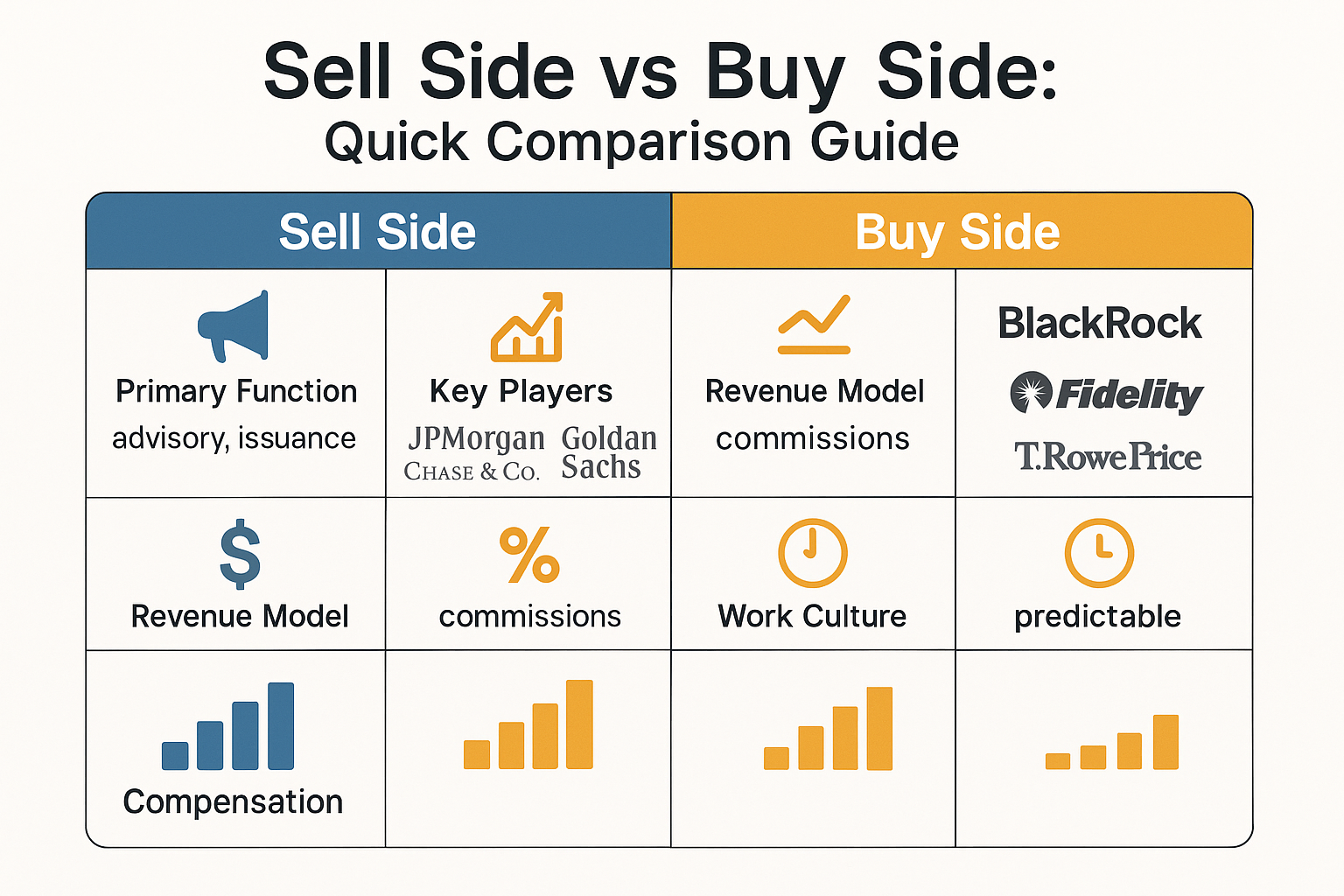
To understand the friction and synergy between these two sides, one must look at their operational DNA. The following table summarizes the core distinctions as they stand in 2026.
| Feature | Sell Side | Buy Side |
|---|---|---|
| Primary Goal | Facilitate transactions and provide liquidity. | Generate investment returns (Alpha). |
| Main Entities | Investment banks, commercial banks, stockbrokers. | Hedge funds, PE firms, pension funds, mutual funds. |
| Revenue Source | Commissions, advisory fees, underwriting spreads. | Management fees (AUM) and performance fees. |
| Research Focus | Broad coverage to stimulate trading volume. | Deep, proprietary analysis to find "edge." |
| Key Metric | Market share and deal flow volume. | Return on Investment (ROI) and Sharpe Ratio. |
| Clients | Corporations and buy-side institutions. | Individual investors, retirees, and foundations. |
Revenue Models and Incentives
The sell side is essentially a service industry. They get paid when a deal happens. If a company goes public, the bank takes a cut of the proceeds. If a trader buys a stock, the broker takes a commission or profits from the "bid-ask spread." This creates an incentive for the sell side to maximize transaction volume and maintain strong relationships with corporate issuers.
The buy side, conversely, is a performance industry. While they do charge management fees, their long-term survival depends on the growth of the assets they manage. If they make poor investment decisions, their AUM shrinks as investors withdraw capital, and their performance fees disappear. Consequently, the buy side is much more selective and guarded with its information.
The Nature of Research and Analysis
While both sides employ analysts, their work serves different masters. A sell-side analyst wants their research to be read by as many people as possible to drive "flow" to the firm's trading desk. In contrast, a buy-side analyst performs "proprietary research." If they find a reason why a stock is undervalued, they do not want the rest of the market to know until they have finished accumulating their position. On the buy side, information is a competitive advantage; on the sell side, information is a marketing tool.
The Symbiotic Relationship: How They Work Together
Neither side can exist without the other. The buy side provides the capital that the sell side needs to justify its existence, and the sell side provides the products and liquidity that the buy side needs to invest.
- Product Creation: When the buy side wants exposure to a specific niche—for example, green hydrogen infrastructure in 2026—the sell side (investment banks) identifies companies in that space and helps them issue debt or equity that the buy side can then purchase.
- Liquidity Provision: Without the sell side acting as market makers, a large hedge fund trying to exit a position might see the price collapse due to a lack of immediate buyers. The sell side uses its balance sheet to "absorb" these trades, ensuring the market remains functional.
- Corporate Access: One of the most valued services the sell side provides to the buy side is "corporate access." This involves arranging meetings between institutional investors and the C-suite executives (CEO/CFO) of public companies, allowing the buy side to perform qualitative due diligence.
Career Paths: Comparing Life on Both Sides
For professionals entering the industry in 2026, the choice between buy side and sell side often dictates their lifestyle and career trajectory.
The Sell-Side Experience
The sell side is often where young professionals start their careers. It is known for high-intensity environments, especially in investment banking and trading. The focus is on "execution"—how quickly and accurately can you build a financial model, pitch a client, or execute a block trade? The skill set developed here is highly transferable, focusing on valuation, networking, and technical proficiency.
The Buy-Side Experience
The buy side is often seen as the "exit opportunity" for sell-side professionals. It generally offers a different type of pressure: the pressure of being "right." While the hours can still be long, especially in private equity, the work is more cerebral and focused on long-term conviction. Buy-side professionals must live with their decisions; if they buy a stock and it drops 20%, they are responsible for that loss in the portfolio.
Regulatory Environment and Evolution in 2026
The landscape of buy side vs. sell side has been significantly altered by regulation over the last decade. Historically, the "unbundling" of research fees (initiated by MiFID II in Europe) changed how the buy side pays for sell-side research. Previously, the buy side would pay for research implicitly through trading commissions. In 2026, most jurisdictions require these costs to be transparent and separated.
Furthermore, the rise of "Direct Indexing" and AI-driven autonomous trading has squeezed the margins on the sell side. Banks have had to pivot toward more specialized advisory services, while the buy side has increasingly built internal technology teams that rival those of Silicon Valley.
Despite these technological shifts, the fiduciary distinction remains. The U.S. Securities and Exchange Commission (SEC) and the Financial Industry Regulatory Authority (FINRA) continue to maintain strict rules regarding "Chinese Walls"—the metaphorical barriers that prevent non-public information from leaking between a bank's advisory side (sell side) and its asset management arm (buy side) to prevent insider trading.
Common Misconceptions
One common misconception is that the "sell side" only sells and the "buy side" only buys. In reality, both sides are constantly doing both. A hedge fund (buy side) must "sell" its vision to investors to raise capital. An investment bank (sell side) must "buy" securities to facilitate a trade for a client. The distinction is about the ultimate purpose of the firm, not the direction of a single trade.
Another misconception is that the buy side is always "smarter" or more prestigious. While the buy side often pays higher performance-based bonuses, the sell side houses the world's experts on specific technical niches, such as complex derivatives or distressed debt restructuring, whom the buy side relies upon for specialized execution.
FAQ
Can a firm be both buy side and sell side?
Yes, many large financial conglomerates, often called "universal banks" (like JPMorgan Chase or Goldman Sachs), have divisions for both. They have investment banking and brokerage arms (sell side) and asset management arms (buy side). However, these divisions are strictly separated by regulatory "firewalls" to prevent conflicts of interest.
Is the buy side more profitable than the sell side?
Profitability depends on market conditions. In a bull market with high trading volume and many IPOs, the sell side thrives on fees. In a market where certain assets see massive growth, the buy side earns significant performance fees. Generally, the "ceiling" for individual compensation is higher on the buy side due to profit-sharing models.
Which side is better for a retail investor?
A retail investor is technically a "buy-side" participant, as they are deploying capital for their own benefit. However, retail investors usually interact with the "sell side" (brokers like Charles Schwab or Fidelity) to execute their trades and may use "buy-side" products (like Vanguard mutual funds) to manage their money.
How has AI changed the buy-side/sell-side dynamic in 2026?
AI has largely commoditized standard equity research. Sell-side firms now focus AI on "alternative data" (like satellite imagery or real-time consumer spending) to provide unique insights. On the buy side, AI is used for high-frequency execution and sentiment analysis to gain a millisecond edge over competitors.
What is "Soft Dollar" compensation?
This is a practice where a buy-side firm pays for sell-side services (like research or data terminals) through trading commissions rather than direct cash payments. While it has become more regulated and transparent by 2026, it remains a common way the two sides settle accounts.
Practical Recommendation
If you are a company looking to raise capital, your primary partner is the sell side. You need their reach, their underwriting capability, and their ability to market your story to the world.
If you are an individual or institution with capital to grow, your primary partner is the buy side. You are looking for managers who can steward your funds and navigate market volatility to achieve your specific financial goals.
For those pursuing a career, start by assessing your temperament: if you enjoy the thrill of the deal, the "hustle" of sales, and helping others achieve their objectives, the sell side is an excellent fit. If you prefer deep-dive analysis, the weight of responsibility for investment outcomes, and the quest for market-beating returns, the buy side is likely your destination.
Image Gallery