How to Find a Commercial Truck Accident Lawyer in Boulder
Finding a qualified commercial truck accident lawyer in Boulder requires identifying a specialist who understands both Colorado’s specific motor vehicle statutes and the complex Federal Motor Carrier Safety Administration (FMCSA) regul...
Finding a qualified commercial truck accident lawyer in Boulder requires identifying a specialist who understands both Colorado’s specific motor vehicle statutes and the complex Federal Motor Carrier Safety Administration (FMCSA) regulations. Start by vetting local attorneys through the Boulder County Bar Association, prioritizing those with a verified track record in multi-party liability cases and a deep understanding of electronic logging device (ELD) data.
Contents
Commercial truck accidents are fundamentally different from standard passenger vehicle collisions. Because they involve massive weights, complex insurance hierarchies, and federal oversight, the legal path to recovery is significantly more technical. As of 2026, the landscape of commercial litigation in Colorado has become even more specialized, requiring victims to move quickly to preserve digital evidence that may otherwise be purged by trucking companies.
Why Specialized Legal Representation is Critical in Boulder
A standard personal injury lawyer may handle a car accident with ease, but a commercial truck accident involves a web of state and federal laws that do not apply to private citizens. In Boulder, where heavy commercial traffic moves along the US-36 corridor and the Diagonal Highway (CO-119), these accidents often involve sophisticated logistics companies with aggressive legal teams.
The Complexity of Multi-Party Liability
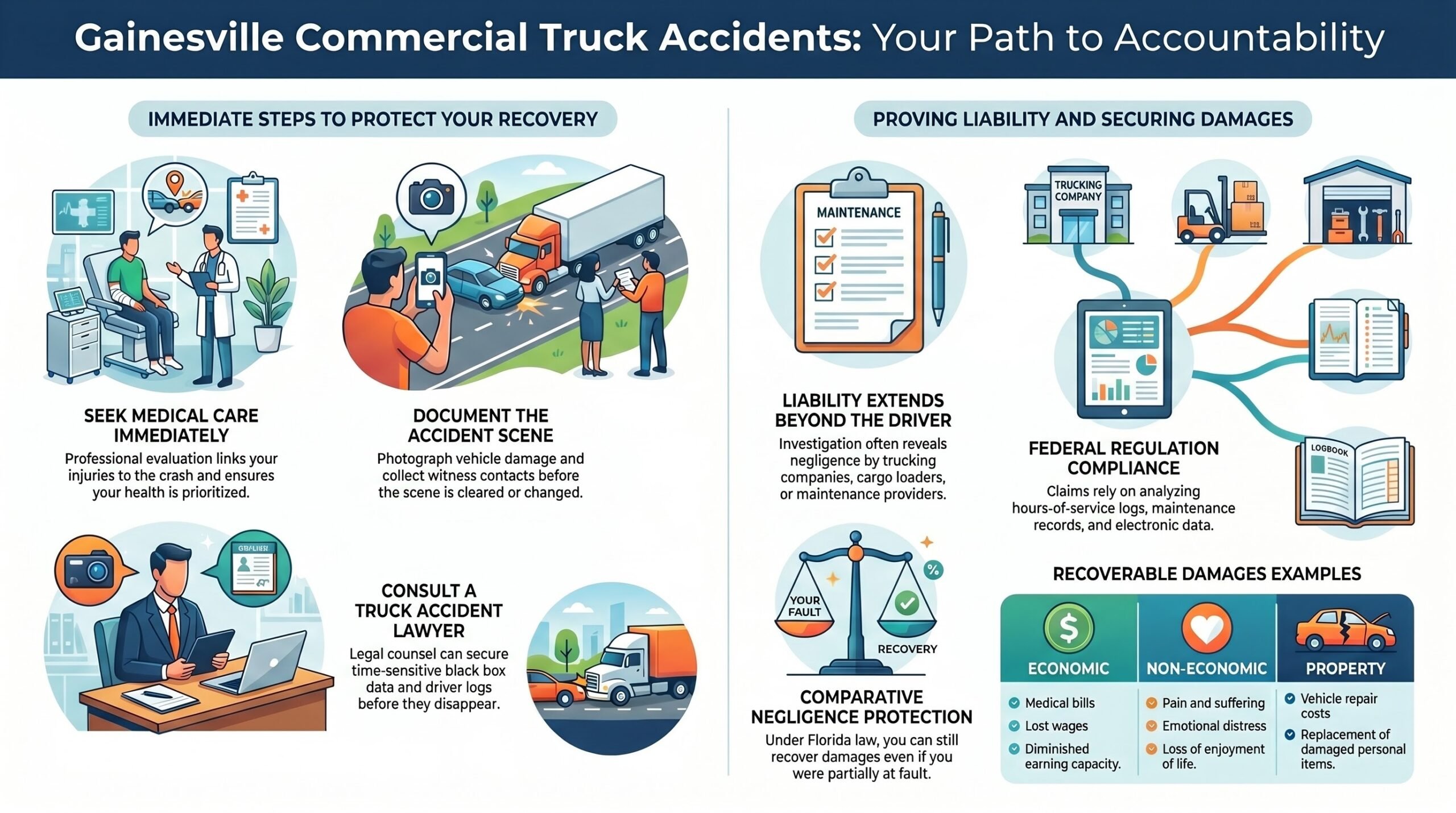
In a typical car crash, you sue the other driver. In a commercial truck accident, liability is rarely limited to the person behind the wheel. A specialized lawyer will investigate the following entities:
- The Trucking Company (Carrier): They are often responsible for the driver's actions under the doctrine of respondeat superior (vicarious liability).
- Maintenance Contractors: If a mechanical failure, such as brake loss or a tire blowout, caused the crash, the third-party company responsible for inspections may be liable.
- Cargo Loaders: Improperly balanced or secured freight can cause "jackknifing" or rollovers. The entities that loaded the trailer are subject to specific safety protocols.
- Manufacturers: Defective parts in the truck’s steering or braking systems could shift liability to the vehicle manufacturer.
Preserving "Black Box" and Digital Evidence
Modern commercial trucks in 2026 are equipped with advanced Electronic Control Modules (ECM) and Electronic Logging Devices (ELD). This data provides a second-by-second account of speed, braking patterns, and how long the driver had been behind the wheel. However, trucking companies are often legally permitted to overwrite this data after a certain period unless a "Letter of Spoliation" is sent immediately by a lawyer. A Boulder-based specialist knows how to file these injunctions locally to ensure that GPS data and cabin camera footage are not destroyed.
Step-by-Step Guide to Finding the Right Lawyer in Boulder
Navigating the local legal market requires a systematic approach to ensure you aren't just hiring the firm with the largest billboard, but the one with the most relevant technical expertise.
1. Utilize Local Legal Directories and Peer Reviews
While national "settlement mills" may advertise in the Boulder area, local expertise is invaluable for navigating the 20th Judicial District Court system.
- Boulder County Bar Association: Use their referral service to find attorneys who are active in the local legal community.
- Super Lawyers or Martindale-Hubbell: Look for attorneys with a "Preeminent" rating or those listed specifically under "Transportation/Maritime Law" or "Personal Injury - Product Liability."
- Colorado Trial Lawyers Association (CTLA): Membership in this organization often indicates a lawyer who is committed to staying updated on the latest litigation techniques and state Supreme Court rulings.
2. Verify Experience with FMCSA Regulations
During your initial research, look for firms that explicitly mention their familiarity with Title 49 of the Code of Federal Regulations. These are the rules governing the trucking industry. A lawyer who cannot explain "Hours of Service" (HOS) rules or "Safety Fitness Categories" is likely not a true specialist in this field.
3. Analyze Past Case Results (Verdicts and Settlements)
Check the firm’s website for specific outcomes related to semi-trucks, tractor-trailers, or delivery vans (like Amazon or FedEx fleets). You are looking for high-value recoveries—often in the seven-figure range—because commercial insurance policies are significantly larger than private ones. A firm that consistently wins large settlements demonstrates that they have the financial capital to fund a long-term investigation against a corporate defendant.
The Initial Consultation: What to Ask
Most Boulder personal injury firms offer free initial consultations. This is your opportunity to "interview" the attorney. In 2026, the complexity of vehicle tech means you should ask highly specific questions:
- How do you handle data from the truck's Event Data Recorder (EDR)? If they don't have a specific forensic expert they work with to download this data, they may not be equipped for a high-stakes case.
- Will you represent me in court, or is this firm a "settlement-only" practice? Some firms avoid the courtroom at all costs, which can result in lower settlements. You want a lawyer whom insurance companies know will actually take the case to trial in Boulder County District Court.
- What is your fee structure? Almost all commercial truck accident lawyers work on a contingency fee basis, meaning they only get paid if you win. Confirm that they will also front the costs of expert witnesses and accident reconstruction.
Comparing Specialist vs. Generalist Lawyers
To help you decide, consider the differences in how these two types of attorneys approach a case:
| Feature | General Personal Injury Lawyer | Commercial Truck Specialist |
|---|---|---|
| Primary Focus | Slip and falls, minor fender benders. | Federal trucking regulations and corporate liability. |
| Evidence Collection | Police reports and witness statements. | ELD data, maintenance logs, and fuel receipts. |
| Expert Network | General medical doctors. | Accident reconstructionists and trucking safety experts. |
| Defendant Type | Individual drivers and their insurance. | Global logistics firms and commercial umbrella policies. |
| Legal Strategy | Simple negligence. | Non-delegable duties and regulatory violations. |
| Litigation Budget | Low to moderate. | High (necessary for complex discovery). |
Navigating Colorado-Specific Laws in 2026
When seeking a lawyer in Boulder, you must ensure they are experts in Colorado’s specific legal environment. As of 2026, several factors remain critical for your case:
The Statute of Limitations
In Colorado, the statute of limitations for most motor vehicle accidents is three years from the date of the accident (C.R.S. § 13-80-101). However, if the accident resulted in a fatality, the wrongful death statute of limitations is generally two years. Waiting too long to find a lawyer can permanently bar your right to recovery.
Modified Comparative Negligence
Colorado follows a "51% bar" rule for comparative negligence. This means you can recover damages as long as you are less than 50% responsible for the accident. However, your total compensation will be reduced by your percentage of fault. A skilled Boulder attorney will work to minimize any "blame-shifting" tactics used by the trucking company’s defense team.
Damage Caps
Colorado law imposes certain caps on "non-economic" damages (pain and suffering). As of early 2026, these caps are adjusted periodically for inflation. An experienced lawyer will know how to categorize your losses—such as medical bills and lost wages (economic damages)—to ensure they are not subject to these restrictive limits.
Common Mistakes to Avoid
The process of finding a lawyer can be overwhelming, leading many victims to make errors that jeopardize their claims:
- Hiring the First Lawyer Who Calls: If a "runner" or "capper" contacts you at the hospital or via an unsolicited phone call, be wary. This is often an ethical violation and a sign of a low-quality firm.
- Choosing Based Solely on Location: While you want a lawyer familiar with Boulder courts, it is more important that they have the specific technical skill set for trucking accidents. A lawyer in Denver who specializes in trucks is often a better choice than a Boulder lawyer who only handles small claims.
- Accepting an Early Settlement Offer: Trucking insurance adjusters may offer a quick check within days of the accident. This is almost always an "undervalue" offer designed to get you to sign away your right to future claims before the full extent of your injuries is known.
FAQ: Commercial Truck Accidents in Boulder
How much does it cost to hire a truck accident lawyer in Boulder? Most attorneys operate on a contingency fee, typically between 33% and 40% of the final settlement or verdict. You should not have to pay any upfront out-of-pocket costs for the investigation or filing fees.
Can I sue the trucking company if the driver was an independent contractor? Yes. In many cases, federal law treats the carrier as responsible for the vehicle's operation regardless of the driver's employment status. This is a complex area of "Lease-On" agreements that your lawyer must navigate.
What if the accident happened on a mountain pass near Boulder? Accidents on steep grades, like those found on Canyon Boulevard or the Peak to Peak Highway, often involve issues with braking systems and "runaway truck" protocols. A specialist will look at whether the driver was properly trained for mountain driving and if the truck's auxiliary braking systems were functional.
What documents should I bring to my first meeting? Bring the police report (or the case number), photos of the scene, contact information for witnesses, your medical records, and any correspondence you have received from insurance companies.
How long do these cases typically take to resolve? Because of the extensive discovery process required to obtain corporate records and ELD data, commercial truck cases often take 12 to 24 months to reach a resolution, though many settle sooner once the evidence is clearly established.
Final Recommendation
To find the best commercial truck accident lawyer in Boulder, prioritize technical investigative capability over flashy marketing. Begin your search by contacting the Boulder County Bar Association for a referral, then vet those candidates specifically for their history with FMCSA litigation. Before signing any fee agreement, ensure the attorney has a clear plan for preserving the truck's digital "black box" data, as this will likely be the cornerstone of your case.
Image Gallery