What an HRMS Solution Provides: A Comprehensive Guide for 2026
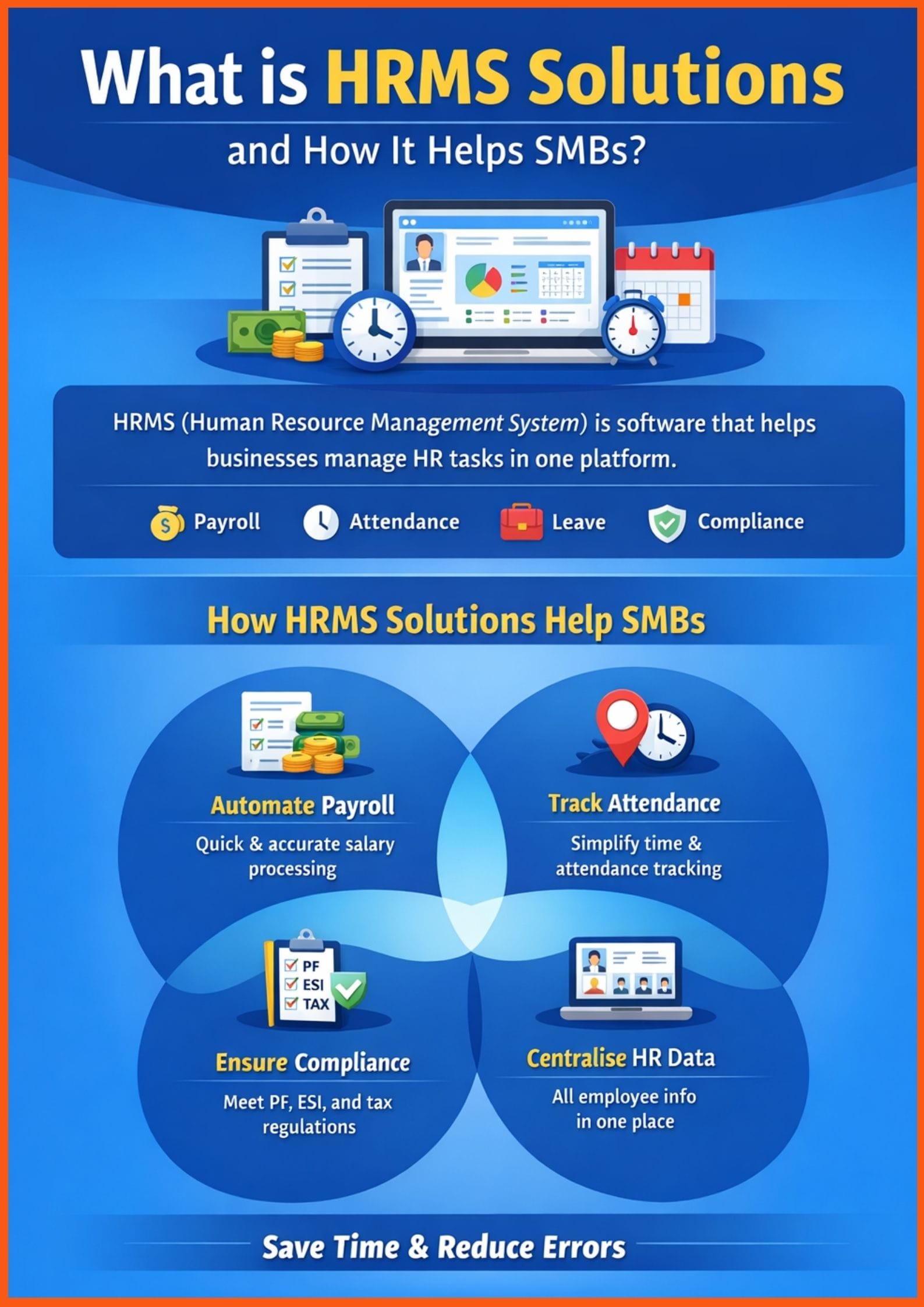
An HRMS (Human Resource Management System) solution provides a centralized digital platform to manage the entire employee lifecycle, from recruitment and onboarding to payroll and retirement. By consolidating data and automating admini...
An HRMS (Human Resource Management System) solution provides a centralized digital platform to manage the entire employee lifecycle, from recruitment and onboarding to payroll and retirement. By consolidating data and automating administrative tasks, it improves operational efficiency, ensures regulatory compliance, and offers strategic insights through advanced workforce analytics and reporting.
Contents
As we move through 2026, the definition of a "standard" HRMS has evolved significantly. No longer just a digital filing cabinet for employee records, modern HRMS platforms serve as the operational heartbeat of an organization. They integrate artificial intelligence, real-time data processing, and user-centric design to bridge the gap between administrative necessity and strategic talent management. For businesses navigating a hybrid, global, and highly regulated labor market, understanding the specific components and capabilities of an HRMS is essential for maintaining a competitive edge.
The Core Functional Pillars of an HRMS
At its most fundamental level, an HRMS solution provides a suite of modules designed to handle different aspects of human resources. These modules work in tandem to ensure that data flows seamlessly across the organization, reducing manual entry and the risk of human error.
Centralized Employee Records and Data Management
The "Single Source of Truth" is perhaps the most critical provision of an HRMS. In a 2026 business environment, employee data is highly fragmented across remote work logs, benefits portals, and performance reviews. An HRMS centralizes this into a single profile for every worker. This includes personal information, employment history, tax documents, certifications, and emergency contacts.
Beyond simple storage, the system manages data privacy and access control. Using role-based access control (RBAC), an HRMS ensures that a manager can see a direct report’s performance history but not their medical records or salary details, adhering to strict data protection regulations like GDPR or the CCPA.
Automated Payroll and Tax Administration
Payroll is the most sensitive HR function. An HRMS provides automated calculations for gross-to-net pay, accounting for diverse variables such as overtime, shift differentials, bonuses, and commission structures. For companies operating across multiple jurisdictions, the HRMS automatically updates tax tables to ensure the correct withholdings for federal, state, and local taxes.
In 2026, this also includes the management of "on-demand pay" or earned wage access (EWA), allowing employees to withdraw a portion of their earned salary before the official payday. The system handles the complex accounting behind these transactions while maintaining the integrity of the final payroll run.
Benefits Administration and Open Enrollment
Managing health insurance, retirement plans (like 401ks), and life insurance is notoriously complex. An HRMS provides an interface where employees can compare plans, view costs, and enroll digitally. For the employer, the system automates premium deductions and facilitates direct communication with insurance carriers via Electronic Data Interchange (EDI) feeds. This eliminates the need for HR staff to manually update carrier websites every time an employee joins or leaves the company.
Strategic Talent Management and Development
Modern HRMS solutions go beyond administrative tasks to focus on the "human" element of human resources. These features are designed to attract, develop, and retain high-performing talent.
Recruitment and Applicant Tracking (ATS)
The HRMS provides tools to manage the entire hiring funnel. This includes posting job openings to multiple boards simultaneously, parsing resumes using AI to identify top candidates, and scheduling interviews. In 2026, these systems are frequently equipped with "bias-mitigation" algorithms that help recruiters focus on objective skills and experience rather than subjective markers, promoting a more diverse and inclusive workforce.
Onboarding and Employee Integration
First impressions are vital. An HRMS provides an automated onboarding workflow that begins the moment a candidate accepts an offer. New hires can sign contracts electronically, upload identification documents, and complete mandatory training modules before their first day. This structured approach ensures that no "day one" tasks fall through the cracks and allows the employee to focus on culture and team integration rather than paperwork.
Performance Management and Continuous Feedback
The annual performance review is largely a thing of the past. Today’s HRMS provides modules for continuous feedback, goal tracking (OKRs), and 360-degree reviews. Managers and employees can set milestones within the system, and progress is tracked in real-time. This data-driven approach to performance allows for more objective promotion and compensation decisions.
Workforce Management and Compliance
Managing a modern workforce requires precise tracking of time and strict adherence to labor laws. An HRMS provides the technical infrastructure to ensure the company remains compliant and productive.
Time, Attendance, and Absence Management
Whether employees are punching a digital clock on a mobile app or logging hours via a desktop portal, the HRMS captures this data directly. It then applies complex business rules—such as rounding rules, overtime thresholds, and holiday pay—to calculate accurate hours for payroll.
Absence management is equally critical. The HRMS provides a self-service portal where employees can request time off. The system automatically checks their accrued balance, alerts the manager for approval, and updates the team calendar. This prevents understaffing and ensures that "Paid Time Off" (PTO) liabilities are accurately reflected on the company’s balance sheet.
Regulatory Compliance and Reporting
Labor laws are in a constant state of flux. An HRMS provides automated updates for compliance with the Fair Labor Standards Act (FLSA) and various international labor standards. It generates mandatory reports, such as EEO-1 filings in the United States, with a few clicks. By maintaining an immutable audit trail of all HR actions—from hiring decisions to disciplinary notes—the HRMS protects the organization in the event of legal disputes or regulatory audits.
Comparing HRMS, HRIS, and HCM
While these terms are often used interchangeably, there are subtle differences in what they provide. Understanding these distinctions helps organizations choose the right level of complexity for their needs.
| Feature | HRIS (Information System) | HRMS (Management System) | HCM (Capital Management) |
|---|---|---|---|
| Primary Focus | Quantitative data & record keeping | HR processes & automation | Strategic talent & workforce ROI |
| Core Admin | High (Personnel, Benefits) | High (Full suite) | High (Full suite) |
| Payroll | Often an add-on | Core integrated module | Core integrated module |
| Talent Acquisition | Basic | Advanced ATS | Comprehensive / Global |
| Learning (LMS) | Rarely included | Frequently included | Core strategic pillar |
| Predictive AI | Minimal | Moderate | High (Succession planning) |
The Role of People Analytics in 2026
One of the most powerful provisions of a modern HRMS is the ability to turn raw data into actionable intelligence. This is known as People Analytics. By analyzing trends across the entire employee database, the HRMS can identify patterns that are invisible to the naked eye.
For example, an HRMS can calculate "Flight Risk" by analyzing factors such as time since the last promotion, recent changes in commuting patterns, and engagement survey scores. This allows HR leaders to intervene before top talent leaves. Similarly, "Workforce Planning" tools help executives project future hiring needs based on historical turnover rates and planned business expansion.
In 2026, these analytics are often presented through intuitive dashboards that allow non-technical managers to "drill down" into the data. You can see, for instance, which departments have the highest turnover or which recruitment sources produce the longest-tenured employees. This level of insight shifts HR from a cost center to a strategic partner that contributes directly to the bottom line.
Implementation: What to Expect
Adopting an HRMS is a significant undertaking that requires careful planning. It is not merely a software installation; it is a transformation of business processes.
- Requirement Analysis: Identify the "must-have" features versus "nice-to-have" features based on your specific industry and workforce size.
- Data Migration: This is the most critical phase. Cleaning and moving data from legacy spreadsheets or older systems into the new HRMS requires meticulous attention to detail.
- Integration Mapping: Ensure the HRMS can "talk" to your existing software, such as your accounting system (ERP) or your internal communication tools (like Slack or Microsoft Teams).
- Training and Adoption: A system is only as good as the people who use it. Comprehensive training for HR staff, managers, and general employees is essential for a high Return on Investment (ROI).
Common Pitfalls and Troubleshooting
Despite the benefits, HRMS implementations can fail if not managed correctly. One common mistake is "over-customization." Modern SaaS (Software as a Service) platforms are built on industry best practices; trying to force the software to mimic an outdated manual process can lead to bugs and make future updates difficult.
Security is another area of concern. Because an HRMS holds the most sensitive data in the company—social security numbers, bank details, and health info—it is a prime target for cyberattacks. Organizations must ensure their HRMS provider adheres to ISO/IEC 27001 standards and utilizes multi-factor authentication (MFA) and data encryption both at rest and in transit.
FAQ
What is the difference between an HRMS and an ERP?
An ERP (Enterprise Resource Planning) is a broad software suite that manages all aspects of a business, including finance, supply chain, and sales. An HRMS is a specialized system specifically for people management. While some large ERPs include HR modules, a dedicated HRMS often provides deeper, more specialized functionality for talent and compliance.
How much does an HRMS solution typically cost in 2026?
Most modern HRMS solutions operate on a PEPM (Per Employee Per Month) pricing model. Costs can range from $5 to $25 per employee monthly, depending on the complexity and the number of modules selected. Implementation fees are usually separate and can range from a few thousand dollars to six figures for large enterprises.
Can an HRMS help with remote and hybrid work management?
Yes. Modern HRMS solutions provide "geofencing" for mobile time clocks, remote equipment tracking, and compliance tools that manage different labor laws based on where the employee is physically located. This is essential for companies with a distributed workforce.
Is an HRMS suitable for small businesses?
Absolutely. There are "light" HRMS versions specifically designed for small businesses that provide core functions like payroll and document storage without the cost or complexity of enterprise-level talent management suites.
How does AI impact what an HRMS provides in 2026?
AI in 2026 facilitates "Generative HR," such as auto-creating personalized career development plans, drafting job descriptions based on top-performer data, and utilizing chatbots to answer 80% of routine employee HR questions instantly.
Recommendation for Next Actions
If your organization is currently managing employee data through manual spreadsheets or disconnected systems, the first step is a Gap Analysis. Document every HR task performed over a 30-day period and identify where manual entry, data duplication, or compliance risks occur. This list will form the basis of your Request for Proposal (RFP) when evaluating HRMS vendors. Prioritize platforms that offer a high degree of mobile accessibility and robust API integrations to ensure the system remains scalable as your organization grows through 2026 and beyond.
Image Gallery