How Senior Living SEO Shapes Online Visibility
Senior living SEO shapes online visibility by aligning a community’s digital presence with the specific search behaviors of adult children and seniors. By optimizing for local intent, establishing high-authority content through E-E-A-T...
Senior living SEO shapes online visibility by aligning a community’s digital presence with the specific search behaviors of adult children and seniors. By optimizing for local intent, establishing high-authority content through E-E-A-T principles, and utilizing technical schema, communities ensure they appear in the local map pack and AI-driven search results where placement is most influential.
Contents
The landscape of senior care has shifted significantly as of 2026. Prospective residents and their families no longer rely solely on word-of-mouth or traditional placement agencies. Instead, the journey begins with a search query. For senior living operators, search engine optimization (SEO) is not merely a marketing tactic; it is the primary mechanism through which trust is established before a single phone call is made. Understanding how SEO shapes visibility requires a deep dive into the technical, local, and psychological factors that govern search engine results pages (SERPs).
The Evolution of Search Intent in Senior Living
Search intent in the senior living sector is uniquely complex because it often involves two distinct audiences: the "influencer" (usually an adult daughter or son) and the "end-user" (the senior). By 2026, the sophistication of search algorithms allows engines to distinguish between these demographics based on query phrasing and historical search patterns.
Early-stage search intent is often educational. Users search for terms like "signs of dementia" or "how to talk to parents about assisted living." SEO shapes visibility here by positioning a community as a thought leader. If a website provides comprehensive, empathetic answers to these questions, it builds "top-of-funnel" visibility. As the search moves toward the "bottom-of-funnel," the intent shifts to location-based queries such as "memory care facilities in North Scottsdale" or "best independent living near me."
Visibility at this stage is dictated by Local SEO. If a community has not optimized its local signals, it remains invisible to the users most likely to convert. In 2026, search engines prioritize proximity, relevance, and prominence, meaning that a community must have a consistent digital footprint across multiple platforms to appear in the coveted "Map Pack" or "Local Pack."
Local SEO: The Foundation of Community Visibility
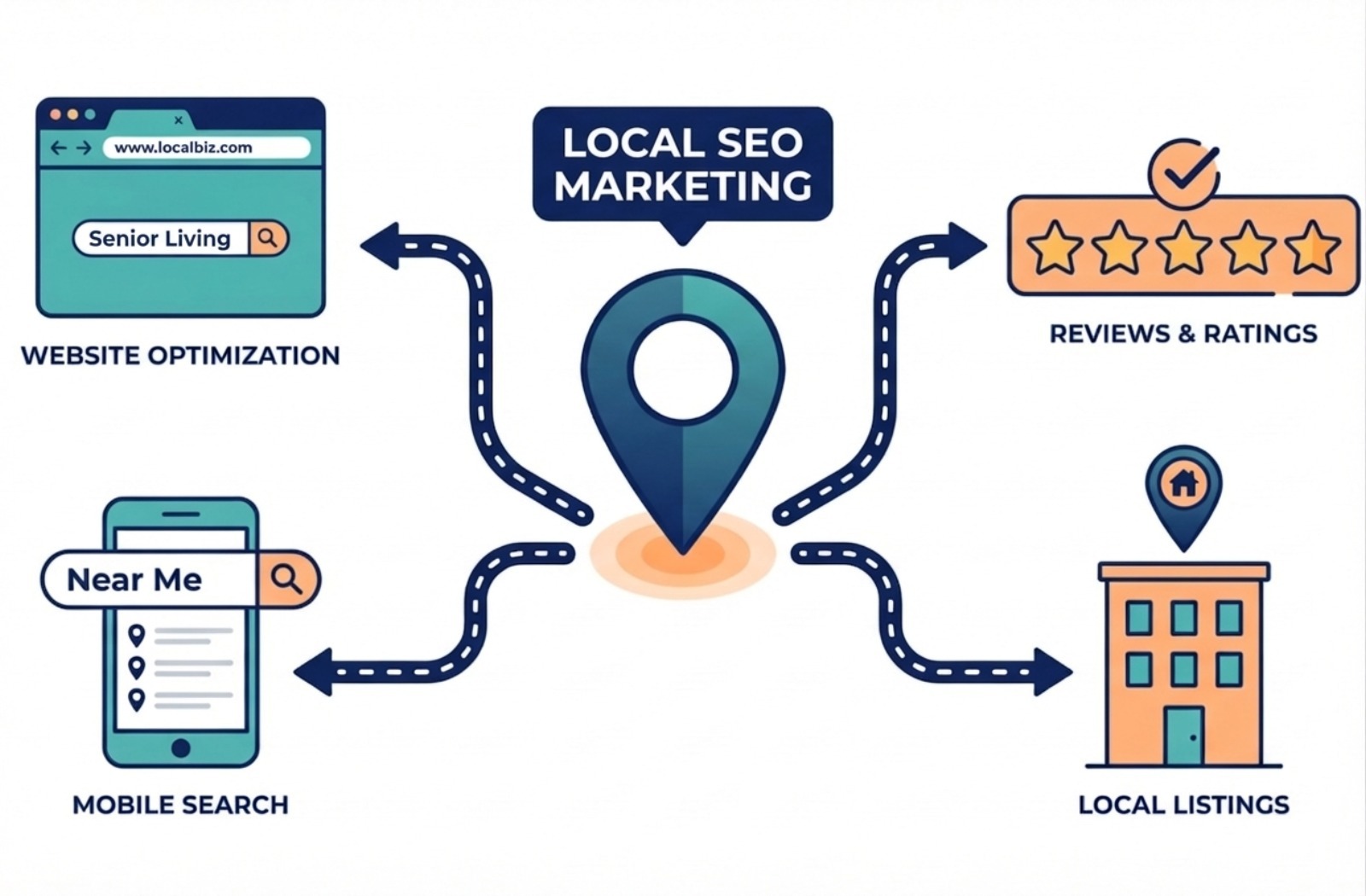
For senior living providers, global visibility is irrelevant; regional dominance is everything. Local SEO shapes visibility by ensuring that when a family searches for care within a 10-to-20-mile radius, the community appears at the top of the list.
Google Business Profile Optimization
The Google Business Profile (GBP) is the most critical asset for local visibility. In 2026, this profile acts as a "mini-website" within the search results. SEO efforts shape visibility here by:
- Managing Real-Time Attributes: Indicating current availability, specific care levels (e.g., Parkinson’s care), and specialized amenities.
- Review Velocity and Sentiment: Encouraging a steady stream of authentic reviews. Search engines analyze the keywords within reviews; if multiple residents mention "excellent physical therapy," the community is more likely to rank for physical therapy-related searches.
- Visual Engagement: High-resolution 360-degree tours and recent photos of community life signal to the algorithm that the community is active and transparent.
NAP Consistency and Local Citations
Search engines cross-reference information across the web to verify a business’s legitimacy. "NAP" stands for Name, Address, and Phone Number. Discrepancies between a website, a Facebook page, and a directory like A Place for Mom can dilute a community’s "trust score," causing it to drop in rankings. Senior living SEO involves auditing these citations to ensure a unified digital identity, which directly correlates to higher visibility in local searches.
Building Trust through E-E-A-T and YMYL
The senior living industry falls under Google’s Your Money Your Life (YMYL) category. Because the information provided can impact a person's health and financial well-being, search engines hold these websites to a higher standard of quality. This is where E-E-A-T (Experience, Expertise, Authoritativeness, and Trustworthiness) becomes the primary driver of visibility.
To shape visibility in 2026, senior living content must be more than just "SEO-friendly" keywords; it must be medically and legally sound.
- Experience: Content written or reviewed by staff who have hands-on experience in caregiving.
- Expertise: Articles authored by Medical Directors, Registered Nurses, or Certified Dementia Practitioners.
- Authoritativeness: Earning backlinks from reputable health organizations (e.g., the Alzheimer's Association) or government agencies (e.g., Medicare.gov).
- Trustworthiness: Clear disclosure of pricing, licensing information, and physical location.
Communities that ignore these standards find their visibility throttled. Conversely, those that invest in high-quality, expert-led content find themselves ranking not just for their name, but for a broad array of care-related topics, casting a wider net for prospective leads.
Technical SEO and User Experience (UX)
Visibility is not just about getting people to a site; it is about keeping them there and showing search engines that the site is a valuable resource. Technical SEO shapes visibility by ensuring the site is accessible to both search crawlers and human users—particularly seniors who may have visual or motor impairments.
Core Web Vitals and Page Speed
In 2026, page load speed is a non-negotiable ranking factor. If a site takes longer than two seconds to load, bounce rates skyrocket. Search engines interpret high bounce rates as a sign that the site is not useful, leading to a decrease in rankings.
Accessibility and ADA Compliance
Web Content Accessibility Guidelines (WCAG) are essential in the senior living niche. High-contrast colors, adjustable text sizes, and screen-reader compatibility are not just ethical requirements; they are SEO signals. Sites that are easy for seniors to navigate are rewarded with higher engagement metrics, which in turn boosts visibility.
Schema Markup
Schema is a form of microdata that helps search engines understand the context of content. For senior living, specific schema types—such as NursingHome, SingleFamilyResidence, or MedicalOrganization—allow search engines to display "rich snippets." These snippets can include star ratings, price ranges, and event dates directly in the search results, significantly increasing the click-through rate (CTR).
Comparing SEO Strategies by Senior Care Type
Different levels of care require different SEO approaches to maximize visibility. The keywords and search behaviors for independent living are vastly different from those for memory care or skilled nursing.
| Care Level | Primary Search Intent | Key SEO Focus | Critical Visibility Factor |
|---|---|---|---|
| Independent Living | Lifestyle, Socialization, Amenities | High-quality imagery, Video SEO, Lifestyle blogging | Social proof and community vibrancy |
| Assisted Living | Assistance with ADLs, Safety, Care | Local SEO, FAQ pages, Cost-transparency content | Proximity and care-specific keywords |
| Memory Care | Specialized safety, Clinical expertise | E-E-A-T, Medical citations, Long-form educational guides | Trustworthiness and clinical authority |
| Skilled Nursing | Post-acute care, Rehabilitation | Technical SEO, Medical Schema, Referral-source optimization | Speed of information and facility licensing |
The Role of AI and Search Generative Experience (SGE)
By 2026, the way SEO shapes visibility has been transformed by AI-integrated search results. Instead of a list of blue links, users often see a synthesized summary of the best communities based on their specific needs.
To remain visible in this AI-driven environment, senior living SEO must focus on Natural Language Processing (NLP). Families are now asking complex, conversational questions: "Find me a pet-friendly assisted living community in Austin with 24/7 nursing and a high staff-to-resident ratio."
SEO shapes visibility in these "conversational" results by ensuring the website contains specific, structured data that answers these multi-layered queries. If a site only uses generic terms like "senior housing," it will be overlooked by AI models looking for granular details.
Frequently Asked Questions
How long does it take for senior living SEO to show results?
Generally, it takes 4 to 6 months to see significant shifts in organic visibility. Because senior living is a high-competition, YMYL industry, search engines require time to crawl, index, and verify the authority of new content. However, local SEO improvements, such as optimizing a Google Business Profile, can often yield increased visibility in local map searches within 30 to 60 days.
Why is local SEO more important than national SEO for a single community?
Senior living is a "hyper-local" service. Most families choose a community within a 20-minute drive of their home or workplace to facilitate frequent visits. National SEO might bring traffic to a site, but if that traffic is from a different state, it will not convert into move-ins. Local SEO ensures that the visibility is concentrated on the geographical area that actually drives occupancy.
Does social media impact senior living SEO visibility?
Social media does not directly improve SEO rankings, but it has a powerful indirect effect. Active social profiles drive traffic to the website, which signals to search engines that the site is relevant. Furthermore, social media platforms are often indexed by search engines; a community’s Facebook or LinkedIn page may appear on the first page of search results for its brand name, effectively "owning" more real estate on the SERP.
What is the biggest SEO mistake senior living communities make?
The most common mistake is neglecting the mobile experience. While the seniors themselves might use desktops, the adult children who perform the majority of the research are almost exclusively using mobile devices. A site that is not mobile-optimized will suffer from poor rankings and high abandonment rates, regardless of how good the content is.
How does video content shape SEO visibility in 2026?
Video content significantly increases "dwell time," which is the amount of time a user spends on a page. In 2026, video SEO (using transcripts and video schema) allows these videos to appear in Google’s video carousel and YouTube searches. For senior living, video tours and resident testimonials provide the emotional connection that text cannot, leading to higher trust and better search performance.
Practical Recommendations for Maximizing Visibility
To effectively shape online visibility in the current 2026 environment, senior living operators should move beyond basic keyword stuffing and adopt a holistic digital strategy.
- Prioritize the "Human" Element: Search algorithms are now highly attuned to authenticity. Avoid using stock photography; instead, use real photos and videos of residents and staff to build immediate trust.
- Audit for E-E-A-T Regularly: Ensure that every piece of health-related content is reviewed and signed off by a clinical expert. Include a brief bio of the reviewer to signal authority to search engines.
- Leverage Hyper-Local Content: Create content that goes beyond the community walls. Write about local hospitals, senior centers, or local events. This strengthens the site's relevance to the specific geographic area.
- Invest in Technical Health: Conduct monthly technical audits to fix broken links, optimize image sizes, and ensure that schema markup is correctly implemented for events and reviews.
- Monitor AI Snapshots: Regularly search for your community and care types using AI-integrated browsers to see how your brand is being summarized. Adjust your content to fill any information gaps the AI might be missing.
By focusing on these pillars, senior living communities can ensure that their online visibility is not just a matter of chance, but a deliberate reflection of their excellence in care.
Image Gallery