Why Arizona Incorporation is Simpler Than You Think
Incorporating in Arizona is a streamlined process facilitated by the Arizona Corporation Commission’s (ACC) digital eCorp platform. By submitting Articles of Incorporation, appointing a statutory agent, and fulfilling a unique but mana...
Incorporating in Arizona is a streamlined process facilitated by the Arizona Corporation Commission’s (ACC) digital eCorp platform. By submitting Articles of Incorporation, appointing a statutory agent, and fulfilling a unique but manageable newspaper publication requirement, entrepreneurs can establish a legal entity within days, enjoying one of the most business-friendly regulatory environments in the United States.
Contents
The prospect of "incorporating" often conjures images of endless paperwork, expensive legal retainers, and months of waiting for government approval. However, as of 2026, the state of Arizona has refined its systems to make business formation remarkably accessible. Whether you are launching a tech startup in Phoenix or a consultancy in Tucson, the path to a formal corporate structure is logical and well-documented. By understanding the specific requirements of the Arizona Corporation Commission (ACC) and leveraging their modernized digital tools, you can navigate the transition from a solo venture to a formal corporation with surprising ease.
The Foundation: Understanding the Arizona Corporation Commission
The primary entity overseeing all business formations in the state is the Arizona Corporation Commission. Unlike many other states where business filings are handled by the Secretary of State, Arizona consolidates these responsibilities under the ACC. In 2026, the ACC’s eCorp system serves as the central hub for all filings, tracking, and compliance.
The simplicity of Arizona incorporation stems from this centralized approach. The eCorp portal allows users to check name availability in real-time, file documents electronically, and receive digital certificates of incorporation. This eliminates the "black box" experience of mailing paper forms and waiting weeks for a response. For most standard filings, the system provides automated feedback, ensuring that if you make a clerical error, you can correct it before the final submission, preventing unnecessary rejections and fee losses.
Determining Your Entity Type
Before filing, you must decide if you are forming a Business Corporation (for-profit) or a Nonprofit Corporation. While Limited Liability Companies (LLCs) are also popular in Arizona, the term "incorporation" specifically refers to the creation of a corporation. Corporations in Arizona are governed by Title 10 of the Arizona Revised Statutes. They offer a rigid structure involving shareholders, directors, and officers, which is often preferred by investors and businesses planning to go public or offer stock options.
Prerequisites for a Smooth Filing Process
Preparation is the reason why many find the process "simpler than they think." If you have your data organized, the actual filing takes less than thirty minutes.
1. Name Availability and Reservations
Your corporation's name must be "distinguishable" from any other entity already on record with the ACC. This means it cannot be confusingly similar to an existing business name, even if the ending (Corp, Inc, Ltd) is different. In 2026, the eCorp name search tool is the final authority. If you aren't ready to file the Articles of Incorporation today, you can file a Name Reservation for a small fee, which holds the name for 120 days.
2. Appointing a Statutory Agent
Every Arizona corporation must have a statutory agent (often called a registered agent in other states). This individual or entity is responsible for receiving service of process—legal documents and official notices—on behalf of the corporation. The agent must:
- Be an individual resident of Arizona or a business entity authorized to act as an agent.
- Have a physical street address in Arizona (P.O. Boxes are not permitted for this role).
- Formally accept the appointment through a Statutory Agent Acceptance form, which is integrated into the online filing process.
3. The "Known Place of Business"
Arizona requires corporations to designate a physical address within the state as their known place of business. This does not have to be the actual place where business is conducted; it can be the office of your statutory agent. However, having this address ready is essential for the Articles of Incorporation.
Step-by-Step: Filing Your Articles of Incorporation
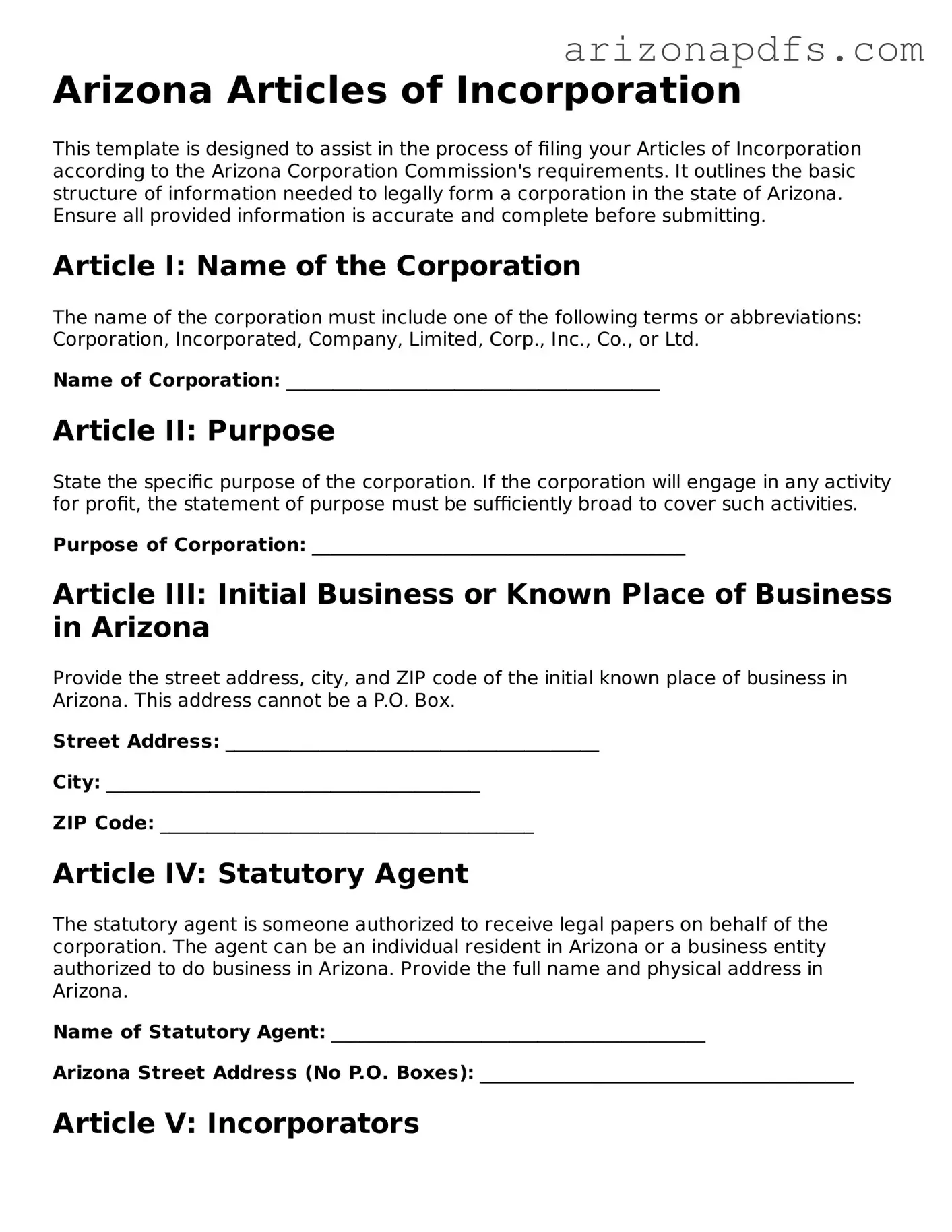
Once the prerequisites are met, you proceed to the formal filing. The Articles of Incorporation are the "birth certificate" of your business. In Arizona, this document requires a specific set of information to be legally valid.
Drafting the Content
The eCorp system guides you through the digital form, but you should have the following details finalized:
- Entity Name: Including the mandatory suffix (e.g., "Corporation," "Incorporated," "Company," or abbreviations like "Corp." or "Inc.").
- Character of Business: A brief description of the primary activity the corporation will engage in.
- Shares: You must state the total number of shares the corporation is authorized to issue. Unlike some states that calculate fees based on share count, Arizona charges a flat filing fee regardless of whether you authorize 1,000 or 1,000,000 shares.
- Directors and Officers: You must list the names and addresses of the initial board of directors.
- Incorporators: The names and signatures of the individuals forming the corporation.
Submission and Fees
As of 2026, the standard filing fee for a Business Corporation is $60. For those in a hurry, the ACC offers expedited processing for an additional $35, often resulting in approval within 24 to 48 hours. The simplicity here lies in the transparent fee structure; there are no hidden franchise taxes or "capitalization fees" during the initial formation.
| Fee Type | Amount (2026) | Processing Time |
|---|---|---|
| Articles of Incorporation (Standard) | $60 | 15–30 Business Days |
| Articles of Incorporation (Expedited) | $95 | 1–3 Business Days |
| Name Reservation (Optional) | $10 | Immediate (Online) |
| Statutory Agent Change | $10 | 7–10 Business Days |
| Certificate of Good Standing | $10 | Immediate (Digital) |
The Publication Requirement: Myth vs. Reality
The most common reason people think Arizona incorporation is difficult is the publication requirement. Arizona law requires corporations to publish a notice of their incorporation in a newspaper of general circulation in the county of their known place of business for three consecutive publications.
However, this is much simpler than most realize for two primary reasons:
- The Maricopa and Pima County Exception: If your corporation's known place of business is in Maricopa or Pima County, you do not need to publish in a newspaper. The ACC automatically posts your filing information to their own public database, which satisfies the legal requirement. This covers the vast majority of new businesses in the Phoenix and Tucson metro areas.
- Streamlined Affidavits: For businesses in other counties (like Yuma, Coconino, or Yavapai), local newspapers are very familiar with this process. They provide "templates" for incorporation notices. Once the three-week run is complete, the newspaper provides an Affidavit of Publication. You simply keep this with your corporate records; in many cases, you don't even need to file it back with the ACC unless they specifically request it during an audit.
Post-Incorporation Compliance
Simplicity shouldn't lead to complacency. Once the ACC approves your filing, there are several "next steps" that ensure your corporation remains in good standing.
Federal EIN and Tax Elections
A corporation is a separate legal entity and requires its own Employer Identification Number (EIN) from the IRS. This is a free service provided by the IRS website. Furthermore, you must decide if you want to be taxed as a C-Corporation (the default) or an S-Corporation. To choose S-Corp status, you must file Form 2553 with the IRS within 75 days of incorporation.
The Arizona Annual Report
Unlike Arizona LLCs, which generally do not have to file annual reports, Arizona Corporations must file an Annual Report with the ACC. This report confirms the current directors, officers, and share structure. It is due on the anniversary of your incorporation date. The fee is currently $45, and it can be filed entirely online via eCorp. Failing to file this is the most common reason corporations fall into "delinquent" status, but the eCorp system sends automated email reminders to prevent this.
Corporate Bylaws and Initial Meetings
While not filed with the state, you must draft corporate bylaws. These define how the corporation is governed—how meetings are called, how directors are elected, and how officers are appointed. You should also hold an initial meeting of the board of directors to adopt these bylaws and authorize the issuance of stock certificates.
Common Mistakes to Avoid
Even with a simplified system, errors can cause delays. Knowing these pitfalls ensures you don't run into hurdles:
- Mismatched Signatures: The Statutory Agent Acceptance form must be signed by the agent. If you are acting as your own agent, you must sign in both the "Incorporator" and "Statutory Agent" sections.
- Incomplete Address Information: The ACC will reject filings that use a P.O. Box for the statutory agent's address or the known place of business. Use a physical street address.
- Vague Business Character: While you don't need a 50-page business plan, writing "any legal purpose" is sometimes less effective than a simple one-sentence description like "Retail sales of consumer electronics."
- Forgetting the Annual Report: Because the first report isn't due for a year, many founders forget it. Mark your calendar or set an alert in the eCorp portal.
Frequently Asked Questions
Do I need a lawyer to incorporate in Arizona?
No, a lawyer is not legally required. The ACC forms are designed to be completed by business owners. However, if your corporation has a complex share structure, multiple classes of stock, or specific investor requirements, consulting a legal professional is highly recommended to ensure your bylaws and articles are tailored to those needs.
How long does the entire process take in 2026?
If you use the eCorp portal and select expedited processing, you can have your approved Articles of Incorporation in as little as 24 to 72 hours. Standard processing varies based on the ACC's current workload but generally takes between two and four weeks.
Can I incorporate in Arizona if I don't live there?
Yes, you can form an Arizona corporation while residing elsewhere. However, you must maintain a Statutory Agent who has a physical address within Arizona and a Known Place of Business (which can be the agent's address) within the state.
Is Arizona better than Delaware for incorporation?
For small to mid-sized businesses physically operating in Arizona, incorporating locally is usually simpler and cheaper. Incorporating in Delaware while operating in Arizona requires you to "Foreign Qualify" your Delaware corp in Arizona, effectively doubling your filing fees and annual report obligations. Delaware is typically preferred only for companies seeking venture capital or planning a massive national scale.
What is the difference between a Corporation and an LLC in Arizona?
A Corporation has a more formal structure with directors and officers and must file annual reports. An LLC is more flexible, has fewer record-keeping requirements, and currently does not have to file annual reports in Arizona. Corporations are generally chosen for businesses that want to issue stock or eventually go public.
Practical Next Steps for Success
To move forward, your first action should be to visit the Arizona Corporation Commission eCorp website. Use the "Name Search" feature to see if your desired business name is available. If it is, and you have identified a statutory agent, you are already 75% of the way through the process.
Once your Articles are filed and approved, immediately apply for your EIN on the IRS website. This allows you to open a corporate bank account, which is the most critical step in maintaining the "corporate veil" and protecting your personal assets from business liabilities. Arizona's business-friendly environment and digital-first approach make it one of the most efficient states for new business formation in 2026.
Image Gallery