Mastering the Entry-Level Data Scientist Resume in 2026
Building an effective entry-level data scientist resume requires a strategic focus on technical proficiency, evidence-based project work, and a clear demonstration of business-value understanding. To succeed in 2026, you must highlight...
Building an effective entry-level data scientist resume requires a strategic focus on technical proficiency, evidence-based project work, and a clear demonstration of business-value understanding. To succeed in 2026, you must highlight your mastery of core languages like Python and SQL while showcasing hands-on experience through GitHub-hosted projects that solve real-world problems.
Contents
The Evolution of Entry-Level Data Science Requirements
By 2026, the threshold for entry-level data science roles has shifted significantly. While foundational knowledge of statistics and linear algebra remains mandatory, the market now demands a baseline understanding of MLOps (Machine Learning Operations), data ethics, and the integration of Large Language Models (LLMs) into production workflows. Hiring managers no longer look for candidates who can simply run a model; they seek individuals who understand the entire data lifecycle—from ingestion and cleaning to deployment and monitoring.
An entry-level resume must act as a bridge between your academic or self-taught background and the operational needs of a modern enterprise. Because you may lack years of industry experience, your resume serves as a proxy for your professional competence. It must communicate that you can handle messy, unstructured data and translate complex mathematical outputs into actionable business insights.
Structuring Your Resume for Maximum Impact
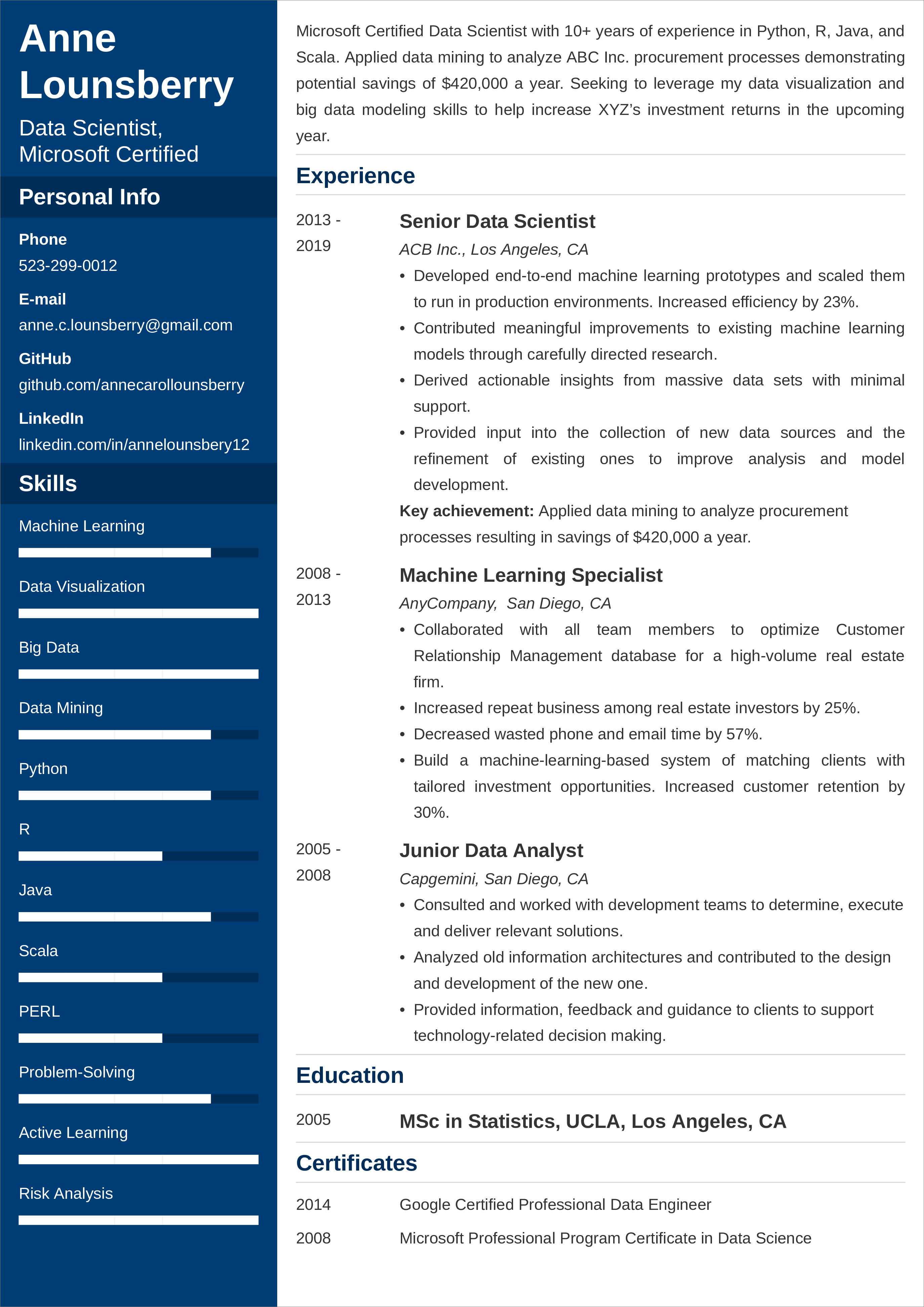
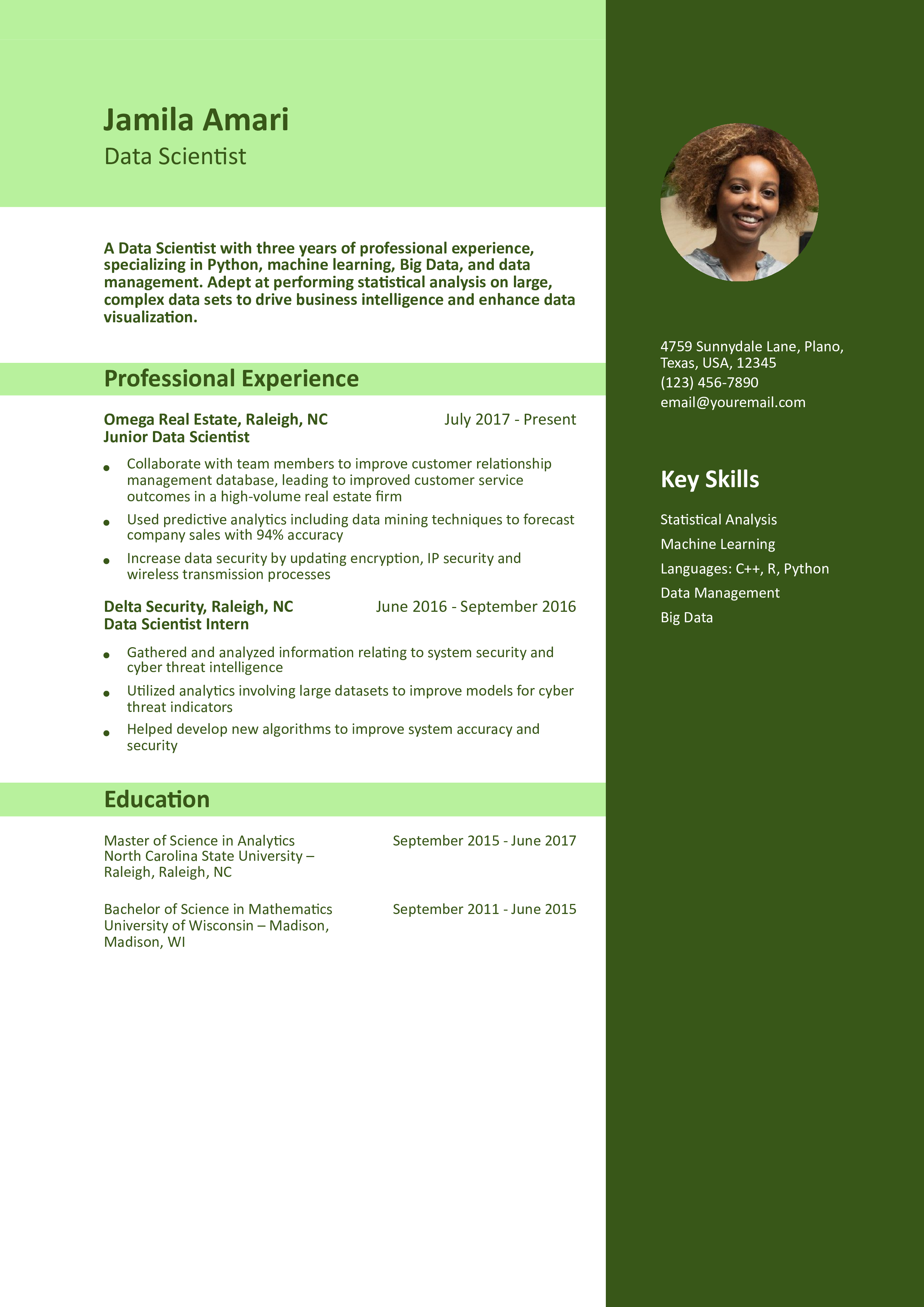
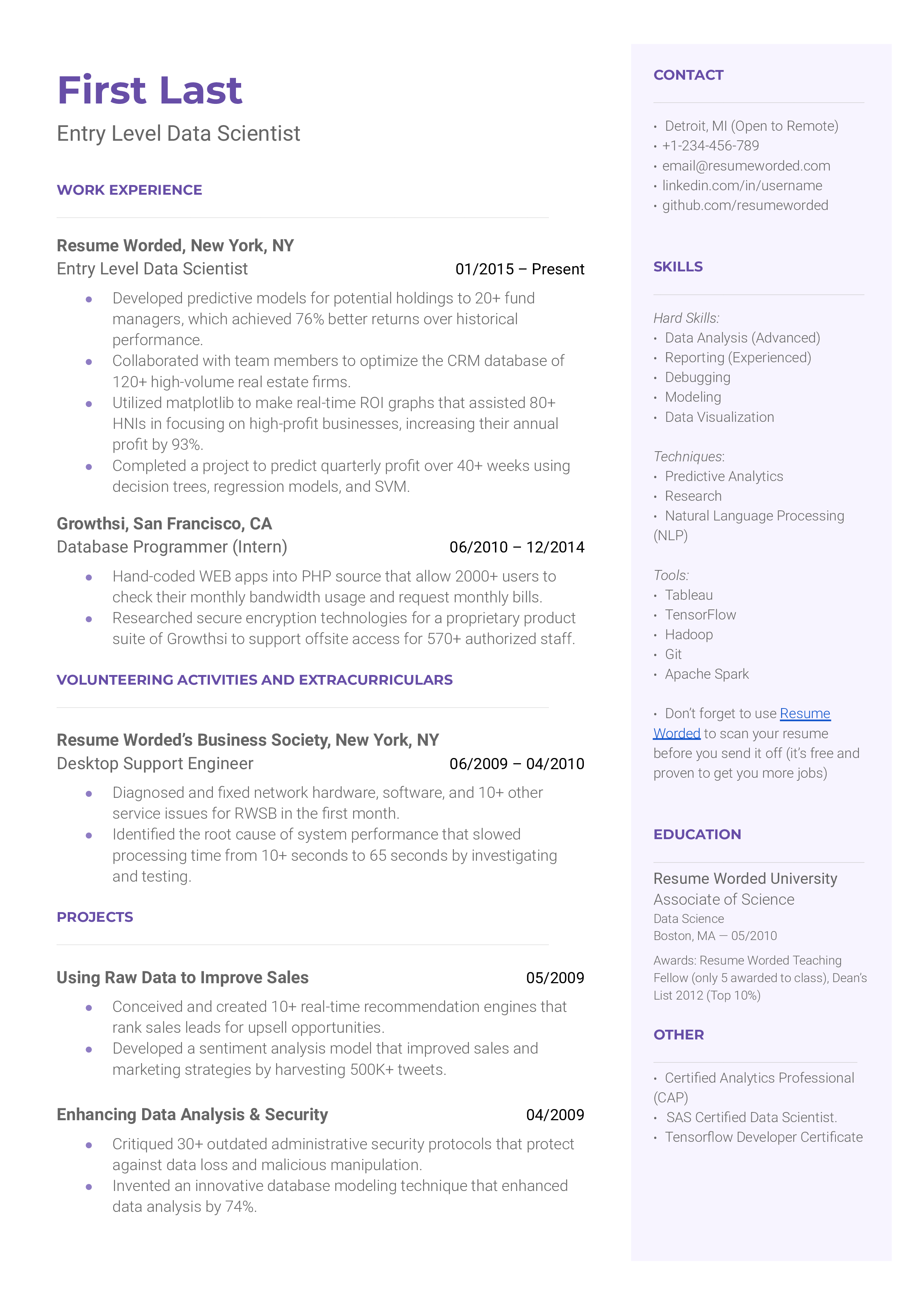
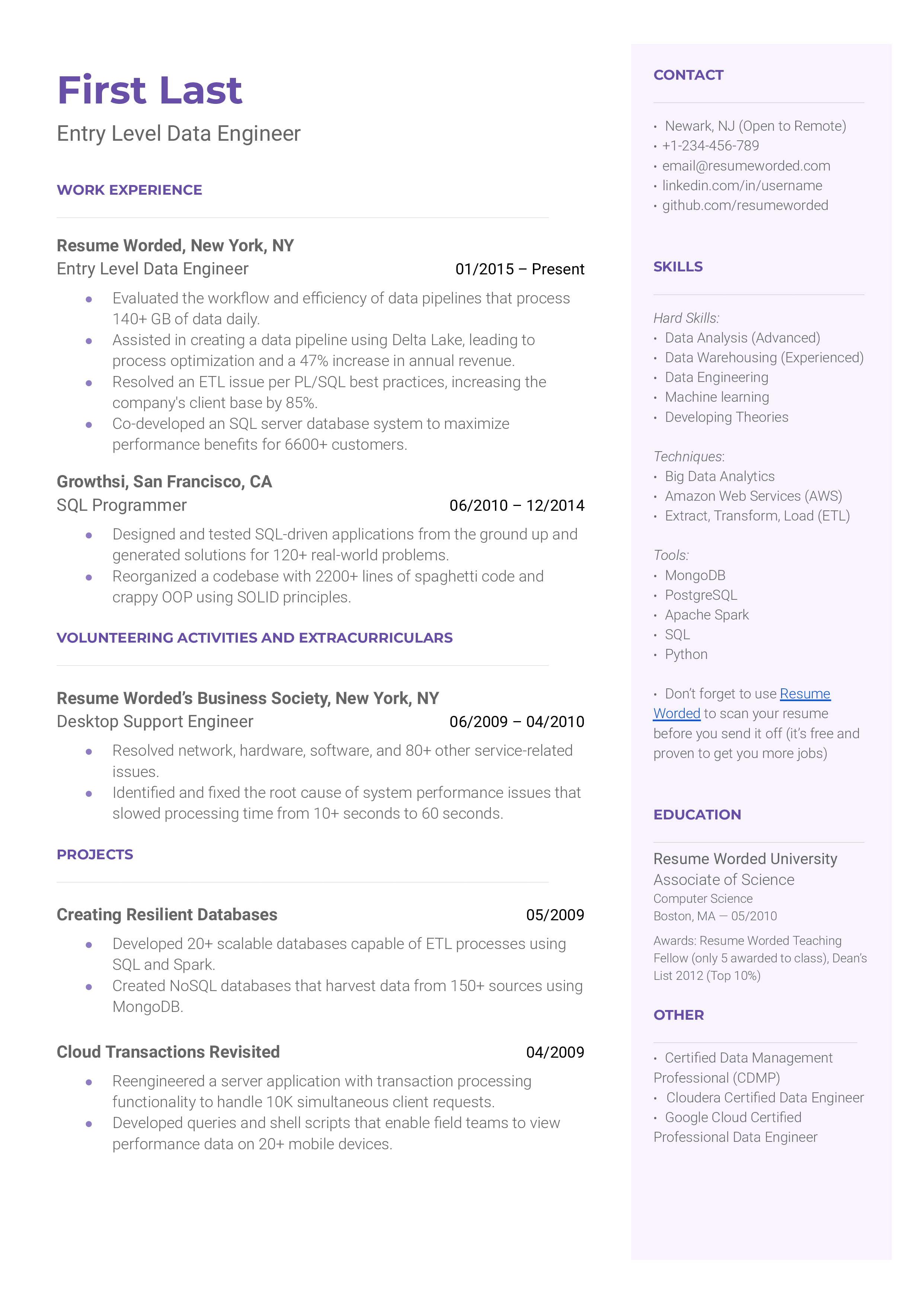
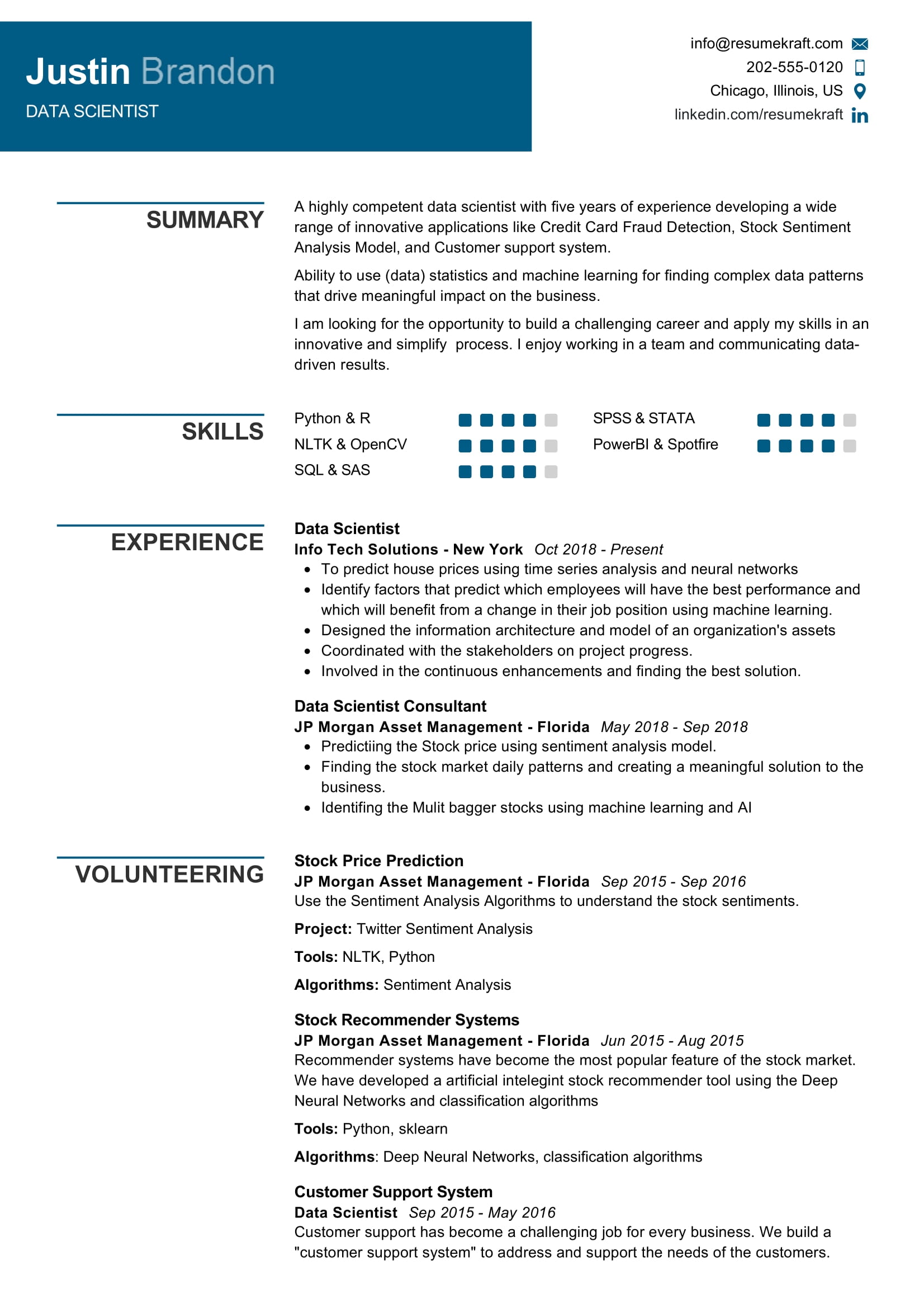
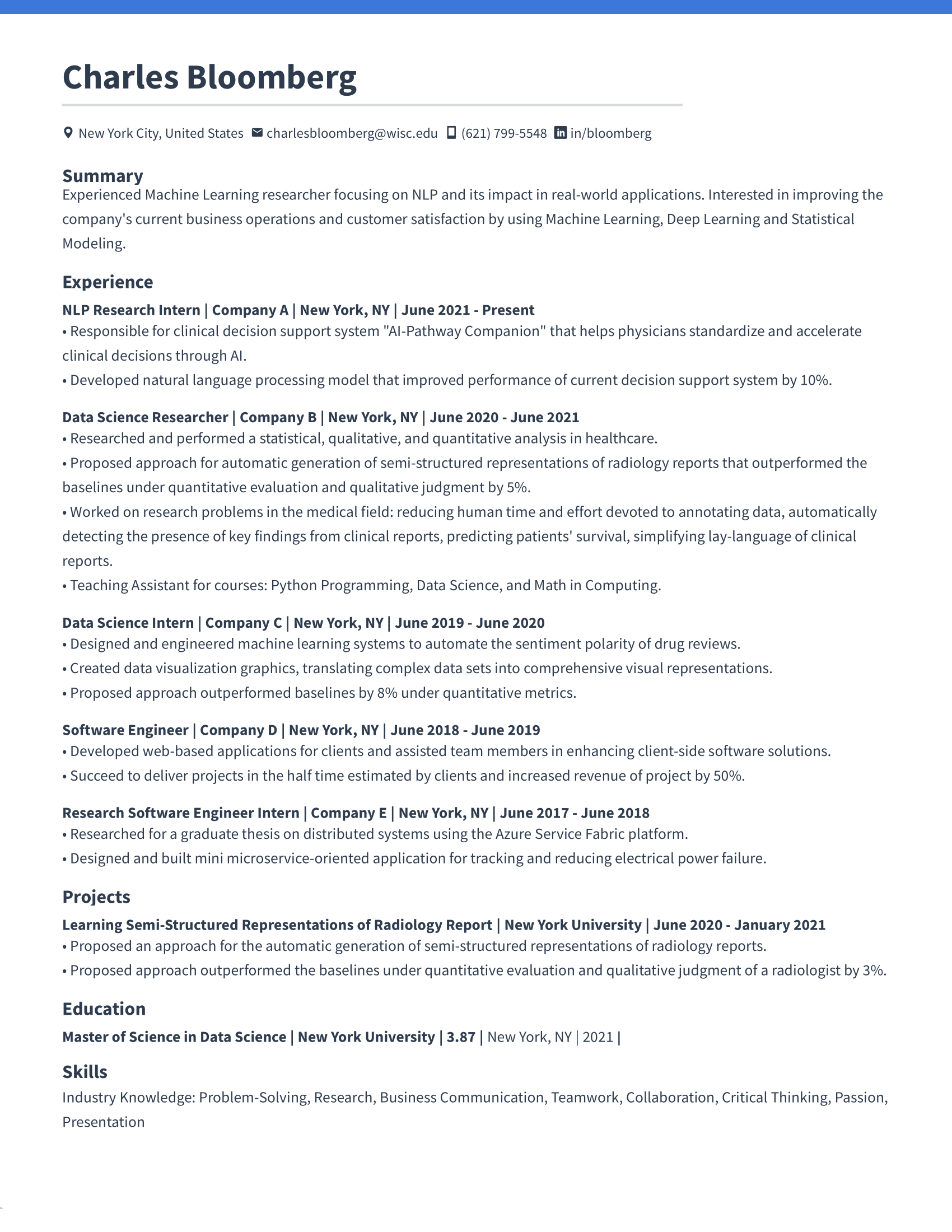
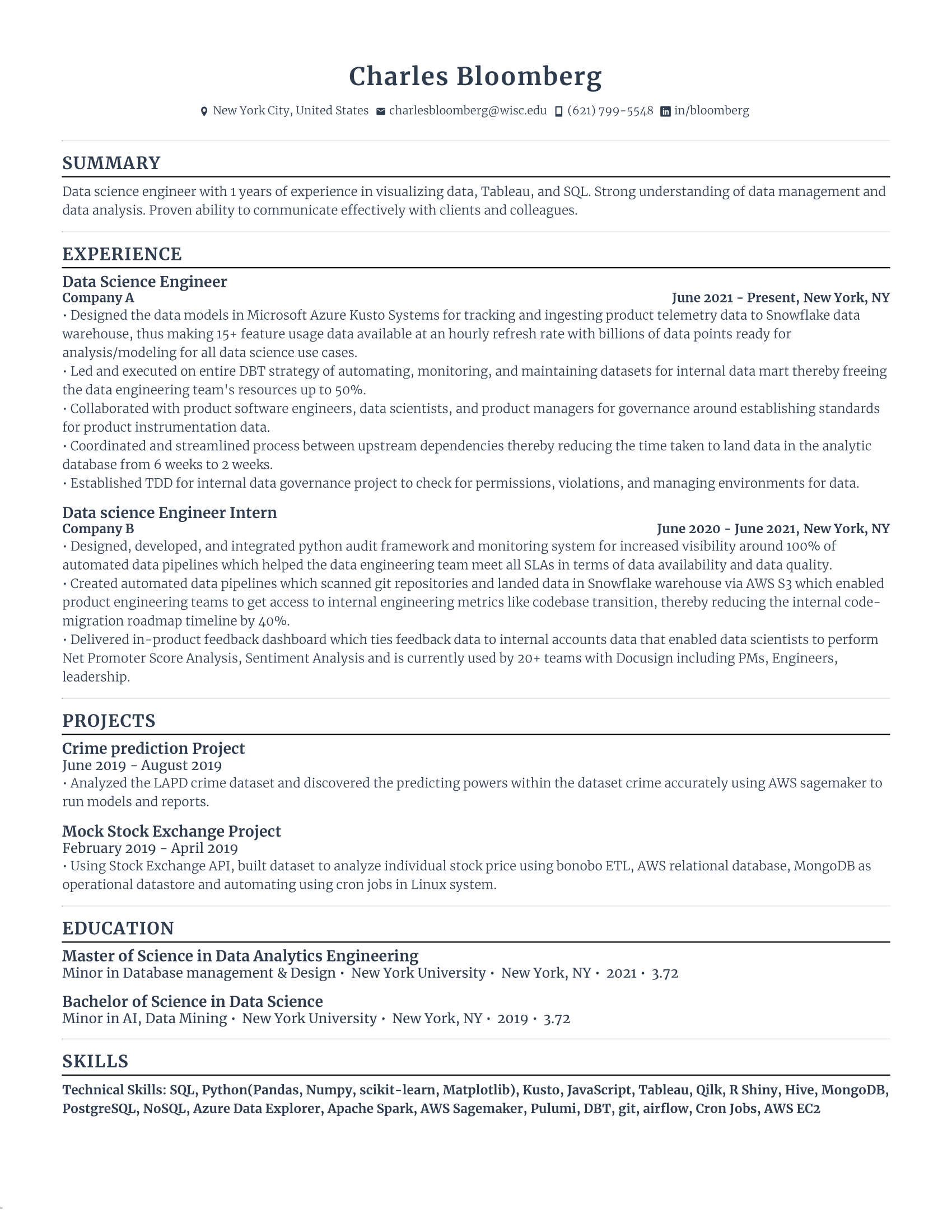
The architecture of your resume determines how quickly a recruiter or an Applicant Tracking System (ATS) can parse your value. In 2026, the standard format remains a single-page document, unless you have extensive research publications or multiple high-level internships.
Header and Contact Information
Your header should be clean and professional. Include your full name, a professional email address, your LinkedIn profile, and a direct link to your GitHub repository or personal portfolio. In 2026, the portfolio link is arguably more important than the physical address. Ensure your GitHub is organized, with clear README files for every project you list on your resume.
The Professional Summary vs. Objective
For entry-level candidates, a professional summary is often more effective than an objective. Instead of stating what you want (a job), state what you offer. A strong 2026 summary might look like this: "Data Science graduate with a focus on predictive modeling and NLP. Proficient in Python, SQL, and AWS SageMaker. Developed a customer churn model that improved retention by 15% during a six-month internship at a FinTech startup. Committed to ethical AI practices and scalable model deployment."
Designing the Technical Skills Matrix
The technical skills section is the most scanned part of a data science resume. Avoid listing every tool you have ever touched. Instead, categorize your skills to show a structured understanding of the field.
| Category | Essential Skills (Core) | Competitive Differentiators (2026) |
|---|---|---|
| Languages | Python (Pandas, NumPy), SQL, R | Rust, Julia, Advanced Cython |
| Machine Learning | Scikit-learn, Regression, Clustering | PyTorch, TensorFlow, Transformers |
| Data Engineering | ETL Pipelines, Data Cleaning | Spark, Kafka, Snowflake, dbt |
| Cloud & DevOps | AWS (EC2, S3), Docker | MLOps (MLflow), Kubernetes, GCP Vertex AI |
| Visualization | Tableau, Power BI, Matplotlib | Plotly, Streamlit, D3.js |
Why Categorization Matters
Recruiters use these categories to quickly verify if you meet the baseline requirements for a specific tech stack. By separating "Core" from "Specialized" or "Differentiators," you signal that you understand which tools are standard in the industry and which ones represent cutting-edge expertise.
The "Portfolio-First" Project Section
For an entry-level candidate, the Projects section is the heart of the resume. This is where you prove you can apply theoretical knowledge to practical problems. Each project description should follow the STAR (Situation, Task, Action, Result) method, but with a technical twist.
Deep Dive into Project Descriptions
When describing a project, focus on the "Action" and "Result." Avoid vague terms like "helped build" or "learned about." Use strong action verbs like "Engineered," "Optimized," "Architected," or "Validated."
- Project Title and Link: Clearly name the project and provide a clickable link to the code.
- The Problem Statement: Briefly explain what you were trying to solve. For example: "Predicting housing prices in high-density urban areas to assist real estate investment decisions."
- The Technical Approach: Mention the specific libraries and algorithms used. "Implemented a Gradient Boosting Regressor using XGBoost and performed hyperparameter tuning via Optuna."
- Quantifiable Results: This is crucial. Even if the project was academic, quantify the outcome. "Achieved an R-squared value of 0.89 and reduced mean absolute error by 12% compared to the baseline linear model."
Including LLM and Generative AI Projects
In 2026, having at least one project involving Generative AI or LLM fine-tuning is highly recommended. This demonstrates that you are current with the rapid evolution of the field. A project involving RAG (Retrieval-Augmented Generation) or fine-tuning a small-parameter model (like Llama 3 or similar 2026-era models) shows that you can leverage modern AI architectures.
Education and Relevant Coursework
If you are a recent graduate, your education section should remain prominent. List your degree, university, and graduation date. If your GPA is 3.5 or higher, include it; otherwise, focus on your relevant coursework and honors.
Highlighting Specialized Education
In 2026, employers look for specific specializations. If you took advanced modules in Bayesian Statistics, Deep Learning, or Data Ethics, list them. Additionally, mention any reputable certifications from providers like Coursera, Udacity, or cloud-specific certifications (e.g., AWS Certified Machine Learning – Specialty). These certifications act as a signal of continuous learning and commitment to the craft.
Leveraging Non-Technical Work Experience
Many entry-level data scientists are career changers or have worked in service industries during college. Do not omit this experience, but frame it through a data-driven lens.
If you worked as a retail manager, emphasize how you used sales data to optimize inventory. If you were a teacher, highlight your ability to communicate complex concepts to a non-technical audience—a skill known as Data Storytelling. Data storytelling is one of the most sought-after soft skills in 2026, as companies struggle to bridge the gap between technical teams and executive leadership.
Optimizing for the 2026 Applicant Tracking Systems (ATS)
Most medium-to-large companies use ATS software to filter resumes before a human ever sees them. To pass these filters, your resume must be formatted correctly.
- Standard Fonts: Use clean, sans-serif fonts like Arial, Calibri, or Roboto.
- Keywords: Ensure keywords from the job description are reflected in your resume. If the job description emphasizes "Data Governance" or "Feature Engineering," these exact terms should appear in your text.
- Simple Layouts: Avoid multi-column layouts, images, or charts inside the resume file. While they look good to humans, they often break the parsing logic of older ATS versions still in use in 2026.
- File Format: Always save and send your resume as a PDF unless the job posting explicitly requests a .docx file. This ensures your formatting remains consistent across different devices.
Common Pitfalls to Avoid
Even a technically brilliant candidate can be rejected due to preventable errors.
- The "Kitchen Sink" Approach: Do not list every project you've ever done. Choose the 3-4 most relevant ones that demonstrate a breadth of skills (e.g., one cleaning/ETL project, one supervised learning project, and one deep learning/AI project).
- Ignoring Data Cleaning: Many resumes focus only on the "sexy" part of modeling. In 2026, managers are desperate for people who can handle dirty data. Explicitly mention your experience with data wrangling, outlier detection, and handling missing values.
- Lack of Business Context: A model that is 99% accurate but costs $10,000 per day to run is useless to most companies. Always mention the efficiency or cost-effectiveness of your solutions where applicable.
Frequently Asked Questions
Do I need a Master’s degree to get an entry-level data science job in 2026?
While a Master's degree or PhD is still highly valued for research-heavy roles, many companies in 2026 accept candidates with a Bachelor's degree in a quantitative field (Math, CS, Physics, Economics) combined with a strong project portfolio. Demonstrable skill and hands-on experience often outweigh the specific degree level for general data science positions.
How many projects should be on an entry-level resume?
Aim for 3 to 5 high-quality projects. It is better to have three deeply documented projects with clear code on GitHub than ten shallow projects that only use standard datasets like Iris or Titanic. Use unique datasets to show you can find and process original information.
Is Python still the dominant language for data science in 2026?
Yes, Python remains the primary language due to its massive ecosystem of libraries like PyTorch, Scikit-learn, and Polars. However, familiarity with SQL is equally important, as most enterprise data lives in relational databases. Some specialized roles may also look for Rust or Julia for high-performance computing tasks.
Should I include my GitHub link if my code isn't perfect?
Yes, you should include it. Hiring managers do not expect perfection from entry-level candidates. They are looking for your thought process, how you structure your code, how you handle errors, and whether you provide adequate documentation (READMEs). Perfect code is less important than a logical and organized approach to problem-solving.
What is the most important "soft skill" for a data scientist?
In 2026, the most important soft skill is Data Storytelling. This is the ability to explain "why" a model's findings matter to a stakeholder who does not understand math. If you can translate a p-value into a profit margin, you become significantly more valuable to an organization.
How do I handle a gap in my employment or education?
Be honest and proactive. If you took time off to complete an intensive data science bootcamp or self-study period, list that time as "Independent Study: Data Science & Machine Learning" and treat it like a job, listing the skills learned and projects completed during that time.
Next Steps for Your Application
Once your resume is polished, your next action should be to tailor it for every specific role you apply for. Change the order of your skills or highlight different projects based on the company's industry. After submitting, ensure your LinkedIn profile mirrors your resume and that your GitHub repositories are set to "Public" so recruiters can verify your work immediately.
Image Gallery