How Many People Have Only Group Life Insurance? Coverage Statistics and Risks
According to industry data from financial research organizations such as LIMRA, approximately 40 to 50 million American adults rely exclusively on group life insurance provided through their employer. This means roughly 35% to 40% of a...
According to industry data from financial research organizations such as LIMRA, approximately 40 to 50 million American adults rely exclusively on group life insurance provided through their employer. This means roughly 35% to 40% of all insured individuals in the United States hold no supplemental or individual life insurance policy whatsoever, leaving many households significantly underinsured.
Contents
Breakdown of Group Life Insurance Statistics
Life insurance ownership in the United States presents a complex picture. While millions of workers maintain active policies, a substantial portion of the population relies entirely on workplace benefits.
The Scope of Workplace Coverage
The U.S. Bureau of Labor Statistics reports that approximately 60% of private industry workers and over 80% of state and local government employees have access to employer-provided group life insurance. Because employers frequently cover 100% of the premium for basic group policies, participation rates among eligible workers are high.
However, industry studies published by LIMRA and Life Happens reveal a persistent coverage gap:
- Overall Life Insurance Ownership: Approximately 52% of U.S. adults carry some form of life insurance.
- Exclusive Group Coverage: Among those who are insured, roughly 35% rely only on employer-provided group policies. Across the entire U.S. adult population, this translates to nearly 1 in 5 adults relying solely on workplace insurance.
- The Underinsurance Gap: Over 100 million Americans report that they do not have enough life insurance coverage, with group-only policyholders forming a major segment of this underinsured demographic.
Total U.S. Insured Population Dynamics (Approximate Distribution)
| Policy Category | Distribution |
|---|---|
| Individual Policy Only | ~30% |
| Both Group & Individual Policies | ~35% |
| Group Policy Only | ~35% (40–50 Million Adults) |
Why Millions of Workers Rely Solely on Workplace Policies
Understanding why so many individuals hold only workplace coverage helps highlight both the convenience and the systemic limitations of employer benefit plans.
Automatic Enrollment and Zero Out-of-Pocket Cost
For most full-time employees, basic group life insurance is included automatically during onboarding. Employers often provide a basic benefit—frequently equal to one year of the employee's salary—at no cost to the worker. Because no immediate effort or expense is required, many employees check the box and assume their life insurance needs are fully satisfied.
No Medical Underwriting
Standard group life insurance policies typically offer guaranteed issue up to a specified threshold (such as $50,000 or 1x annual earnings). Employees do not need to take a medical exam, provide blood samples, or answer extensive medical history questionnaires. For workers with pre-existing health conditions, group coverage represents an accessible line of financial protection.
Perception of High Costs for Individual Policies
A recurring finding in consumer surveys is the misperception of individual insurance costs. Research indicates that consumers consistently overestimate the cost of an individual term life insurance policy by up to three times its actual price. Consequently, workers often defer purchasing private policies, believing their employer plan is the only affordable option.
The Hidden Risks of Relying Only on Group Life Insurance
While employer-provided life insurance is a valuable benefit, using it as your sole safety net introduces severe financial vulnerabilities.
Disclaimer: The following analysis is provided for educational purposes only and should not replace personalized advice from a licensed insurance professional or certified financial advisor.
1. Inadequate Coverage Amounts
The standard basic group life benefit pays out 1x to 2x an employee's annual salary. For a single person with no dependents, this may cover immediate funeral and final expenses. However, for households with dependents, mortgages, or substantial debts, 1x salary falls far short of long-term financial security.
Financial planners generally recommend carrying 10x to 12x your annual gross income in life insurance protection. A worker earning $75,000 per year might receive a $75,000 death benefit through work, but their actual family protection requirement could range between $750,000 and $1,000,000.
2. Lack of Portability During Job Transitions
Group life insurance is tied directly to your employment. If you leave your job voluntarily, face a layoff, or are terminated, your coverage generally ends on your last day of employment or at the end of that calendar month.
If you experience job loss during a period of poor health, you may find it difficult or prohibitively expensive to qualify for an individual policy on the private market.
3. Conversion Limitations and Cost Surges
Many group plans offer a conversion option, allowing departing workers to convert their group benefit into an individual permanent life insurance policy without a medical exam. However:
- Conversions typically must be exercised within a tight window (often 31 days).
- Converted policies usually transition into whole life insurance rather than low-cost term insurance.
- The premium rates for converted policies are calculated based on your attained age, making them significantly more expensive than standard individual policies.
4. Age-Banded Supplemental Pricing
While basic group life is often free, buying supplemental group life insurance through your employer to cover the remaining gap can become unexpectedly expensive over time. Group supplemental rates are structured in five-year age brackets (e.g., ages 30–34, 35–39, 40–44). As you move into higher age brackets, your monthly premiums increase automatically, whereas an individual level-term policy locks in a fixed rate for 10, 20, or 30 years.
Group Life vs. Individual Life Insurance: Detailed Comparison
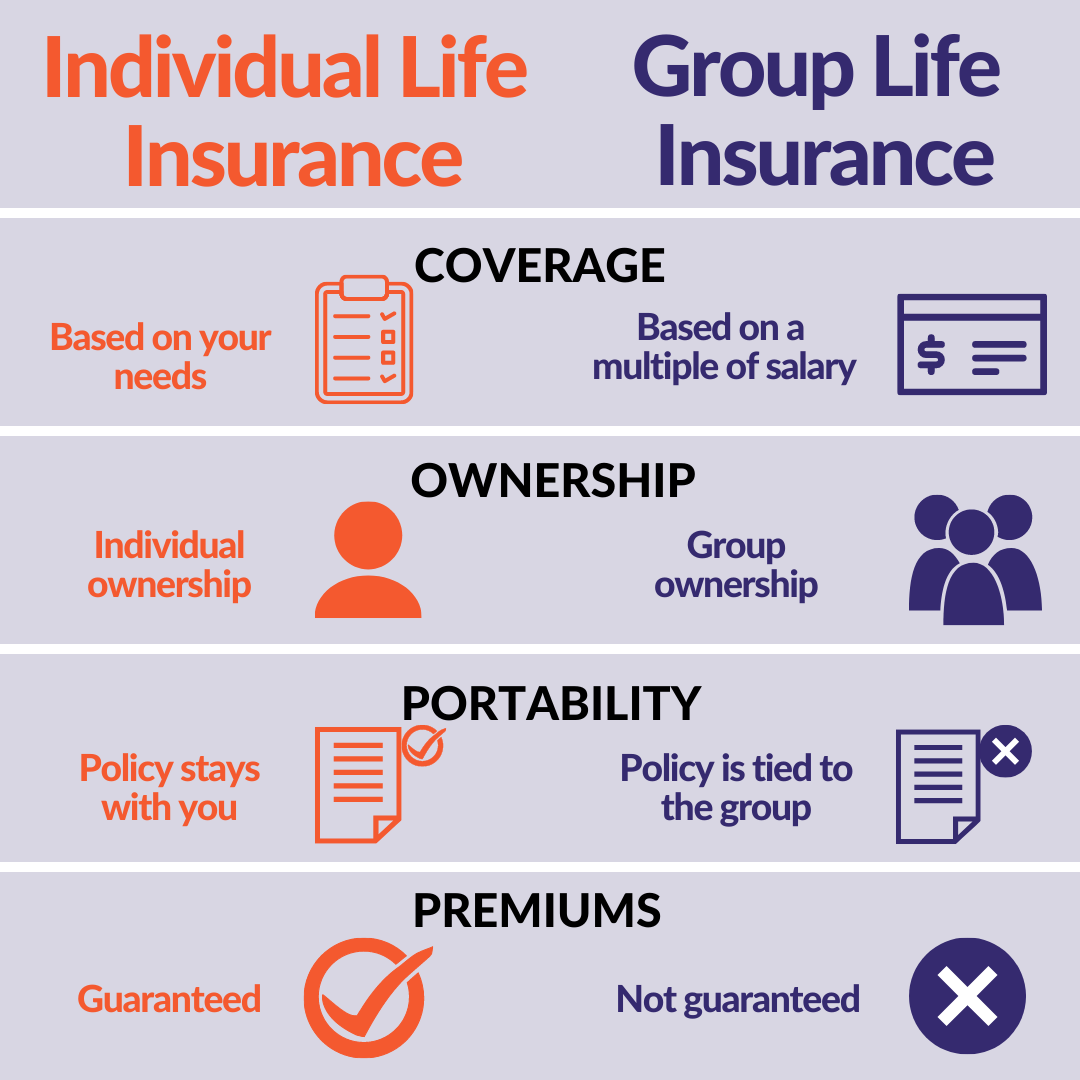
| Feature | Group Life Insurance (Employer-Provided) | Individual Life Insurance (Private Market) |
|---|---|---|
| Ownership | Employer owns the master policy; worker holds a certificate. | You own the policy directly. |
| Coverage Cap | Typically limited to 1x–2x salary or fixed cap ($50,000). | Customizable (e.g., $250,000 to $5,000,000+). |
| Portability | Terminated upon job separation (unless converted). | Fully portable; remains active regardless of employer changes. |
| Medical Exam | Generally waived for basic benefit limits. | Required for high coverage amounts (simplified/no-exam options exist). |
| Premium Costs | Free/cheap for basic coverage; supplemental rates rise every 5 years. | Fixed level premiums locked in for 10, 20, or 30 years. |
| Riders & Customization | Limited to standard employer selections. | Highly customizable (waiver of premium, child riders, accelerated death benefits). |
| Health Lock-In | Vulnerable if job loss occurs alongside health changes. | Locks in rates based on your health at the time of application. |
Calculating Your Actual Insurance Needs: The DIME Formula
Relying on a arbitrary multiple of your salary can leave significant blind spots. Insurance analysts frequently use the DIME method to establish appropriate coverage limits:
Total Need = (D)ebt + (I)ncome Replacement + (M)ortgage + (E)ducation
- Debt: Sum all outstanding personal debts, credit cards, auto loans, and estimated final/funeral expenses (excluding your home mortgage).
- Income Replacement: Multiply your annual income by the number of years your family will need financial support until dependents are self-sufficient (e.g., $80,000 × 10 years = $800,000).
- Mortgage Balance: Include the full payoff amount of your primary home mortgage.
- Education Expenses: Estimate college tuition and living expenses for each child (e.g., $100,000 to $150,000 per child).
Example Calculation
Consider a 35-year-old worker earning $80,000 annually with two young children and a mortgage:
- Debt & Final Expenses: $25,000
- Income (10 Years): $800,000
- Mortgage Balance: $300,000
- Education (2 Children): $200,000
- Total Required Coverage: $1,325,000
If this worker relies solely on a standard employer group policy of 1x salary ($80,000), their family faces a $1,245,000 coverage shortfall in the event of an untimely death.
Steps to Bridge the Group Life Coverage Gap
If you are currently part of the group-only demographic, securing your family’s financial future requires a deliberate, step-by-step strategy.
Step 1: Audit Your Current Workplace Policy
Review your summary plan description (SPD) or consult your human resources representative to clarify:
- The exact benefit payout calculation (e.g., flat $50k vs. 2x salary).
- Whether supplemental coverage is available and at what age-bracket rates.
- What options exist for portability or policy conversion upon departure.
Step 2: Determine Your Personal Coverage Need
Run a calculation using the DIME formula or work with a licensed professional to establish your family's actual target coverage figure.
Step 3: Secure an Individual Level-Term Policy First
Before making any changes to optional supplemental coverage at work, apply for an individual level-term policy on the open market.
- Apply while young and healthy: Rates are locked in based on your age and medical status at application.
- Choose an appropriate term length: Match the term (15, 20, or 30 years) to your financial obligations, such as the duration of your mortgage or until your children graduate.
Step 4: Layer Group and Individual Coverage
Do not view workplace insurance and private policies as mutually exclusive. Treat your employer's free basic group policy as a baseline layer of protection, and use your private individual policy to cover the remaining 80% to 90% of your total financial need.
Frequently Asked Questions
Is group life insurance enough for a single person with no dependents?
For a single individual with no children, spouse, or cosigned debts, basic group life insurance may be sufficient. It provides enough cash to cover immediate funeral costs and final medical bills. However, purchasing a small individual policy while young and healthy can lock in low rates for future needs, such as a mortgage or marriage.
What happens to my group life policy if I get laid off?
In most cases, group life insurance terminates automatically when your employment ends. Some plans allow you to convert the policy to an individual whole life plan within 31 days without evidence of insurability, though the premiums for converted policies are typically much higher than standard individual term policies.
Why is supplemental group life insurance sometimes more expensive than private term life?
Supplemental group life rates increase every five years based on age brackets. Additionally, group policy pricing reflects a broad risk pool that includes individuals with pre-existing medical conditions. If you are healthy, an individual term policy with full medical underwriting will often cost less over time than workplace supplemental coverage.
Can my employer change or cancel my group life insurance benefit?
Yes. Because the employer owns the master policy, management reserves the right to alter benefit structures, change providers, or eliminate life insurance benefits altogether during annual contract renewals.
Do I need a medical exam for an individual life insurance policy?
Not always. Many insurance carriers now offer accelerated underwriting or simplified-issue term policies that do not require physical medical exams or fluid draws for qualified applicants up to certain coverage limits (often up to $1,000,000 or $2,000,000), depending on age and medical history.
Practical Recommendation
Relying exclusively on employer-provided life insurance leaves your family exposed to severe financial gaps caused by low payout caps and job transitions.
To build an effective safety net:
- Accept your employer's free basic group policy.
- Avoid over-relying on voluntary supplemental workplace insurance if your health permits you to qualify for private rates.
- Purchase an individual level-term life insurance policy to cover long-term liabilities like mortgages, income replacement, and educational funds.
By combining a free workplace baseline with a portable individual policy, you ensure continuous, comprehensive financial protection regardless of career changes or health developments.
Image Gallery