How to Navigate ATL Airport Maps: A Complete Guide to Hartsfield-Jackson Terminal Layouts
Navigating Hartsfield-Jackson Atlanta International Airport (ATL) maps requires understanding its linear, parallel concourse design. The airport consists of two landside terminals—Domestic and International—connected airside by seven p...
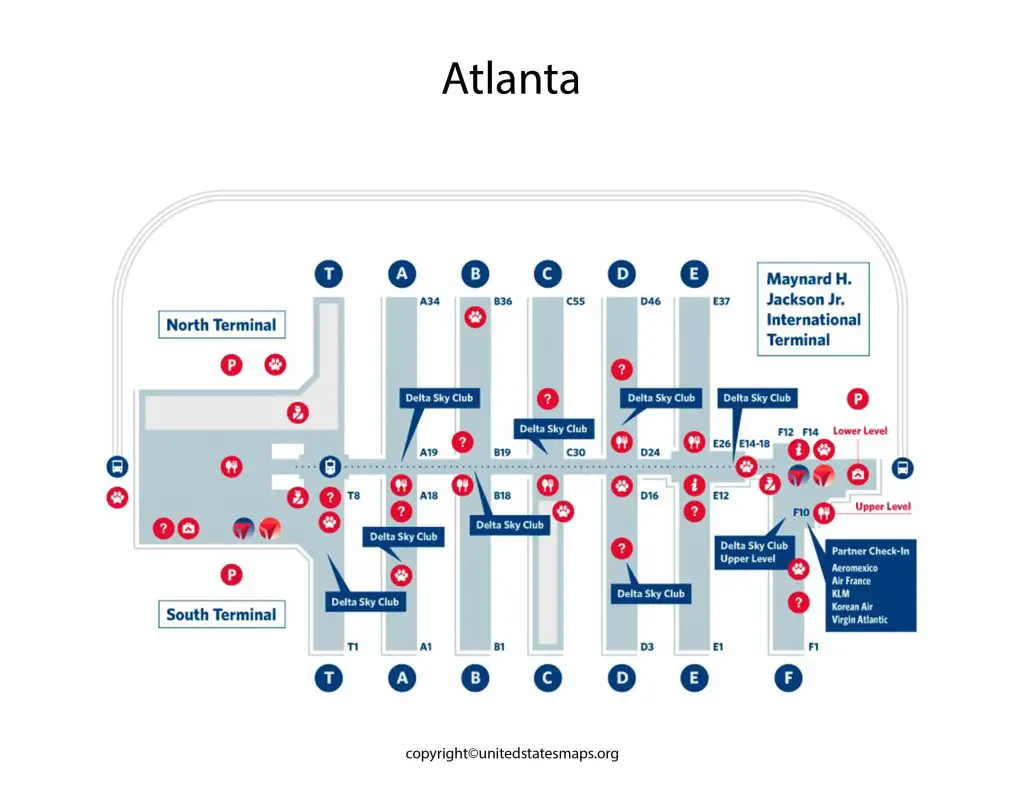
Navigating Hartsfield-Jackson Atlanta International Airport (ATL) maps requires understanding its linear, parallel concourse design. The airport consists of two landside terminals—Domestic and International—connected airside by seven parallel concourses (T, A, B, C, D, E, and F). Passengers travel between concourses using the underground Plane Train or the walking Transportation Mall.
Contents
Understanding Hartsfield-Jackson Atlanta Airport’s Layout
Hartsfield-Jackson Atlanta International Airport is one of the world's busiest aviation hubs. Despite its massive passenger volume, its physical layout follows a remarkably logical, grid-based layout designed for high-capacity passenger throughput.
- Domestic Terminal (North & South)
- Airside Concourses: Concourse T, Concourse A, Concourse B, Concourse C, Concourse D, Concourse E, Concourse F to International Terminal (Maynard H. Jackson Jr.)
- Landside Connection: ATL SkyTrain to Rental Car Center / Hotels
- International Terminal (Maynard H. Jackson Jr.)
- Landside Connection: Landside Shuttle Bus to Rental Car Center / Hotels
The airport operates around two main terminal complexes situated at opposite ends of the airfield:
- The Domestic Terminal: Located on the west side of the airport complex, divided into Domestic South (primarily Delta Air Lines ticketing and baggage claim) and Domestic North (other domestic carriers including Southwest, American, United, and Spirit).
- The Maynard H. Jackson Jr. International Terminal: Located on the east side of the airport complex, handling international check-in, arrivals, customs, and immigration.
Spanning between these two end-cap terminals are seven linear, parallel concourses aligned north-to-south. From west to east, these concourses are labeled T, A, B, C, D, E, and F.
- Concourse T is directly attached to the Domestic Terminal building.
- Concourse F forms the airside gate area of the International Terminal.
- Concourses A, B, C, D, and E sit sequentially in the center of the airfield layout.
All concourses are linked underground airside (post-security) by a continuous 1.2-mile subterranean corridor housing both the automated people mover system (The Plane Train) and a pedestrian walking route (The Transportation Mall).
Master Map Mechanics: Reading ATL's Concourse and Terminal Layout
To read an ATL airport map accurately, you must first distinguish between airside (secure, post-TSA screening areas) and landside (public, pre-security areas).
- LANDSIDE (Pre-Security)
- Domestic Terminal (North/South Ticketing & Baggage Claim) | MARTA Station
- TSA Security Checkpoints
- AIRSIDE (Post-Security Secure Zone)
- Concourse T, Concourse A, Concourse B, Concourse C, Concourse D, etc. (Connected underground by Plane Train & Transportation Mall)
1. The Domestic Terminal Complex (West End)
When viewing the Domestic Terminal map, note that it is split into two landside halls connected by an atrium:
- Domestic South: Houses Delta Air Lines check-in counters, baggage drop, and South Baggage Claim (Carousels 1–9).
- Domestic North: Houses ticketing for non-Delta domestic airlines and North Baggage Claim (Carousels 10–18).
- Atrium: A central public zone between North and South featuring retail outlets, service desks, and access to the underground MARTA rail station.
- Security Checkpoints: Main Security is situated centrally near the Atrium entrance. Lower Level/Domestic South Checkpoints cater to TSA PreCheck and CLEAR lines depending on operational hours.
2. The Midfield Concourses (T, A, B, C, D, E)
Each central concourse functions as a self-contained linear hall with aircraft gates distributed along its north and south wings:
- Concourse T: Attached directly to the main domestic security checkpoint. It houses gates T1 through T21. Because of its proximity to main security, it is often the quickest concourse to reach on foot after TSA screening.
- Concourse A: Primarily dedicated to domestic Delta Air Lines flights (Gates A1 to A34).
- Concourse B: Houses Delta’s high-density domestic departures (Gates B1 to B36), along with central retail and dining hubs.
- Concourse C: Features domestic flights operated by Delta, Southwest, and regional partners (Gates C1 to C55).
- Concourse D: Accommodates regional jet operations and domestic flights for Spirit, Frontier, JetBlue, and American (Gates D1 to D55). Note that Concourse D has narrower concourse walking aisles compared to A or B.
- Concourse E: Designed for international long-haul flights and domestic overflow (Gates E1 to E36). It features expansive lounge spaces and duty-free retail hubs.
3. The International Terminal & Concourse F (East End)
The Maynard H. Jackson Jr. International Terminal map shows a self-contained facility at the airport's east boundary:
- Concourse F: Contains gates F1 through F14. It connects directly to the International Terminal arrivals hall, U.S. Customs and Border Protection (CBP) inspection facility, and international ticketing desks.
- Dual Inter-Concourse Access: Concourse F connects to Concourse E and the rest of the airport airside via the underground Plane Train and Transportation Mall, allowing post-security transfers without exiting the secure zone (unless arriving on an non-precleared international flight requiring customs exit).
Transit Options on the Map: Moving Between Concourses
Understanding how to read movement corridors on ATL maps is essential for making tight connections. Transportation pathways fall into three distinct systems.
- LANDSIDE TRANSIT (Outside Security Checkpoints)
- ATL SkyTrain: Connects Domestic Terminal to RCC & Gateway Center
- Terminal Shuttle Bus: Connects Domestic Terminal to International Terminal
- AIRSIDE TRANSIT (Inside Security Checkpoints)
- Plane Train: Underground Automated Train (Serves Concourses T to F)
- Transportation Mall: Subterranean Pedestrian Walkway with Moving Skys
The Underground Plane Train
The Plane Train is an automated people mover (APM) running in a subterranean tunnel directly beneath the centerline of all concourses. On airport maps, Plane Train stations are marked with train icons at the center point of each concourse level.
- Route:
- Domestic Baggage Claim station
- Concourse T
- Concourse A
- Concourse B
- Concourse C
- Concourse D
- Concourse E
- Concourse F (International)
- Frequency: Operates approximately every 2 minutes.
- Travel Time: Inter-concourse transit takes roughly 90 seconds to 2 minutes per stop. Total travel time from Concourse T to Concourse F is under 10 minutes.
The Transportation Mall (Pedestrian Walkway)
Parallel to the Plane Train track is a climate-controlled underground pedestrian corridor. Maps designate this as the Transportation Mall.
- Moving Walkways: Equipped with high-speed automated walkways running in both directions between concourses.
- Walking Times: Walking between adjacent concourses (e.g., A to B) takes approximately 5 to 7 minutes on foot using the moving walkways.
- Art and Exhibits: The tunnel sections feature distinct thematic exhibits, including light installations between Concourses A and B, and a Zimbabwean stone sculpture exhibit between Concourses T and A.
ATL SkyTrain (Landside Only)
The ATL SkyTrain is an elevated landside train located outside the TSA secure perimeter at the Domestic Terminal (near Domestic West baggage claim and the MARTA station).
- Route: Connects the Domestic Terminal to the Gateway Center (Georgia International Convention Center and airport hotels) and the Rental Car Center (RCC).
- Important Map Caution: The ATL SkyTrain does not take passengers to Concourse F or the International Terminal. To travel landside between Domestic and International terminals, passengers must use the dedicated landside shuttle bus outside terminal ground transportation doors.
Ground Transit & Inter-Terminal Connectivity
| Transit System | Location Type | Route / Destinations Served | Average Travel Time | Best Used For |
|---|---|---|---|---|
| Plane Train | Airside (Post-Security) | Connects Domestic Baggage Claim, Concourse T, A, B, C, D, E, and F | 2 minutes per concourse stop | Fast transfers between gates across all concourses. |
| Transportation Mall | Airside (Post-Security) | Underground pedestrian tunnel parallel to Plane Train (T through F) | 5–7 minutes per concourse on foot | Short transfers (1 concourse away), stretching legs, or avoiding train crowding. |
| ATL SkyTrain | Landside (Pre-Security) | Domestic Terminal $\leftrightarrow$ Gateway Center $\leftrightarrow$ Rental Car Center (RCC) | 5 minutes to RCC | Accessing rental vehicles, GICC, and off-site airport hotels. |
| Terminal Shuttle Bus | Landside (Pre-Security) | Domestic Terminal (Curbside) $\leftrightarrow$ International Terminal (Curbside) | 12–15 minutes (plus wait) | Transferring landside between Domestic and International complexes. |
Strategic Navigation: Step-by-Step Map Scenarios
Scenario 1: Navigating from Domestic Security to Departure Gates
- Identify Security Clearance Point: Clear TSA screening at the Domestic Main Terminal checkpoint.
- Locate Center Escalators: Walk past the exit screens to the central atrium opening. Follow overhead signs labeled Plane Train to All Concourses.
- Descend to Subterranean Mall: Take the steep escalator bank down two levels to the underground transportation tunnel.
- Choose Transit Mode:
- If your flight departs from Concourse T, do not take the train; walk directly up the escalators leading to Concourse T.
- If your flight departs from Concourses A through F, board the next available Plane Train. Audio visual announcements will state: *"The next stop is Concourse [Letter]." *
- Ascend to Gate Level: Upon reaching your designated station, step off the train and take the central escalators up to the main concourse floor. Gate numbers are arranged sequentially with lower numbers extending in one direction and higher numbers in the opposite direction.
Scenario 2: Connecting Domestic Flights (Airside Transfer)
When arriving on a domestic flight and connecting to another domestic or international flight, do not exit the secure area.
Check Flight Information Screens: Verify your departure concourse and gate number upon exiting the arrival jetbridge.
Locate Center Concourse Escalators: Walk toward the center of your arrival concourse hall (marked by gate numbers counting down toward the center hub).
Descend to Train Level: Take the central escalator or elevator down to the Plane Train station level.
Board Plane Train or Walk: Ride the train to your target concourse (or walk the Transportation Mall if transitioning just one concourse over, such as B to C).
Ascend and Locate Gate: Take the escalators up to your departure concourse and follow signage toward your gate number.
Arriving Jetbridge
Walk to Center of Concourse
Escalator Down to Plane Train
Ride Train to Target Concourse
Escalator Up to Departure Level
Arrive at Departure Gate
Scenario 3: Arriving Internationally and Connecting to Domestic Destinations
International arrivals undergo a specific layout flow governed by federal border control protocols.
- Customs and Border Protection (CBP): Deplane at Concourse E or F and follow red overhead signs marked Customs / Passenger Arrival.
- Baggage Reclaim & Inspection: Clear passport control, retrieve checked luggage from international baggage carousels, and pass through customs inspection.
- Re-Check Baggage: Immediately following customs, follow signs for Connecting Flights Baggage Drop to re-deposit bags onto the airline transfer system.
- Airside Re-Screening: Pass through the adjacent dedicated TSA security checkpoint reserved for arriving international connecting passengers.
- Access Main Concourses: Once re-screened, you emerge airside at Concourse F or E. Take the Plane Train or walk the Transportation Mall to reach your domestic departure concourse.
Digital vs. Paper Maps: Tools for Real-Time Navigation
While overhead static maps placed throughout terminal halls offer basic orientation, dynamic map tools provide step-by-step navigation, real-time wait times, and gate changes.
| Tool | Primary Use Case |
|---|---|
| Official Airport Web Maps | Dynamic turn-by-turn indoor routing & concessions |
| Fly Delta Mobile App | Integrated gate change alerts & layout overlays |
| Apple Maps / Google Maps | Bluetooth micro-location & floor-level switching |
Official Hartsfield-Jackson Interactive Map
The airport provides a mobile-optimized web map accessible through any browser on the official Hartsfield-Jackson Atlanta International Airport Map Portal.
- Indoor Positioning: Features interactive floor-by-floor toggle switches (Ground Level, Departure Level, Train Level).
- Turn-by-Turn Routing: Allows users to input their current location (or gate number) and target destination to generate precise walking or train directions with estimated movement times.
- Amenities Filter: Search map layers for charging stations, nursing pods, pet relief areas, specific food vendors, and TSA PreCheck lanes.
Airline Mobile Applications
- Fly Delta App: Because Delta utilizes ATL as its primary hub, its mobile app features integrated indoor mapping mapped specifically to ATL’s layout. When a connecting gate is updated, the map dynamically recalculates the path from your arrival gate to the new departure gate, factoring in Plane Train travel times.
- Partner Airline Apps: Apps for American Airlines, United Airlines, and Southwest provide gate locator maps that link into standardized airport mapping frameworks.
Mobile OS Mapping (Apple Maps & Google Maps)
Both Apple Maps and Google Maps feature detailed indoor cartography for Hartsfield-Jackson.
- Floor-Level Views: Users can zoom into terminal buildings to view individual gate numbers, restrooms, security lines, and food court layouts.
- Indoor Positioning Systems (IPS): Leverages Wi-Fi signals and Bluetooth beacons across the terminal to display a blue dot indicating your real-time position within the concourse.
Essential Wayfinding Tips and Common Navigation Pitfalls
1. Distinguish Between Domestic North and South Check-In
A frequent mistake for departing passengers is dropping off at the wrong terminal entrance.
- Domestic South handles Delta Air Lines exclusively.
- Domestic North handles all other domestic carriers (e.g., Southwest, American, Spirit, Frontier, United).
- Consequence: Arriving at the wrong curb requires walking through the central public atrium landside, adding 5 to 10 minutes to your pre-security timeline.
2. Verify International Terminal Pick-Up vs. Drop-Off
The International Terminal (Maynard H. Jackson Jr. Terminal) has its own separate landside roadway network accessible via Interstate 75 (Exit 239).
- If flying on an international itinerary originating in Atlanta, you must check in at the International Terminal off I-75 if your ticketing airline mandates it.
- Parking or being dropped off at the Domestic Terminal when departing on an international carrier that requires International Terminal check-in will require taking a landside shuttle bus, adding 15–20 minutes to your journey.
3. Estimate Plane Train vs. Walking Times Accurately
When making a connection across multiple concourses (e.g., Concourse A to Concourse E), always use the Plane Train. Walking five concourses underground via the Transportation Mall covers over a mile and can take up to 30 minutes, whereas the train covers that distance in under 8 minutes. Reserve walking for adjacent concourses (such as T to A, or B to C) or during peak operating times when train boarding platform crowds are high.
4. Locate Pet Relief Areas and Accessible Restrooms
Map legends indicate specialized facilities with distinct icons:
- Service Animal / Pet Relief Areas: Located airside near Gates T7, A10, B28, C19, D-Center, E14, and F6.
- Accessible Restrooms: Distributed centrally in every concourse hall immediately adjacent to the main elevator banks.
Frequently Asked Questions
Which concourse is connected directly to the main Domestic Terminal building?
Concourse T is the only concourse directly connected to the Domestic Terminal landside building post-security. Passengers clearing main domestic security step out immediately into the Concourse T hall level before descending down to the Plane Train station to reach Concourses A through F.
Can I walk between all concourses at ATL without exiting security?
Yes. The subterranean Transportation Mall runs parallel to the Plane Train and connects Concourses T through F airside. You can walk between any concourses without exiting the post-security zone or undergoing additional TSA screening, provided you do not exit through the airport's landside exit doors.
How do I get to the Rental Car Center from the airport terminal?
From the Domestic Terminal, follow overhead signs toward Domestic West baggage claim and exit toward the MARTA station area. Board the elevated landside ATL SkyTrain. The SkyTrain provides free transportation to the Rental Car Center (RCC) in approximately 5 minutes, stopping at the Gateway Center en route.
How do I transfer landside between the Domestic and International Terminals?
If you are outside the secure area and need to travel between the Domestic and International terminals, take the free 24/7 airport terminal shuttle bus. Curbside pickup points are located outside Domestic West Baggage Claim (Door W1) and outside the International Terminal Arrivals curb (Door A1). Drive time is approximately 12 to 15 minutes.
Are TSA PreCheck and CLEAR lines marked on ATL terminal maps?
Yes. Map overlays for the Domestic Terminal indicate specific security lanes. Dedicated TSA PreCheck and CLEAR access lanes are situated primarily at the Domestic South Checkpoint and designated lanes within the Main Security Checkpoint. Check real-time operational status on airport monitors or via the official web map before selecting your line.
Actionable Next Steps for Travelers
- Verify Your Departure Terminal: Check your airline ticket confirmation before departing for ATL. Ensure you know whether your airline operates out of Domestic South, Domestic North, or the Maynard H. Jackson Jr. International Terminal.
- Download Navigation Maps Ahead of Time: Save an offline map or load your flight into your airline’s mobile application (such as Fly Delta) to ensure instant access to gate locations and concourse routing upon arrival.
- Calculate Transfer Margins: If connecting at ATL, check your arrival and departure concourses on terminal monitors upon deplaning. If your layover is less than 45 minutes and spans more than two concourses (e.g., Concourse A to Concourse D), proceed directly to the underground Plane Train platform without stopping.
- Bookmark Official Resources: Review security wait times and interactive floor layouts directly on the official Hartsfield-Jackson Airport Website prior to heading to the airport.
Image Gallery