Understanding the Mass of Gamma Radiation: Rest Mass vs. Energy
Gamma radiation consists of photons, which are elementary particles that possess zero rest mass. While gamma rays carry significant energy and momentum, they do not have a physical "weight" or invariant mass like atoms or subatomic par...
Gamma radiation consists of photons, which are elementary particles that possess zero rest mass. While gamma rays carry significant energy and momentum, they do not have a physical "weight" or invariant mass like atoms or subatomic particles such as protons and electrons. In the framework of modern physics, they are defined as massless gauge bosons.
Contents
The Fundamental Nature of Gamma Radiation
To understand why gamma radiation has no mass, we must first define what it is. Gamma radiation is a form of electromagnetic radiation, similar to visible light, X-rays, and radio waves, but it occupies the highest energy end of the electromagnetic spectrum. It is composed of discrete packets of energy called photons.
Unlike alpha radiation (which consists of two protons and two neutrons) or beta radiation (which consists of electrons or positrons), gamma radiation is not made of matter. It is pure energy. In the context of nuclear physics in 2026, we categorize gamma rays by their origin: they are typically emitted from the nucleus of an atom when it transitions from a high-energy state to a lower-energy, more stable state. Because photons are the force carriers for the electromagnetic force, they are governed by quantum electrodynamics (QED), which mandates that they remain massless to travel at the speed of light.
The Distinction Between Rest Mass and Relativistic Mass
The question "what is the mass of gamma radiation" often stems from a misunderstanding of the term "mass." In physics, there are two primary ways to discuss mass: rest mass (invariant mass) and relativistic mass.
Rest Mass (Invariant Mass)
Rest mass is the mass of an object when it is at a complete standstill relative to an observer. For particles like electrons, this is a fixed value ($9.11 \times 10^{-31}$ kg). However, a photon can never be at rest. By its very nature, a photon always moves at the speed of light ($c$), which is approximately 299,792,458 meters per second in a vacuum. Because a photon has no "stationary" state, its rest mass is mathematically and physically zero.
Relativistic Mass and Energy-Mass Equivalence
While gamma rays have no rest mass, they do possess energy. According to Albert Einstein’s famous equation, $E=mc^2$, energy and mass are interchangeable. In the early 20th century, physicists often used the term "relativistic mass" to describe the "mass" an object gains due to its kinetic energy. Under this outdated convention, one could calculate a "mass" for a gamma-ray photon by rearranging the formula to $m = E/c^2$.
However, modern scientific consensus in 2026 discourages the use of the term "relativistic mass" because it can be misleading. Instead, physicists prefer to say that gamma radiation has energy and momentum, but zero mass. The total energy of a system may increase when it absorbs a gamma ray, and that system's gravity might increase accordingly, but the photon itself remains a massless entity.
The Mathematical Proof: The Energy-Momentum Relation
To truly explain why gamma radiation is massless, we look at the full version of Einstein’s energy equation, known as the energy-momentum relation:
$$E^2 = (pc)^2 + (m_0c^2)^2$$
In this equation:
- $E$ is the total energy.
- $p$ is the momentum.
- $c$ is the speed of light.
- $m_0$ is the rest mass (invariant mass).
For a particle with mass (like an electron), the $m_0$ term is positive. For gamma radiation, we know that $E = pc$ (energy equals momentum times the speed of light). If we plug $E = pc$ into the equation, the only way for the equation to hold true is if $m_0 = 0$. This confirms that for any particle traveling at the speed of light, the invariant mass must be zero. If a gamma ray had even a tiny amount of mass, it would require infinite energy to reach the speed of light, which is physically impossible.
How Gamma Radiation Interacts with Matter
Even though gamma rays lack mass, they interact with matter in ways that make them seem "heavy" or high-impact. Because they carry high frequency and short wavelengths, they are highly ionizing. There are three primary ways gamma radiation interacts with the mass of other objects:
1. The Photoelectric Effect
In this process, a gamma-ray photon hits an atom and is entirely absorbed. The energy of the photon is transferred to an electron, which is then ejected from the atom. This demonstrates that while the photon has no mass, its energy is sufficient to displace particles that do have mass.
2. Compton Scattering
During Compton scattering, a gamma-ray photon strikes an electron but is not fully absorbed. Instead, it "bounces" off, losing some energy and changing direction. The electron is knocked out of its orbit. This interaction proves that photons carry momentum. Just as a cue ball transfers momentum to a billiard ball, a massless gamma photon transfers momentum to a massive electron.
3. Pair Production
This is perhaps the most striking evidence of the energy-mass relationship. If a gamma ray has an energy of at least 1.02 MeV (mega-electronvolts), it can interact with the electric field of an atomic nucleus and spontaneously convert its energy into two particles: an electron and a positron. In this event, pure, massless energy is converted into two particles that possess actual rest mass. This is a direct laboratory demonstration of $E=mc^2$ in action.
Comparison of Radiation Types and Their Masses
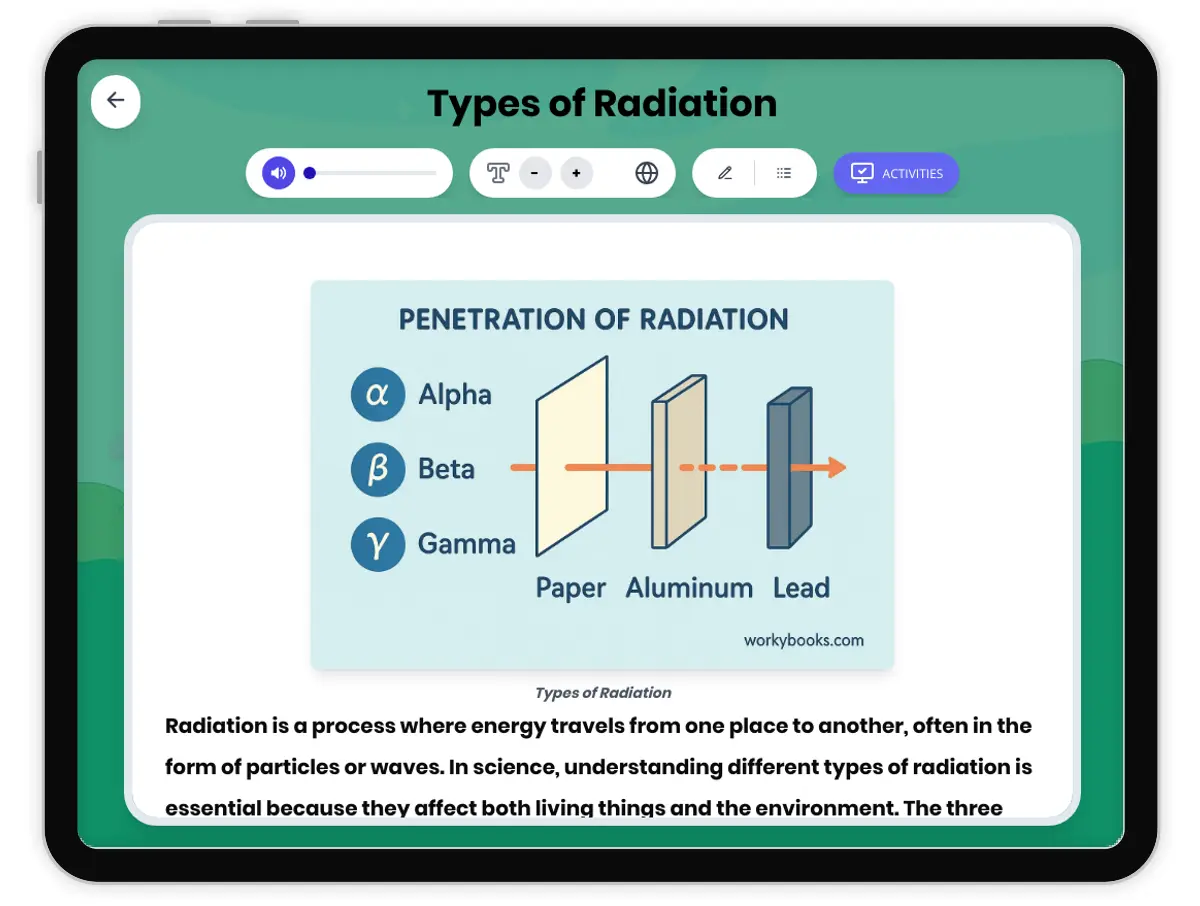
To provide context, it is helpful to compare gamma radiation with other common types of nuclear radiation. As shown in the table below, gamma radiation is unique due to its lack of both mass and charge.
| Radiation Type | Particle Composition | Rest Mass (Atomic Mass Units) | Electrical Charge | Penetrating Power |
|---|---|---|---|---|
| Alpha ($\alpha$) | 2 Protons, 2 Neutrons | ~4.0015 amu | +2 | Low (Blocked by paper) |
| Beta ($\beta^-$) | 1 Electron | ~0.000548 amu | -1 | Medium (Blocked by aluminum) |
| Gamma ($\gamma$) | 1 Photon | 0 (Massless) | 0 (Neutral) | High (Blocked by lead/concrete) |
| Neutron ($n$) | 1 Neutron | ~1.0086 amu | 0 | Very High |
Why the "Massless" Status Matters in 2026
The fact that gamma radiation has no mass is not just a theoretical curiosity; it has significant practical implications for technology and safety today.
- Speed of Propagation: Because they are massless, gamma rays travel at the maximum speed possible in the universe. In medical applications like PET scans, this allows for near-instantaneous detection of annihilation events within the body.
- Penetration Depth: Having no mass and no charge allows gamma rays to pass through the empty space within atoms more easily than alpha or beta particles. This is why thick shields of lead or several meters of concrete are required to stop them.
- Astrophysics: In 2026, deep-space telescopes like the Fermi Gamma-ray Space Telescope utilize the massless nature of gamma rays to observe events billions of light-years away. Because they travel at $c$, they are the first signals (along with neutrinos and gravitational waves) to reach us from cataclysmic cosmic events like supernova collapses or black hole mergers.
Common Misconceptions About Gamma Mass
"If it has no mass, why is it affected by gravity?"
A common question is how gravity can bend light (gravitational lensing) if photons are massless. According to General Relativity, gravity is not just a force between two masses; it is the curvature of spacetime itself. Even though a gamma ray has no mass, it must follow the curved path of spacetime created by massive objects like stars or black holes. Furthermore, because gamma rays have energy, they contribute to the stress-energy tensor, which is the source of gravity in Einstein's field equations.
"Does 'massless' mean 'nothing'?"
No. In physics, "massless" simply means the particle lacks an intrinsic property that resists acceleration in a vacuum or interacts with the Higgs field in a way that creates "drag." A gamma ray is very much a "something"—it is a packet of oscillating electric and magnetic fields carrying enough energy to damage DNA or power industrial imaging equipment.
Frequently Asked Questions
Does gamma radiation have any weight?
No, gamma radiation does not have weight. Weight is the force exerted on a mass by gravity ($W=mg$). Since the rest mass ($m$) of a gamma photon is zero, its weight is also zero. However, its energy does contribute to the total mass-energy of any system it is part of.
Can gamma radiation be weighed on a scale?
You cannot weigh a beam of gamma radiation on a traditional scale. However, if you have a sealed box and you fill it with high-energy gamma radiation, the box would technically become infinitesimally heavier to an outside observer. This is because the energy of the photons adds to the total energy of the box, and total energy has a mass equivalent ($m = E/c^2$).
Why do we say gamma rays are "particles" if they have no mass?
In quantum mechanics, the concept of a "particle" does not require mass. A particle is a "quantum" or a discrete unit of a field. For the electromagnetic field, that unit is the photon. Photons behave like particles because they can be counted and they interact with matter in localized, discrete events, despite being massless.
Is there a "limit" to how much energy a massless gamma ray can have?
Theoretically, there is no upper limit to the energy a gamma photon can carry, though the GZK limit describes interactions for ultra-high-energy cosmic rays. As energy increases, the wavelength of the gamma ray gets shorter, but it remains massless regardless of how energetic it becomes.
Practical Recommendation for Further Study
To gain a deeper understanding of how massless radiation interacts with the physical world, researchers and students should study Quantum Electrodynamics (QED). For those interested in the safety aspects of gamma radiation, the International Atomic Energy Agency (IAEA) provides extensive resources on how the energy—not mass—of gamma rays is managed in industrial and medical environments. Understanding that gamma rays are "pure energy" is the first step toward mastering the complexities of nuclear physics and radiation protection.
Image Gallery