Unraveling the Difference Between Orca and Whale: Taxonomy, Behavior, and Anatomy
The fundamental difference between an orca and a whale lies in their taxonomy: while all orcas are technically whales—belonging to the order Cetacea and the suborder Odontoceti, or toothed whales—they are specifically the largest speci...
The fundamental difference between an orca and a whale lies in their taxonomy: while all orcas are technically whales—belonging to the order Cetacea and the suborder Odontoceti, or toothed whales—they are specifically the largest species of dolphin. In common parlance, people use "whale" to refer to baleen whales or larger mysticetes, whereas the orca is an apex predator distinguished by its striking black-and-white coloration and specialized hunting strategies.
Contents
Understanding marine mammal taxonomy often brings up questions of nomenclature, particularly when popular terminology diverges from scientific classification. The relationship between orcas and other cetaceans is a prime example of this linguistic overlap. To fully grasp how these magnificent marine mammals differ, one must look closely at their biological classification, physical characteristics, social structures, and ecological niches in the world's oceans.
Biological Classification and the "Killer Whale" Misnomer
To understand the difference between an orca and a whale, one must first examine how scientists classify marine life. Both creatures belong to the order Cetacea, which includes all whales, dolphins, and porpoises. Within this order, cetaceans are divided into two main suborders:
- Mysticeti (Baleen Whales): These marine mammals possess rows of baleen plates instead of teeth to filter small prey like krill and small schooling fish from seawater. Examples include the blue whale, humpback whale, and minke whale.
- Odontoceti (Toothed Whales): These animals possess teeth and hunt individual, often larger prey. This suborder includes sperm whales, beaked whales, dolphins, porpoises, and orcas.
The orca (Orcinus orca) is classified within the family Delphinidae, making it the largest species of dolphin in the world. The common moniker "killer whale" is actually a historical mistranslation. Ancient Spanish sailors observed pods of these animals hunting larger baleen whales and referred to them as asesina de ballenas (whale killer). Over time, English speakers inverted the phrase into "killer whale," cementing a confusing title that suggests the animal is a true whale rather than a massive dolphin.
Anatomical and Physical Differences
While baleen whales and orcas share a streamlined, aquatic body plan evolved for swimming, their physical traits vary significantly. These differences reflect their distinct evolutionary paths, diets, and survival strategies in diverse marine environments.
Size and Body Shape
Baleen whales represent some of the largest animals ever to have lived on Earth. The blue whale, for instance, can reach lengths of up to 100 feet and weigh as much as 200 tons. Even smaller baleen whales, like the minke whale, typically exceed the length of most orcas.
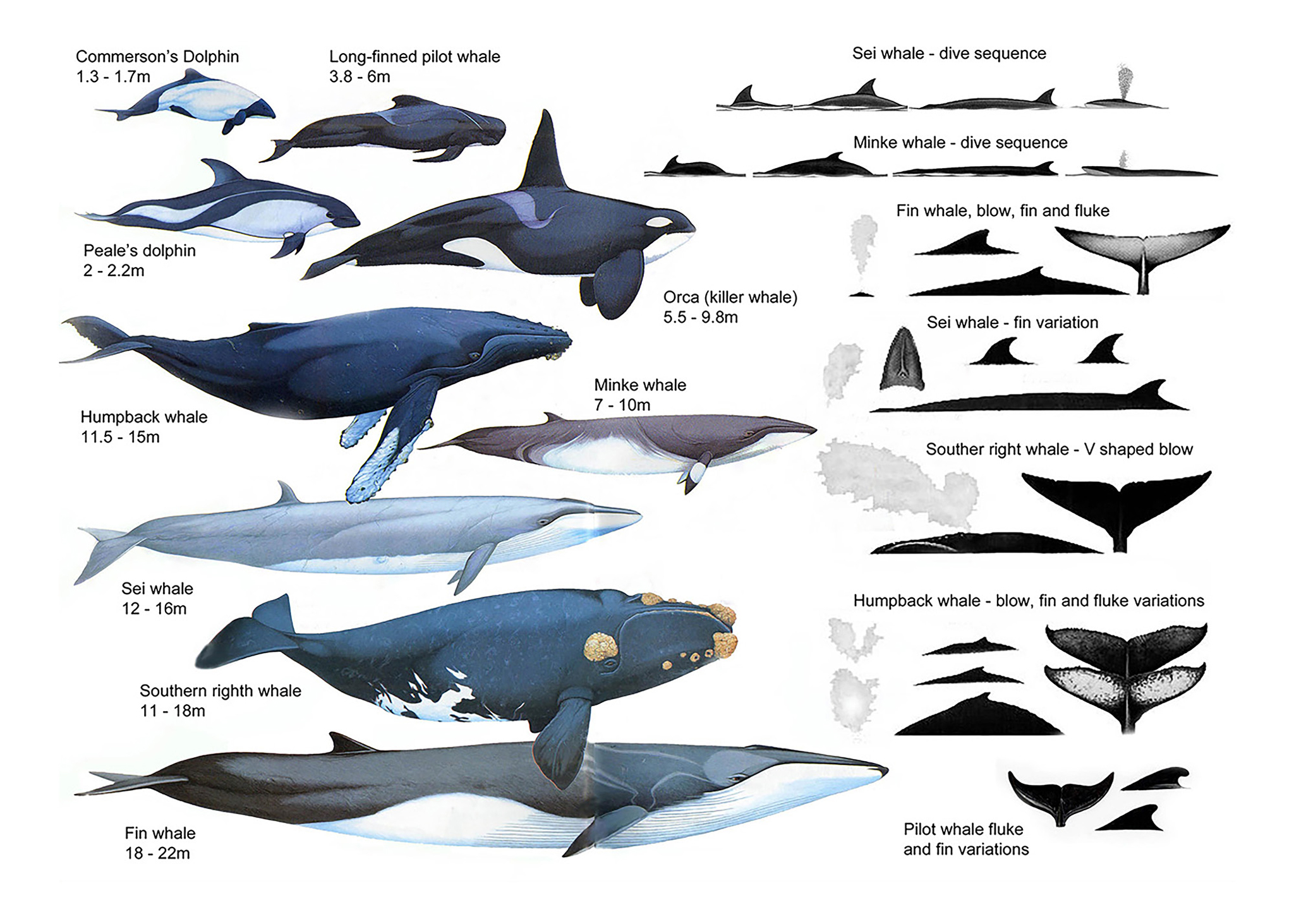
In contrast, adult male orcas generally reach lengths of 20 to 26 feet and weigh between 8 and 11 tons, while females are somewhat smaller at 16 to 23 feet and weigh 4 to 6 tons. Physically, orcas feature a prominent dorsal fin—which can grow up to 6 feet tall in adult males—along with distinct paddle-shaped pectoral flippers and a robust, muscular frame built for explosive speed and agility.
Feeding Apparatus: Teeth vs. Baleen
The most striking anatomical difference lies inside the mouth.
- Orcas possess 40 to 52 interlocking, conical teeth designed for grasping, tearing, and holding slippery or large prey, ranging from fish and squid to seals and marine mammals.
- Baleen whales lack teeth entirely. Instead, they feature keratinous plates that hang from the upper jaw. They use these plates as a giant sieve, gulping massive volumes of water and expelling it through the baleen while trapping tiny marine organisms inside.
| Feature | Orca (Orcinus orca) | Baleen Whale (e.g., Blue, Humpback) |
|---|---|---|
| Suborder | Odontoceti (Toothed Whales) | Mysticeti (Baleen Whales) |
| Family | Delphinidae (Oceanic Dolphins) | Balaenopteridae, Balaenidae, etc. |
| Average Adult Length | 20–26 feet (males) / 16–23 feet (females) | 30–100+ feet depending on species |
| Average Adult Weight | 8–11 tons (males) / 4–6 tons (females) | 10–200+ tons depending on species |
| Feeding Structure | 40–52 conical teeth for active hunting | Keratin baleen plates for filter feeding |
| Social Structure | Complex, stable matrilineal pods | Generally solitary or loose, temporary aggregations |
Social Structures and Behavioral Patterns
Behavioral ecology highlights another major division between orcas and most whale species. Orcas exhibit some of the most complex social structures in the animal kingdom, rivaling elephants and primates in terms of cultural transmission and familial bonds.
Pod Dynamics and Culture
Orcas live in tight-knit, stable family groups called pods, which are centered around a matriarch. Calves stay with their mothers for life, resulting in multi-generational pods where dialects of communication, specialized hunting techniques, and social rules are passed down from generation to generation. This represents a distinct form of non-human culture.
Conversely, most baleen whales are relatively solitary creatures or form loose, fluid aggregations. While humpback whales or right whales may gather temporarily in feeding grounds or breeding areas, they do not maintain the lifelong, permanent family structures characteristic of resident orca populations. Their vocalizations, while complex (such as the famous songs of the humpback whale), serve primarily long-range communication and mating purposes rather than coordinating cooperative hunting maneuvers within a family unit.
Hunting Strategies
As apex predators, orcas employ sophisticated, cooperative hunting tactics. Depending on their ecotype, different orca populations specialize in specific prey. Some populations hunt schooling fish using bubble rings and tail slaps to stun their quarry; others intentionally beach themselves on sloping shores to snatch sea lions from the sand, or work in synchronized waves to wash seals off ice floes.
Baleen whales, on the other hand, rely on sheer volume and passive collection of lower trophic-level organisms. Techniques like lunge-feeding—where a whale accelerates into a dense patch of krill with its mouth wide open—require immense energy expenditure but do not involve the strategic, coordinated teamwork seen among orca pods.
Distribution, Habitat, and Ecological Impact
Both orcas and whales inhabit every ocean on Earth, from the icy waters of the Arctic and Antarctic to tropical equatorial seas. However, their specific habitat preferences and ecological roles diverge based on their feeding habits.
Orcas are perhaps the most cosmopolitan mammal species after humans. While they can be found in open ocean pelagic waters, they frequently inhabit coastal marine environments, fjords, and shallow seas where prey density is high. Because they occupy the absolute top of the marine food chain, orcas exert a profound top-down influence on marine ecosystems, regulating the populations of seals, sea lions, sharks, and even other cetaceans.
Baleen whales are also wide-ranging, often undertaking monumental migrations between polar feeding grounds (rich in krill during the summer months) and tropical breeding grounds (where they give birth during the winter). Their ecological impact is famously linked to the "whale pump"—a process where deep-diving baleen whales consume nutrients at depth and release nutrient-rich fecal plumes near the surface, stimulating phytoplankton growth and supporting global marine carbon sequestration.
Frequently Asked Questions
Is an orca a whale or a dolphin?
An orca is technically both. Scientifically, it is classified as a toothed whale within the order Cetacea, and more specifically, it is the largest species of oceanic dolphin belonging to the family Delphinidae. Because all dolphins are technically toothed whales, calling an orca a whale is biologically accurate, though calling it a dolphin is more specific.
Why are orcas called killer whales?
The name "killer whale" stems from historical mistranslation. Spanish sailors who observed groups of orcas hunting larger baleen whales called them asesina de ballenas (whale killers). English speakers later inverted this to "killer whale." Despite the terrifying name, orcas are not typically a threat to humans in the wild and have no history of regular predatory attacks on people.
Do orcas hunt and eat other whales?
Yes, certain populations of orcas—known as transient or Bigg's orcas—specialize in hunting marine mammals, including seals, sea lions, walruses, and occasionally large baleen whales like gray whales, minke whales, and even blue whale calves. They hunt cooperatively to exhaust and overwhelm these massive animals.
How can you tell the difference between an orca and a whale at sea?
The easiest way to tell an orca apart from most whales at sea is by its distinct visual markers: a prominent, tall black dorsal fin (which can reach up to 6 feet in males) and striking, high-contrast black-and-white coloration with a white patch just behind the eye. Most baleen whales lack such stark coloration and feature smaller, more curved dorsal fins set much further back on their bodies.
Do orcas have baleen?
No, orcas do not have baleen. They are toothed whales (Odontocetes) and possess strong, conical teeth designed for catching and tearing prey. Baleen whales (Mysticetes) are the only cetaceans that possess keratin baleen plates for filter-feeding on small organisms like krill and copepods.
Conclusion and Next Actions
While the casual interchange of the terms "orca" and "whale" is common in everyday conversation, recognizing the biological reality reveals a fascinating distinction. Orcas are specialized, highly intelligent apex predators belonging to the dolphin family, whereas "whale" typically conjures images of massive filter-feeding baleen giants or other specialized toothed species. For marine conservation enthusiasts, researchers, and wildlife observers, understanding these anatomical, social, and taxonomic differences provides a deeper appreciation for the complex biodiversity of our planet's oceans. If you plan to observe these animals in the wild, consult local eco-tourism guidelines that promote responsible whale and dolphin watching to ensure minimal disruption to their natural behaviors.
Image Gallery