Why the Best Condo and Auto Insurance Bundle Often Favors Renters with Cars
Bundling condo and auto insurance policies allows policyholders to leverage multi-policy discounts, typically resulting in lower premiums for both coverages compared to purchasing them separately. For renters who own condos and maintai...
Bundling condo and auto insurance policies allows policyholders to leverage multi-policy discounts, typically resulting in lower premiums for both coverages compared to purchasing them separately. For renters who own condos and maintain an active vehicle policy, this strategy simplifies administrative management while simultaneously minimizing the total annual cost of risk transfer for their primary personal assets.
Contents
The Mechanics of the Multi-Policy Discount
Insurance companies operate on the principle of risk pooling. When a single carrier assumes the risk for two different aspects of your life—your physical residence and your primary mode of transportation—the administrative burden on the insurer decreases. This efficiency is passed on to the consumer, primarily through the multi-policy discount, often referred to as a "bundling" discount.
In the context of condo insurance (which covers the interior elements, personal property, and liability within your unit) and auto insurance (which covers liability, collision, and comprehensive losses), the discount is not merely a marketing gimmick. It is a strategic pricing mechanism. Insurers view customers who bundle policies as "sticky" clients, meaning they are statistically less likely to switch providers. By incentivizing you to consolidate your policies, the company secures a longer-term relationship, which they reward with a percentage-based reduction on the premiums of both policies.
For a condo owner, this is particularly advantageous. Condo insurance policies are often subject to specific master policy considerations (where the HOA covers the building exterior and common areas). By adding an auto policy to this specialized coverage, you optimize the cost-efficiency of a policy that might otherwise be seen as a low-margin product for the insurer.
Risk Management and Liability Synchronization
One of the most nuanced benefits of bundling is the harmonization of liability protection. Your condo insurance policy includes personal liability coverage, which protects you if someone is injured within your unit or if you accidentally cause damage to a neighbor’s property. Similarly, auto insurance provides liability coverage for incidents occurring on the road.
When you bundle these with the same carrier, you reduce the likelihood of "coverage gaps." While the policies remain distinct contracts, your insurance agent has a holistic view of your risk profile. They can ensure that your personal umbrella policy—if you choose to carry one—is correctly integrated with both your home and auto underlying limits. If you have different carriers for your condo and car, it can become significantly more difficult to verify that your underlying liability limits meet the requirements for a personal umbrella policy, potentially leaving you exposed during a high-stakes litigation event.
Financial and Administrative Efficiency
Maintaining a single point of contact simplifies life, particularly during the 2026 fiscal cycle where time management and financial consolidation are priorities for many households. The advantages of centralizing your insurance portfolio include:
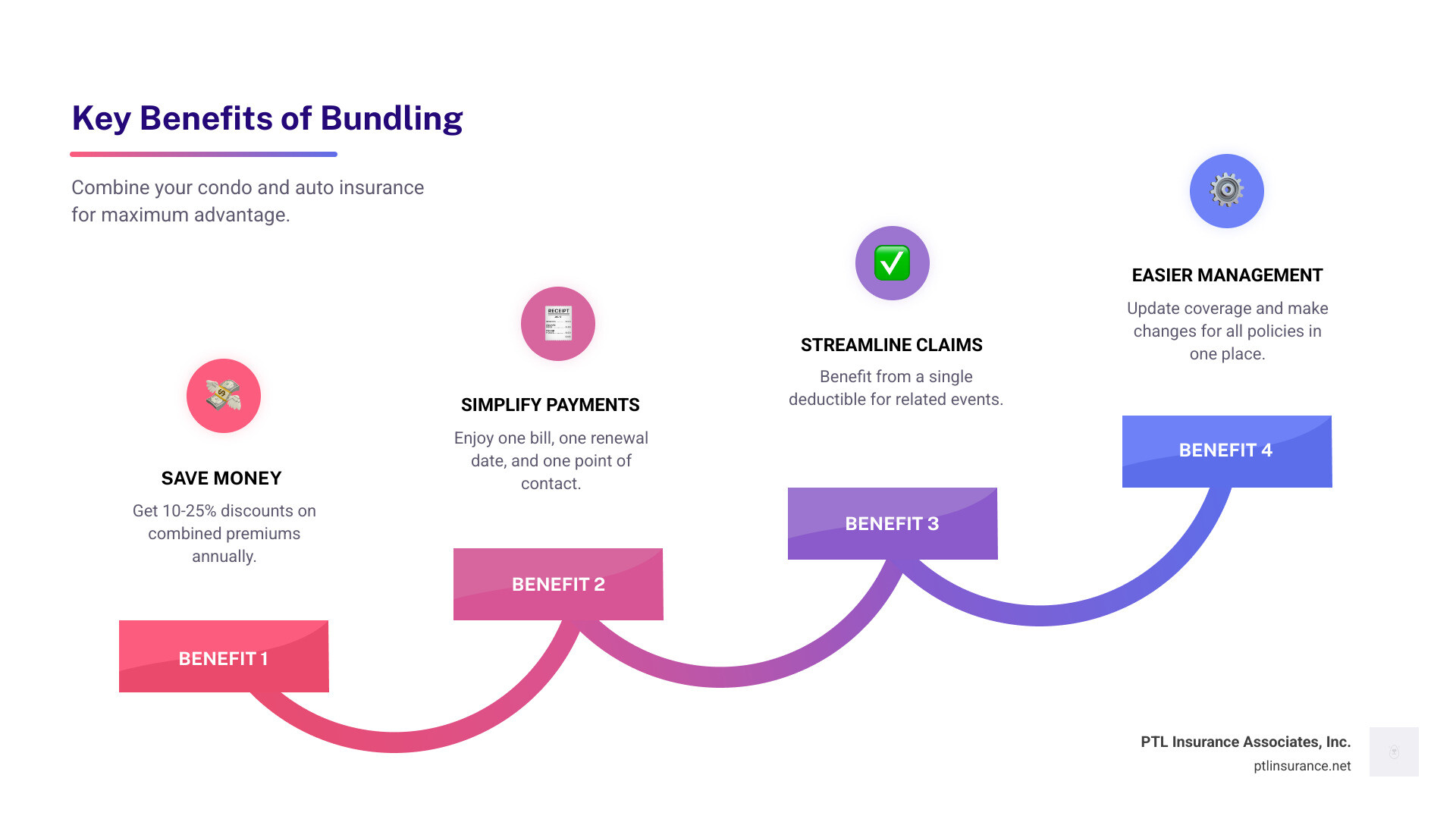
- Simplified Billing Cycles: Instead of tracking disparate renewal dates and payment schedules, a bundled policy typically offers a unified billing date, reducing the risk of accidental policy lapses due to missed payments.
- Single Claims Point of Contact: In the event of a catastrophic incident that affects both your condo (e.g., a burst pipe causing water damage) and your vehicle (e.g., a flooded garage), having a single claims department simplifies the coordination of adjusters and repair estimates.
- Unified Deductibles: Some modern insurance carriers offer "disappearing deductibles" or credits that apply more effectively when your total account value with the insurer exceeds a certain threshold, a status easier to reach through bundling.
Comparing Bundled vs. Monoline Coverage
To understand the financial impact, it is useful to look at the differences between consolidated and fragmented coverage models. While monoline policies (buying from different companies) might theoretically offer a lower price for one specific item, the cumulative cost of two separate policies rarely beats a well-negotiated bundle.
| Feature | Bundled Coverage | Monoline (Separate) Coverage |
|---|---|---|
| Pricing | Multi-policy discount applied | Higher base rates per policy |
| Renewal Dates | Typically synchronized | Varies by company |
| Claims Handling | Centralized oversight | Independent processes |
| Account Management | One login, one portal | Multiple accounts to manage |
| Liability Integration | Simplified for umbrella policies | Complex verification required |
Evaluating the Suitability of Bundling
While bundling is generally the superior financial choice, it is not a universal rule. Before moving both policies to a single carrier, consider these critical evaluation factors:
- Underwriting Requirements: Ensure that the carrier’s condo insurance covers the specific requirements of your Homeowners Association (HOA) master policy. If the auto-focused insurer does not offer robust interior/loss assessment coverage for your condo, the discount may not be worth the coverage deficiency.
- State-Specific Regulations: Insurance laws vary significantly by state. Some regions have highly competitive auto markets but limited home insurance capacity. Ensure that the carrier you choose is financially stable and authorized to write policies in your specific jurisdiction.
- Claims History and Eligibility: If you have a high number of claims, some insurers may be willing to bundle you, but the combined premium might be higher than searching for a niche carrier that specializes in high-risk condo coverage.
- Asset Value: For luxury condos or high-performance vehicles, ensure the bundled carrier provides enough "replacement cost" coverage rather than "actual cash value" coverage. Replacement cost is vital for ensuring that your assets are restored to their pre-loss condition regardless of depreciation.
Navigating the 2026 Insurance Market
As of 2026, the insurance market remains in a state of adjustment. Reinsurance costs and climate-related adjustments have influenced property premiums globally. For the condo owner, this makes the bundling discount more critical than ever. In previous years, the discount might have been viewed as a convenience, but in the current high-premium environment, it functions as a necessary financial offset.
When speaking with your insurance broker or an automated underwriting system, ask specifically about the "account-level" discount. Many carriers in 2026 are shifting toward loyalty-based pricing models where the longer you stay with the company and the more products you consolidate, the deeper your loyalty rewards become. This is particularly relevant for those who plan to remain in their condo for several years.
Frequently Asked Questions
Does bundling auto and condo insurance always guarantee the lowest price? Not always. While it is the most common path to savings, a specialized insurer might offer a lower rate for a specific type of high-value condo that a general-purpose bundled carrier might overcharge for. Always compare a bundle against the best possible stand-alone quote for each policy.
What happens if I sell my car but keep the condo? The loss of the auto policy will trigger the removal of the multi-policy discount. Your condo insurance premium will likely increase at your next renewal. You should immediately look to add another qualifying policy—such as a personal articles floater for high-value items—to maintain a similar level of discounting.
Is it harder to file a claim if everything is bundled? No, it is generally easier. A single carrier can see the big picture. If a fire starts in the kitchen, they handle both the unit damage and any smoke damage that might have affected your vehicle parked in an attached garage.
Are there specific condo types that don't qualify for common bundles? Some non-standard condos, such as those with unique structural risks or commercial-use components, may require a "surplus lines" insurer that does not offer a personal auto bundle. Always verify the underwriting eligibility of your specific property type.
Should I use an agent or an online portal? For condo owners, an agent is often superior. Condo insurance requires an understanding of the "walls-in" coverage versus the HOA's "walls-out" master policy. An experienced agent can review your HOA documents to prevent over-insuring or under-insuring your unit.
Final Recommendations for Policyholders
The path to the best insurance strategy begins with a thorough review of your HOA master policy. Once you understand exactly what the association covers, you can determine the precise amount of dwelling coverage you need for your unit. Following this, reach out to your current provider to request a "bundling audit." Request a quote that specifically isolates the multi-policy discount. By presenting them with the fact that you are reviewing your options for 2026, you often encourage the carrier to apply the most favorable tiering available for your risk profile. Finally, ensure that your liability limits are unified, providing you with a seamless safety net across your home and your travels.
Image Gallery