Comprehensive Guide to Finding Help for Back Taxes Owed in 2026
If you are seeking help for back taxes owed, your primary options include setting up an IRS installment agreement, submitting an Offer in Compromise to settle for less than you owe, or requesting "Currently Not Collectible" status if y...
If you are seeking help for back taxes owed, your primary options include setting up an IRS installment agreement, submitting an Offer in Compromise to settle for less than you owe, or requesting "Currently Not Collectible" status if you are facing significant financial hardship. Resolving tax debt requires filing all delinquent tax returns before the IRS will consider any formal relief application.
Contents
The Reality of Tax Debt in 2026
Owing back taxes to the IRS or state authorities is a high-stakes financial challenge that millions of taxpayers face annually. As of 2026, the IRS has significantly enhanced its automated collection systems and data-matching capabilities, making it increasingly difficult to remain "under the radar" with unpaid balances. Tax debt is unique because, unlike most consumer debt, the government possesses extraordinary powers to seize assets, garnish wages, and place liens on property without a court order in many instances.
The total amount you owe is typically composed of three parts: the original tax assessment, accrued interest, and various penalties. In 2026, the failure-to-pay penalty remains at 0.5% of the unpaid taxes for each month or part of a month the tax remains unpaid, up to a maximum of 25%. When combined with market-based interest rates that adjust quarterly, a tax bill can grow by 8% to 12% per year simply through inaction. Understanding how to navigate the IRS bureaucracy is the first step toward reclaiming financial stability.
Prerequisites for Obtaining Tax Relief
Before you can apply for any form of help for back taxes owed, you must meet specific compliance requirements. The IRS will generally refuse to negotiate or process relief applications if the taxpayer is not "current" with their filings.
Filing All Delinquent Returns
You must file all required tax returns for the past six years. This is often referred to as being "in filing compliance." If you have unfiled returns, the IRS may have filed a Substitute for Return (SFR) on your behalf. These substitutes rarely include the deductions or credits you are entitled to, often resulting in a tax bill much higher than what you actually owe. Preparing original returns to replace these substitutes is frequently the most effective way to immediately reduce the total balance.
Current Year Compliance
If you are self-employed or have a business, you must be current on your estimated tax payments for 2026. If you are an employee, you should ensure your withholding is adjusted so that you do not incur new tax debt during the current year. The IRS views "pyramiding"—adding new tax debt while trying to pay off old debt—as a sign of bad faith, which can lead to the denial of installment agreements or settlements.
Primary IRS Resolution Options
Once you are in filing compliance, you can choose from several formal programs designed to resolve unpaid balances. The right choice depends entirely on your monthly disposable income, your total assets, and the amount of time remaining on the IRS’s 10-year statute of limitations for collection.
1. Installment Agreements (Payment Plans)
The most common way to handle back taxes is through an installment agreement. This allows you to pay your debt over a series of monthly payments.
- Streamlined Installment Agreements: For individual taxpayers owing up to $50,000, the IRS offers streamlined processing. You can typically set these up online without providing a detailed financial statement, provided the debt can be paid off within 72 months or before the statute of limitations expires.
- Partial Payment Installment Agreements (PPIA): If you cannot afford the minimum monthly payment required for a standard agreement, a PPIA allows for a lower payment based on your documented ability to pay. This requires full financial disclosure using Form 433-A or 433-F.
- Direct Debit Agreements: In 2026, the IRS strongly prefers direct debit setups. These often come with lower setup fees and a reduced risk of default, as the payment is automatically withdrawn from your bank account.
2. Offer in Compromise (OIC)
An Offer in Compromise is a formal agreement where the IRS allows you to settle your tax debt for less than the full amount you owe. This is often what "tax relief" companies refer to when they promise to settle debt for "pennies on the dollar."
To qualify, the IRS must determine that your Reasonable Collection Potential (RCP) is less than the total debt. The RCP calculation includes the equity in your assets (homes, cars, bank accounts) plus your projected future income over a 12-month or 24-month period, minus "necessary living expenses." The IRS uses national and local standards to determine what constitutes a necessary expense, which may be lower than your actual spending.
3. Currently Not Collectible (CNC) Status
If you are experiencing severe financial hardship, you can request that your account be placed in Currently Not Collectible status. This does not erase the debt, but it does stop active collection efforts like wage garnishments and bank levies. To qualify, you must demonstrate that paying the IRS would prevent you from meeting basic living expenses such as food, utilities, and rent. The IRS will review your status periodically (usually annually or biannually) to see if your financial situation has improved.
Summary of Tax Relief Options
The following table compares the most common methods for resolving back taxes in 2026.
| Option | Best For | Requirement | Impact on Debt |
|---|---|---|---|
| Full Payment | Those with liquid assets | Immediate payment of total | Stops all interest and penalties immediately. |
| Streamlined IA | Debts under $50,000 | 72-month payoff term | Debt paid in full; interest continues to accrue. |
| Offer in Compromise | Those with low income/assets | Proof of inability to pay | Settles debt for a fraction of the balance. |
| Hardship (CNC) | Severe financial crisis | Detailed Form 433-A | Temporarily stops collections; debt remains. |
| Penalty Abatement | Good history, one-time error | Reasonable cause or first-time | Removes specific penalties; tax/interest remains. |
Managing Penalties and Interest
One of the most frustrating aspects of back taxes is seeing the balance grow despite making payments. However, there are specific mechanisms to reduce these additions.
First-Time Penalty Abatements
The IRS offers a "First-Time Abate" (FTA) administrative waiver. If you have a clean compliance history for the three years prior to the tax year in question, you can often have failure-to-file and failure-to-pay penalties removed simply by asking. This is a one-time relief option that does not require a showing of financial hardship.
Reasonable Cause
If you do not qualify for an FTA, you may still get help for back taxes owed by demonstrating "Reasonable Cause." This requires proving that you exercised ordinary business care and prudence but were still unable to file or pay on time due to circumstances beyond your control. Examples include:
- Death or serious illness of an immediate family member.
- Destruction of records due to a fire, flood, or natural disaster.
- Inability to obtain records despite significant effort.
It is important to note that "lack of funds" is generally not considered reasonable cause for failure to file, though it may be considered for failure to pay if you can show that paying the tax would have resulted in undue hardship.
Professional Representation: When to Seek Help
While many taxpayers can set up simple installment agreements themselves via the IRS.gov Online Payment Agreement tool, complex cases often require professional intervention.
Enrolled Agents (EAs) and CPAs
Enrolled Agents are federally authorized tax practitioners who have technical expertise in the field of taxation and are empowered by the U.S. Department of the Treasury to represent taxpayers before all administrative levels of the IRS. CPAs (Certified Public Accountants) also provide high-level representation, particularly when the tax debt involves complex business entities or forensic accounting.
Tax Attorneys
If your case involves potential criminal charges, such as tax evasion or willful failure to file, you should consult a tax attorney. Unlike CPAs or EAs, communications with an attorney are protected by attorney-client privilege, which is broader than the limited practitioner-client privilege provided under IRC Section 7525.
Avoiding "Tax Relief" Scams
The Federal Trade Commission (FTC) frequently issues warnings about companies that promise to reduce tax debt to almost nothing. Be wary of any firm that asks for a large upfront fee without first performing a detailed analysis of your financial situation. Legitimate help for back taxes owed always begins with an investigation of your IRS transcripts and a thorough review of your income and assets.
Frequently Asked Questions
Does the IRS ever stop trying to collect back taxes? Yes. The IRS has a statutory period of 10 years to collect unpaid taxes, known as the Collection Statute Expiration Date (CSED). After 10 years, the debt is generally extinguished and becomes legally uncollectible. However, certain actions—such as filing for bankruptcy, applying for an Offer in Compromise, or requesting an appeal—can "toll" or pause this clock, giving the IRS more time to collect.
Can back taxes affect my passport? Yes. Under the Fixing America's Surface Transportation (FAST) Act, the IRS can notify the State Department of taxpayers who have a "seriously delinquent tax debt," which is generally defined as an amount exceeding $62,000 (adjusted for inflation in 2026). If certified, the State Department can deny a new passport application or revoke an existing one.
Will the IRS take my house? While the IRS has the authority to seize a primary residence, it is a remedy of last resort. Seizing a home requires a court order and approval from a high-ranking IRS official. The IRS prefers to work out payment plans or place a federal tax lien on the property, which ensures they get paid if the house is sold or refinanced.
How do state back taxes differ from federal back taxes? State tax agencies often have more aggressive collection tactics than the IRS. Many states can revoke professional licenses, driver's licenses, or even professional certifications if you owe back taxes. Furthermore, states do not always follow the same settlement (Offer in Compromise) rules as the IRS, so you must negotiate with your state’s Department of Revenue separately.
Is interest on back taxes tax-deductible? For individual taxpayers, interest paid on personal back taxes is generally not deductible. This differs from business-related tax debt, where interest might be considered a deductible business expense in specific circumstances. You should consult a tax professional for guidance on your specific 2026 tax filing.
Next Steps for Resolution
If you are overwhelmed by tax debt, the first and most important action is to communicate with the IRS. Ignoring notices will not stop the process; it will only accelerate the move toward levies and seizures.
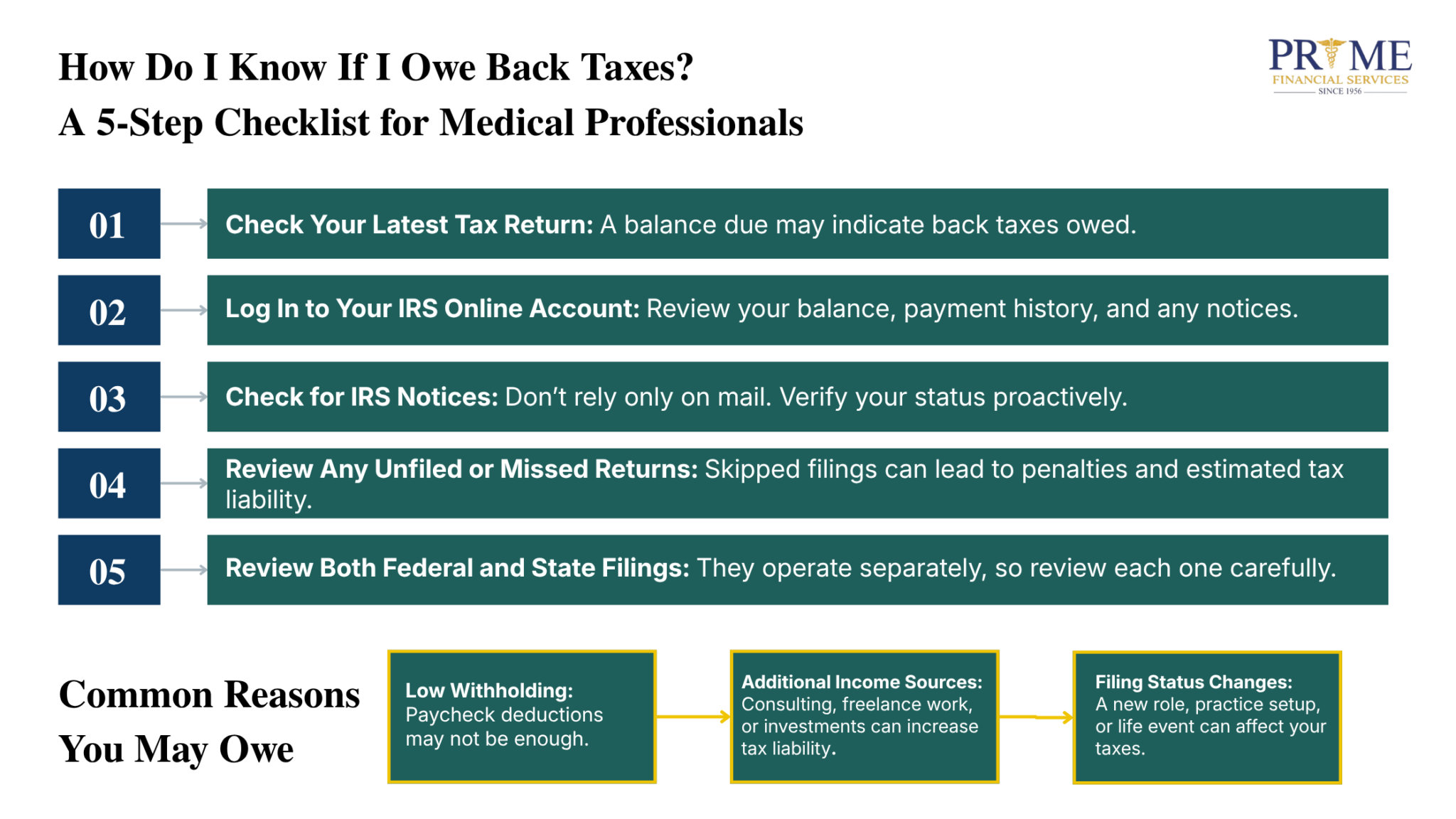
- Request your transcripts: Download your "Account Transcript" from the IRS website to see exactly what you owe, what penalties have been assessed, and how much time remains on the statute of limitations.
- File missing returns: Prioritize the last six years of returns to bring your account into compliance.
- Evaluate your budget: Determine your "allowable living expenses" using the IRS National Standards to see which resolution program fits your reality.
- Submit a proposal: Whether it is an online installment agreement or a formal Offer in Compromise, getting a proposal on file can often pause active collection activities while the IRS reviews your case.
Image Gallery