Personal Laser Hair Removal: What Works and Who Benefits
Personal laser hair removal uses focused light energy or intense pulsed light to target hair follicle melanin, significantly reducing unwanted body and facial hair from home. While high-contrast combinations of dark hair and light skin...
Personal laser hair removal uses focused light energy or intense pulsed light to target hair follicle melanin, significantly reducing unwanted body and facial hair from home. While high-contrast combinations of dark hair and light skin achieve the most dramatic results, modern devices with advanced sensors and adjustable wavelengths have broadened suitability for a wider range of skin tones.
Contents
Disclaimer: This guide is for informational purposes and does not substitute for professional dermatological advice. Individual skin reactions, medical conditions, and device specifications vary.
Understanding the Technology: How At-Home Light Devices Work
At-home hair removal devices operate on the principle of selective photothermolysis. This process transmits specific light wavelengths through the skin surface to be absorbed by melanin, the pigment located in the hair shaft and follicle matrix. As melanin absorbs this optical energy, it converts into thermal energy, heating the hair follicle to a temperature that disrupts its growth mechanism without damaging surrounding skin tissue.
To evaluate what works in personal hair removal, it is essential to distinguish between the two primary technologies used in consumer devices:
1. Intense Pulsed Light (IPL)
IPL devices emit a broad spectrum of non-coherent light wavelengths, typically ranging from 500 to 1,200 nanometers. Optical filters cut off shorter, damaging ultraviolet wavelengths, allowing targeted red and near-infrared light to penetrate the dermis. Because IPL scatters light over a wider area rather than firing a focused beam, it operates at lower peak fluences (energy density measured in Joules per square centimeter, or $\text{J/cm}^2$) than clinical machines. This lower intensity ensures consumer safety while still delivering enough thermal disruption over multiple sessions to impede follicle activity.
2. True Diode Lasers
At-home diode laser devices emit a single, highly coherent wavelength of monochromatic light (usually around 810 nanometers). Unlike IPL, a diode laser directs energy straight down the hair shaft with minimal dispersion. This precise energy delivery allows diode devices to target deeper follicles effectively. However, true diode handheld devices generally feature smaller treatment windows, requiring more time to treat larger body areas such as legs or back.
Selective Photothermolysis Process:
- Light Energy (IPL / Diode)
- Melanin Absorption
- Thermal Conversion
- Follicle Disruption
- Anagen Phase Suppression
- Hair Reduction
Who Benefits Most: Candidate Selection and Skin-Tone Matching
The effectiveness and safety of personal laser hair removal depend heavily on the contrast between hair pigment (eumelanin) and skin pigment (melanin in the epidermis). Dermatology uses the Fitzpatrick Skin Phototype Scale to classify skin tones based on their reaction to ultraviolet radiation and pigment density.
Fitzpatrick Scale Overview:
- Type I: Very fair, burns easily, never tans (e.g., pale white, freckles)
- Type II: Fair, burns easily, tans minimally
- Type III: Medium, burns moderately, tans gradually (e.g., beige, light olive)
- Type IV: Olive/Brown, burns minimally, tans easily (e.g., moderate brown)
- Type V: Dark Brown, rarely burns, tans profusely
- Type VI: Deeply Pigmented / Black, never burns
Ideal Candidates
- Dark Hair on Light-to-Medium Skin (Fitzpatrick Types I–IV): The high concentration of melanin in dark brown or black hair paired with low melanin in the surrounding skin allows maximum energy absorption by the hair shaft. This minimizes skin heating while maximizing follicular destruction.
- Coarse, Dense Hair: Thicker hair shafts contain larger melanin targets, absorbing thermal energy more efficiently than fine, vellus hair ("peach fuzz").
Moderate Candidates
- Medium-Dark Skin Tones (Fitzpatrick Types IV–V): Individuals with olive to dark brown skin can use specific FDA-cleared IPL or diode devices equipped with active skin-tone sensors. These sensors automatically calibrate energy output to prevent epidermal burns. Lower fluence settings are required, which may extend the total number of sessions needed to see results.
Ineligible Candidates
- Light Blonde, Red, Grey, or White Hair: These hair colors lack sufficient eumelanin (red hair contains pheomelanin, which does not absorb standard laser wavelengths efficiently; grey and white hair lack pigment entirely). Without melanin to absorb the light, the energy passes through without destroying the follicle.
- Deeply Pigmented Skin (Fitzpatrick Type VI): Traditional consumer IPL and high-fluence laser devices pose significant risks of hyperpigmentation, hypopigmentation, blistering, or scarring on deeply pigmented skin because the surface melanin competes with the follicle for light energy. Specialized clinical lasers, such as long-pulse Nd:YAG (1064 nm), remain the safest option for Fitzpatrick Type VI skin and should be performed by licensed practitioners.
What Works: Expected Timelines and Maintenance Realities
A common misconception is that personal devices deliver instantaneous, 100% permanent hair removal after a few uses. According to guidelines from the U.S. Food and Drug Administration (FDA regulations on OTC light-based hair removal devices), consumer devices are cleared for permanent hair reduction, defined as the long-term, stable reduction in the number of regrowing hairs after a treatment regimen.
The Hair Growth Cycle Factor
Light energy only destroys hair follicles that are actively in the anagen phase (the growth period when the hair shaft is attached to the follicle bulb). At any given time, only 15% to 30% of body hair is in the anagen phase. The remaining hairs are in transitional (catagen) or resting (telogen) phases, during which light absorption does not cause permanent damage.
Consistent, repeated treatments spaced over several weeks are required to catch every follicle as it enters the active growth window.
Hair Growth Stages:
- Anagen (Active Growth): Optimal Target for Light Energy
- Catagen (Transition): Detaching Shaft; Reduced Absorption
- Telogen (Resting/Shedding): No Active Target; Ineffective Phase
Realistic Treatment Timeline
- Weeks 1 to 4 (Initial Phase): Treatments conducted every 1 to 2 weeks. Hair continues to grow normally at first, but treats begin to weaken internal root structures. Shedding usually begins around week 3 or 4.
- Weeks 5 to 8 (Transition Phase): Noticeable slowing of hair regrowth. Remaining hairs become finer, lighter, and sparse. Treatments continue bi-weekly.
- Weeks 9 to 12 (Results Phase): Up to 70% to 80% reduction in visible hair density across suitable treatment areas. Hair that regrows appears as faint, slow-growing vellus strands.
- Maintenance Phase (Ongoing): Touch-up sessions are typically performed once every 1 to 3 months to treat newly awakened follicles and preserve smooth skin.
Comparative Matrix: At-Home Light Devices vs. Clinical Treatments
Choosing between personal light-based hair removal devices and professional clinical procedures depends on budget, target body area, skin tone, and desired convenience.
| Feature / Criteria | At-Home IPL Devices | At-Home Diode Lasers | In-Clinic Professional Lasers |
|---|---|---|---|
| Primary Technology | Broadband Pulsed Light (500–1200 nm) | Monochromatic Diode (810 nm) | Alexandrite (755 nm), Diode (810 nm), Nd:YAG (1064 nm) |
| Max Energy Density (Fluence) | 3 to 7 $\text{J/cm}^2$ | 7 to 20 $\text{J/cm}^2$ | 10 to 50+ $\text{J/cm}^2$ |
| Fitzpatrick Suitability | Types I–IV (Select Type V with sensors) | Types I–IV | Types I–VI (Including dark & tanned skin via Nd:YAG) |
| Hair Color Efficacy | Dark Brown, Black | Dark Brown, Black | Dark Brown, Black (Limited efficacy for dark blonde in clinic) |
| Treatment Speed | Fast (Wide window, flash modes) | Moderate (Small spot size) | Fast to Moderate (High-speed professional handpieces) |
| Average Initial Regimen | 8 to 12 weekly/bi-weekly sessions | 6 to 10 bi-weekly sessions | 6 to 8 sessions spaced 4–8 weeks apart |
| Typical Hair Reduction | 60% to 80% reduction | 70% to 85% reduction | 80% to 95% reduction |
| Typical Cost Range | $200 – $500 (One-time device purchase) | $400 – $600 (One-time device purchase) | $1,500 – $4,000+ (Full multi-session series) |
Safety Guidelines, Preparation, and Best Practices
Operating personal laser or IPL devices safely requires strict adherence to preparation protocols and awareness of potential contraindications.
Essential Preparation Steps
- Shave the Target Area: Shave the treatment site 12 to 24 hours prior to your session. Shaving leaves the hair root intact inside the follicle while removing surface hair that could absorb light energy, burn the epidermal layer, or damage the device window.
- Cleanse thoroughly: Ensure the skin is completely free of lotions, deodorants, self-tanners, oils, and topical makeup.
- Avoid Epilation and Waxing: Do not wax, pluck, sugar, or use chemical depilatories for at least 4 weeks before treatment. These methods remove the hair root entirely, leaving no melanin target for the light energy.
- Conduct a Patch Test: Perform a single flash test at the target energy setting on a small, discreet patch of skin 24 to 48 hours before treating a full body area to check for adverse reactions.
Key Contraindications and Cautions
- Active Tattoos or Permanent Makeup: Never flash light energy over tattooed skin or dark permanent makeup. The heavy ink pigments absorb excessive light energy, causing severe thermal burns, blistering, and ink distortion.
- Recent Sun Exposure: Tanned skin has elevated epidermal melanin levels, increasing the risk of surface burns and post-inflammatory hyperpigmentation. Suspend treatments for 2 to 4 weeks after intense sun exposure.
- Pregnancy and Nursing: Clinical safety testing for light-based hair removal devices is rarely conducted on pregnant or nursing individuals; usage is generally advised against due to hormonal fluctuations affecting hair patterns.
- Photosensitizing Medications: Avoid using devices while taking medications that increase light sensitivity, such as isotretinoin (Accutane), tetracycline antibiotics, or topical retinoids on the treatment site. Consult clinical references via the National Center for Biotechnology Information (NCBI) regarding photosensitizing drug interactions.
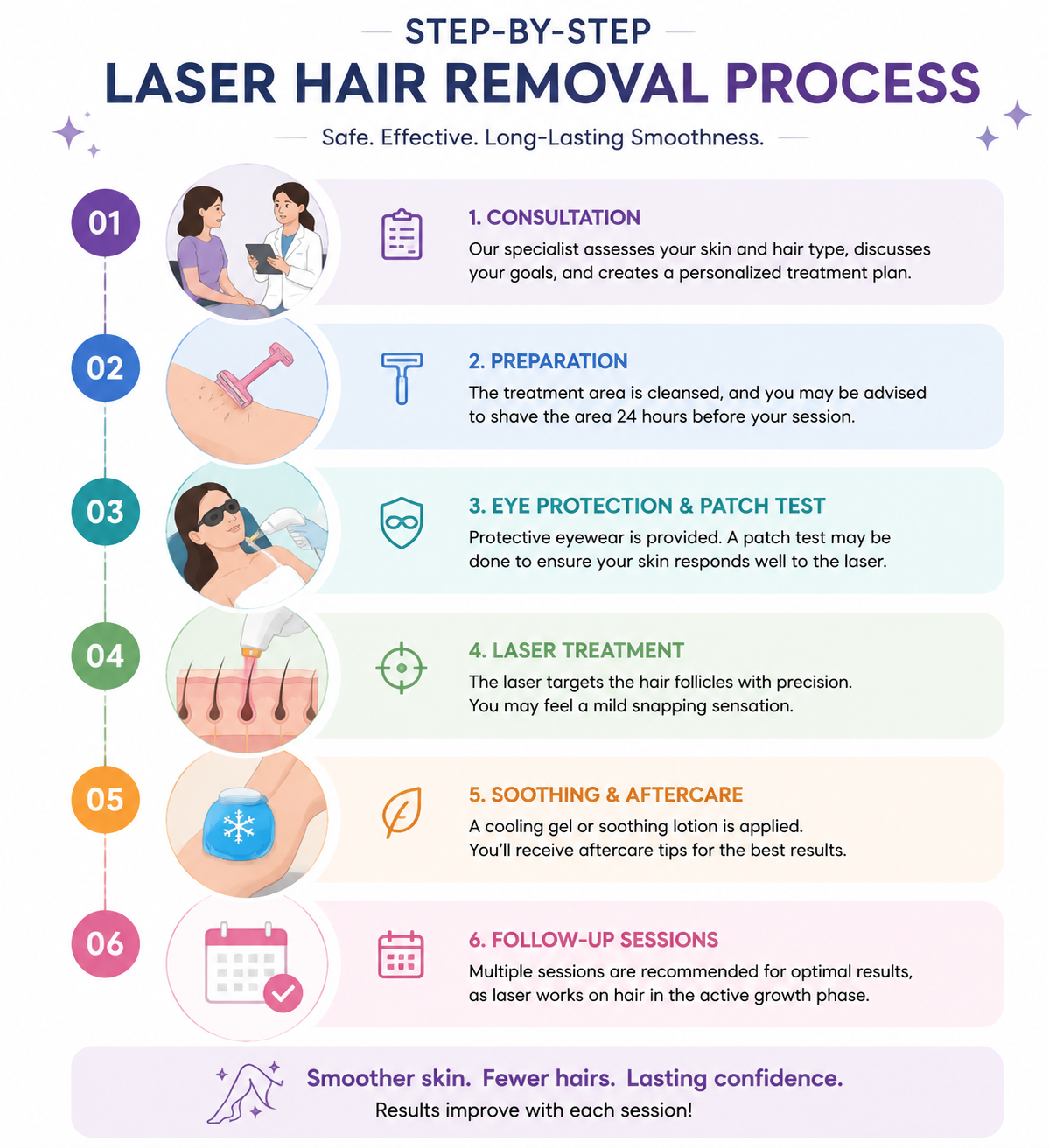
Step-by-Step Treatment Protocol
Follow this standard procedure to maximize efficacy and safety during a personal hair removal session:
Prep Skin: Shave area 12-24 hours prior; dry and clean skin.
Eye Protection: Wear safety glasses rated for the device's light spectrum.
Power & Sensor: Connect device; allow integrated skin sensor to scan area.
Grid Treatment: Place window flat against skin; flash once; move in a grid pattern.
Post-Care: Apply soothing aloe gel; avoid hot showers and direct sun for 24h.
Safety Eyewear: Put on protective eye goggles specifically rated for IPL or laser wavelengths to block intense flashes, even if the device includes built-in skin-contact safety switches.
Device Contact: Hold the device window flat against the skin at a 90-degree angle. Most modern units feature contact sensors that block flashes unless full contact is made.
Systematic Application: Work across the treatment area in a uniform grid pattern, overlapping flash zones by no more than 10%. Avoid flashing the exact same spot multiple times in a single session, as this increases heat buildup without improving results.
Post-Treatment Care: Apply pure aloe vera gel or a light, fragrance-free moisturizer to cool treated skin. Avoid hot tubs, saunas, heavy exercise, and direct sun exposure for 24 to 48 hours post-treatment. Always apply a broad-spectrum SPF 30+ sunscreen on exposed treated areas.
Frequently Asked Questions
Does personal laser hair removal hurt?
Most users describe the sensation as a light snap, similar to a rubber band against the skin, accompanied by a warm sensation. Pain levels depend on the energy setting, personal pain tolerance, and the area being treated. Sensitive areas with dense hair roots, such as the bikini line or underarms, may feel more tender than the legs or arms.
Can at-home devices be used on facial hair?
Yes, but only on areas below the cheekbones, such as the upper lip, chin, and jawline. Personal devices must never be used near the eyes, eyebrows, or forehead due to the risk of permanent optical damage from stray high-intensity light flashes. Men should exercise caution when treating dense beard areas, as high follicle density can cause concentrated heat and discomfort.
Why is hair still growing after 3 or 4 sessions?
Hair growth occurs in asymmetric cycles. Light energy only impacts hair during its active growth (anagen) stage. Shedding of damaged follicles often takes 1 to 2 weeks post-treatment, and resting follicles will gradually emerge over time. Visible reduction generally becomes clear after 6 to 8 consistent treatments.
Are at-home laser hair removal results permanent?
At-home devices achieve permanent hair reduction, not complete, lifelong eradication. While up to 80% of active follicles can be rendered dormant, hormonal shifts, aging, or reactivation of resting follicles over time may cause fine, sparse hairs to return. Periodic maintenance treatments every few months are normal and necessary to maintain smooth results.
Is at-home hair removal safe for dark skin?
It depends on the specific device and skin tone. Fitzpatrick Type VI skin should avoid standard consumer IPL and laser devices due to high risks of burning. Individuals with Fitzpatrick Type IV or V skin must select devices specifically cleared for darker skin tones that feature integrated skin-tone sensors and adjustable fluence controls.
Final Recommendation: Actionable Next Steps
Personal laser and IPL hair removal offer an accessible, cost-effective way to achieve long-term hair reduction from home. To get the best results safely, take these practical steps before buying or starting treatment:
- Evaluate Skin and Hair Suitability: Verify that your hair color contains sufficient dark pigment (black or dark brown) and that your skin tone falls within Fitzpatrick Types I–V.
- Select an FDA-Cleared Device: Choose a device with clear regulatory clearance, built-in skin-tone sensors, UV-blocking filters, and adjustable intensity settings.
- Commit to a Schedule: Plan for an initial 8-to-12-week regimen, holding sessions every 1 to 2 weeks without skipping sessions or altering pre-shaving rules.
- Consult a Professional when Unsure: If you have underlying skin conditions (such as eczema or psoriasis), a history of keloid scarring, dark skin (Fitzpatrick Type VI), or take photosensitizing medications, schedule a consultation with a board-certified dermatologist before using home light devices.
Image Gallery