Professional Golf Club Fitting in Houston, TX: Complete Guide to Fitters, Process, and Costs
Custom golf club fitting in Houston, TX matches golf equipment to an individual player's physical dimensions, swing speed, attack angle, and tempo using optical or radar launch monitors. By optimizing shaft flex, lie angle, clubhead de...
Custom golf club fitting in Houston, TX matches golf equipment to an individual player's physical dimensions, swing speed, attack angle, and tempo using optical or radar launch monitors. By optimizing shaft flex, lie angle, clubhead design, and grip size, fitters help golfers maximize distance, tighten shot dispersion, and adapt to Houston’s unique Bermuda grass turf and humid coastal climate.
Contents
Why Custom Golf Club Fitting Matters for Houston Golfers
Standard golf clubs off the rack are manufactured to generic industry specifications: typically tailored for a male golfer standing 5 feet 9 inches tall with a moderate swing speed. However, fewer than 10% of golfers naturally match standard off-the-rack dimensions. Playing with ill-fitting equipment forces golfers to make subconscious swing compensations to achieve solid contact, resulting in inconsistent ball flight, reduced distance, and unnecessary lateral curvature (slices or hooks).
In the Greater Houston metropolitan area—where golfers enjoy year-round play across more than 80 public and private courses—equipment specs must also account for distinct environmental factors. Houston's warm, humid air alters atmospheric density, while local soils predominantly feature dense, coarse Bermuda grass. A precise custom fitting ensures that club turf interaction, wedge bounce, and ball launch metrics are calibrated for optimal performance in these specific conditions.
Types of Golf Club Fitting Sessions
Golf fitting facilities across Houston offer targeted sessions depending on which part of the bag requires optimization.
1. Full Bag Fitting
A comprehensive full bag fitting examines every club from the driver down to the putter. Over a session lasting three to four hours, the fitter analyzes distance gapping across all clubs to ensure consistent yardage increments (typically 10 to 15 yards between irons, and proper spacing between fairway woods, hybrids, and wedges).
2. Driver and Wood Fitting
Focusing on the top end of the bag, driver and fairway wood fittings aim to maximize total distance while minimizing dispersion off the tee. Fitters evaluate clubhead loft, center of gravity (CG) settings, shaft weight, torque, and bend profile to achieve an optimal blend of launch angle and spin rate (typically aiming for 2,000–2,600 RPM of backspin for drivers depending on swing speed).
3. Iron Fitting
Iron fittings emphasize consistency, turf interaction, and landing angle. Key metrics include shaft weight (ranging from light 55-gram graphite to heavy 130-gram steel), lie angle (which controls direction at impact), and loft profile (game-improvement, players' distance, or tour cavity). Fitters select sole widths and bounce configurations suited to your attack angle and typical turf conditions.
4. Wedge Fitting
Wedge fitting is crucial for Houston golfers due to tight Bermuda lies and varied bunker sand conditions. A proper wedge session determines the ideal loft structure, bounce angle (low, mid, or high), and sole grind (such as C-grind, S-grind, or D-grind). The goal is to allow clean contact on tight fairway lies without digging excessively on softer greenside turf.
5. Putter Fitting
Putter fittings use motion analysis platforms such as SAM PuttLab or Quintic Ball Roll to measure face angle at impact, stroke tempo, rotation, and launch dynamics. Customizing length, lie angle, loft (usually 2 to 4 degrees), offset, and grip geometry ensures consistent forward roll and alignment accuracy.
Step-by-Step Breakdown of the Fitting Process
- Static Measurements & Interview
- Height, wrist-to-floor, hands size, skill level, miss patterns, goals.
- Baseline Data Collection
- Measure current clubs on launch monitor (spin, launch, path, speed).
- Shaft Profile Optimization
- Test shaft weight, flex, kick point, and torque for optimal load/tempo.
- Clubhead & Feature Matching
- Adjust loft, lie angle, weighting, and head shape for optimal flight.
- Final Blueprinting & Ordering
- Confirm grip size, swingweight, set gapping, and build specs.
Step 1: Player Interview and Static Measurements
The session begins with a detailed interview covering your playing history, physical limitations, typical shot patterns, miss tendencies (e.g., push-slice or pull-hook), and targeted goals. Static measurements are taken, including overall height, wrist-to-floor measurement, and hand size to establish initial starting points for club length, lie angle, and grip size.
Step 2: Baseline Data Collection
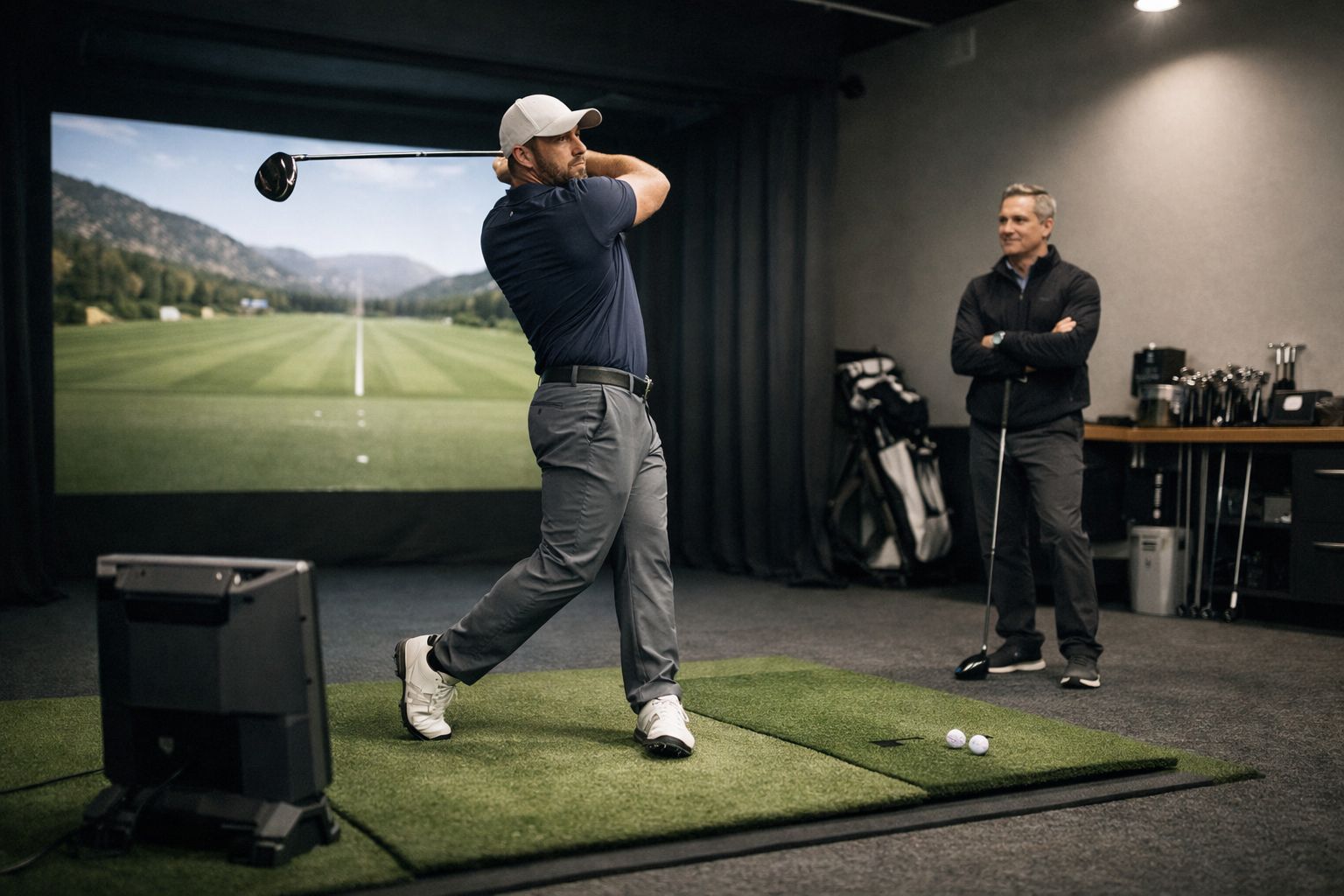
The golfer hits 5 to 10 shots with their current baseline equipment while an optical launch monitor (such as Foresight GCQuad) or a 3D Doppler radar unit (such as TrackMan 4) records baseline performance metrics:
- Clubhead Speed: Speed of the clubhead immediately prior to impact.
- Ball Speed: Initial velocity of the golf ball after leaving the face.
- Smash Factor: Ratio of ball speed to clubhead speed (measuring energy transfer efficiency).
- Launch Angle: Vertical angle of the ball's trajectory relative to the horizon.
- Spin Rate: Backspin measured in revolutions per minute (RPM).
- Attack Angle: Upward or downward angle at which the clubhead strikes the ball.
Step 3: Shaft Optimization
The fitter isolates the shaft variable first using interchangeable hosel systems. By maintaining a single clubhead profile, the fitter tests different shaft weights (e.g., 50g vs. 70g for drivers), flex profiles (Regular, Stiff, Extra Stiff), and bend points (low-launch vs. high-launch). Matching shaft weight to a golfer's natural transition and tempo stabilizes face angle at impact and improves center-face contact.
Step 4: Clubhead and Lie Angle Selection
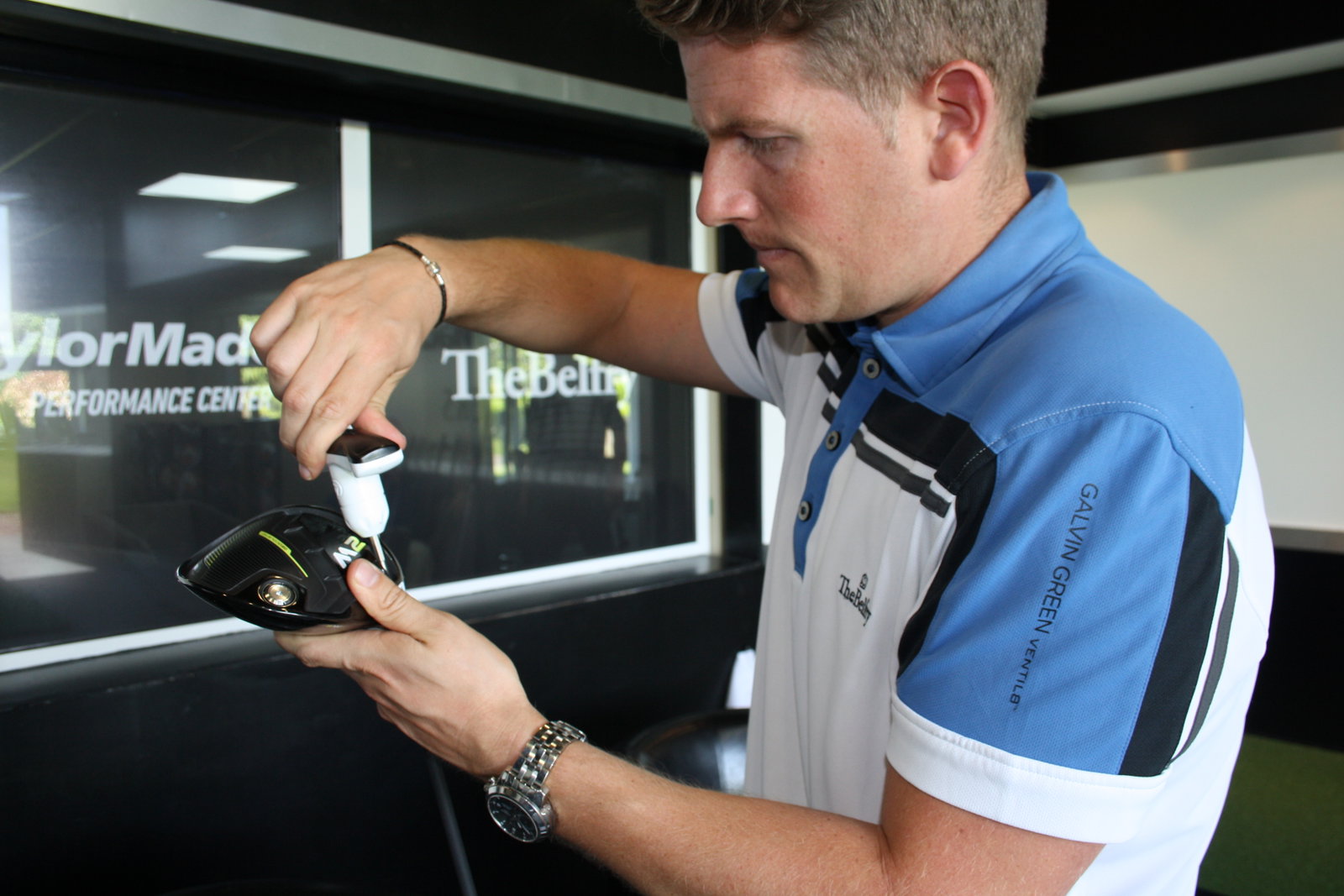
Once the shaft is locked in, the fitter tests various clubheads from top manufacturers (such as Titleist, Callaway, TaylorMade, PING, Mizuno, and Cobra). Adjustable weight ports, hosel loft sleeve settings, and lie angles are modified. Dynamic lie angle—checked using impact tape or camera data—ensures the sole enters the turf level. If a lie angle is too upright, shots tend to start left of the target; if too flat, shots tend to leak right.
Step 5: Fine-Tuning Build Specifications and Gapping
The fitter confirms grip material, texture, and wrap thickness (standard, midsize, or added tape wraps). The final step involves calculating yardage gaps across the set to eliminate unwanted overlap or excessive distance gaps between short irons and wedges.
Major Golf Club Fitting Locations in Houston, TX
Houston features three primary categories of fitting venues: brand-agnostic boutique studios, big-box outdoor/indoor retailers, and club-affiliated PGA professional facilities.
- Houston Club Fitting Options
- Brand-Agnostic Fitters (Deep custom matrices)
- Club Champion
- True Spec Golf
- Retail Superstores (Retail-focused fits)
- PGA TOUR Superstore
- Golf Galaxy
- PGA Facilities/Ranges (Instruction & outdoor)
- GolfTEC Locations
- Country Club Pros
- Brand-Agnostic Fitters (Deep custom matrices)
1. Boutique Brand-Agnostic Fitting Studios
Brand-agnostic fitters carry interchangeable heads and shafts across major manufacturers and niche shaft vendors (such as Fujikura Ventus, Graphite Design, Composite Techno, and KBS).
- Club Champion: Features multiple studio locations across Greater Houston, including facilities near the Galleria, Willowbrook, and The Woodlands. These studios feature indoor hit bays powered by TrackMan technology, SST PURE shaft alignment machinery, and extensive build labs.
- True Spec Golf: Offers premium indoor-to-outdoor or full indoor fitting experiences in select private club settings and standalone studios in Houston, utilizing Foresight GCQuad technology and exhaustive shaft/head matrices.
2. National Retailers and Superstores
Big-box stores provide broad accessibility, walk-in convenience, and large inventories of stock and custom-order options.
- PGA TOUR Superstore: Locations in Katy, Shenandoah/The Woodlands, and Galleria/Westchase feature broad hitting bays, indoor fitting studios, and certified fitting specialists using Foresight launch monitors.
- Golf Galaxy: Facilities in Houston (Galleria area) and Spring/Champions offer custom fittings powered by TrackMan and specialized fitting bays for drivers, irons, and putters.
3. Outdoor Driving Ranges and PGA Club Professionals
Golfers who prefer seeing actual ball flight in outdoor atmospheric conditions can seek fitting services at regional outdoor centers:
- GolfTEC Houston: Multiple locations (including Westchase, Memorial, Tanglewood, Sugar Land, and The Woodlands) combine video swing analysis with custom club fitting using internal motion-capture tools and launch monitors.
- Local Private & Public Golf Courses: Select premier facilities—such as Memorial Park Golf Course, BlackHorse Golf Club, and Cypresswood Golf Club—host manufacturer demo days and custom fitting sessions conducted by staff PGA Professionals utilizing outdoor turf tees.
Cost Considerations for Golf Club Fitting in Houston
Fitting fees in Houston vary based on session scope, venue type, and whether components are custom-built in-house or ordered through original equipment manufacturers (OEMs).
The table below outlines average standard costs and typical session durations across Houston fitters:
| Fitting Type | Average Session Duration | Fitting Fee Range | Typical Component / Build Pricing Notes |
|---|---|---|---|
| Full Bag Fitting | 3.5 to 4.5 Hours | $350 – $500 | Fee covers fitting time; clubs and custom aftermarket shafts billed separately. |
| Driver / Wood Fitting | 60 to 90 Minutes | $125 – $200 | Includes head, hosel, and shaft profiling. Waived at some retail stores with purchase. |
| Iron Set Fitting | 90 to 120 Minutes | $150 – $250 | Covers shaft weight/flex, lie angle, loft calibration, and set makeup. |
| Wedge Fitting | 45 to 60 Minutes | $100 – $150 | Evaluates turf interaction, bounce angles, and distance gapping. |
| Putter Fitting | 45 to 60 Minutes | $100 – $150 | Uses motion platforms (SAM PuttLab / Quintic) to check alignment and roll. |
Note: Session fees pay for the fitter's time, expertise, and facility technology. Boutique studios generally charge dedicated fitting fees regardless of purchase, while major retail stores often discount or waive fitting fees if complete off-the-rack or custom club sets are purchased during the session.
How Houston’s Climate and Turf Affect Your Equipment Specs
Selecting equipment specifications in Southeast Texas requires attention to distinct local regional dynamics:
1. Bermuda Grass Turf and Bounce Requirements
Houston courses—such as Memorial Park, Golf Club of Houston, and Augusta Pines—primarily utilize Bermuda grass fairways and roughs. Bermuda features thick, coarse blades that grow horizontally, creating firm, tight lies when mowed close, but dense resistance in the rough.
- Wedge Bounce & Grind: Golfers playing tight Houston fairways typically require mid-to-high bounce angles (8° to 12°) with versatile heel and toe relief (such as a C-Grind or M-Grind) to prevent the leading edge from digging into firm soil beneath wet Bermuda turf.
- Iron Sole Design: Golfers with steep attack angles playing on local clay-heavy soils (such as Houston's native "Black Gum" clay) benefit from wider soles and soft leading-edge blunting to avoid excessive turf resistance.
2. Humidity, Air Density, and Shaft Selection
Houston’s humid subtropical climate features high ambient humidity and low elevation (sea level). High air humidity slightly increases overall air density, particularly during warm coastal summer months.
- Spin Calibration: Higher air density creates additional aerodynamic drag. Drivers fitted with excessively high spin rates (above 3,000 RPM) will balloon and lose total distance in Houston conditions. Fitters calibrate driver heads and shafts to maintain low-to-mid spin profiles (2,100 to 2,500 RPM) to maximize rollouts on firm summer fairways.
- Grip Material Selection: High heat and humidity lead to excessive perspiration. Fitters in Houston frequently recommend multi-compound, full-cord, or brushed cotton cord grips (such as Golf Pride MCC or Lamkin UTx) rather than soft, non-cord rubber grips, which can become slippery under humid conditions.
Key Indicators That It Is Time for a Custom Fitting
Golfers should consider a professional fitting session in Houston under the following circumstances:
- Consistent Directional Tendencies: Your miss pattern is predictable (e.g., every iron shot leaks right), indicating incorrect dynamic lie angles or unsuitable shaft flex profiles.
- Inconsistent Distance Gapping: You experience minimal yardage separation between adjacent irons (e.g., hitting your 5-iron and 6-iron virtually the same distance).
- Physical or Swing Changes: You have experienced significant physical changes, altered your swing mechanics through lessons, or changed your average swing speed.
- Mismatched Flight Trajectory: Your driver shots balloon high into the wind without rollout, or your iron shots land flat without stopping power on greens.
- Playing Stock Hand-Me-Downs: You are playing standard off-the-rack equipment that was never evaluated for your height, wrist-to-floor distance, or swing speed.
Frequently Asked Questions
How long does a full bag golf club fitting take?
A full bag golf club fitting typically takes between 3.5 and 4.5 hours. Because swinging continuously for this period causes physical fatigue, many fitters in Houston allow players to split a full bag fitting into two separate sessions (e.g., woods and driver on day one; irons, wedges, and putter on day two) to maintain consistent swing mechanics throughout data collection.
Should high-handicapped golfers get fitted for custom clubs?
Yes. High-handicapped golfers often benefit significantly from custom fitting. Off-the-rack clubs with improper lie angles or overly stiff shafts force high handicappers to make swing compensations. A custom fitting selects high-MOI (Moment of Inertia) game-improvement clubheads and appropriate shaft weights that increase forgiveness, elevate launch angles, and reduce off-center strike penalties.
What is the difference between an indoor studio fitting and an outdoor fitting?
Indoor fittings use high-speed cameras (Foresight GCQuad) or radar units (TrackMan) with premium, real-time ball flight graphics in a controlled environment unaffected by wind or rain. Outdoor fittings allow the golfer and fitter to physically track actual ball flight through the air and visually judge turf interaction on real grass, though weather factors must be accounted for. Both methods yield accurate data when managed by certified fitters.
Do fitters charge session fees if I buy the equipment from them?
Policy varies by retailer. Specialized brand-agnostic fitters (like Club Champion or True Spec) charge separate fitting fees for their time and technical expertise regardless of equipment purchases. Conversely, big-box retailers (like PGA TOUR Superstore or Golf Galaxy) frequently waive or apply full credit for their standard fitting session fees toward the final purchase price of custom-ordered clubs.
What should I bring and wear to a Houston fitting appointment?
Wear typical golf attire, including golf shoes (soft spikes), a comfortable polo shirt, and your standard playing glove. Bring your full current set of clubs so the fitter can capture baseline performance data and evaluate gaps across your current setup.
Next Steps to Prepare for Your Fitting Session
To maximize the efficiency of your custom golf club fitting in Houston:
- Warm Up Properly: Arrive at least 15 to 20 minutes prior to your scheduled appointment to stretch and warm up your swing in a hitting bay.
- Define Your Budget: Determine your maximum budget prior to the session, including fitting fees, clubheads, custom shafts, and grip upgrades. Inform your fitter of your budget parameters before starting.
- Use Your Standard Golf Ball: Bring the specific golf ball model you play on the course. Different ball constructions (e.g., premium urethane tour balls versus soft ionomer balls) alter spin rates, launch angles, and ball speed metrics on launch monitors.
- Keep an Open Mind: Avoid targeting a specific brand based solely on marketing. Allow launch monitor data and strike consistency to dictate which combination of head and shaft produces optimal performance for your swing.
EDITORIAL CATEGORY METADATA:
Image Gallery