Why Security Is Becoming the #1 Concern in Cloud Computing
Security has become the primary concern in cloud computing due to expanding attack surfaces, persistent cloud misconfigurations, and increasingly sophisticated threats targeting decentralized infrastructure. As organizations shift miss...
Security has become the primary concern in cloud computing due to expanding attack surfaces, persistent cloud misconfigurations, and increasingly sophisticated threats targeting decentralized infrastructure. As organizations shift mission-critical workloads away from traditional perimeters, managing multi-cloud complexity, enforcing identity access controls, and adhering to strict international compliance mandates have become critical operational priorities.
Contents
The Evolution of Cloud Priorities: From Migration Speed to Threat Resilience
During early cloud adoption, enterprise technology strategy focused almost exclusively on deployment speed, operational agility, and infrastructure cost optimization. Organizations rapidly provisioned virtual instances, migrated legacy applications, and embraced software-as-a-service (SaaS) platforms to accelerate time-to-market. However, this aggressive expansion created widespread infrastructure visibility gaps and operational vulnerabilities that traditional IT security controls could not address.
As infrastructure environments mature, the consequences of cloud incidents have escalated from isolated downtime events to enterprise-level operational disruptions. Modern cloud environments are no longer secondary hosting environments; they store core intellectual property, critical financial records, personal identifiable information (PII), and proprietary machine learning models. Consequently, cybersecurity posture has evolved from a secondary IT checklist item into the central determinant of cloud strategy viability and executive governance.
Primary Catalysts Driving Security to the Top of the Cloud Agenda
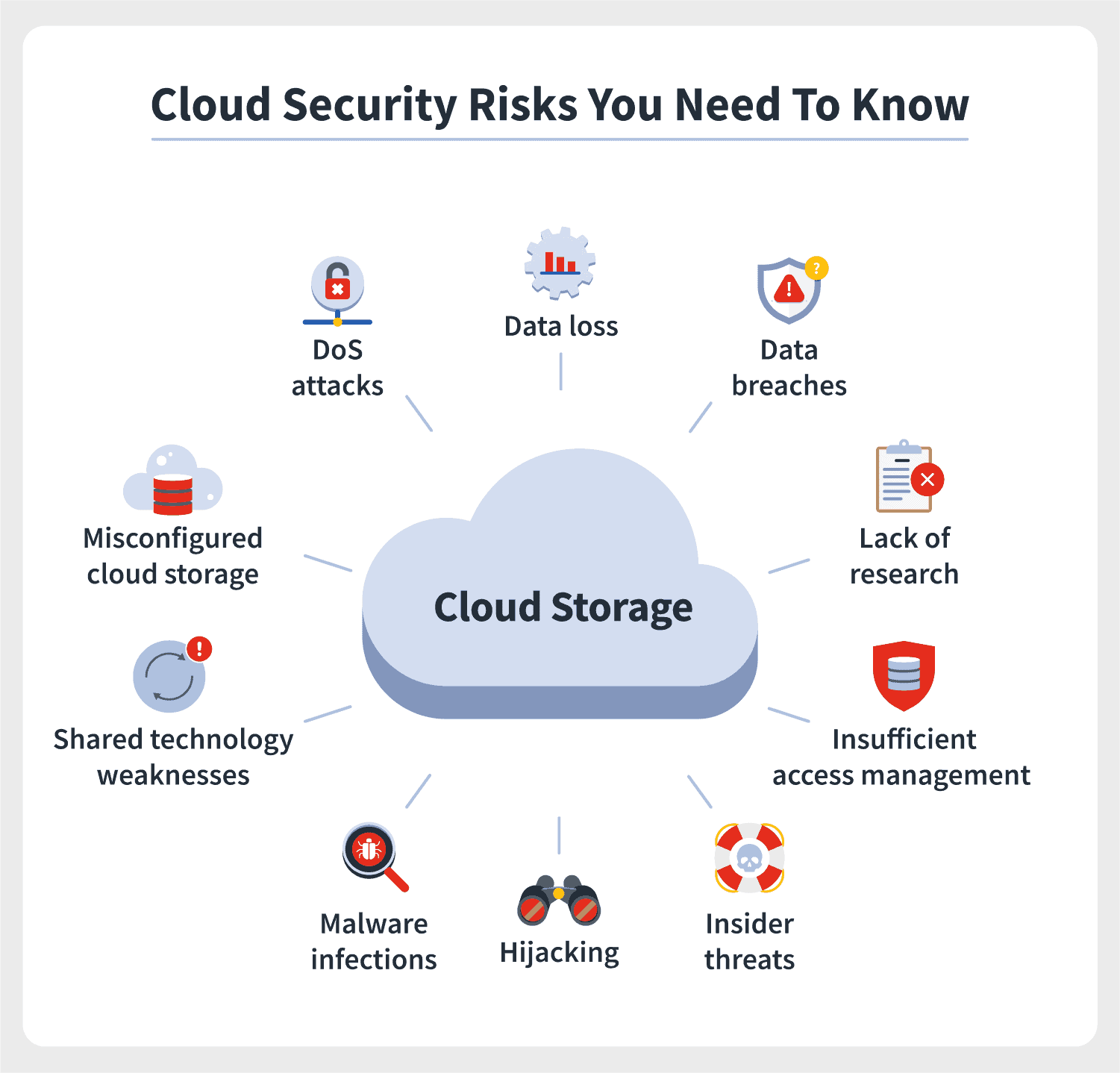
KEY DRIVERS OF CLOUD SECURITY RISKS
- Perimeter Dissolution: Identity is the new control plane
- Misconfigurations: Shared responsibility confusion
- API Proliferation: Unmonitored programmatic access
- Regulatory Mandates: SEC rules, DORA, and heavy fines
- Automated Attacks: AI-enhanced exploit discovery
The transformation of cloud security into the paramount challenge for Chief Information Officers (CIOs) and Chief Information Security Officers (CISOs) stems from structural changes in how software is deployed, accessed, and exploited.
1. Identity Over Perimeter: The Dissolution of the Traditional Network Boundary
In traditional on-premises architectures, security relied on a well-defined physical and network perimeter—often described as "castle-and-moat" defense. Firewalls, intrusion prevention systems (IPS), and virtual private networks (VPNs) filtered incoming traffic at predictable entry points.
Cloud computing completely dissolves this perimeter. Infrastructure is hosted across geographically distributed datacenters, accessed by hybrid workforces, and dynamically scaled using automated scripts. In this decentralized architecture, identity and access management (IAM) serves as the primary control boundary. Cybercriminals target identity systems through credential harvesting, session hijacking, and privilege escalation, knowing that a compromised cloud identity often provides unrestricted lateral access across entire cloud tenants.
2. The Shared Responsibility Misconception and Cloud Misconfigurations
Major cloud service providers (CSPs)—such as Amazon Web Services (AWS), Microsoft Azure, and Google Cloud Platform (GCP)—operate under a Shared Responsibility Model. While CSPs secure the underlying physical infrastructure, virtualization layer, and hardware, the enterprise client remains responsible for configuring services, managing user access, encrypting stored data, and maintaining application security.
SHARED RESPONSIBILITY MODEL DISCONNECTED ROLES
- Customer Responsibility (Data, IAM, App Security, Configs)
- Provider Responsibility (Hardware, Datacenters, Hypervisor)
Misunderstandings regarding this division of labor represent one of the largest vulnerabilities in cloud computing. Common misconfigurations include:
- Publicly Accessible Storage Buckets: Failing to restrict public read/write permissions on storage containers (e.g., AWS S3 buckets or Azure Blob Storage).
- Overly Permissive IAM Roles: Granting wildcards (
*) in policy documents, allowing non-privileged service accounts excessive administrative access. - Exposed Management Ports: Leaving administrative ports such as SSH (Port 22) or RDP (Port 3389) open to the public internet.
- Disabled Auditing and Logging: Failing to enable continuous logging services, which prevents security operations teams from detecting ongoing unauthorized access or performing forensics.
According to research from the Cloud Security Alliance (CSA), human error and platform misconfiguration remain leading contributors to enterprise cloud data exposure.
3. API Proliferation and Microservices Complexity
Modern cloud applications are rarely monolithic. Instead, they rely on microservice architectures interconnected via Application Programming Interfaces (APIs). These APIs allow microservices, third-party integrations, external clients, and automated CI/CD pipelines to query data and execute system commands.
This architectural shift dramatically expands the attack surface. "Shadow APIs"—undocumented or legacy API endpoints created during rapid software updates—frequently lack authentication checks or rate limiting. Attackers exploit these vulnerabilities using Broken Object Level Authorization (BOLA) and parameter pollution, bypassing frontend application security to directly exfiltrate back-end database records. The OWASP API Security Project highlights that unmanaged API endpoints now rank among the most frequently exploited threat vectors in cloud-native environments.
4. Escalating Regulatory Enforcement and Financial Accountability
Global regulatory standards have evolved from simple guidance to strict, enforceable compliance frameworks with substantial financial and legal consequences. Regulations directly impacts how organizations store, process, and protect cloud workloads:
- General Data Protection Regulation (GDPR): Imposes fines of up to 4% of global annual turnover for failures to protect personal data.
- Digital Operational Resilience Act (DORA): Enforces strict ICT risk management, incident reporting, and digital resilience requirements across financial institutions operating within the European Union.
- SEC Cyber Disclosure Rules: Mandate that public companies publicly report material cybersecurity incidents within four business days, putting executive leadership directly under regulatory scrutiny.
Because non-compliance risks severe legal liabilities, brand devaluation, and loss of operating licenses, enterprise boards now manage cloud security as an enterprise risk management priority rather than a routine technical function.
5. Automated Attack Tooling and AI-Driven Threats
Threat actors increasingly leverage automated scanners, machine learning tools, and generative AI to identify and exploit cloud vulnerabilities at scale. Weaponized scanning scripts continuously index IP ranges assigned to major public cloud vendors, detecting unpatched systems, open ports, and default configurations within minutes of deployment.
Furthermore, Ransomware-as-a-Service (RaaS) operations have adapted their business models specifically for public cloud environments. Rather than simply encrypting local hard drives, cloud-focused ransomware tactics exfiltrate sensitive cloud data, delete underlying cloud backups and volume snapshots, and demand ransoms under threat of public disclosure.
Comparative Analysis of Cloud Security Defense Pillars
To counter complex threats across dynamic infrastructure, enterprise security teams employ specialized management platforms. The following table contrasts the core operational pillars of cloud-native defense.
| Security Pillar | Primary Focus Area | Target Layer / Components | Key Operational Advantage |
|---|---|---|---|
| Cloud Security Posture Management (CSPM) | Configuration hygiene and compliance monitoring | Control plane, storage, network access, policy rules | Detects drift, misconfigurations, and non-compliant settings across multi-cloud environments. |
| Cloud Workload Protection Platform (CWPP) | Runtime threat protection and behavioral analysis | Containers, serverless functions, Virtual Machines (VMs) | Provides process visibility, malware detection, and vulnerability scanning inside running workloads. |
| Cloud Infrastructure Entitlement Management (CIEM) | Identity privilege governance and access analysis | IAM accounts, service roles, temporary access tokens | Identifies over-permissioned accounts and enforces least-privilege policies across non-human identities. |
| Cloud-Native Application Protection Platform (CNAPP) | Unified visibility and integrated security lifecycle | Full application stack from code repositories to cloud runtime | Consolidates CSPM, CWPP, and CIEM insights into a single prioritization engine to eliminate security silos. |
Essential Frameworks for Securing Cloud Environments
Addressing the operational challenges of modern cloud hosting requires shifting from legacy defensive controls to continuous, identity-centric architectures.
ZERO TRUST CORE PRINCIPLES
- Explicit Verification: Validate identity & posture
- Least Privilege Access: Just-In-Time & Just-Enough Access
- Assume Breach: Micro-segment & encrypt everywhere
Implementing a Zero Trust Architecture (ZTA)
Zero Trust operates under a fundamental principle: Never trust, always verify. In a Zero Trust cloud environment, no device, user, or microservice is granted inherent trust based purely on its network location or IP address.
Guidance from the National Institute of Standards and Technology (NIST SP 800-207) outlines three core operational tenets for cloud Zero Trust implementation:
- Explicit Verification: Always authenticate and authorize based on all available data points, including user identity, geographic location, device health status, resource context, and anomaly detection.
- Least Privilege Access: Limit user and non-human entity access using Just-In-Time (JIT) and Just-Enough-Access (JEA) permissions, minimizing potential blast radiuses if credentials are compromised.
- Assume Breach: Micro-segment cloud networks, encrypt all data both in transit and at rest, and continuously monitor end-to-end operational telemetries to detect malicious behavior in real time.
Integrating DevSecOps and "Shifting Left"
Waiting until production deployment to address vulnerabilities introduces severe operational risks and increases remediation costs. DevSecOps embeds security automation directly into continuous integration and continuous deployment (CI/CD) pipelines.
DEVSECOPS CONTINUOUS INTEGRATION FEEDBACK LOOP
- Code
- IaC Scan
- Build
- Runtime CNAPP
- Threat Feedback (loops back to Code)
By scanning Infrastructure-as-Code (IaC) templates (such as Terraform, AWS CloudFormation, or Ansible) during development, teams detect misconfigured security groups, hardcoded secrets, and unencrypted databases before infrastructure is provisioned. Organizations adopting "shift-left" practices drastically reduce production vulnerabilities while preserving rapid software delivery schedules.
Frequently Asked Questions (FAQs)
What is the biggest security threat in cloud computing today?
Cloud misconfiguration and mismanaged identity access remain the leading vulnerabilities in public cloud environments. Overly permissive IAM policies, exposed databases, and unencrypted storage containers consistently account for a vast majority of successful enterprise data breaches.
How does cloud security differ from traditional on-premises IT security?
On-premises security relies on static physical boundaries, hardware firewalls, and centralized infrastructure control. Cloud security relies on dynamic software abstraction layers, identity-based access perimeters, continuous policy enforcement, and API integration, requiring automated, real-time threat detection rather than perimeter filtering.
What is Cloud Infrastructure Entitlement Management (CIEM)?
CIEM is a specialized security technology designed to manage and enforce access permissions across multi-cloud infrastructure. It analyzes non-human identities, service accounts, and human users to discover excessive or unused entitlements, helping security teams enforce the principle of least privilege.
Why are legacy firewalls ineffective for protecting cloud-native applications?
Legacy firewalls filter traffic based on static IP addresses, predictable ports, and physical network topology. Cloud-native architectures use dynamic workloads, ephemeral containers, and auto-scaling microservices that constantly shift IP addresses, rendering static packet-filtering rules obsolete.
What role does artificial intelligence play in cloud security defenses?
Artificial intelligence speeds up cloud security by processing millions of event logs in real time, establishing behavioral baselines, and detecting anomalies that indicate account compromise or data exfiltration. Automated AI security systems can also trigger instant policy updates to isolate compromised workloads before threats spread laterally.
Strategic Action Plan for Cloud Security Leaders
To successfully manage risk while maintaining business agility, cloud security leaders should focus on actionable operational goals:
- Conduct a Multi-Cloud IAM Audit: Map all human and non-human identities, eliminate administrative wildcard permissions, and mandate phishing-resistant Multi-Factor Authentication (MFA) across all administration portals.
- Unify Visibility via CNAPP Platforms: Transition away from point solutions and deploy continuous Cloud-Native Application Protection Platforms to unify misconfiguration tracking, workload monitoring, and identity management.
- Automate IaC Scanning in CI/CD Pipelines: Mandate static code analysis for all infrastructure templates prior to deployment to stop misconfigurations from reaching live environments.
- Adopt Continuous Compliance Monitoring: Implement automated compliance reporting to assess operational configurations continuously against benchmarks such as CIS Controls, NIST, GDPR, and DORA.
Securing the cloud is not a static endpoint, but a continuous operational practice. By aligning security governance directly with identity management, developer workflows, and enterprise risk management, organizations build resilient infrastructures capable of scaling securely in complex multi-cloud ecosystems.
Image Gallery