Self-Directed Learning in Higher Education: Frameworks, Implementation, and Student Success
Self-directed learning in higher education is an instructional process where students take primary initiative for identifying their learning needs, setting goals, selecting resources, implementing strategies, and evaluating their cogni...
Self-directed learning in higher education is an instructional process where students take primary initiative for identifying their learning needs, setting goals, selecting resources, implementing strategies, and evaluating their cognitive outcomes. While supported by faculty advisors and structured curricula, self-directed learning transfers ownership of the educational journey from instructor to learner, fostering lifelong critical thinking and adaptive expertise.
Contents
Theoretical Foundations of Self-Directed Learning
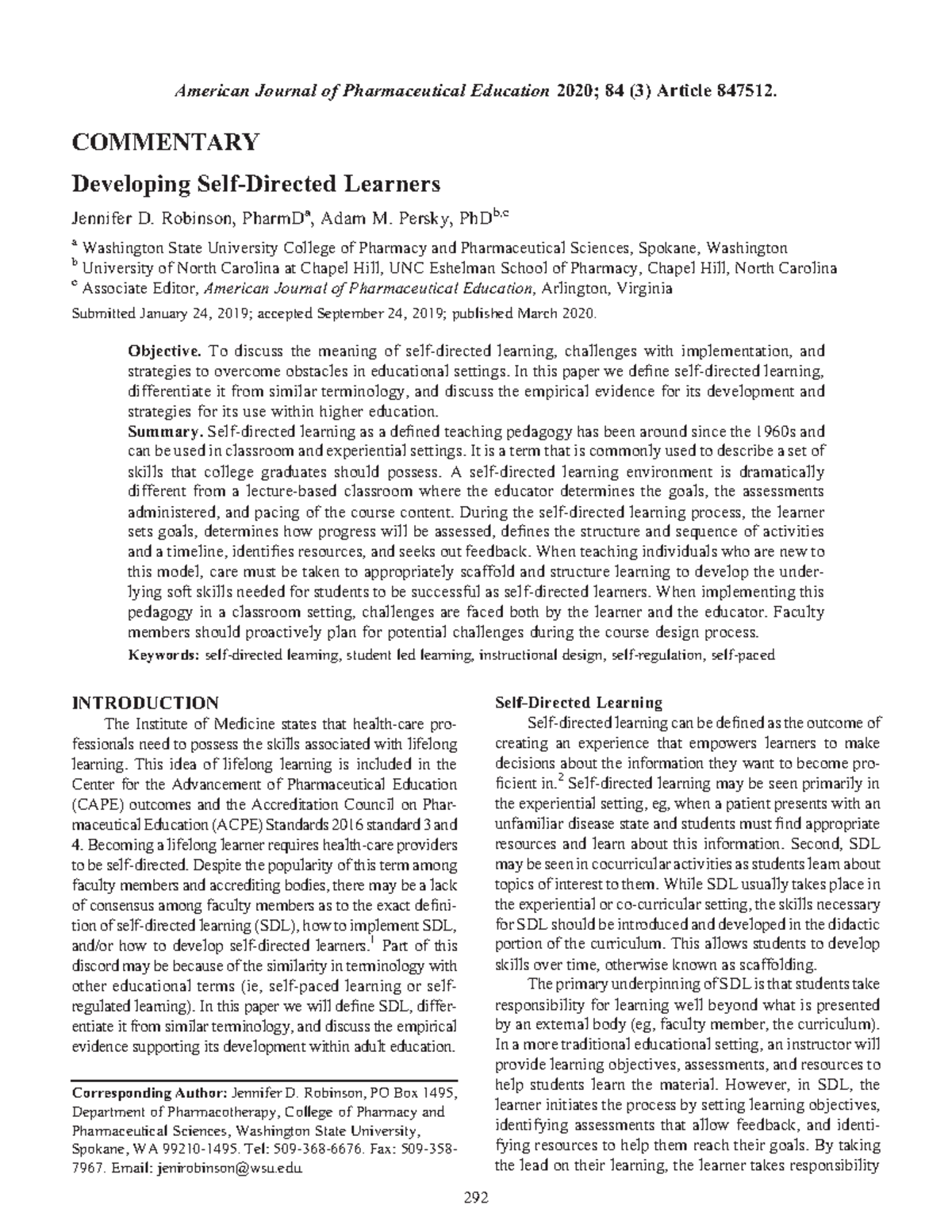
Self-directed learning (SDL) in post-secondary education is not simply an instructional technique; it is a fundamental shift in educational philosophy grounded in adult learning theory (andragogy) and cognitive psychology. Understanding how students transition from passive receivers of information to proactive directors of their own cognitive development requires examining three key theoretical models.
Malcolm Knowles' Andragogical Model
In 1975, Malcolm Knowles established the foundational definition of self-directed learning as a process in which individuals take the initiative, with or without the help of others, in diagnosing their learning needs, formulating learning goals, identifying human and material resources for learning, choosing and implementing appropriate learning strategies, and evaluating learning outcomes. Knowles argued that as individuals mature, their self-concept moves from dependent personality toward self-directed human being. In higher education, this transition requires academic institutions to design environments that respect student autonomy while providing structural guidance.
Garrison's Comprehensive Model of Self-Directed Learning
D. Randy Garrison expanded Knowles' work by integrating cognitive and social dimensions into a comprehensive three-part model published in Adult Education Quarterly:
- Self-Management (Control): Refers to the task-control issues surrounding the contextual management of learning resources, institutional support, and time management. It addresses the practical implementation of learning activities.
- Self-Monitoring (Responsibility): Concerns the cognitive and metacognitive processes wherein students monitor their comprehension, critically reflect on new information, and evaluate their understanding against academic standards.
- Motivation (Entering and Task Motivation): Focuses on the internal drive to initiate and maintain effort toward educational goals, distinguishing between the initial decision to learn and the sustained effort required during complex academic tasks.
Self-Determination Theory and Autonomy
Edward L. Deci and Richard M. Ryan's Self-Determination Theory (SDT) further explains why self-directed learning enhances academic performance. SDT posits that optimal human functioning requires fulfilling three basic psychological needs: autonomy (feeling in control of one's choices), competence (feeling effective in interacting with the environment), and relatedness (feeling connected to a community). When higher education degree programs structure learning tasks to support learner autonomy, students demonstrate deeper cognitive processing, higher retention rates, and greater intrinsic motivation.
Key Pillars of the Self-Directed Learning Process
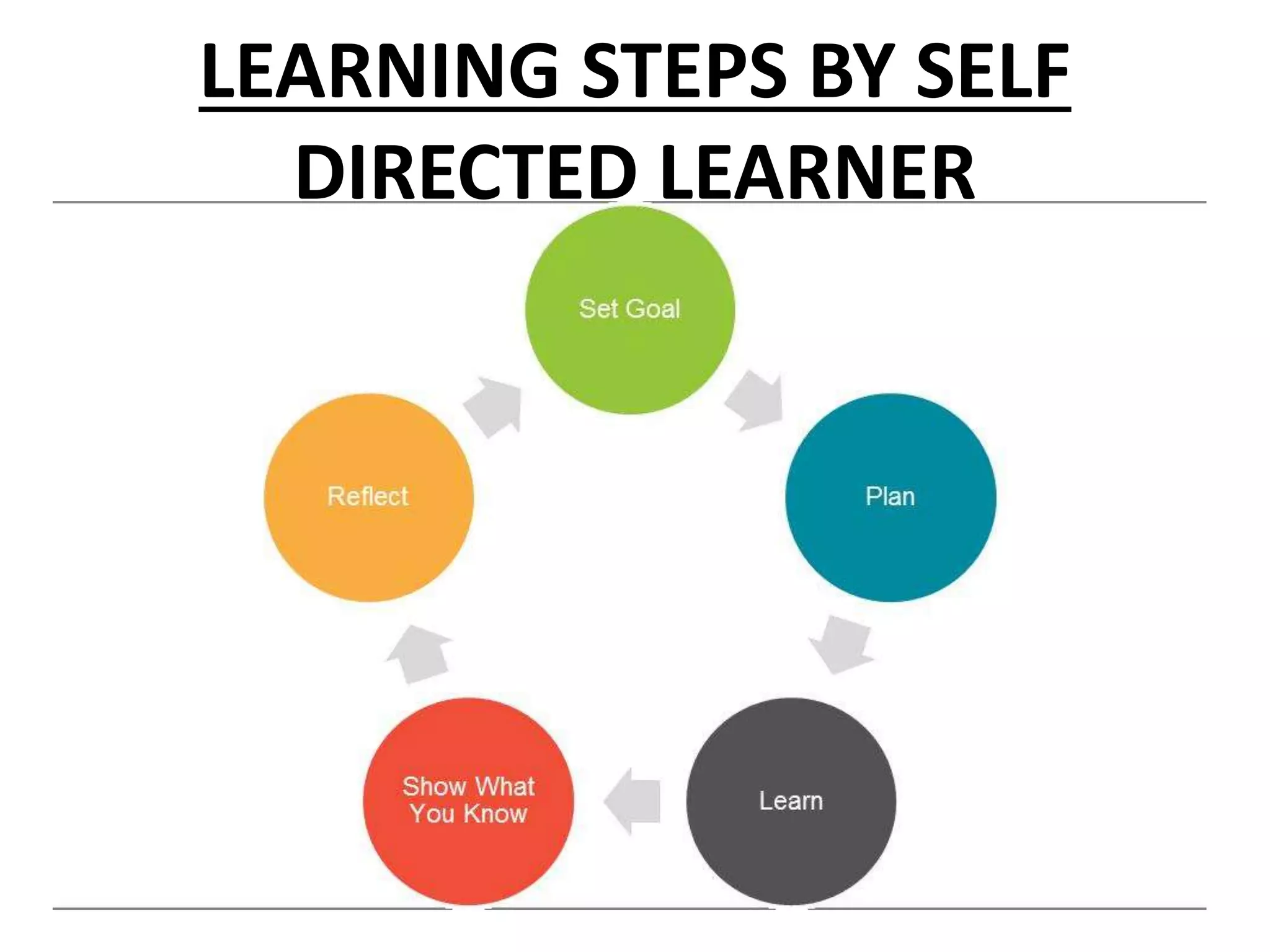
Executing effective self-directed learning within university and college degree frameworks relies on a continuous, multi-stage cycle. Both undergraduate and graduate students navigate these core phases to achieve mastery in academic subjects.
- Diagnose Needs
- Formulate Goals
- Select Tools [Resources]
- Execute Strategy
- Evaluate Mastery
1. Diagnosing Learning Needs and Skill Gaps
Before commencing independent study, learners must accurately assess what they already know and identify what they must acquire. This diagnostic phase involves analyzing syllabus competencies, reviewing professional standards, and evaluating personal diagnostic assessments. Without accurate self-assessment, learners risk focusing on comfortable subjects while ignoring critical conceptual gaps.
2. Formulating Specific Learning Objectives
Once gaps are identified, students convert broad academic requirements into precise, measurable objectives. Effective self-directed learners utilize frameworks such as Bloom's Taxonomy to design objectives that progress from lower-order skills (remembering and understanding) to higher-order cognitive processing (analyzing, evaluating, and creating original research).
3. Identifying Human and Material Resources
Navigating modern academic research requires discriminating between peer-reviewed academic literature, authoritative databases, institutional open educational resources (OER), and unverified online material. Self-directed learners actively map their resource landscape, identifying subject librarians, faculty mentors, digital repositories, and peer study cohorts.
4. Selecting and Executing Learning Strategies
Self-directed execution goes beyond passive reading or highlight-driven studying. It requires deliberate practice, retrieval techniques, spaced repetition, concept mapping, and self-explanation. Students tailor their learning strategies to the discipline—applying quantitative problem sets in STEM fields or historiographical analysis in the humanities.
5. Assessing and Evaluating Learning Outcomes
The final phase requires objective self-evaluation against predetermined standards. Students validate their learning through practice examinations, rubric-based peer reviews, capstone presentations, and reflection essays. This stage feeds directly back into diagnostic assessment, creating a continuous loop of academic development.
Institutional Models Integrating Self-Directed Learning
Universities implement self-directed learning across various academic delivery models. Rather than leaving self-direction entirely to chance, structured institutional frameworks provide the necessary scaffolding for student success.
Problem-Based Learning (PBL)
PBL presents students with complex, ill-structured, real-world problems before formal instruction occurs. Working individually and in small groups, students identify what they need to learn to solve the problem, locate relevant literature, synthesize solutions, and present findings. Medical, law, and engineering faculties widely utilize PBL to cultivate professional autonomy.
Competency-Based Education (CBE)
In Competency-Based Education programs, academic progression is determined by demonstrated mastery of specific learning outcomes rather than credit-hour seat time. Students move through academic material at their own pace, taking advantage of self-directed study schedules while receiving feedback from faculty assessors upon request.
The Flipped Classroom Model
Flipped learning shifts foundational information transmission (lectures, readings) outside the classroom into self-directed study periods. In-person class time is reserved for collaborative problem-solving, debates, laboratory work, and deeper conceptual synthesis guided by faculty.
Undergraduate Research and Independent Study Contracts
Upper-level undergraduate and graduate coursework frequently incorporates formal independent study contracts. These agreements allow students to design customized research projects under the supervision of a faculty sponsor, establishing their own reading lists, milestone deadlines, and final deliverables.
Traditional Instruction vs. Self-Directed Learning
Understanding the operational differences between instructor-led instruction and self-directed academic frameworks helps clarify how student and faculty roles shift within higher education environments.
| Dimension | Traditional Teacher-Directed Learning | Self-Directed Higher Education |
|---|---|---|
| Learner Role | Passive receiver of content; follows prescribed syllabus sequentially. | Active agent; sets sub-goals, selects pathways, and monitors cognitive progress. |
| Faculty Role | Primary knowledge authority, lecturer, and sole grader. | Facilitator, cognitive coach, resource guide, and mentor. |
| Goal Setting | Defined entirely by institutional curricula and instructor syllabi. | Co-created by student and instructor based on degree benchmarks and career goals. |
| Pace & Sequencing | Fixed institutional timeline (semesters/quarters) uniform for all learners. | Flexible pace guided by mastery; students adjust time allocation per topic. |
| Assessment Method | Summatively focused on midterm and final examinations. | Formative self-assessments, portfolio evaluation, peer review, and authentic project defense. |
| Primary Motivation | Extrinsic (grades, class ranking, credit completion). | Intrinsic mastery combined with autonomous professional goals. |
Practical Framework: Designing a Self-Directed Learning Contract
A practical mechanism for operationalizing self-directed learning in degree programs is the formal Learning Contract. Developed collaboratively between the student and an academic advisor, this document establishes clear expectations and accountability.
Step 1: Define Specific Objectives
Formulate 3 to 5 clear learning objectives using actionable verbs.
- Example: "Synthesize current peer-reviewed literature regarding machine learning applications in diagnostic radiology published between 2022 and 2026."
Step 2: Identify Learning Resources and Strategies
List exact resources and methodological approaches for reaching each objective.
- Example: "Conduct systematic searches on IEEE Xplore and PubMed; analyze 20 core studies using a literature matrix tool; consult with department data science faculty."
Step 3: Specify Target Deliverables (Evidence of Accomplishment)
Define concrete evidence demonstrating objective attainment.
- Example: "Produce a 4,000-word systematic review article formatted for submission to a designated peer-reviewed journal, alongside an annotated bibliography."
Step 4: Establish Assessment Criteria and Evaluation Rubrics
Specify how the work will be evaluated and by whom.
- Example: "Evaluation will be conducted by the faculty advisor using the department's graduate writing rubric, requiring a minimum performance score of 85% across analytical depth and methodological rigor."
Step 5: Draft a Milestone Schedule
Break the semester into clear bi-weekly checkpoints for progress submission and review.
Technological Enablers of Modern Self-Directed Learning
Digital learning infrastructure provides critical infrastructure supporting self-directed learners in modern higher education settings.
Learning Management Systems (LMS) and Adaptive Learning
Modern enterprise LMS platforms (such as Canvas, Blackboard, or Moodle) integrate adaptive learning paths. These system modules analyze student practice quiz results and automatically suggest targeted remedial content or advanced extension activities based on individual performance data.
Open Educational Resources (OER) and Academic Repositories
Self-directed scholars leverage open-access databases, including ERIC (Education Resources Information Center), Directory of Open Access Journals (DOAJ), and institutional digital repositories, to access high-quality research papers without paywall restrictions.
Generative AI and Intelligent Tutoring Systems
Generative artificial intelligence and automated tutoring tools serve as cognitive scaffolds for self-directed learners. When used appropriately, AI tools allow students to query complex concepts, generate custom practice problem sets, test code, and receive instantaneous formative feedback on draft outlines during late-night study sessions.
Common Challenges and Mitigation Strategies
While self-directed learning offers documented cognitive benefits, students frequently encounter psychological and structural challenges when transitioning away from traditional lecture-based formats.
| Challenge | Mitigation Strategy |
|---|---|
| Lack of Self-Regulation | Time-boxing & Goal Scaffolding |
| Cognitive Overload | Information Curation Standards |
| Academic Isolation | Peer Learning Networks (PLNs) |
Challenge 1: Poor Self-Regulation and Procrastination
Without fixed daily lecture schedules and frequent low-stakes quizzes, self-directed learners may struggle with time management and delay critical project work.
- Mitigation: Implement time-boxing frameworks, break long-term projects into micro-deliverables, and utilize digital project management tools (e.g., Trello, Notion) to maintain task visibility.
Challenge 2: Cognitive Overload and Information Fatigue
The vast abundance of online research can overwhelm students, making it difficult to distinguish seminal scholarly work from peripheral or low-quality sources.
- Mitigation: Seek institutional library training on search query strings, leverage systematic review methodologies, and establish strict inclusion/exclusion criteria for independent literature reviews.
Challenge 3: Academic Isolation and Reduced Motivation
Independent study can lead to feelings of isolation, reducing student engagement over extended academic terms.
- Mitigation: Form peer learning networks (PLNs), establish weekly study accountability partnerships, and schedule regular check-in meetings with faculty mentors.
Frequently Asked Questions
Does self-directed learning mean students learn entirely without faculty involvement?
No. Self-directed learning shifts the faculty role from primary lecturer ("sage on the stage") to expert facilitator, mentor, and evaluator ("guide on the side"). Faculty provide necessary cognitive scaffolding, validate learning contracts, address complex conceptual misunderstandings, and assess final mastery.
How does self-directed learning differ from self-paced online courses?
Self-paced online courses typically offer pre-packaged instructional materials that students complete at their own speed following a rigid, linear path. In contrast, true self-directed learning grants students autonomy over the selection of learning goals, resources, strategies, and evidence generation, rather than simply controlling the speed of delivery.
What role does self-efficacy play in self-directed learning outcomes?
Self-efficacy—an individual's belief in their ability to succeed in specific situations—is a primary predictor of success in self-directed learning environments. Students with high self-efficacy set more challenging learning goals, persist longer when facing academic obstacles, and employ more sophisticated metacognitive learning strategies.
How can university instructors evaluate self-directed learning skills objectively?
Instructors evaluate self-directed learning skills using validated psychometric scales such as Guglielmino's Self-Directed Learning Readiness Scale (SDLRS) or Cheng's Self-Directed Learning Scale (SDLS). Additionally, instructors assess performance directly through reflective learning journals, self-assessment accuracy comparisons, and learning contract achievement metrics.
Is self-directed learning suitable for all academic disciplines?
Yes, though its application varies by field. In technical or heavily regulated fields like medicine or engineering, foundational knowledge may require structured safety rules and core competencies before students take control of specialized research projects. In the humanities and social sciences, self-directed learning can be integrated earlier through independent textual analysis and self-designed qualitative research.
Practical Next Steps for Students and Faculty
To successfully foster self-directed learning in higher education, both learners and educators should adopt explicit actionable steps:
- For Students: Begin by completing a self-assessment of your current metacognitive habits. Select one upcoming course module to practice self-directed study by drafting a formal learning contract complete with personalized sub-goals, resource mapping, and self-evaluation rubrics.
- For Faculty and Instructional Designers: Audit course syllabi to identify opportunities for learner autonomy. Shift a portion of traditional assessments toward project-based deliverables, incorporate flipped classroom techniques, and explicitly teach research diagnostic strategies within your discipline.
Additional research on adult learning theory and instructional design frameworks is available through the UNESCO Institute for Lifelong Learning and official university academic development centers.
Image Gallery