AI for Mortgage Loan Officers: Streamlining Origination and Compliance
Artificial intelligence for mortgage loan officers encompasses machine learning models, automated underwriting workflows, and generative text systems designed to reduce manual data entry, accelerate loan cycles, and ensure regulatory c...
Artificial intelligence for mortgage loan officers encompasses machine learning models, automated underwriting workflows, and generative text systems designed to reduce manual data entry, accelerate loan cycles, and ensure regulatory compliance in a competitive market environment.
Contents
The modern mortgage industry operates under intense pressure. Loan officers (LOs) must balance stringent consumer expectations for speed with complex, heavily regulated underwriting criteria. Historically, origination involved manual document collection, tedious data re-entry across legacy systems, and prolonged communication cycles between borrowers, processors, and underwriters. Artificial intelligence (AI) has transformed this landscape. By integrating machine learning (ML), optical character recognition (OCR), natural language processing (NLP), and generative AI into daily workflows, mortgage loan officers can automate repetitive tasks, identify risk patterns instantly, and dedicate more time to advisory services and relationship management.
The Evolution of Mortgage Origination and the Role of AI
For decades, the mortgage origination process was characterized by paper-heavy files, siloed databases, and redundant verification steps. Loan officers spent a significant portion of their day chasing W-2s, tax returns, and bank statements, manually keying figures into loan origination systems (LOS). This operational friction not only extended closing timelines—often stretching beyond 45 days—but also introduced human error that could lead to costly compliance breaches or buyback risks.
The introduction of AI into mortgage lending shifts the paradigm from reactive processing to proactive orchestration. Modern AI applications do not replace the loan officer; instead, they function as cognitive co-pilots. Machine learning algorithms analyze historical loan performance data to predict application friction points, while intelligent document processing (IDP) extracts data from unstructured documents with high accuracy. These systems integrate directly with major Loan Origination Systems like Ellie Mae's Encompass or ICE Mortgage Technology, streamlining the journey from initial pre-qualification to clear-to-close.
Core Applications of AI for Mortgage Loan Officers
To understand how artificial intelligence impacts day-to-day operations, it is necessary to examine the specific pillars of origination where technology delivers measurable value.
Intelligent Document Processing and Data Extraction
Borrowers submit financial documentation in varied formats, including scanned PDFs, mobile phone photos, messy photocopies, and digital bank statements.
- Optical Character Recognition (OCR) and Computer Vision: Advanced OCR systems combined with computer vision identify document types (e.g., pay stubs, 1040s, profit and loss statements) automatically.
- Data Mapping: The software extracts income figures, asset balances, and employer details, mapping them directly into the appropriate fields within the LOS.
- Error Reduction: This drastically minimizes manual transcription errors, reducing the back-and-forth communication required to clarify illegible numbers or transposed digits.
Automated Underwriting Support and Risk Assessment
While Automated Underwriting Systems (AUS) like Fannie Mae’s Desktop Underwriter (DU) and Freddie Mac’s Loan Product Advisor (LPA) have existed for years, AI enhances pre-qualification and portfolio analysis.
- Credit Risk Modeling: Machine learning models look beyond traditional credit scores, factoring in alternative data such as rental payment history and cash flow analytics to evaluate thin-file borrowers.
- Condition Cleansing: AI engines scan incoming documents against existing underwriting conditions, automatically checking off satisfied items when valid documentation is uploaded and verified.
Generative AI for Borrower Communication and CRM Integration
Client acquisition and retention dictate a loan officer's long-term success. Generative AI tools assist in scaling personalized communication without sacrificing compliance.
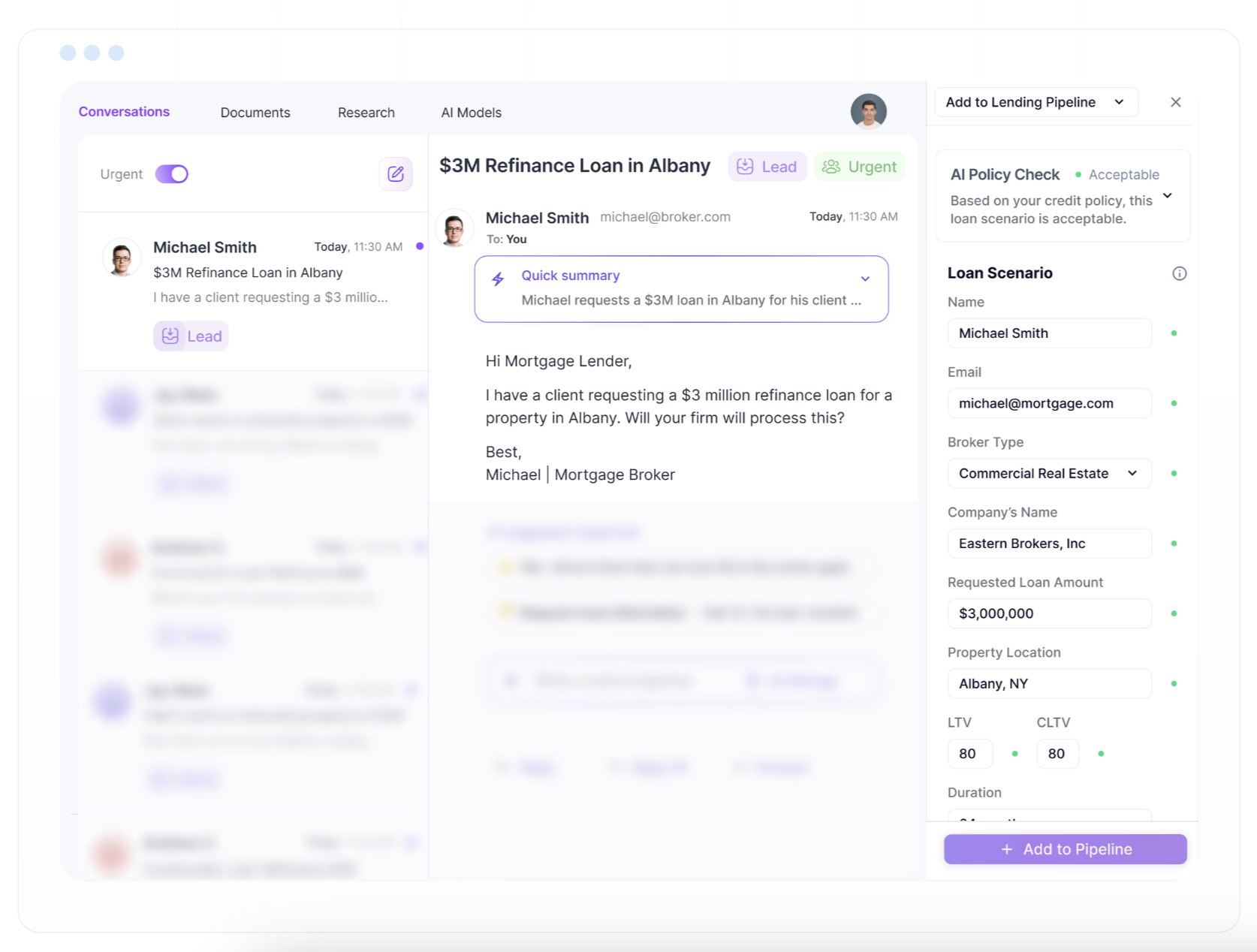
- Automated Lead Nurturing: AI-driven Customer Relationship Management (CRM) platforms draft personalized follow-up emails, market updates, and rate-drop alerts tailored to specific borrower personas.
- Multilingual Support: Natural language tools translate documents and facilitate real-time communication for non-English speaking borrowers, expanding addressable market segments while maintaining documentation integrity.
Operational Comparison: Traditional vs. AI-Powered Origination
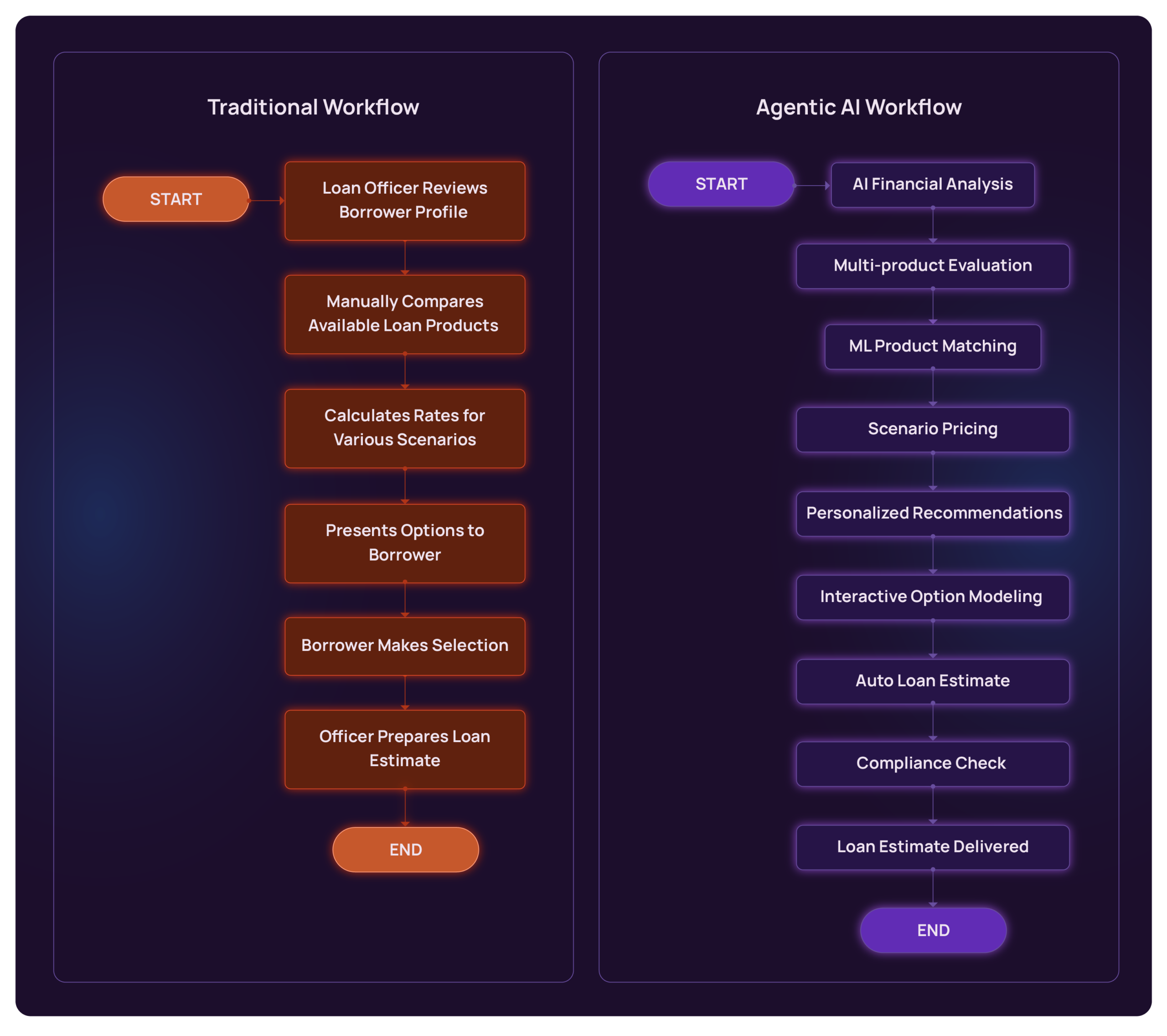
The integration of artificial intelligence fundamentally alters key performance indicators across the loan lifecycle. The table below outlines the operational differences between legacy workflows and AI-enabled loan origination.
| Operational Metric | Traditional Workflow | AI-Powered Workflow |
|---|---|---|
| Initial Document Intake | Manual upload, visual inspection, manual re-keying into LOS. | Automated IDP, instant classification, and direct field mapping. |
| Average Time to Pre-Approval | Hours or days depending on document review queues. | Minutes via automated income calculation and credit review. |
| Compliance Auditing | Periodic manual spot-checks for disclosures and TRID timelines. | Real-time automated compliance checks flagging missing disclosures instantly. |
| Borrower Communication | Reactive, manual phone calls and sporadic email follow-ups. | Omnichannel automated nurturing, predictive rate alerts, and chat assistants. |
| Cost per Loan Origination | Higher labor costs driven by redundant manual processing steps. | Reduced operational overhead through streamlined automation. |
Compliance, Regulatory Considerations, and Data Security
Adopting artificial intelligence in mortgage lending requires strict adherence to federal and state regulations. Because lending decisions directly impact consumer financial access, AI tools must operate transparently and fairly.
- Fair Lending and Bias Mitigation: Under the Equal Credit Opportunity Act (ECOA) and the Fair Housing Act, algorithms must not discriminate against protected classes. Loan officers and compliance teams must audit machine learning models regularly to ensure disparate impact does not occur, particularly when utilizing alternative credit data.
- Data Privacy and Security: Mortgage applications contain highly sensitive Personally Identifiable Information (PII) and Non-Public Personal Information (NPI). AI platforms utilized by loan officers must comply with the Gramm-Leach-Bliley Act (GLBA) and maintain SOC 2 Type II certification to prevent data breaches.
- Explainability: Regulators require that adverse action notices provide clear, accurate reasons for loan denials. "Black box" AI models that cannot explain why an application was flagged or rejected present severe regulatory risks. Loan officers must ensure their technology stack relies on explainable AI (XAI) frameworks.
Common Challenges and Implementation Pitfalls
While the advantages of AI are clear, integration is not without friction. Organizations and individual loan officers often encounter predictable obstacles during adoption.
- Legacy System Friction: Many brokerages and regional banks rely on legacy infrastructure that resists seamless API integration with modern cloud-based AI tools.
- User Adoption Resistance: Loan officers accustomed to legacy workflows may distrust automated outputs, leading to shadow processes where manual verification duplicates AI efforts.
- Data Hygiene Issues: AI models depend on clean data. If historical loan files contain input errors or inconsistent labeling, machine learning models trained on that data will propagate those inaccuracies.
- Over-Reliance on Automation: Treating AI as a complete replacement for human judgment can lead to missed contextual nuances in complex self-employed borrower tax returns.
Frequently Asked Questions
Will AI replace mortgage loan officers?
No. Artificial intelligence automates administrative friction, document processing, and initial data verification, but it cannot replicate the human advisory role. Loan officers provide critical emotional intelligence, strategic financial planning, complex relationship management, and guidance through high-stakes real estate transactions that software cannot duplicate.
How does AI handle complex self-employed borrower income?
Advanced AI models use intelligent document processing to parse complex multi-page tax returns (Forms 1040, Schedule C, 1120S, K-1s). While they automate the extraction of line items and calculate baseline cash flows instantly, loan officers still review the final output to interpret business trends and reconcile depreciation or amortization adjustments.
What compliance regulations apply to AI in mortgage lending?
Mortgage AI tools must comply with the Truth in Lending Act (TILA), Real Estate Settlement Procedures Act (RESPA), Equal Credit Opportunity Act (ECOA), the Fair Credit Reporting Act (FCRA), and GLBA data security mandates. Algorithms must be audited continuously for disparate impact and discriminatory bias.
Can AI predict when a borrower is ready to refinance?
Yes. AI-driven predictive analytics monitor macroeconomic indicators—such as fluctuating mortgage rates—alongside individual borrower credit profiles and life events to identify optimal refinancing windows or home equity borrowing opportunities, prompting targeted outreach.
What should a loan officer look for in an AI vendor?
Loan officers and branch managers should evaluate vendors based on secure API integration with their existing LOS, proven GLBA and SOC 2 compliance, transparent and explainable algorithmic logic, robust customer support, and clear adherence to fair lending laws.
Recommended Next Action for Loan Officers
To begin integrating artificial intelligence effectively, start by auditing your current origination bottlenecks. Identify whether your greatest friction lies in document collection, data entry, or lead nurturing. Select one specialized AI tool—such as an intelligent document processing plugin for your existing CRM or LOS—to pilot on a subset of files before scaling enterprise-wide.
Image Gallery