Diamonds as an Investment: Market Realities, Liquidity, and Valuation
Diamonds have long captured human imagination as symbols of wealth, but treating them as a financial asset requires navigating a complex, illiquid market distinct from traditional equities, bonds, or bullion. Unlike standardized commod...
Diamonds have long captured human imagination as symbols of wealth, but treating them as a financial asset requires navigating a complex, illiquid market distinct from traditional equities, bonds, or bullion. Unlike standardized commodities such as gold or silver, which trade on public exchanges at transparent, universally recognized spot prices, natural diamonds lack a unified centralized marketplace. Consequently, evaluating diamonds as an investment demands a clear understanding of grading standards, market liquidity constraints, certification dependencies, and long-term price performance history.
Contents
Understanding the Diamond Market Structure
The global diamond trade operates through a multi-tiered pipeline stretching from primary mining conglomerates like De Beers and Lucara Diamond to cutting centers in Antwerp, Surat, and Tel Aviv, down to wholesale dealers and retail jewelers. Unlike gold, which is melted down and traded purely on weight and purity, every natural diamond is chemically and physically unique. This individuality complicates valuation and creates a notable gap between retail purchase prices and wholesale resale values.
Wholesale diamond trading is largely business-to-business, facilitated by specialized platforms, private viewings, and international bourses. Retail buyers typically purchase stones marked up by margins ranging from 50% to over 200% to account for boutique overhead, marketing, and designer craftsmanship. Because these retail markups rarely translate to immediate resale value, viewing diamond jewelry as an investment is a common financial misconception. True diamond investing focuses strictly on loose, high-quality, certified stones acquired at wholesale or close-to-wholesale pricing levels.
The 4Cs and Their Impact on Investment Value
To evaluate any diamond for its wealth-preservation potential, investors rely universally on the 4Cs established by the Gemological Institute of America (GIA): Cut, Color, Clarity, and Carat weight. However, not all characteristics hold equal weight in an investment portfolio.
- Cut: This refers to the symmetry, proportions, and polish of a stone, dictating how well it interacts with light. For investment-grade diamonds, an "Excellent" or "Ideal" cut is non-negotiable, as poor cuts severely diminish brilliance and market desirability.
- Color: Graded on a scale from D (colorless) to Z (light yellow or brown), investment diamonds generally cluster at the top of the scale (D through F). Exceptionally rare colored diamonds—such as pink, blue, or intense yellow—constitute a separate, highly specialized niche known as fancy colored diamonds, which have historically shown stronger appreciation due to extreme scarcity.
- Clarity: Evaluated under 10x magnification, clarity measures internal inclusions and external blemishes on a scale from Flawless (FL) down to Included (I3). Investment-grade stones typically range from Flawless to Very Very Slightly Included ($VVS_1$ or $VVS_2$).
- Carat Weight: Weight directly dictates overall size. Larger stones command exponential price premiums per carat because large, high-quality rough diamonds are unearthed much less frequently than small ones.
| Characteristic | Jewelry-Grade Standard | Investment-Grade Standard |
|---|---|---|
| Primary Focus | Visual appeal and immediate aesthetic harmony | Scarcity, liquidity, and perfection metrics |
| Color Range | D to J (near-colorless is popular) | D to F (colorless tier exclusively) |
| Clarity Range | VS1 to SI2 (eye-clean inclusions accepted) | FL to VVS2 (minimal or no inclusions) |
| Cut Quality | Very Good to Excellent | Excellent or Ideal only |
| Certification | Various labs or uncertified | GIA or AGS strictly required |
The Liquidity Challenge and Exit Strategies
Liquidity is the single greatest hurdle facing diamond investors. If an investor needs to liquidate stocks or exchange-traded funds, transactions settle within days on regulated public exchanges. By contrast, liquidating a diamond can take months or even years, depending on market demand, the specific characteristics of the stone, and the chosen exit channel.
When selling an investment diamond, owners generally rely on several primary avenues, each carrying distinct trade-offs:
- Wholesale Dealers and Bourses: Selling back to trade professionals offers the fastest route to cash, but offers will reflect wholesale buying prices, which sit significantly below retail or replacement valuations.
- Auction Houses: High-profile auction houses like Sotheby’s or Christie's handle exceptional, rare, or historically significant stones. While auctions can attract global high-net-worth buyers and occasionally drive competitive bidding, they charge high seller commissions and require months of cataloging and marketing lead time.
- Consignment: Placing a stone with a reputable broker allows the owner to target retail buyers directly, potentially securing a higher final price. However, the asset remains tied up indefinitely while waiting for a matching buyer, and security risks during consignment must be managed carefully.
Certification and Independent Verification
An investment diamond without a globally recognized certificate is practically unmarketable at a fair price. Independent gemological laboratories inspect, grade, and document stones, issuing formal reports that verify authenticity and grade specifications.
The gold standard for diamond certification is the Gemological Institute of America (GIA), followed by the American Gem Society (AGS) and the International Gemological Institute (IGI). Investors must ensure that any stone under consideration comes with a physical certificate matching a laser inscription engraved on the diamond’s girdle. Relying on certificates issued by unknown or in-house retail laboratories introduces severe valuation risk, as grading standards can be overly lenient.
Natural Diamonds Versus Lab-Grown Diamonds
The rapid expansion of the lab-grown diamond market over the past decade has fundamentally altered the industry landscape. Synthetically manufactured in high-pressure, high-temperature (HPHT) or chemical vapor deposition (CVD) laboratories, lab-grown diamonds are chemically, physically, and optically identical to natural stones mined from the earth.
From an investment perspective, however, they occupy entirely different categories. Lab-grown diamonds have experienced sharp retail price declines as manufacturing technology scales and production efficiencies improve. Because supply can be endlessly replicated on demand, lab-grown diamonds do not retain resale value and cannot be considered store-of-value assets. Natural diamonds, restricted by finite geological reserves, remain the sole focus for those pursuing tangible asset preservation.
Historical Performance and Market Volatility
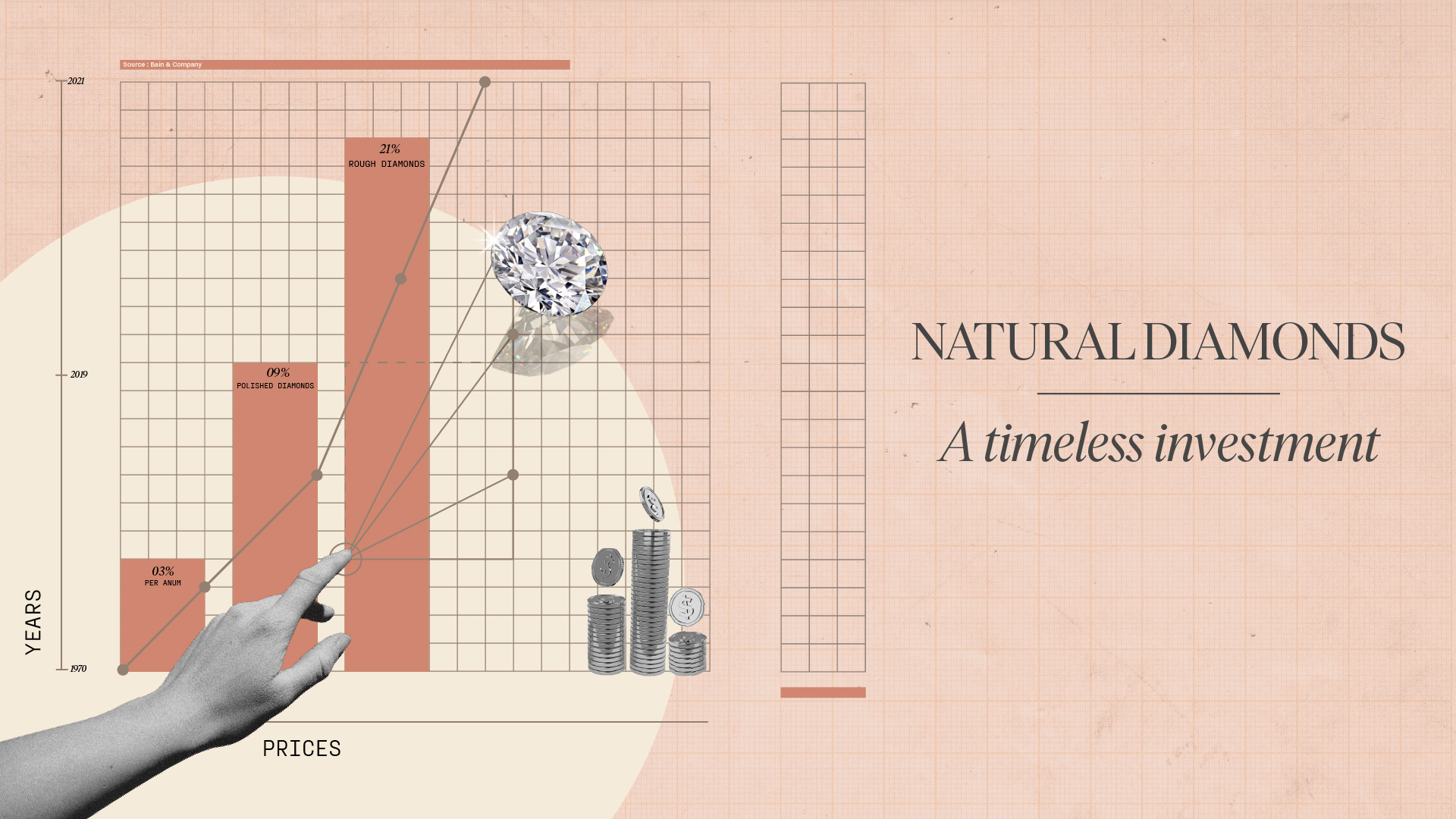
Historically, polished natural diamonds have functioned more effectively as a wealth-preservation vehicle and inflation hedge than as a high-growth speculative asset. Unlike equities, which generate dividends and corporate earnings, or real estate, which produces rental income, diamonds generate no cash flow. Their economic return relies exclusively on capital appreciation driven by rising extraction costs, diminishing major mine discoveries, and shifting global consumer wealth.
Data compiled across multi-decade periods shows that while top-tier, rare investment diamonds tend to preserve purchasing power through economic downturns, mainstream diamond categories can experience prolonged flat performance or downward corrections. Investors should also factor in the carrying costs of diamond ownership, which include secure vault storage fees, specialized insurance policies, and periodic appraisal expenses.
Common Pitfalls for Novice Investors
Entering the diamond market without deep industry expertise exposes buyers to substantial financial risk. Common mistakes include:
- Buying Retail Jewelry: Paying retail markups guarantees an immediate capital loss upon purchase, as the secondary market values stones at wholesale rates.
- Ignoring Market Trends: Tastes shift across global markets. Over-focusing on specific shapes or sizes that fall out of favor can severely impair resale potential.
- Neglecting Storage and Insurance: Keeping high-value portable assets at home without adequate insurance or bank-grade vault storage introduces catastrophic theft or loss risks.
- Failing to Verify Provenance: Ensuring ethical sourcing through the Kimberley Process certification scheme protects against acquiring conflict diamonds and maintains regulatory compliance.
Professional Advice and Portfolio Allocation
Disclaimer: The following information is for educational purposes and does not constitute formal financial, tax, or legal advice. Precious stones and alternative assets carry unique market risks, and individuals should consult qualified wealth advisors before altering their asset allocation.
For accredited investors and high-net-worth individuals exploring alternative assets, diamonds should represent a very small, highly conservative fraction—typically less than 1% to 3%—of an overall diversified portfolio. They serve primarily as private, portable stores of wealth rather than instruments for short-term capital growth. Diligent research, reliance on top-tier GIA certification, and partnership with trusted trade professionals are indispensable prerequisites for anyone navigating this specialized asset class.
Image Gallery