UC Berkeley's Reputation and Ranking: A Comprehensive Analysis
UC Berkeley maintains a powerhouse global reputation, consistently ranking among the top public universities worldwide and frequently competing with elite Ivy League private institutions in research output, academic prestige, and gradu...
UC Berkeley maintains a powerhouse global reputation, consistently ranking among the top public universities worldwide and frequently competing with elite Ivy League private institutions in research output, academic prestige, and graduate employability.
Contents
Evaluating a major institution requires looking beyond a single metric. University prestige is shaped by a complex matrix of global academic reputation, research citation impact, selectivity metrics, alumni outcomes, and subject-specific excellence. For prospective students, researchers, and employers, understanding how the University of California, Berkeley performs across major domestic and international evaluation systems clarifies its actual standing in higher education.
The Foundations of UC Berkeley’s Global Prestige
The reputation of the University of California, Berkeley, is built upon a legacy of groundbreaking academic research, Nobel laureates, and historic contributions to science, humanities, and social movements. Founded in 1868, it serves as the flagship campus of the ten-campus University of California system. Its historical commitment to accessible, high-caliber public education has continually challenged the traditional dominance of private elite institutions.
Academic prestige is heavily anchored in faculty achievement. The campus community includes numerous Nobel laureates, Turing Award winners, Fields Medalists, and MacArthur Fellows. This concentration of intellectual capital drives high volumes of peer-reviewed research, attracting billions of dollars in federal and private research grants annually. Consequently, bibliometric indicators—such as total publications and citation counts—frequently place Berkeley near the absolute peak of global academic influence.
Breakdown of Major University Rankings
Different ranking publications emphasize distinct methodologies. Understanding how these methodologies apply to Berkeley helps decode why its position shifts slightly between domestic service providers and international organizations.
Domestic vs. International Methodologies
Domestic rankings, such as U.S. News & World Report, heavily weight undergraduate selectivity, graduation rates, financial resources per student, and peer assessment surveys completed by administrators at other universities. International systems, such as the Academic Ranking of World Universities (ARWU) and the Times Higher Education (THE) World University Rankings, place much higher emphasis on research volume, citation impact, international faculty ratios, and global reputation among academics.
Because Berkeley is a massive public research institution with a large undergraduate cohort, it sometimes faces disadvantages in student-to-faculty ratio metrics compared to heavily endowed private liberal arts colleges. Conversely, its massive research enterprise allows it to dominate international tables that measure pure scholarly output and global peer recognition.
Comparative Academic Standing
| Ranking Organization | Primary Focus | General Standing | Key Strengths |
|---|---|---|---|
| U.S. News & World Report (National) | Undergraduate focus, peer assessment, outcomes | Top public university / Top 20 overall | Public university leadership, engineering, computer science |
| Times Higher Education World Rankings | Teaching, research, citations, international outlook | Global Top 10 | Research influence, physical sciences, social sciences |
| Academic Ranking of World Universities (ARWU) | Research output, Nobel laureates, publications | Global Top 5 | Faculty achievements, scientific citations |
| QS World University Rankings | Academic reputation, employer reputation, citations | Global Top 15 to 20 | Employer outcomes, international research networks |
Research Impact and Innovation Ecosystem
Research output is the primary engine driving Berkeley’s international reputation. The university operates or co-manages multiple Department of Energy national laboratories, including the Lawrence Berkeley National Laboratory and Lawrence Livermore National Laboratory, which expand its scientific footprint far beyond standard campus boundaries.
In fields like computer science, physics, chemistry, economics, and environmental engineering, Berkeley faculty and researchers frequently pioneer new paradigms. The discovery of multiple chemical elements on the periodic table, foundational developments in open-source computing, and breakthrough advancements in CRISPR gene editing technology highlight an institutional culture oriented toward transformative scientific discovery. This robust research environment directly benefits graduate education and provides undergraduates with unique opportunities to participate in high-level investigations early in their academic careers.
Selectivity, Admissions, and Student Quality
The prestige of a university is tightly correlated with the competitiveness of its admissions process and the academic caliber of its incoming student body. UC Berkeley receives hundreds of thousands of applications annually for its undergraduate and graduate programs, making it one of the most sought-after higher education destinations globally.
Undergraduate Admissions Landscape
Admissions criteria at Berkeley are comprehensive, evaluating holistic student profiles that include academic GPA, course rigor, personal insight questions, and extracurricular achievements. Because of extreme demand, overall acceptance rates remain highly selective, particularly for out-of-state and international applicants. Admitted students typically rank at the very top of their high school graduating classes, creating a peer environment characterized by intense academic motivation and intellectual engagement.
Graduate and Professional Program Selectivity
At the graduate level, professional schools such as the Haas School of Business, Berkeley Law, the College of Engineering, and various doctoral programs in the humanities and basic sciences maintain acceptance rates comparable to or lower than many Ivy League counterparts. These programs draw top-tier talent from around the world, reinforcing the institution's reputation as a global hub for advanced professional training.
Employer Perception and Graduate Employability
Beyond academic metrics, reputation is heavily validated by how corporate recruiters, tech conglomerates, academic institutions, and public sector organizations view Berkeley graduates.
Global employer reputation surveys consistently place UC Berkeley among the top institutions worldwide. Proximity to Silicon Valley gives its computer science, data science, and business graduates a distinct advantage in the technology and venture capital sectors. At the same time, alumni networks span global financial institutions, biotechnology firms, government agencies, and non-profit organizations, ensuring strong professional mobility across diverse career trajectories.
Strengths Across Key Academic Disciplines
While the university is recognized broadly for academic excellence, certain departments and colleges drive a disproportionate share of its reputation.
- Engineering and Computer Science: Consistently ranked among the top programs globally, known for pioneering computer architecture, artificial intelligence research, and civil engineering innovations.
- Basic Sciences and Mathematics: Globally renowned for physics, chemistry, and biological sciences, bolstered by close ties to national research laboratories.
- Social Sciences and Humanities: Leading programs in economics, sociology, history, and English, characterized by strong theoretical foundations and public policy impact.
- Business: The Haas School of Business commands immense respect for entrepreneurship, finance, and corporate strategy.
Common Misconceptions Regarding Public University Rankings
Navigating university reputation data often involves cutting through common myths. A frequent misunderstanding is that large public universities offer lower academic quality due to large lecture sizes in introductory courses. While introductory classes can feature hundreds of students, upper-division coursework transitions to smaller seminar settings taught by leading experts. Furthermore, large public institutions often provide significantly broader course catalogues and research funding opportunities than smaller private colleges.
Another misconception is that domestic rankings capture the entirety of an institution's value. A school may rank lower on domestic undergraduate metrics due to state-mandated enrollment caps or funding constraints while simultaneously ranking in the global top ten for research citations and peer academic respect.
Frequently Asked Questions
Is UC Berkeley considered an Ivy League school?
No, UC Berkeley is not an Ivy League institution. The Ivy League is an athletic conference consisting of eight private universities in the Northeastern United States (such as Harvard, Yale, and Princeton). However, Berkeley matches or exceeds many Ivy League institutions in academic prestige, research output, and global reputation.
How does UC Berkeley rank compared to other public universities?
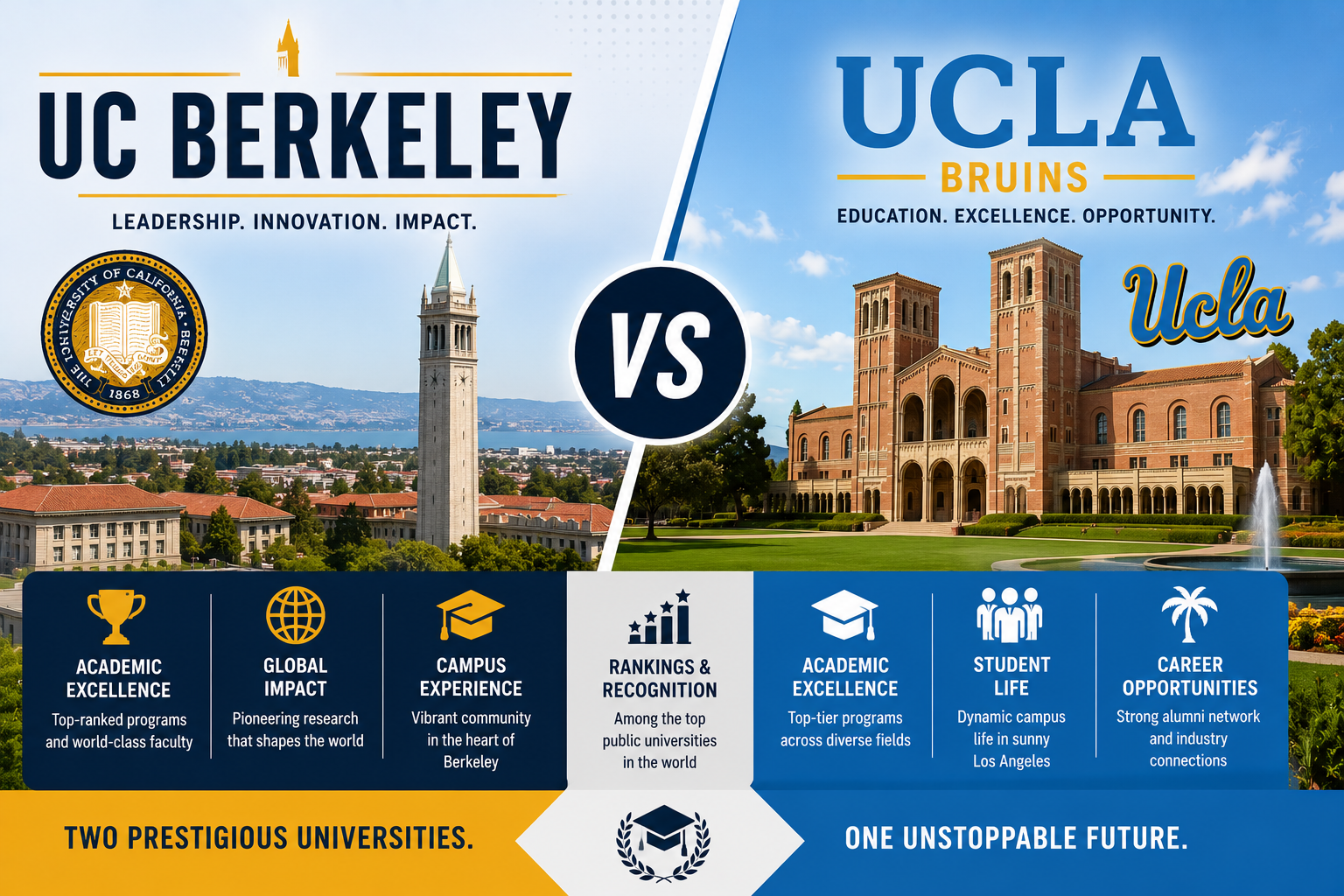
UC Berkeley consistently vies with the University of California, Los Angeles (UCLA) for the top spot among public universities in the United States according to major domestic publications like U.S. News & World Report.
Why do international rankings often place Berkeley higher than domestic rankings?
International rankings heavily weight research output, citation frequency, and global academic reputation surveys. Because Berkeley operates a massive research enterprise with high citation counts and global scholarly impact, it performs exceptionally well on international metrics.
Does attending UC Berkeley help with job placement after graduation?
Yes. Employers globally recognize the rigorous academic standards of the university. Strong career services, robust alumni networks in major employment hubs, and deep recruiting pipelines with technology, finance, and research organizations provide graduates with significant professional advantages.
How has Berkeley's reputation changed over recent years?
Berkeley's reputation has remained remarkably stable at the elite tier of global higher education. While fluctuating slightly year-to-year in specific algorithmic rankings, its core standing as a premier public research university remains secure.
Next Steps for Prospective Students and Researchers
For students evaluating undergraduate or graduate admission, relying on broad reputational scores alone is insufficient. Applicants should examine department-specific faculty profiles, research funding availability, graduation outcomes, and financial aid structures. Prospective graduate researchers should review citation indices and laboratory partnerships associated with their specific fields of study to align their academic goals with the university's strongest operational areas.
Image Gallery