How Earnest Money Works for Mortgage Loans in 2026
In a mortgage transaction, earnest money serves as a "good faith" deposit that demonstrates a buyer's commitment to the seller. While it is paid upfront when a sales contract is signed, the funds are held in escrow and ultimately appli...
In a mortgage transaction, earnest money serves as a "good faith" deposit that demonstrates a buyer's commitment to the seller. While it is paid upfront when a sales contract is signed, the funds are held in escrow and ultimately applied toward your down payment or closing costs at settlement, reducing the total cash you must bring to the final closing table.
Contents
The Role of Earnest Money in Real Estate Transactions
Earnest money is often described as the "deposit" on a home, but it functions differently than a standard security deposit or a down payment. When you find a property and submit an offer, the seller takes the home off the market based on your promise to buy it. To ensure you do not walk away without a valid reason, you provide a sum of money—the earnest money—to be held by a neutral third party, such as a title company or an escrow agent.
In 2026, the real estate market continues to prioritize financial transparency and security. Earnest money acts as a financial buffer for the seller. If the buyer breaches the contract terms, the seller may be entitled to keep this deposit as liquidated damages for the time the property was unavailable to other potential buyers. Conversely, if the deal proceeds to closing, the money is not "lost" or "spent"; it is credited back to the buyer's side of the ledger.
The amount required for an earnest money deposit (EMD) typically ranges from 1% to 3% of the purchase price, though this can fluctuate based on local market conditions and the level of competition. In highly competitive urban markets, a higher EMD—sometimes up to 5% or 10%—may be necessary to make an offer stand out among multiple bidders.
How Lenders Verify and Credit Earnest Money
From a mortgage lender's perspective, earnest money is a critical component of the "cash to close" calculation. However, because mortgage lending is strictly regulated to prevent fraud and money laundering, the lender must meticulously document the source and movement of these funds.
The Sourcing and Seasoning Process
Lenders follow "Anti-Money Laundering" (AML) guidelines and requirements set by entities like Fannie Mae, Freddie Mac, or the FHA. When you pay earnest money, the lender will require proof that the funds came from your own accounts or an acceptable source (like a documented gift).
To verify this, you will typically need to provide:
- A copy of the earnest money check or a wire transfer confirmation.
- Bank statements showing the funds leaving your account.
- Evidence of "seasoning," which confirms the money has been in your account for at least 60 days. If the funds were a recent large deposit, you must provide a "paper trail" explaining where that money originated (e.g., a tax refund, a bonus, or the sale of another asset).
The "Credit" at Closing
Once the lender verifies that the earnest money was paid from a legitimate source, they include it in the Closing Disclosure (CD). The Closing Disclosure is the final document that outlines all loan terms and costs. On this form, you will see a line item for the earnest money deposit. This amount is subtracted from the total amount you owe for the down payment and closing costs.
For example, if you are buying a $500,000 home with a 10% down payment ($50,000) and you paid $10,000 in earnest money, the lender will only require you to bring $40,000 (plus closing costs) to the settlement table.
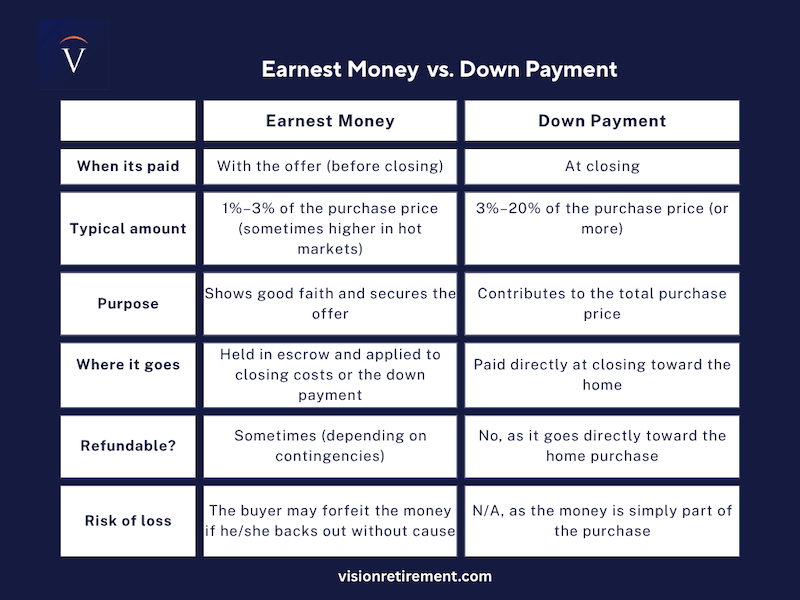
Earnest Money vs. Down Payment: Key Distinctions
It is a common misconception that earnest money and down payments are two entirely separate costs. In reality, earnest money is a prepayment of a portion of your down payment.
| Feature | Earnest Money Deposit (EMD) | Down Payment |
|---|---|---|
| When it is paid | When the purchase agreement is signed. | At the final closing/settlement. |
| Who holds the funds | A third-party escrow agent or title company. | Paid directly to the lender/settlement agent. |
| Primary Purpose | To show "good faith" and secure the contract. | To establish equity in the home for the loan. |
| Typical Amount | 1% to 3% of the purchase price. | 3% to 20%+ depending on the loan type. |
| Refundability | Refundable only if specific contingencies are met. | Not applicable; it is part of the final purchase. |
| Lender Requirement | Must be verified/sourced by the lender. | Must be verified/sourced by the lender. |
Protecting Your Earnest Money via Contingencies
Because earnest money is a significant sum, buyers must use "contingencies" within the real estate contract to protect these funds. A contingency is a condition that must be met for the sale to proceed. If a contingency is not met, the buyer can typically withdraw from the deal and receive a full refund of their earnest money.
The Financing Contingency
This is the most important protection for your loan process. A financing contingency states that the purchase is dependent on the buyer securing a mortgage. In 2026, lenders are more rigorous with final approvals. If your loan is denied—perhaps due to a change in interest rates, an unexpected dip in your credit score, or an issue with the property—the financing contingency allows you to walk away with your earnest money intact.
The Appraisal Contingency
Lenders will not loan more money than a property is worth. If the professional appraisal comes in lower than the agreed-upon purchase price, a gap is created. The appraisal contingency allows the buyer to renegotiate the price or cancel the contract and recover their earnest money if the seller refuses to lower the price to the appraised value.
The Home Inspection Contingency
If a professional inspection reveals significant structural issues, mold, or safety hazards, the inspection contingency allows the buyer to request repairs, ask for a credit, or cancel the deal. This is a common point where earnest money is protected, as buyers may decide the "true cost" of the home is too high given the necessary repairs.
Common Mistakes to Avoid with Earnest Money
Navigating the earnest money process requires precision. Errors can lead to delays in loan approval or, in the worst-case scenario, the forfeiture of your deposit.
- Using Cash or Unverifiable Funds: Never pay your earnest money in physical cash. Lenders cannot verify the source of physical currency, which can lead to the lender disqualifying those funds from being used toward your down payment. Always use a personal check, cashier's check, or wire transfer.
- Missing Contract Deadlines: Real estate contracts are "time is of the essence" documents. If you have a 10-day window to complete an inspection and you wait until day 11, you may have waived your right to cancel based on that inspection, putting your earnest money at risk.
- Opening New Credit Lines: Between the time you pay your earnest money and the time you close the loan, do not take out new loans or credit cards. If your debt-to-income ratio changes and your loan is denied after your financing contingency period has expired, you will likely lose your earnest money.
- Moving Money Between Accounts: Try to keep the funds for your earnest money and down payment in one account. Moving large sums between multiple bank accounts creates a "paperwork nightmare" for the lender's underwriter, who must then source every single transfer to ensure no "undisclosed debt" was used to fund the purchase.
The Escrow Process: Where the Money Goes
When you hand over your earnest money check, it does not go to the seller's personal bank account. If it did, the buyer would have very little leverage if the seller decided to back out of the deal. Instead, the funds enter an escrow account.
An escrow account is a neutral holding area managed by a third party. In most states, this is a title insurance company, an escrow firm, or a real estate brokerage's trust account. The escrow agent has a fiduciary duty to both the buyer and the seller to follow the instructions laid out in the purchase agreement. They cannot release the funds to the seller unless the deal closes or the buyer breaches the contract. Similarly, they cannot return the funds to the buyer unless the seller agrees or a court orders the release.
In 2026, digital escrow services have become the standard. These platforms allow buyers to deposit earnest money via secure portals, providing an immediate digital trail that lenders can use for verification, which often speeds up the underwriting process by several days.
Frequently Asked Questions
Can I get my earnest money back if I change my mind?
Generally, no. If you simply decide you no longer like the house or found a better one, you are likely in breach of contract. Earnest money is specifically designed to prevent "buyer's remorse" from hurting the seller. You can only get the money back if you cancel based on a specific, unfulfilled contingency, such as a failed inspection or a loan denial.
What happens to the earnest money if the seller backs out?
If the seller decides to cancel the sale for a reason not allowed by the contract, the buyer is entitled to a full refund of their earnest money. In some jurisdictions, the buyer may also be able to sue for "specific performance," forcing the seller to complete the sale, or seek additional damages for the breach of contract.
Is earnest money required for a VA or USDA loan?
While VA and USDA loans offer 0% down payment options, sellers still usually expect an earnest money deposit to take the home off the market. If you are using a 0% down loan, the earnest money you pay at the start will be applied toward your closing costs. If your earnest money exceeds the total closing costs, you may actually receive a check back for the difference at the closing table.
How much earnest money should I offer in 2026?
The "right" amount depends on the local market and the seller's expectations. A standard starting point is 1% to 2% of the purchase price. However, if you are in a "seller's market" with limited inventory, offering a larger deposit (e.g., 3% to 5%) can signal to the seller that you are a highly qualified buyer with strong financial backing, which can be the deciding factor in getting your offer accepted.
Does the earnest money earn interest?
In most standard residential transactions, the earnest money is held in a non-interest-bearing escrow account. Because the funds are usually only held for 30 to 60 days, the interest earned would be negligible. However, for very large commercial transactions or long-term developments, the parties may agree to place the funds in an interest-bearing account.
Final Recommendation
When navigating the complexities of earnest money and mortgage loans, the best path forward is early communication and meticulous documentation. Ensure your earnest money is paid from an account you have already disclosed to your lender, and keep every receipt and bank statement associated with the transfer. Before signing a contract, review the contingency dates with your real estate agent to ensure you have enough time for your lender to complete the appraisal and final loan approval. By aligning your earnest money deposit with strong contractual protections, you can secure your dream home while keeping your financial interests safe.
Image Gallery