U.S. Net Worth Demographics: Breakdown by Age, Income, and Race
U.S. net worth demographics reveal significant wealth disparities across age groups, education levels, races, and income brackets. According to official data from the Federal Reserve’s Survey of Consumer Finances, median household net...
U.S. net worth demographics reveal significant wealth disparities across age groups, education levels, races, and income brackets. According to official data from the Federal Reserve’s Survey of Consumer Finances, median household net worth stands at approximately $192,900, while the mean net worth exceeds $1,063,700. Age, homeownership, and educational attainment remain the primary drivers of wealth accumulation in America.
Contents
Understanding U.S. Net Worth: Median vs. Mean Metrics
Net worth measures an individual’s or household’s financial standing by subtracting total liabilities (such as mortgages, credit card debt, student loans, and auto loans) from total asset values (including real estate, investment accounts, cash reserves, vehicles, and business equity). When analyzing demographic trends in the United States, economists rely primarily on two key metrics: median net worth and mean net worth.
The median represents the exact midpoint of the economic spectrum—50 percent of American households possess a higher net worth, and 50 percent possess a lower net worth. Median values provide the most accurate representation of a typical American household because extreme outliers do not skew the figure. In contrast, mean net worth divides the nation’s total wealth by the total number of households. Because ultra-high-net-worth individuals hold a disproportionate share of total national assets, the mean net worth is significantly higher than the median figure.
Understanding this distinction is critical for evaluating socioeconomic benchmark data. For instance, while mean net worth across all U.S. households exceeds $1 million, fewer than 20 percent of households actually possess a net worth of $1 million or more.
Net Worth Demographics by Age Group
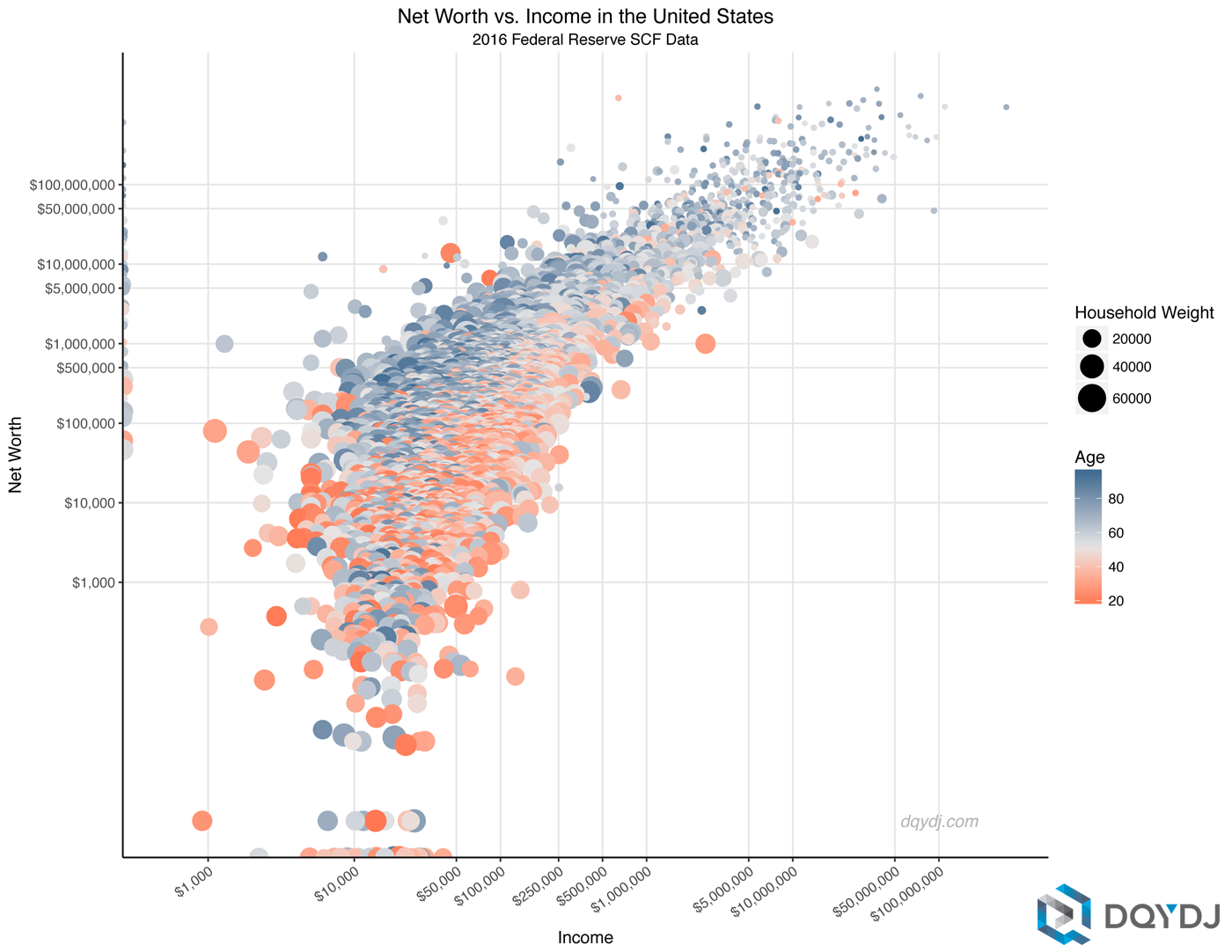
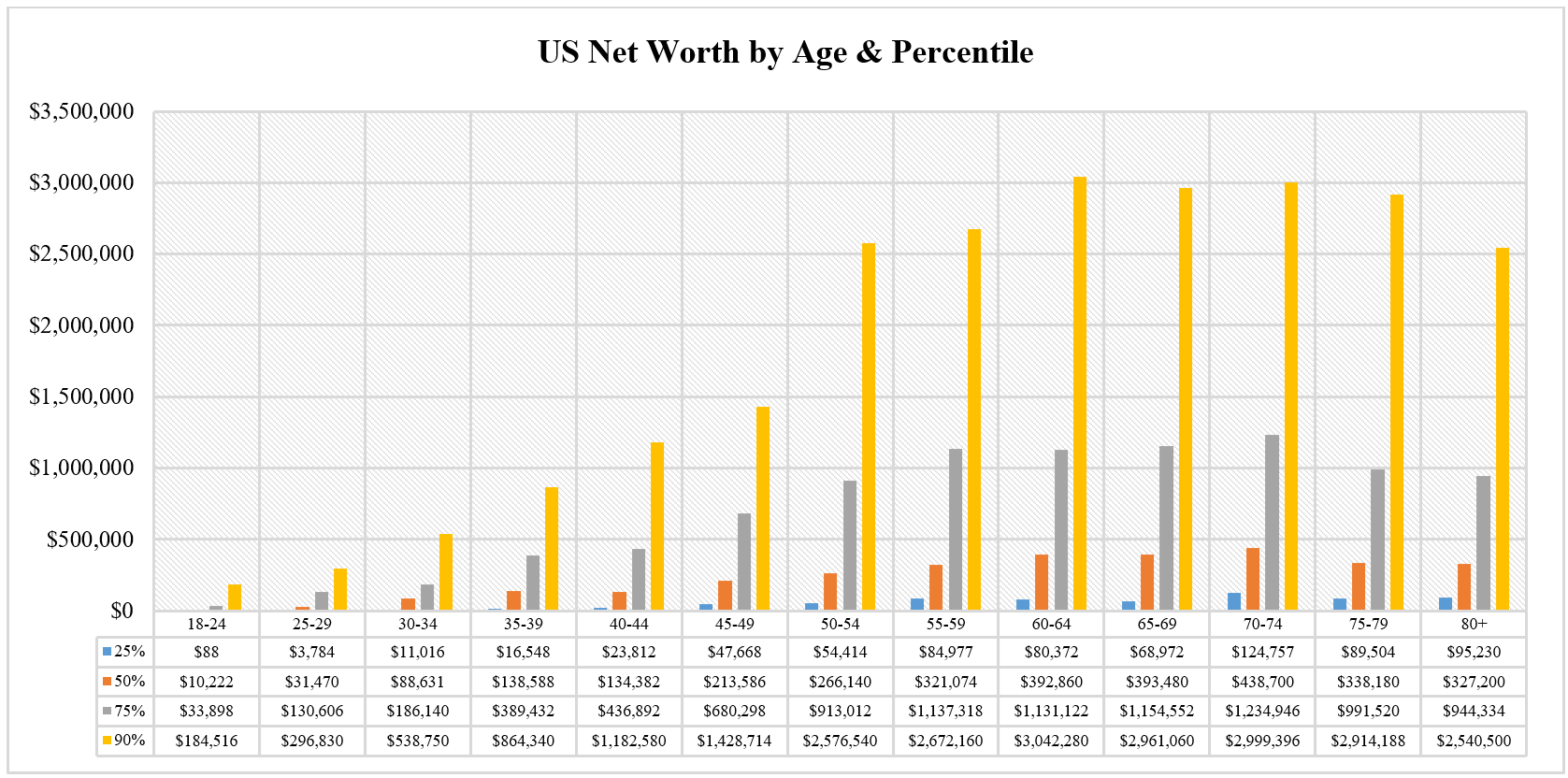
Wealth accumulation in the United States follows a distinct lifecycle trajectory. Young adults typically begin their working careers with minimal savings, higher relative debt obligations (such as student loans), and lower earning potential. As workers gain professional experience, advance in their careers, pay down primary debts, and benefit from compound growth in retirement accounts and residential real estate equity, net worth increases significantly. Peak net worth generally occurs during early retirement before decumulation begins.
Data from the Federal Reserve Survey of Consumer Finances illustrates how household net worth shifts across age brackets:
| Age Bracket | Median Net Worth | Mean Net Worth | Key Financial Drivers |
|---|---|---|---|
| Under 35 | $39,000 | $183,500 | Early retirement contributions, student loan debt, initial real estate purchases |
| 35–44 | $135,600 | $549,600 | Career advancement, mortgage amortization, growing home equity |
| 45–54 | $247,200 | $975,800 | Peak earning capacity, accelerated investment account growth |
| 55–64 | $364,500 | $1,566,900 | Pre-retirement consolidation, catch-up contributions, paid-down mortgages |
| 65–74 | $409,900 | $1,794,600 | Peak accrued wealth, commencement of retirement withdrawals |
| 75 and Older | $335,600 | $1,624,100 | Portfolio decumulation, healthcare expenses, estate distribution planning |
Under Age 35
Households led by individuals under age 35 often face initial financial hurdles, including entry-level salaries, high rental housing costs, and educational debt. However, early adoption of employer-sponsored retirement plans, such as 401(k) accounts, and disciplined saving habits allow younger demographics to build foundation wealth that benefits from long-term compound interest.
Ages 35 to 54
Middle-aged households usually undergo rapid net worth expansion. During these two decades, primary earnings typically reach their peak. As homeowners pay down mortgage principal and benefit from long-term property appreciation, primary residential equity becomes a major component of net worth. Simultaneously, compounding investment returns accelerate portfolio values in tax-advantaged accounts like IRAs and 401(k)s.
Ages 65 and Older
Net worth reaches its maximum statistical level in the 65-to-74 age range. At this stage, many Americans have paid off primary mortgages and accumulated substantial balances in qualified retirement plans. For households aged 75 and older, median net worth declines slightly as retirees draw down principal balances to support daily living expenses, manage long-term care needs, or make financial gifts to heirs.
Wealth Demographics by Race and Ethnicity
Demographic research published by the Federal Reserve and the U.S. Census Bureau highlights structural disparities in wealth distribution across racial and ethnic lines. These disparities stem from systemic historical factors, unequal access to homeownership, differences in intergenerational wealth transfer, and disparities in business ownership rates.
- White (Non-Hispanic) Households: Possess a median net worth of approximately $285,000. Higher rates of historical homeownership, greater access to inheritance assets, and higher participation in stock market investments contribute to this benchmark.
- Asian Households: Report a median net worth exceeding $536,000 in dedicated sub-group studies, supported by high average levels of educational attainment, higher median household incomes, and strong real estate holdings in major urban markets.
- Hispanic Households: Possess a median net worth of approximately $61,600. While Hispanic wealth creation has outpaced several national growth benchmarks in recent years—driven by rising entrepreneurship and homeownership—the overall median figure reflects lower historical baseline assets.
- Black (Non-Hispanic) Households: Possess a median net worth of approximately $44,900. Factors such as lower historic rates of homeownership, lower rates of employer-sponsored retirement account access, and lower average inheritance transfers keep the median figure below the national baseline.
Addressing racial wealth disparities remains a focal point for economists and policy researchers. Targeted initiatives focused on equalizing access to affordable mortgage credit, enhancing financial literacy programs, expanding access to capital for minority entrepreneurs, and broadening access to employer-sponsored retirement programs serve as critical avenues for closing these structural gaps.
Impact of Education and Homeownership on Household Wealth
Two specific demographic variables hold the strongest predictive value for an American household's net worth: higher education attainment and primary homeownership status.
Key Determinants of U.S. Household Wealth
- Educational Attainment
- Graduate/College Degree: Higher lifetime earnings & investments
- High School Diploma: Limited access to equity compensation
- Housing Status
- Homeowners: Forced savings via mortgage debt amortization
- Renters: Miss out on home equity and property appreciation
Educational Attainment
Educational attainment correlates directly with lifetime earning capacity and personal balance sheet strength:
- No High School Diploma: Households led by an individual without a high school diploma have a median net worth of roughly $44,000.
- High School Diploma: Median net worth increases to approximately $106,800.
- Some College or Associate Degree: Median net worth rises to roughly $137,800.
- Bachelor’s Degree or Higher: Households with a college degree achieve a median net worth of approximately $461,000—more than four times the net worth of high school-only households.
Higher educational attainment grants access to career tracks that offer higher base salaries, equity compensation, structured bonus incentives, and robust benefits packages containing employer-matched 401(k) contributions.
Homeownership Status
Housing equity represents the largest single asset category for middle-class American families. The gap between homeowners and renters remains stark:
- Homeowners: Median net worth is approximately $396,200.
- Renters: Median net worth stands at approximately $10,400.
Homeownership acts as an automated savings mechanism. Monthly mortgage payments reduce loan principal while building housing equity over time. Additionally, long-term real estate appreciation provides a natural inflation hedge that renters cannot leverage.
Wealth Percentiles in the United States
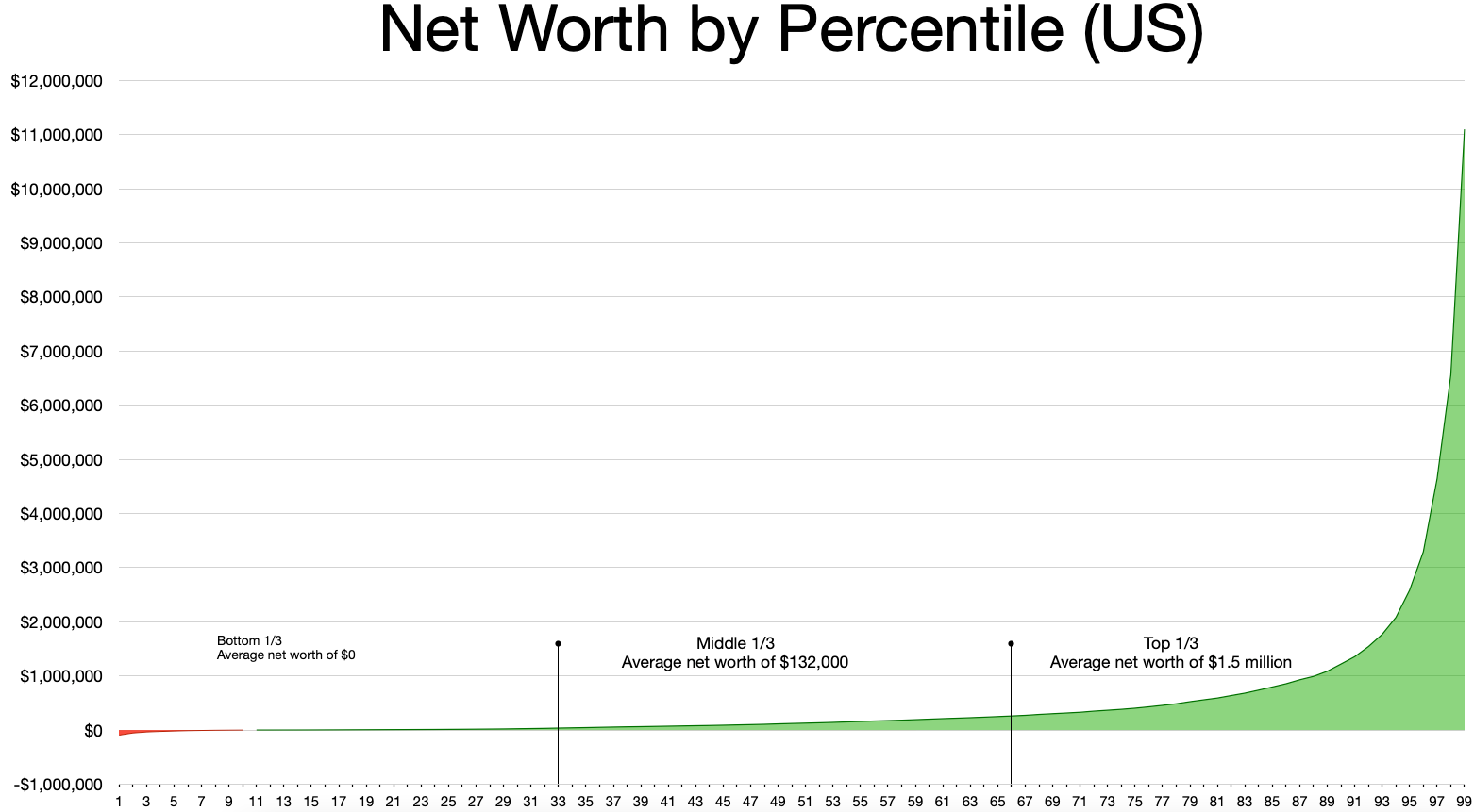
Wealth concentration in the United States is highly skewed toward top-tier brackets. The thresholds required to enter specific wealth percentiles highlight the steep upward trajectory of American economic distribution:
- Top 50th Percentile (Median): $192,900
- Top 25th Percentile: $537,800
- Top 10th Percentile: $1,921,000
- Top 5th Percentile: $3,790,000
- Top 1st Percentile: $13,660,000
While the bottom 50 percent of American households combined hold approximately 2.5 percent of total national wealth, the top 10 percent of households hold over 66 percent of overall wealth. The top 1 percent alone holds roughly 30 percent of total national wealth. Higher percentiles hold a significantly larger proportion of financial assets—such as direct stock ownership, private business equity, and corporate bonds—whereas lower and middle percentiles hold the majority of their net worth in primary residential real estate and cash deposits.
Applying Demographic Data to Personal Financial Planning
Comparing your net worth to national demographic averages offers a valuable baseline, but broad averages should not be viewed as absolute rules for individual success. Differences in geographical cost of living, household composition, pension access, and health factors affect individual balance sheet requirements.
To build and preserve wealth across any demographic group, implement these core financial actions:
- Calculate Baseline Net Worth Regularly: List all liquid and non-liquid assets (bank accounts, investment accounts, home equity, vehicles) and subtract all outstanding liabilities (mortgages, personal debt, student loans). Reevaluate this calculation semi-annually.
- Maximize Employer Retirement Contributions: Take full advantage of matching contributions in 401(k) or 403(b) plans. Employer matches offer immediate, guaranteed returns on your contributions.
- Transition from Liquid Savings to Income-Producing Assets: Holding excess wealth in cash drag reduces purchasing power due to inflation. Reinvest surplus cash reserves into diversified stock index funds, fixed-income instruments, or real estate.
- Manage High-Interest Debt: Prioritize paying down consumer debt carrying high interest rates, such as credit card balances and high-rate personal loans, which erode personal net worth over time.
- Establish Adequate Insurance Coverage: Protect personal balance sheets against catastrophic health issues, disability, or liability claims by maintaining comprehensive health, life, property, and umbrella insurance coverage.
Disclaimer: This article is provided for informational and educational purposes only and does not constitute formal financial, investment, legal, or tax advice. Individuals should consult a qualified financial advisor, CPA, or estate planning attorney regarding their specific financial circumstances.
Frequently Asked Questions
What is the median net worth of an American household?
The median net worth of a U.S. household is approximately $192,900. This metric represents the midpoint of national household wealth, meaning half of U.S. households have a higher net worth and half have a lower net worth.
Why is the mean net worth in the U.S. so much higher than the median?
The mean net worth (exceeding $1,063,700) is significantly higher than the median because it is skewed upward by ultra-wealthy households. High-net-worth individuals holding billions of dollars in stock, business equity, and real estate pull the average up, while the median reflects the exact midpoint of the population.
How much net worth is required to be in the top 1% in the U.S.?
To enter the top 1 percent of U.S. net worth, a household needs a minimum net worth of approximately $13.66 million. This threshold varies slightly depending on asset market valuations and economic conditions.
How does homeownership affect personal net worth?
Homeownership significantly increases net worth. The median net worth of American homeowners is roughly $396,200, compared to just $10,400 for renters. Homeownership serves as a forced savings tool through debt amortization and provides long-term asset appreciation.
At what age do Americans typically reach their peak net worth?
Americans typically reach their peak net worth between the ages of 65 and 74, when the median household net worth reaches approximately $409,900. After age 75, median net worth generally decreases as retirees spend down savings to cover living and medical expenses.
Practical Next Steps
To improve your personal financial standing relative to national demographic benchmarks, take immediate action to optimize your balance sheet:
- Perform an accurate net worth inventory by identifying all real assets and subtracting current debt obligations.
- Automate recurring monthly transfers into long-term investment accounts to capture market compounding.
- Schedule a consultation with a fee-only Certified Financial Planner (CFP) to build a personalized wealth management strategy aligned with your retirement timeline.
Image Gallery