How Cheap Auto Insurance in Minneapolis Is Calculated
Cheap auto insurance in Minneapolis is calculated using actuarial risk formulas that combine Minnesota’s state-mandated coverage minimums with localized personal data. Insurers establish a baseline rate based on compulsory No-Fault (PI...
Cheap auto insurance in Minneapolis is calculated using actuarial risk formulas that combine Minnesota’s state-mandated coverage minimums with localized personal data. Insurers establish a baseline rate based on compulsory No-Fault (PIP), liability, and uninsured motorist coverage, then adjust that figure using your Minneapolis ZIP code, credit-based insurance score, driving record, vehicle repair costs, and annual mileage.
Contents
Disclaimer
Auto insurance regulations, statutory minimums, and underwriting guidelines in Minnesota are overseen by the Minnesota Department of Commerce. The information provided in this guide is for educational purposes and does not constitute formal legal or financial advice. Insurance rates vary by carrier and individual risk profile.
The Core Actuarial Formula Behind Minneapolis Car Insurance Rates
Car insurance pricing is not arbitrary. Auto insurance companies operating in Minnesota calculate baseline quotes through complex underwriting models designed to predict the likelihood and cost of future claims.
To determine what constitutes a "cheap" policy for an individual driver, an insurer begins with a pure premium—the baseline dollar amount required to cover expected losses across a large group of insured drivers—and applies a series of multiplying risk factors:
$$\text{Final Premium} = \text{Base Rate} \times \text{Driver Risk Multiplier} \times \text{Location Factor} \times \text{Vehicle Symbol Factor} - \text{Discounts}$$
Understanding each component of this equation reveals why two drivers living only a few miles apart in Hennepin County can receive wildly different auto insurance quotes for identical vehicles.
Minnesota Legal Requirements: The Mandatory Coverage Baseline
Before an insurance provider factors in your personal background or driving history, it calculates the cost to cover Minnesota's legal minimum requirements. Minnesota is a no-fault insurance state, meaning that after an accident, your own insurance policy pays for your personal medical expenses regardless of who caused the crash.
Under Minnesota Statute § 65B.49, every auto policy issued in Minneapolis must include four specific coverage types. The sum of these core coverages forms the absolute lowest cost threshold for a legal auto insurance policy:
| Coverage Type | Limit / Details |
|---|---|
| 1. Personal Injury Protection (PIP) | $40,000 total per person- Medical Expenses: $20,000- Non-Medical (Lost Wages/Services): $20,000 |
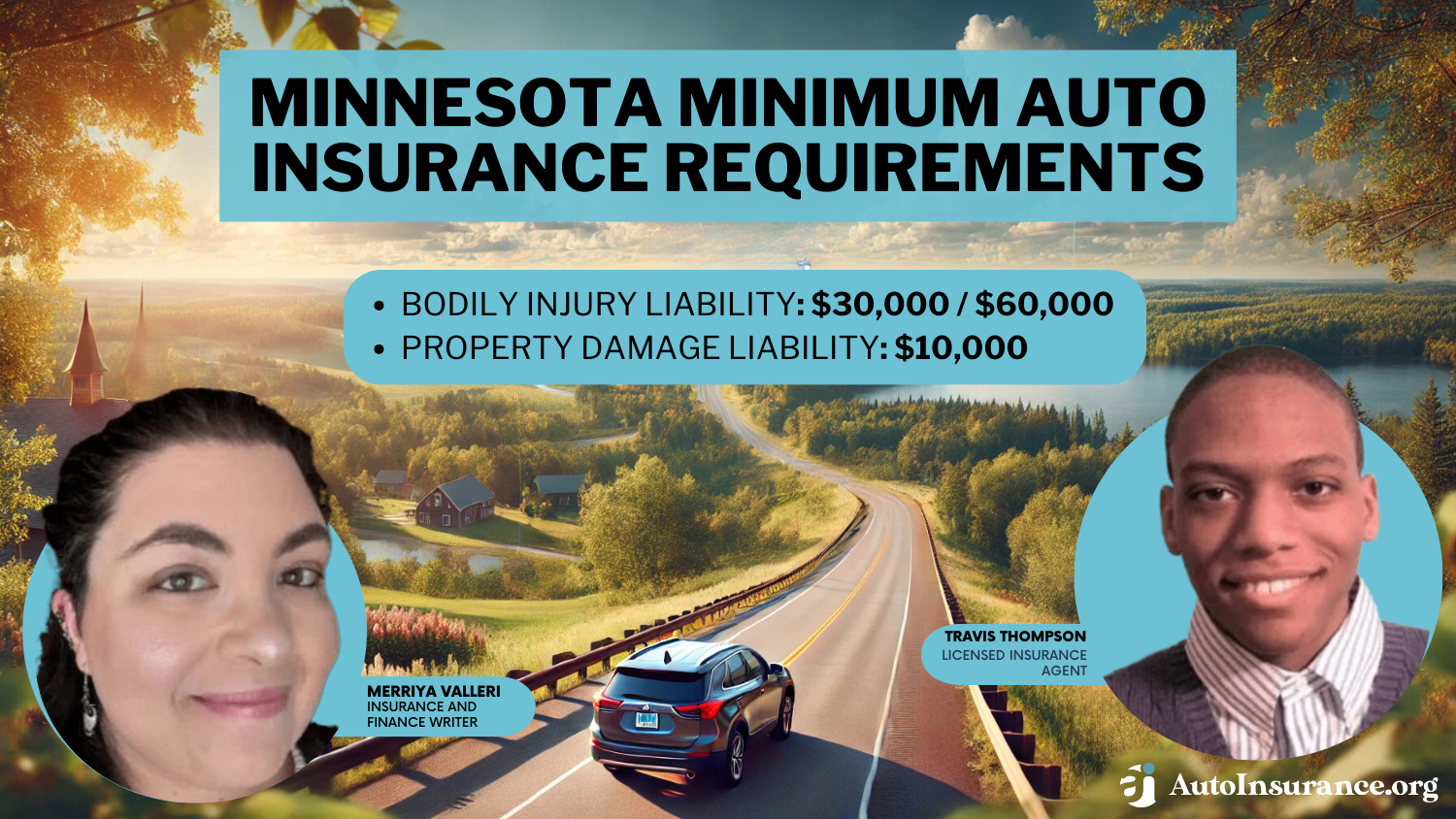
| 2. Liability Coverage (30/60/10) | - Bodily Injury per Person: $30,000- Bodily Injury per Accident: $60,000- Property Damage per Accident: $10,000 |
| 3. Uninsured Motorist (UM) | $25,000 / $50,000 |
| 4. Underinsured Motorist (UIM) | $25,000 / $50,000 |
1. Personal Injury Protection (PIP)
Minnesota requires $40,000 in PIP coverage per person per accident. This is split into $20,000 for medical expenses and $20,000 for non-medical expenses, such as lost wages, replacement household services, or funeral costs. Because PIP pays claims regardless of fault, it creates a fixed baseline cost in every Minneapolis auto insurance calculation.
2. Liability Coverage
If you are at fault in a collision, liability insurance pays for injuries to other people and damage to their property. The Minnesota statutory minimums are expressed as 30/60/10:
- $30,000 for bodily injury to one person.
- $60,000 total for bodily injury per accident (if multiple people are hurt).
- $10,000 for property damage.
While a policy offering only 30/60/10 limits yields the lowest monthly quote, it leaves drivers vulnerable to personal financial liability if a crash involves modern vehicles whose repair or replacement costs easily exceed $10,000.
3. Uninsured and Underinsured Motorist Coverage (UM/UIM)
Minnesota law requires drivers to protect themselves against motorists who carry no insurance or insufficient insurance. The legal minimum limit for UM and UIM coverage is $25,000 per person and $50,000 per accident. This mandatory inclusion ensures that your policy pays out if you are struck by a hit-and-run driver or a motorist carrying insufficient liability coverage.
Local Minneapolis Risk Variables That Adjust Your Rate
Once the cost of statutory baseline coverage is established, actuarial algorithms evaluate local environment risk factors within Minneapolis.
- Actuarial Rating Engine
- Local Risk Factors
- ZIP Code Crime/Density
- Severe Winter Weather
- Metro Traffic Corridors
- Personal Attributes
- Credit Insurance Score
- Motor Vehicle Record
- Driving Experience
- Vehicle Profile
- Crash Test / Repair Symbol
- Safety Equipment
- Anti-Theft Features
- Local Risk Factors
1. ZIP Code Micro-Rating
Insurance underwriters analyze claims data down to the five-digit ZIP code level. In Minneapolis, rates fluctuate across neighborhoods due to varying population densities, vehicle theft statistics, vandalism reports, and street-parking exposures.
- Higher-Density / High-Traffic ZIPs: Areas such as Downtown Minneapolis (55401, 55402, 55403), Marcy-Holmes (55414), or Whittier (55404) often feature higher vehicle density, increased commuter traffic, and higher rates of property damage and theft claims. As a result, baseline premiums in these ZIP codes carry a higher location multiplier.
- Lower-Density Neighborhoods: Residential neighborhoods like Southwest Minneapolis, Linden Hills (55410), or Armatage (55419) generally exhibit lower localized claim frequencies, off-street garage parking, and reduced traffic collisions, resulting in lower base multipliers.
2. Severe Winter Weather and Hail Risk
Minnesota’s winter climate heavily influences localized pricing algorithms. Minneapolis experiences months of snow, sub-zero temperatures, black ice, and freeze-thaw cycles that deteriorate pavement conditions.
Insurers evaluate historical weather data across Hennepin County. Winter storms lead to a severe annual spike in fender-benders, multi-vehicle slide-offs on major freeways like I-35W and I-94, and comprehensive claims caused by falling ice or severe spring hail. Insurance companies offset these regional winter claim payouts by adjusting baseline rates upward across the entire metropolitan area.
3. Traffic Density and Commute Corridors
Drivers who regularly commute along major arterial highways—such as Interstate 94, Interstate 35W, Highway 62 (Cross Town), or Highway 100—face statistically higher exposure to accidents than drivers operating in rural Minnesota communities. The daily annual average daily traffic (AADT) volume recorded by the Minnesota Department of Transportation (MnDOT) directly informs how underwriters price collision coverage for local commuters.
Individual Driver Risk Metrics in Rate Calculations
The personal details of the driver serve as the final weight applied to the base policy cost. The following personal variables have the highest mathematical weight when calculating cheap insurance quotes:
| Variable | Impact | Details |
|---|---|---|
| Motor Vehicle Record (MVR) | High Impact | Moving violations, accidents |
| Credit-Based Insurance Score | High Impact | Financial stability indicator |
| Age and Driving Experience | High Impact | Loss stats by demographic group |
| Vehicle Symbol Rating | Moderate Impact | Parts cost, structural safety |
| Annual Commute Mileage | Moderate Impact | Mileage exposure scale |
Credit-Based Insurance Scores in Minnesota
Under Minnesota Statute § 72A.20, Subd. 38, auto insurers are permitted to use a driver’s credit-based insurance score to calculate premiums, subject to regulatory restrictions.
Unlike a traditional credit score used by lenders to evaluate loan performance, an insurance credit score analyzes specific elements of your credit history—such as payment patterns, length of credit history, outstanding debt levels, and available credit utilization—to predict claim probability. Actuarial studies indicate that drivers with high credit-based insurance scores file fewer, less costly insurance claims.
Consequently, a Minneapolis driver with an exceptional credit history may pay significantly less for auto insurance than a driver with an identical vehicle and driving record who has a poor credit history.
Motor Vehicle Record (MVR)
Your driving history over the preceding three to five years is one of the most volatile rating inputs. Moving violations, at-fault collisions, and serious offenses in Hennepin County impact calculations drastically:
- Clean Record: Yields a multiplier of less than 1.0, applying a discount to the base rate.
- Minor Violation (Speeding 1–10 mph over limit): Increases the risk rating for 36 months.
- At-Fault Accident: Can raise collision and PIP rates by 20% to 50% depending on payout severity.
- DWI / DUI Conviction: Places the driver into a high-risk category, requiring mandatory filing of proof of insurance (such as an SR-22) and leading to significant rate increases.
Vehicle Symbol Ratings
Insurers assign every car model a numerical "symbol" based on data compiled by the Insurance Services Office (ISO). This rating accounts for:
- MSRP and Replacement Cost: Expensive vehicles cost more to replace in a total loss.
- Repair Expense and Complexity: Advanced driver-assistance technology (sensor-equipped bumpers, LED light assemblies) increases structural repair costs.
- Safety Rating and Occupant Protection: Vehicles that mitigate injury severity lower the PIP and medical payments portion of the calculated quote.
- Theft Profiles: Models frequently targeted by car thieves in Minneapolis incur higher comprehensive coverage surcharges.
Summary of Auto Insurance Rating Components in Minneapolis
The table below outlines the core components of a Minneapolis auto insurance policy, how state law or local factors dictate their cost, and their relative impact on arriving at a cheap rate calculation.
| Policy Component / Rating Factor | Governing Rule or Local Variable | Primary Calculation Factor | Impact on Policy Cost |
|---|---|---|---|
| Personal Injury Protection (PIP) | MN Statute § 65B.49 ($40,000 min) | Medical costs, crash statistics, fault-free payout laws | High: Mandatory baseline cost for all MN drivers |
| Bodily Injury Liability | MN Statute § 65B.49 ($30k/$60k min) | Driver MVR, population density, historical injury claims | High: Dictates liability baseline cost |
| Property Damage Liability | MN Statute § 65B.49 ($10,000 min) | Average vehicle replacement values, severe crash rates | Moderate: Essential protection against physical damage claims |
| Uninsured/Underinsured (UM/UIM) | Mandatory MN minimum ($25k/$50k) | Uninsured driver rates in Hennepin County | Low to Moderate: Statutory minimum inclusion |
| ZIP Code / Location Rating | Local Minneapolis crime and claim data | Street parking exposure, local theft, crash volume | High: Creates significant rate variance across metro neighborhoods |
| Credit-Based Insurance Score | Regulated by MN Stat. § 72A.20 | Payment history, debt utilization, credit stability | High: Strongly correlates to baseline risk tiering |
| Collision & Comprehensive | Optional (Lender-required for loans) | Vehicle ISO symbol, repair complexity, hail/storm history | High: Represents the largest variable cost component |
Actionable Strategies to Lower Your Calculated Insurance Premium
If your calculated rate in Minneapolis is higher than expected, you can manipulate specific variables in the underwriting equation to lower your policy premium:
| Lever | Action |
|---|---|
| 1. ADJUST DEDUCTIBLES | Increase Comprehensive/Collision deductibles |
| 2. ENROLL IN TELEMATICS | Share driving data via mobile app/plug-in |
| 3. RESTRIC ANNUAL MILEAGE | Log remote-work or low-mileage usage |
| 4. LEVERAGE MN STATUTE DICS. | Complete defensive driving (55+ driver discount) |
| 5. OPTIMIZE CREDIT PROFILE | Maintain low credit balances and prompt pay |
1. Adjust Physical Damage Deductibles
For drivers who own their vehicles outright (without an active auto loan), adjusting or dropping optional collision and comprehensive coverages dramatically reduces premiums. If you carry physical damage coverage, increasing your deductible from $500 to $1,000 lowers the collision and comprehensive portions of your calculated premium by placing more initial financial risk on you.
2. Enroll in Telematics (Usage-Based Insurance)
Most major insurers operating in Minnesota offer telematics programs that measure actual driving behavior via a smartphone app or OBD-II device. These programs track hard braking, rapid acceleration, late-night driving, speed, and mobile phone distraction. Safe drivers in Minneapolis can secure immediate sign-up discounts and ongoing rate reductions of up to 30%.
3. Take Advantage of Minnesota Defensive Driver Discounts
Under Minnesota Statute § 65B.28, state law requires auto insurance companies to provide a policy discount (typically 10%) to drivers aged 55 and older who complete an approved 4-hour accident prevention course. The discount remains valid for three years before a refresher course is required.
4. Review Annual Mileage and Remote-Work Status
Because annual mileage directly measures road exposure, updating your policy to reflect a reduced daily commute or remote-work status lowers your calculated risk profile. If your annual mileage drops from 12,000 miles to under 7,500 miles, notify your insurer to ensure your policy reflects a low-mileage tier.
5. Bundle Auto and Homeowners/Renters Policies
Insurers apply multi-policy discounts when you bundle auto coverage with renters, condo, or homeowners insurance. Bundling can trim 10% to 20% off your total calculated premium while preserving adequate coverage limits.
Frequently Asked Questions
Why are car insurance rates higher in Minneapolis than in rural Minnesota?
Car insurance rates in Minneapolis are generally higher than in rural Minnesota due to higher traffic density, increased vehicle theft and property damage claims, and a greater frequency of traffic collisions at busy metro intersections. Urban environments present more statistical risk to insurers per vehicle mile driven than low-density rural areas.
How does Minnesota being a "No-Fault" state affect my auto insurance calculation?
Minnesota's no-fault status mandates that every driver purchase Personal Injury Protection (PIP) coverage. Because PIP pays up to $40,000 for medical bills and lost wages regardless of who caused an accident, insurers must build this non-negotiable benefit cost into every policy calculation, establishing a higher baseline cost for minimum coverage.
Can a insurance company in Minnesota raise my calculated rate based on my credit score?
Yes. Minnesota law allows insurance companies to use credit-based insurance scores as a factor in calculating premiums. However, state regulations prohibit companies from using credit as the sole determining factor to deny, cancel, or non-renew coverage. Improving your credit score over time can directly help lower your calculated insurance tier.
What is the minimum liability coverage legally required in Minneapolis?
The minimum statutory liability requirement in Minneapolis (and across all of Minnesota) is 30/60/10: $30,000 for bodily injury per person, $60,000 for bodily injury per accident involving multiple injured parties, and $10,000 for property damage per accident. Policies also require minimum PIP and uninsured/underinsured motorist coverages.
How do winter driving conditions in Minneapolis influence car insurance costs?
Winter weather increases claims for vehicle slide-offs, multi-car pileups, severe freeze-thaw road hazards, and hail damage. Underwriters account for these localized seasonal risks by increasing baseline comprehensive and collision coverage rates across Hennepin and surrounding Twin Cities counties.
Next Steps for Finding Affordable Coverage in Minneapolis
To find the lowest legitimate auto insurance rate in Minneapolis without sacrificing vital financial protection, follow these practical steps:
- Gather Your Policy Information: Have your vehicle identification number (VIN), current declarations page, exact annual mileage, and driver's license numbers ready.
- Audit Your Current Coverage: Determine if your current policy carries statutory minimums (30/60/10 liability and $40k PIP) or higher limits. Check if you are paying for collision coverage on an older vehicle whose market value does not warrant the premium cost.
- Request Quotes from Multiple Carriers: Obtain independent quotes from at least three different national and regional insurance providers. Pricing algorithms weight rating factors differently, meaning one carrier may rate your specific ZIP code or credit profile far more favorably than another.
- Verify State Licensing: Ensure any insurer or agent you evaluate is licensed and in good standing with the Minnesota Department of Commerce.
- Re-evaluate Annually: Re-quote your coverage every 12 months or after major life events—such as moving to a new Minneapolis ZIP code, improving your credit score, changing job locations, or turning 55.
Image Gallery