Most Pleasurable Sexual Positions for Women: A Data-Driven Look
Data-driven observational research indicates that the most pleasurable sexual positions for women prioritize direct or indirect clitoral stimulation, modified angles of penetration, and partner control over depth and speed. Positions s...
Data-driven observational research indicates that the most pleasurable sexual positions for women prioritize direct or indirect clitoral stimulation, modified angles of penetration, and partner control over depth and speed. Positions such as the Coital Alignment Technique (CAT), woman-on-top, and rear-entry combined with external stimulation consistently score highest in scientific studies of female orgasm frequency.
Contents
The Science of Female Orgasm: Why Position Mechanics Matter
To evaluate sexual positions objectively, it is necessary to examine the anatomical and physiological realities of female sexual pleasure. For decades, popular culture operated under the assumption that standard vaginal intercourse (penile-vaginal penetration) was the primary vehicle for female orgasm. However, modern sexological research and epidemiological surveys consistently challenge this assumption.
A landmark study published in the Journal of Sex & Marital Therapy by Dr. Debby Herbenick and colleagues revealed that only 18.4% of women report that intercourse alone is sufficient for orgasm. The vast majority—over 70%—indicated that clitoral stimulation is either essential for orgasm or significantly enhances their sexual experience during intercourse.
| Female Orgasm Requirements (Herbenick et al.) | Percentage |
|---|---|
| Clitoral Stimulation Essential | 36.6% |
| Clitoral Stimulation Enhances Orgasm | 36.1% |
| Vaginal Intercourse Alone Sufficient | 18.4% |
| Clitoral Stimulation Unnecessary | 8.9% |
The underlying anatomy explains these data points. The visible clitoral glans is only the exterior tip of a larger anatomical structure that includes the clitoral crura, vestibular bulbs, and the clitourethrovaginal (CUV) complex. Advanced 3D ultrasound studies, such as those conducted by Dr. Odile Buisson, demonstrate that during penetration, the anterior vaginal wall pushes against the internal structures of the clitoris. However, the degree of internal friction and pressure varies wildly depending on posture, pelvic tilt, speed, and body angle.
Consequently, the most pleasurable positions are not defined by subjective novelty, but by how effectively they align body geometry to stimulate both external and internal erectile tissues while allowing adequate rhythm control.
Note: The insights provided in this analysis are based on peer-reviewed sexological literature and anatomical research. They are intended for educational and informational purposes and do not constitute formal medical or therapeutic advice. Individuals experiencing persistent sexual pain, distress, or dysfunction should consult a qualified healthcare provider or certified sex therapist.
Top Data-Backed Sexual Positions Analyzed by Mechanics
By breaking down positions according to mechanical variables—clitoral accessibility, depth control, angle of entry, and partner stamina—sexological studies reveal clear patterns regarding which positions offer the highest rate of physical satisfaction.
Modified Missionary and the Coital Alignment Technique (CAT)
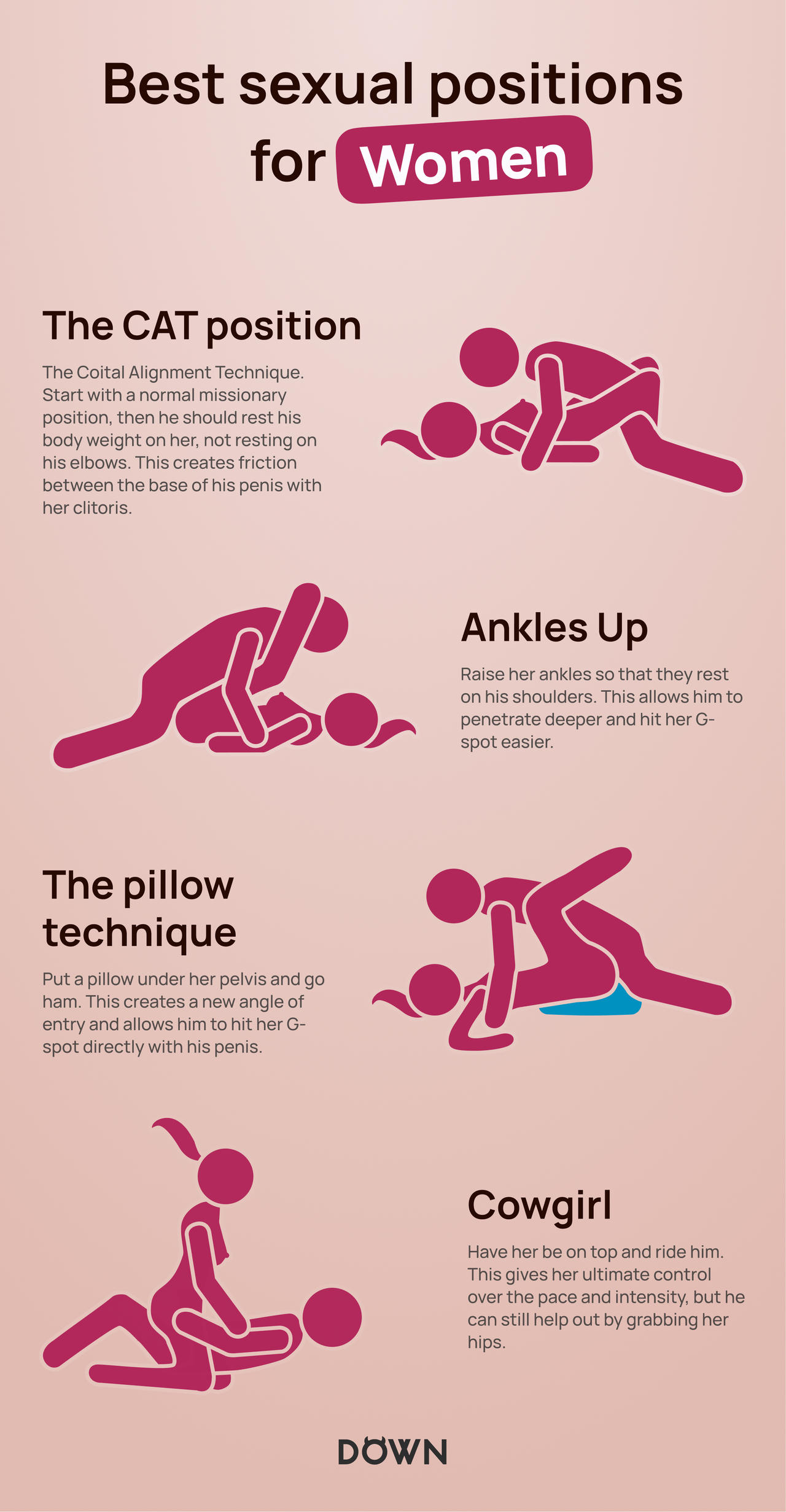
While standard missionary often ranks low for female orgasm frequency due to a lack of direct clitoral contact, its clinical modification—the Coital Alignment Technique (CAT)—is one of the most thoroughly researched positions for female pleasure. First formalized by psychotherapist Edward Eichel, CAT shifts the focus from deep thrusting to constant, rhythmic grinding.
In the CAT variation:
- The penetrating partner lies fully on top, moving higher up on the receiving partner's body so that the base of the penis or pubis rests firmly against the clitoris.
- The motion shifts from inward thrusting to a synchronized, ride-and-slide movement.
- The continuous pressure maintains steady contact with the clitoral glans throughout the movement cycle.
Data from clinical trials evaluate CAT as highly effective for women who struggle to reach orgasm through traditional intercourse. The constant pressure creates steady mechanical feedback to the clitoral complex without relying on high-velocity impact.
Woman-on-Top (Cowgirl / Lotus Variations)
The woman-on-top (or elevated partner) position consistently ranks at or near the top in empirical surveys regarding female sexual satisfaction and orgasm consistency. The anatomical advantage of this position stems entirely from control dynamics.
When the receiving partner is on top, she gains full agency over:
- The depth of penetration, preventing painful cervical impact or uncomfortable collision with the pelvic wall.
- The angle of entry, allowing her to tilt her pelvis forward or backward to target the anterior vaginal wall (often associated with the G-spot zone) or maximize pubic contact.
- The speed and tempo, matching her internal arousal curve rather than relying on the penetrating partner's rhythm.
Furthermore, this position leaves the receiving partner's hands entirely free to apply direct manual or mechanical (vibrator) clitoral stimulation. Research confirms that combining penetrative sex with simultaneous direct clitoral stimulation yields the highest probability of orgasm within a single intimate session.
Rear-Entry (Doggy Style) with Manual Accentuation
Rear-entry positions generate distinct biomechanical characteristics compared to frontal alignment. From an anatomical perspective, entry from behind alters the vaginal vault angle, allowing deeper penetration and targeted friction against the posterior vaginal wall.
However, observational data show that rear-entry alone may lack sufficient anterior or clitoral contact. Its high rating in empirical studies occurs primarily when paired with simultaneous external stimulation. Because the receiving partner's anterior pelvic region remains accessible, either partner can use a hand or external device to stimulate the clitoral glans during penetration.
Additionally, altering the angle—such as having the receiving partner rest lower on her elbows or flat on her stomach (often referred to as the "Prone Bone" position)—changes the compression against the anterior wall, engaging the internal clitoral bulbs more directly.
The Lotus Position (Seated Intimacy)
The Lotus position involves the penetrating partner sitting cross-legged while the receiving partner sits on their lap, wrapping her legs around their waist or back.
From a data-driven perspective, the Lotus position excels in two key metrics: clitoral compression and emotional proximity. The upright, seated posture brings the pubic bones into firm, continuous contact, providing steady external friction against the clitoris. Because deep thrusting is mechanically restricted in a seated position, the physical movement naturally shifts toward micro-movements, swaying, and pelvic tilting. This steady friction profile mirrors the success factors observed in the Coital Alignment Technique.
Side-by-Side (Spooning)
The side-lying or spooning position offers significant mechanical and ergonomic advantages, particularly for extended intimate encounters or partners seeking minimal physical strain.
Data evaluating energy expenditure and muscular fatigue during sexual activity highlight the side-lying position as the least physically demanding for both participants. Entry occurs from behind at a relaxed angle, while both partners maintain free mobility of their hands. This allows for effortless, continuous clitoral stimulation without requiring either partner to support their full body weight. The slow, controlled cadence common to this position also helps reduce premature ejaculation in male partners, indirectly increasing the duration of effective stimulation for the female partner.
Comparative Data Analysis: Evaluating Positions by Key Efficacy Factors
The following comparative table summarizes the mechanical variables, stimulation profiles, and operational factors of primary sexual positions based on sexological research syntheses.
| Position | Primary Stimulation Zone | Clitoral Access | Control of Depth & Angle | Physical Effort / Fatigue | Primary Orgasm Mechanism |
|---|---|---|---|---|---|
| Coital Alignment (CAT) | External Clitoris + Anterior Wall | High (via continuous pubic contact) | Low (requires precise alignment) | Moderate | Continuous vulvar/clitoral friction |
| Woman-on-Top | Anterior Wall + Direct Clitoral | Highest (unobstructed manual access) | Highest (receiver controls all movement) | Moderate to High | Pelvic grinding & direct clitoral contact |
| Rear-Entry (Modified) | Posterior Wall + G-Spot | Moderate to High (manual access from front/below) | Moderate (penetrator controls depth) | Moderate | Deep penetration + manual clitoral aid |
| Lotus (Seated) | Pubic Bone + Internal CUV Complex | High (continuous body-to-body pressure) | High (shared rotational control) | Moderate | Micro-grinding & continuous pressure |
| Side-by-Side (Spooning) | Posterior Wall + External Clitoris | High (hands remain completely free) | Low to Moderate | Lowest | Manual clitoral access + low-effort cadence |
Empirical Variables That Override Position Choice
While positional geometry creates the framework for physical pleasure, statistical analysis of sexual satisfaction surveys demonstrates that positional mechanics alone do not guarantee maximum pleasure. Several physiological and situational variables moderate the efficacy of any given position.
FACTORS INFLUENCING PLEASURE
- LUBRICATION & FRICTION MANAGEMENT
- Ensures tissue comfort and prevents micro-tears.
- PELVIC FLOOR ENGAGEMENT & TONE
- Voluntary contraction (Kegels/relaxation) alters internal grip.
- INTEGRATION OF EXTERNAL AIDS
- Adding targeted vibrators elevates orgasm rates significantly.
- PSYCHOLOGICAL SAFETY & COMMUNICATION
- Low stress levels enable vascular engorgement and arousal.
1. Friction and Lubrication Dynamics
Friction is the primary mechanism of physical arousal, but excessive friction leads to tissue irritation, micro-tears, and involuntary muscle tension (vaginismus or protective guarding). Data show that the use of personal lubricants significantly increases sexual satisfaction and orgasm ease across all age demographics. A optimal balance of lubrication ensures that positions relying on grinding—such as CAT or Lotus—deliver smooth, comfortable stimulation to sensitive erectile tissue.
2. Pelvic Floor Muscle Engagement
The tone and voluntary control of the pelvic floor muscles (levator ani muscle group) play a direct role in orgasmic intensity. Studies utilizing perineometry show that strong, flexible pelvic floor muscles enhance blood flow to the pelvic region during arousal, increasing tissue sensitivity. Furthermore, the ability to consciously contract or relax these muscles during specific positions (such as squeezing during woman-on-top or side-lying) changes internal tightness and heightens feedback for both partners.
3. Integration of External Aids
Survey data reveal a substantial jump in female orgasm consistency when partners integrate external technology into standard positions. Introducing a targeted clitoral vibrator or a positioned sex wedge pillow alters the baseline metrics of traditional intercourse:
- Pelvic Pillows/Wedges: Elevating the hips in missionary or rear-entry positions alters the pelvic angle by 15 to 30 degrees, aligning the vaginal canal directly with the shaft of the penis and exposing the clitoris to greater surface contact.
- Vibrators: Incorporating targeted vibration during woman-on-top or spooning positions bridges the gap between penetrative friction and the high-frequency vibration to which clitoral tissue responds most efficiently.
Common Misconceptions and Technical Mistakes
Sexological research frequently identifies persistent misunderstandings regarding female sexual response. Correcting these mechanical mistakes can immediately improve outcomes regardless of the chosen position.
Mistake 1: Prioritizing Penetration Depth Over Clitoral Friction
A frequent misconception is that deeper penetration automatically correlates with greater female pleasure. Anatomically, the most sensitive nerve endings in the vaginal canal are concentrated in the outer third (the lower anterior wall near the introitus). Deep thrusting often bypasses this highly sensitive region entirely and can cause discomfort if the cervix is repeatedly struck. Data show that short, shallow thrusts combined with steady vulvar friction yield higher satisfaction scores than full-length thrusting.
Mistake 2: Remaining Static in a Single Position
Human bodies possess unique structural variations, including differences in uterine tilt (e.g., retroverted uterus), pelvic width, and clitoral location relative to the vaginal opening. Expecting a single position to work without micro-adjustments is a common pitfall. Studies indicate that couples who actively alter their pelvic angles, shift weight, and adjust leg placement during sex report far higher rates of physical climax than those who remain rigid in a classic textbook pose.
Mistake 3: Neglecting Communication Regarding Speed and Pressure
Clitoral tissue contains over 8,000 sensory nerve endings and is extraordinarily sensitive to rapid shifts in pressure and velocity. A common mistake during positions where the penetrating partner leads (such as missionary or rear-entry) is accelerating speed too early in the arousal curve. Empirical data confirm that female arousal requires sustained, consistent stimulation; sudden changes in cadence or excessive force often reset the arousal curve.
Frequently Asked Questions
Can women reach orgasm through vaginal penetration alone?
While some women reliably reach orgasm through unassisted penile-vaginal penetration, observational studies indicate this applies to roughly 18% to 20% of women. The remaining majority require direct or indirect stimulation of the external clitoris. This is not a dysfunction, but a direct reflection of female erectile anatomy, as the internal vaginal wall has far fewer sensory nerve endings than the clitoral glans and bulbs.
What makes the Coital Alignment Technique (CAT) different from standard missionary?
Standard missionary relies on inward and outward thrusting, which frequently lifts the penetrating partner's pubic bone away from the clitoris. The Coital Alignment Technique modifies this by shifting the penetrating partner higher up on the body, locking the base of the penis or pubic bone firmly against the clitoris, and substituting thrusting with a rhythmic, sliding movement. This maintains constant clitoral contact throughout the entire stroke.
Why does the woman-on-top position rank so high in sexual satisfaction surveys?
The woman-on-top position places full control over speed, depth, pelvic angle, and rhythm in the hands of the receiving partner. Anatomically, this allows her to avoid painful deep thrusting, target the sensitive anterior wall of the vagina, and keep her hands free for concurrent manual or vibratory clitoral stimulation.
How do pelvic pillows or wedges change the physics of a position?
Pelvic wedges lift the hips and tilt the pelvis backward (posterior pelvic tilt). This adjustment changes the entry angle of penetration, reducing strain on the lower back while exposing the anterior vaginal wall and internal clitoral structures to greater direct friction during forward movement.
Is deep penetration necessary for G-spot stimulation?
No. The region commonly referred to as the G-spot—which corresponds to the internal clitourethrovaginal (CUV) complex—is located on the anterior (front) wall of the vagina, typically only 1 to 2 inches (2.5 to 5 cm) past the vaginal opening. Deep penetration bypasses this area. Shallow, angled thrusting or pelvic grinding is far more effective at stimulating this tissue.
Actionable Recommendations for Enhancing Intimate Pleasure
To apply these data-driven findings effectively, individuals and couples should focus on mechanical adjustments rather than complex position variations:
- Prioritize Clitoral Contact: Ensure that every position attempted either maintains constant external friction (as in CAT or Lotus) or leaves space for manual/vibrator access (as in woman-on-top or spooning).
- Utilize Ergonomic Support: Introduce firm pillows or specialized sex wedges beneath the hips to alter penetration angles effortlessly, reducing joint strain and improving alignment with anterior sensitive zones.
- Shift Focus from Depth to Rhythm: Reduce the length of penetrative strokes. Concentrate on micro-movements, steady rotational grinding, and consistent pressure over high-velocity impact.
- Maintain Open Feedback: Communicate preferred pressure and speed in real time. Because female arousal depends heavily on continuous, uninterrupted stimulation, maintaining a consistent rhythm based on verbal or non-verbal cues yields the most reliable results.
By shifting focus from novelty to proven mechanical principles, couples can optimize their intimate routine around the documented realities of female anatomy and physiological response.
Image Gallery