Washington Spiders Chart: Identifying Common and Venomous Species in 2026
Identifying spiders in Washington State requires distinguishing between the hundreds of harmless species that provide natural pest control and the single medically significant species native to the region: the Western Black Widow. This...
Identifying spiders in Washington State requires distinguishing between the hundreds of harmless species that provide natural pest control and the single medically significant species native to the region: the Western Black Widow. This guide provides a comprehensive Washington spiders chart, detailing physical characteristics, habitats, and bite risks for the species most frequently encountered by residents in 2026.
Contents
The Reality of Spiders in Washington State
In 2026, Washington continues to host nearly 1,000 species of spiders, the vast majority of which are entirely harmless to humans. Spiders are an essential part of the Pacific Northwest ecosystem, consuming significant volumes of flies, mosquitoes, and agricultural pests. Despite their benefits, many residents experience "arachnophobia" or concern regarding venomous bites.
In the State of Washington, only the Western Black Widow is considered a primary medical concern. While other spiders like the Yellow Sac spider or the Hobo spider can bite, their effects are generally mild and do not result in the severe necrotic tissue damage often erroneously attributed to them in urban legends. Furthermore, the infamous Brown Recluse is not native to Washington and does not have established populations in the state.
Washington Spiders Identification Chart
The following chart serves as a quick reference for the most common spiders found across both Western and Eastern Washington.
| Common Name | Scientific Name | Average Size (Body) | Color/Markings | Web Type | Human Danger |
|---|---|---|---|---|---|
| Western Black Widow | Latrodectus hesperus | 12–16 mm | Shiny black; red hourglass on abdomen | Irregular, messy | High (Medical) |
| Hobo Spider | Eratigena agrestis | 10–15 mm | Brown; chevron patterns on abdomen | Funnel-shaped | Low (Mild irritation) |
| Giant House Spider | Eratigena duellica | 15–18 mm | Large, leggy, dark brown | Funnel/Sheet | Negligible |
| Yellow Sac Spider | Cheiracanthium | 5–10 mm | Pale yellow or greenish | Silk tube/sac | Moderate (Sting) |
| Wolf Spider | Lycosidae family | 10–35 mm | Grey/Brown; hairy; camouflaged | None (Hunters) | Low |
| Cross Orbweaver | Araneus diadematus | 6–20 mm | Orange/Brown; white cross on back | Circular/Spiral | Negligible |
| Jumping Spider | Salticidae family | 2–15 mm | Varied; often fuzzy; large eyes | None (Hunters) | Negligible |
| Cellar Spider | Pholcidae family | 2–10 mm | Pale; extremely long, thin legs | Tangled | Negligible |
Medically Significant and "Warning" Spiders
Understanding which spiders require caution is the first step toward peaceful coexistence. In Washington, there are three species often discussed in the context of bites.
Western Black Widow (Latrodectus hesperus)
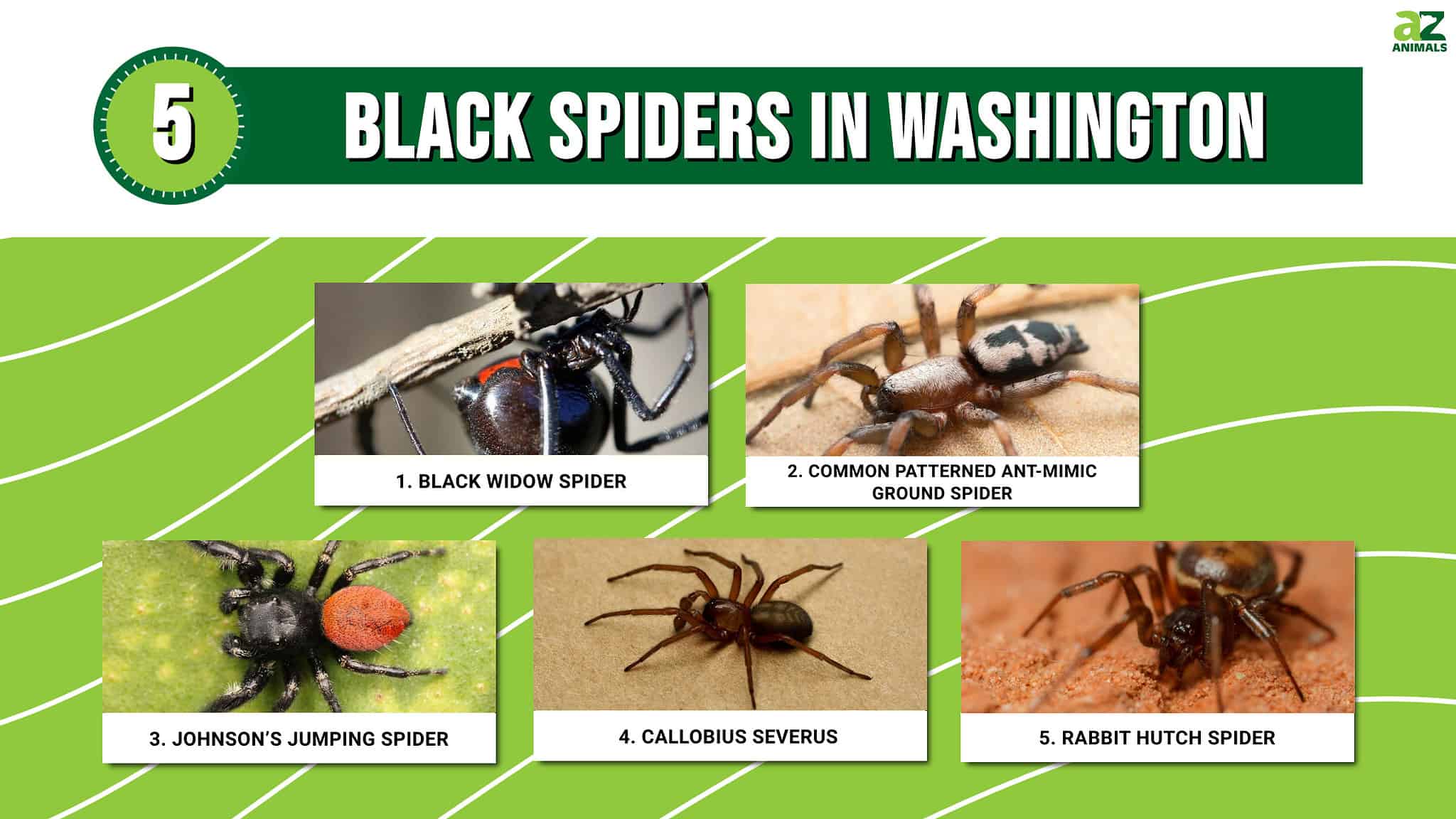
The Western Black Widow is the only spider in Washington with venom that is truly dangerous to humans. They are most prevalent in Eastern Washington, though small populations exist in the dry, rain-shadow regions of Western Washington (such as the San Juan Islands or parts of Whidbey Island).
- Identification: Females are shiny black with a distinctive red hourglass marking on the underside of the abdomen. Males and juveniles are smaller, lighter, and often have white or tan stripes.
- Behavior: They are shy and nocturnal, typically hiding in dark, undisturbed areas like woodpiles, crawlspaces, or under outdoor furniture.
- The Bite: A bite may go unnoticed initially or feel like a pinprick. Within an hour, systemic symptoms can include severe muscle aches, abdominal cramping, and sweating. While rarely fatal in 2026 due to advanced medical care, a bite requires immediate consultation with a healthcare provider or the Washington Poison Center.
Hobo Spider (Eratigena agrestis)
The Hobo spider was once feared as a cause of necrotic skin lesions, but modern research has largely debunked this. In Washington, the Hobo spider is a common resident, particularly in late summer and autumn.
- Identification: Brown with a series of "V" shaped (chevron) markings on the abdomen. They lack the dark bands on their legs found on many other brown spiders.
- Behavior: They build funnel-shaped webs near the ground, often in basement window wells or vegetation.
- Bite Risk: According to the Washington State Department of Health, the Hobo spider is not considered a significant threat. Bites are rare and usually result only in localized redness and minor swelling.
Yellow Sac Spider (Cheiracanthium)
These spiders are common indoors and are more likely to bite than many other species because they may become trapped in clothing or bedding.
- Identification: Small, pale yellow or cream-colored, with dark "feet" (tarsi).
- Behavior: They do not build traditional webs to catch prey; instead, they build small silk "sacs" in corners or where walls meet ceilings to rest during the day.
- The Bite: The bite is often compared to a bee sting—sharply painful with localized swelling and itching that usually subsides within a few hours.
Common Harmless House and Garden Spiders
Most spiders encountered in Washington are beneficial predators that lack the jaw strength or venom toxicity to harm humans.
Giant House Spider (Eratigena duellica)
Often confused with the Hobo spider, the Giant House Spider is significantly larger and faster. It is one of the fastest spiders in the world. Interestingly, the presence of Giant House Spiders is actually beneficial for homeowners, as they are known to compete with and even kill Hobo spiders. They are harmless to humans and generally try to flee when confronted.
Wolf Spiders (Lycosidae)
Wolf spiders are robust, hairy hunters that do not spin webs. They are often found on the ground in gardens or occasionally wandering into garages. Because of their size and hairy appearance, they are frequently mistaken for small tarantulas. They are excellent at controlling garden pests like beetles and grasshoppers.
Cross Orbweaver (Araneus diadematus)
This is the classic "garden spider" seen in late summer and autumn across Washington. They spin large, beautiful, circular webs. You can identify them by the white cross-shaped mark on their large, bulbous abdomen. They are very docile and will only bite if physically squeezed, resulting in a sensation milder than a mosquito bite.
Jumping Spiders (Salticidae)
Jumping spiders are the "charismatic" members of the spider world. They have four pairs of eyes, with the middle pair being very large, giving them excellent vision. They are active during the day, often seen on sunlit walls or windowsills. They are curious and may track your movements with their heads, but they are completely harmless to humans.
Geographic Distribution in Washington
The spider population in Washington is heavily influenced by the Cascade Mountains, which divide the state into two distinct climatic zones.
- Western Washington: The humid, temperate climate of the Puget Sound region and the coast favors moisture-loving spiders. Here, you are most likely to encounter Giant House Spiders, Cross Orbweavers, and Cellar Spiders. Black Widows are rare but can be found in drier pockets.
- Eastern Washington: The arid, hot summers of the Columbia Basin and the Inland Northwest are the primary habitat for the Western Black Widow. Residents in cities like Yakima, Tri-Cities, and Spokane should be more vigilant when cleaning out garages or moving woodpiles.
Debunking Common Spider Myths in Washington
The "Brown Recluse in Washington" Myth
A common misconception is that Brown Recluse spiders (Loxosceles reclusa) live in Washington. Extensive trapping and surveys by Washington State University (WSU) Extension have confirmed that the Brown Recluse is not native to the Pacific Northwest. Any "recluse" sightings are almost certainly misidentifications of Hobo spiders or other harmless brown spiders.
The "Spider Bites While Sleeping" Myth
Spiders do not seek out humans to bite. Most "spider bites" reported to doctors in Washington turn out to be skin infections (like MRSA), flea bites, or stings from other insects. Spiders generally bite only in self-defense, such as when they are crushed against skin.
Prevention and Management
If you wish to reduce the number of spiders entering your home in 2026, focus on environmental controls rather than heavy pesticide use.
- Seal Entry Points: Use weatherstripping on doors and caulk around windows and utility penetrations.
- Reduce Clutter: Spiders love dark, undisturbed spaces. Organize garages and basements, and store items in plastic bins with tight-sealing lids rather than cardboard boxes.
- Exterior Maintenance: Keep vegetation, woodpiles, and debris at least two feet away from the home’s foundation.
- Lighting Changes: Swap standard outdoor light bulbs for yellow "bug lights," which attract fewer of the insects that spiders prey upon.
- Vacuuming: The most effective way to remove spiders and their egg sacs is a vacuum cleaner. This is safer and more efficient than using chemical sprays.
Frequently Asked Questions
Which Washington spider is the most dangerous?
The Western Black Widow is the only native spider in Washington with venom that is medically significant to humans. While its bite is rarely fatal in 2026, it can cause severe systemic pain and muscle spasms that require medical intervention.
Do Hobo spiders cause skin rot?
No. Detailed studies, including those by the CDC and arachnologists at the Burke Museum, have found no evidence that Hobo spider venom causes necrosis (skin death) in humans. Most alleged "Hobo bites" are actually misdiagnosed staphylococcal infections.
Is the Giant House Spider dangerous?
No. Despite its intimidating size and speed, the Giant House Spider is harmless. It lacks the venom to harm humans and is actually a beneficial roommate because it displaces the Hobo spider.
How can I tell a Black Widow from a Dark House Spider?
A Black Widow is distinctively shiny, like polished patent leather, and has a red hourglass on its belly. Many common house spiders are dark brown or charcoal grey and have a matte or "fuzzy" appearance. If you cannot see the underside of the spider, look for its web; Black Widows build very strong, tangled, disorganized webs that make a "crackling" sound when torn.
Should I kill spiders in my garden?
Generally, no. Spiders are vital predators that eat pests like aphids, flies, and caterpillars. Unless you find a Black Widow in an area where children play, it is best to leave garden spiders alone to help maintain the ecological balance of your yard.
Practical Recommendation for Residents
If you encounter a spider in your Washington home that you cannot identify using this chart, the safest approach is the "cup and paper" method. Place a cup over the spider, slide a stiff piece of paper underneath, and release it outdoors. If you are in Eastern Washington and suspect a Black Widow infestation in your home, consider contacting a professional pest management service that utilizes Integrated Pest Management (IPM) techniques to secure your perimeter without over-reliance on toxic chemicals. For confirmed bites resulting in severe pain or cramping, always contact a medical professional immediately.
Image Gallery