Navigating Workers’ Compensation in Irvine, Southern California: A 2026 Guide for Employees and Employers
Workers’ compensation in Irvine is a state-mandated insurance system providing medical care, wage replacement, and rehabilitation benefits to employees injured on the job. Regulated by the California Division of Workers’ Compensation (...
Workers’ compensation in Irvine is a state-mandated insurance system providing medical care, wage replacement, and rehabilitation benefits to employees injured on the job. Regulated by the California Division of Workers’ Compensation (DWC), this no-fault system ensures Irvine workers receive prompt medical attention while protecting local businesses from costly civil litigation arising from workplace accidents.
Contents
The Legal Framework of Workers’ Compensation in Southern California
In 2026, the California workers’ compensation system remains one of the most comprehensive in the United States. For individuals working in Irvine—a major economic hub in Orange County—the system is governed strictly by the California Labor Code. Unlike personal injury law, workers’ compensation is a no-fault system. This means an injured employee does not need to prove the employer was negligent to receive benefits. Conversely, the employee generally loses the right to sue the employer in civil court for the injury.
The Division of Workers’ Compensation (DWC) monitors the administration of claims and provides administrative services to help resolve disputes. For residents and workers in Irvine, the nearest Workers’ Compensation Appeals Board (WCAB) district office is typically located in Santa Ana. This office serves as the judicial venue where judges hear disputes regarding claim denials, medical treatment necessity, and disability ratings.
Understanding the local landscape requires recognizing Irvine's specific economic makeup. As a center for technology, healthcare, and higher education, Irvine sees a high volume of claims related to repetitive stress, occupational disease, and office-based ergonomics, alongside traditional construction and manufacturing injuries occurring near the Irvine Business Complex and the Great Park neighborhoods.
Employer Requirements and Compliance in Irvine
Every business operating in Irvine, regardless of size, must carry workers’ compensation insurance. This mandate applies even if a company has only one employee. In California, "employee" is defined broadly and often includes part-time workers, family members, and, following established legal precedents like AB5, many individuals previously classified as independent contractors.
Insurance Acquisition Options
Employers in Southern California generally have three pathways to secure coverage:
- Private Insurance: Purchasing a policy from one of the many private carriers licensed in California.
- State Compensation Insurance Fund (State Fund): A public enterprise that provides a safety net for employers who may have difficulty finding coverage in the private market.
- Self-Insurance: Usually reserved for very large corporations or public entities (like the City of Irvine or major educational institutions) that have the financial reserves to pay their own claims directly.
Failure to maintain insurance is a criminal offense in California. The Uninsured Employers Benefits Trust Fund (UEBTF) may pay benefits to an injured worker if the employer is illegally uninsured, but the state will subsequently take aggressive action against the business to recover those costs, often resulting in liens, heavy fines, and potential business closure.
Types of Workers’ Compensation Benefits in 2026
The benefits provided under the Irvine workers' comp system are designed to address both immediate medical needs and long-term financial stability. These benefits are categorized into five primary areas:
1. Medical Care
The employer is responsible for paying all reasonable and necessary medical costs related to the injury. In Irvine, most employers utilize a Medical Provider Network (MPN). An MPN is a group of physicians and specialists pre-approved by the insurance carrier. Unless an employee has "predesignated" their personal physician prior to the injury, they are generally required to seek treatment within this network.
2. Temporary Disability (TD) Benefits
If an injury prevents an employee from performing their usual job duties while recovering, they are eligible for TD payments. As of 2026, these payments typically equal two-thirds of the worker's average weekly gross wages, subject to state-mandated minimums and maximums. TD payments generally continue until the worker returns to the job or a doctor declares their condition "Permanent and Stationary."
3. Permanent Disability (PD) Benefits
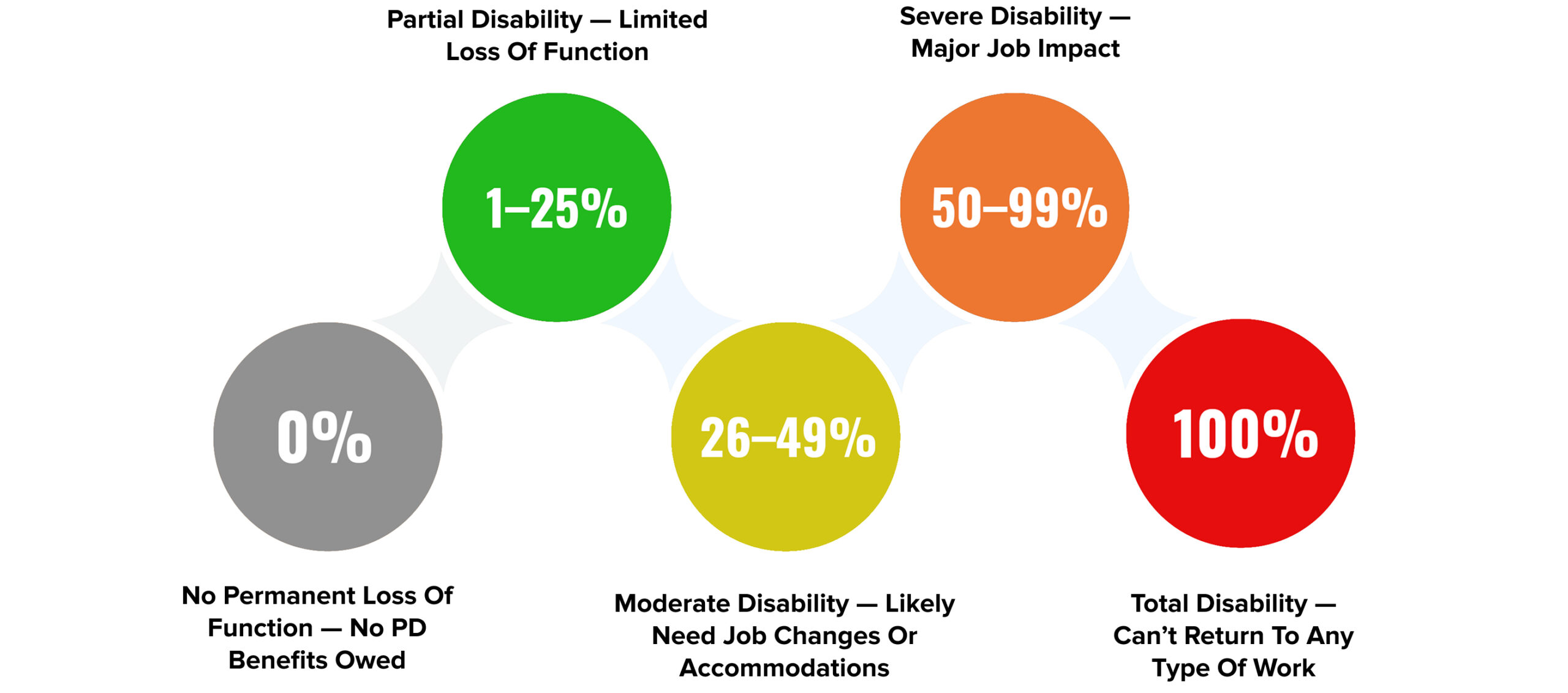
If a worker does not fully recover, they may be eligible for PD benefits. A doctor provides a "permanent disability rating" based on the extent of the physical or mental impairment, the worker's age, and their occupation. This rating translates into a specific dollar amount.
4. Supplemental Job Displacement Benefits (SJDB)
Also known as the "retraining voucher," this is available to workers with permanent partial disability who cannot return to their employer. In 2026, this voucher typically provides up to $6,000 for education-related retraining or skill enhancement at California-accredited schools.
5. Death Benefits
In the tragic event of a workplace fatality, payments are made to the spouse, children, or other dependents of the deceased worker. This also includes reasonable burial expenses up to a limit defined by state law.
| Benefit Type | Purpose | Eligibility Requirement |
|---|---|---|
| Medical Care | Cure or relieve the effects of injury | Immediate upon report of injury |
| Temporary Disability | Wage replacement during recovery | Doctor certifies inability to work for >3 days |
| Permanent Disability | Compensation for lasting impairment | Condition is Permanent and Stationary (P&S) |
| SJDB Voucher | Retraining for new career paths | Permanent disability and no return to employer |
| Death Benefits | Support for surviving dependents | Fatality resulting from work-related activity |
The Step-by-Step Claim Process in Irvine
Navigating a claim requires strict adherence to timelines. Missing a deadline can result in the loss of benefit eligibility.
- Report the Injury: The employee must notify their supervisor or employer immediately. Under California law, this should be done within 30 days of the injury or the discovery of a work-related illness.
- File Form DWC-1: The employer must provide the worker with a Claim Form (DWC-1) within one working day of learning about the injury. The employee completes the "Employee" section, and the employer completes the "Employer" section.
- Seek Medical Treatment: For emergencies, go to the nearest Irvine hospital (such as Hoag or UCI Health). For non-emergencies, use the employer’s designated clinic or MPN provider.
- Initial Claim Decision: The insurance administrator has 14 days to notify the worker of the claim status. They may accept the claim, deny it, or "delay" it for further investigation. During a delay, the carrier is often liable for up to $10,000 in medical treatment until a final decision is made.
- The QME/AME Process: If there is a dispute regarding the severity of the injury or the treatment required, the parties may use a Qualified Medical Evaluator (QME)—a state-certified physician who provides an independent second opinion.
Common Workplace Injuries in Irvine’s Key Industries
Irvine’s diverse economy creates a unique profile of workplace injuries. While construction accidents occur near development sites like the Spectrum District, the city’s massive "Silicon Beach South" presence and healthcare clusters generate different claim types.
- Repetitive Stress Injuries (RSIs): With thousands of software engineers and administrative professionals in Irvine, Carpal Tunnel Syndrome and lower back issues from prolonged sitting are common. These are categorized as "cumulative trauma" claims.
- Occupational Exposure: Healthcare workers at major Irvine medical centers face risks from needle sticks, infectious diseases, and chemical exposures.
- Slip and Falls: Common in the retail environments of the Irvine Spectrum Center and various shopping plazas.
- Vehicular Accidents: Irvine is a commuter city. If an employee is driving for work purposes (excluding the standard commute), an accident on the I-405 or I-5 within city limits is typically compensable.
The Role of the Workers’ Compensation Appeals Board (WCAB)
Disputes are common in the workers’ comp system. When an insurance carrier denies a surgery or disputes the level of permanent disability, the case moves to the Santa Ana WCAB. This is not a formal trial in a traditional courtroom but a specialized administrative hearing.
In these proceedings, an Administrative Law Judge (ALJ) reviews the medical evidence and testimony. Residents of Irvine benefit from the proximity of the Santa Ana office, which handles the bulk of Orange County’s litigation. In 2026, many of these "Status Conferences" and "Priority Conferences" are held via video or teleconference, though "Trials" typically require in-person attendance.
When to Consult an Irvine Workers' Compensation Attorney
While simple claims with minor injuries can often be handled independently, complex cases frequently require legal intervention. Most workers' compensation attorneys in Southern California work on a contingency fee basis, usually receiving 12% to 15% of the final settlement, which must be approved by a judge.
Consider legal counsel if:
- The insurance carrier denies the claim entirely.
- The employer retaliates against the worker for filing a claim (a violation of Labor Code 132a).
- The worker’s injuries are severe enough to prevent them from ever returning to their previous profession.
- The medical provider in the MPN is not providing adequate care.
- There is a dispute over the "Permanent Disability" rating.
Disclaimer: This article provides general information and does not constitute legal advice. Workers’ compensation laws are subject to change. Consult with a qualified legal professional regarding specific claims or compliance issues.
Frequently Asked Questions
Can I see my own doctor for a work injury in Irvine?
Generally, you must see a doctor within the employer’s Medical Provider Network (MPN). However, if you "predesignated" your personal physician in writing before the injury occurred, and that physician agreed to be predesignated, you may be able to treat with them. This document must be on file with your employer prior to the accident.
What should I do if my Irvine employer doesn't have insurance?
If you are injured and find your employer is uninsured, you can file a claim with the Uninsured Employers Benefits Trust Fund (UEBTF). Additionally, because the employer failed to provide the mandatory "exclusive remedy" of insurance, you may be entitled to sue them in civil court in addition to filing a workers' compensation claim, a rare exception to the standard no-fault rules.
How long do I have to file a workers' compensation claim in California?
While you should report the injury within 30 days, the formal statute of limitations to file a claim with the WCAB is generally one year from the date of injury. For cumulative trauma cases, this one-year period usually begins when the employee first suffered a disability and knew (or should have known) it was caused by work.
Can I be fired for filing a workers' comp claim in Irvine?
No. California Labor Code Section 132a strictly prohibits employers from discriminating against or terminating an employee for filing or intending to file a workers' compensation claim. If an employer does this, they may be ordered to pay increased compensation and reinstate the employee with back pay.
What is a "Full and Final" settlement?
In Southern California, many claims end in a Compromise and Release (C&R). This is a settlement where the insurance company pays a lump sum of money to close the case entirely. This usually means the worker is responsible for their own future medical care related to that injury. The alternative is a Stipulated Finding and Award, which leaves medical care open for the specific body part indefinitely.
Practical Recommendations for Irvine Workers
If you are injured on the job in Irvine, your first priority is documentation. Immediately take photos of the accident scene if applicable and gather contact information for any witnesses. When speaking with medical professionals, be very specific about how the injury is related to your work duties. In the Southern California system, the medical report is the most significant piece of evidence in your case. Ensure all symptoms are documented early, as "adding" body parts to a claim months later is often met with skepticism by insurance adjusters and judges.
Image Gallery