How Many Armies Are There in the World? A Global Defense Overview for 2026
As of 2026, there are approximately 174 national militaries active among the world’s 195 sovereign states. While the vast majority of nations maintain standing armed forces to protect their borders and sovereignty, 21 countries current...
As of 2026, there are approximately 174 national militaries active among the world’s 195 sovereign states. While the vast majority of nations maintain standing armed forces to protect their borders and sovereignty, 21 countries currently operate without a formal military, typically relying on police forces or defense treaties with larger allies for security.
Contents
Defining the "Army": National Militaries vs. Land Forces
To accurately answer how many armies exist, we must first resolve a common linguistic ambiguity. In casual conversation, the term "army" is often used interchangeably with "military" or "armed forces." However, in professional defense and geopolitical contexts, these terms have distinct meanings:
- National Military (Armed Forces): The total military capability of a state, which may include several branches like the Army, Navy, Air Force, and Space Force.
- Land Army: A specific branch of the armed forces dedicated to land-based operations.
When people ask how many armies are in the world, they are usually inquiring about the number of sovereign nations that possess a functional military capability. By 2026, the international landscape remains dominated by the Westphalian model, where a state’s legitimacy is often tied to its ability to defend its territory.
Out of the 193 member states of the United Nations, plus the two permanent observer states (Vatican City and Palestine), the vast majority view a standing military as a fundamental requirement of statehood.
Sovereign States and Military Capability in 2026
The number of active militaries is intrinsically linked to the number of recognized sovereign states. However, political recognition is not always uniform. While the UN recognizes 195 states, there are several "de facto" states—such as Taiwan, Kosovo, and various breakaway regions—that maintain highly sophisticated armies despite lacking universal international recognition.
If we include these de facto states, the number of active "national" armies rises closer to 180. Conversely, if we strictly adhere to UN-recognized entities, we must subtract those nations that have constitutionally or practically abolished their armed forces.
The Breakdown of Military Existence
- Total Recognized States: 195
- States with Standing Militaries: ~174
- States without Standing Militaries: 21
This distribution reflects a world where military power remains the primary deterrent against external threats. Even in 2026, as cyber warfare and economic statecraft become more prevalent, the presence of "boots on the ground" remains a critical metric of national power.
Nations Without a Standing Military
It is a common misconception that every country must have an army. As of 2026, 21 sovereign nations function without a standing military. These countries have chosen different paths to security, often dictated by their geography, history, or economic constraints.
The Abolitionist Model: Costa Rica and Panama
Costa Rica is perhaps the most famous example of a nation without an army. Abolished in 1948 following a civil war, the country redirected its defense budget toward education, healthcare, and environmental preservation. Similarly, Panama officially disbanded its military in 1990 following the U.S. invasion. Both nations maintain "Public Forces" with paramilitary capabilities, but they lack a formal military hierarchy and offensive weaponry.
The Microstate Model
Many microstates, such as San Marino, Liechtenstein, Andorra, and Vatican City, do not maintain militaries because the cost would be prohibitive and the strategic depth of their territory is non-existent. These nations typically have defense treaties with neighboring "protector" nations. For example:
- Andorra: Protected by France and Spain.
- Liechtenstein: Protected by Switzerland.
- Monaco: Protected by France.
The Pacific Island Model
Several Pacific island nations, including the Marshall Islands, Micronesia, and Palau, have "Compacts of Free Association" with the United States. Under these agreements, the U.S. is responsible for their defense, and in return, the U.S. maintains exclusive military access to their territorial waters and airspace.
The Organization of Modern Defense Forces
In the current 2026 defense climate, the structure of an "army" has evolved. Most national militaries are no longer just land forces; they are multi-domain organizations. To understand the "how many" question, we must look at how these 174 militaries are organized.
Standard Branch Structures
Most medium-to-large nations divide their military into at least three branches:
- The Army: Land-based warfare, infantry, armor, and artillery.
- The Navy: Maritime security, carrier groups, and submarine warfare.
- The Air Force: Aerial superiority, strategic bombing, and transport.
The Emergence of New Domains
By 2026, the definition of an "army" has expanded to include the digital and orbital realms. Many nations have established Space Forces (following the U.S. model) and Cyber Commands. While these may not be called "armies," they represent a significant portion of a nation's active-duty personnel and defense spending.
Paramilitary and Gendarmerie
In many countries, the line between police and army is blurred. "Gendarmeries" are military forces charged with civilian policing. Countries like France (Gendarmerie Nationale) and Italy (Carabinieri) maintain these forces as a distinct branch that can be deployed both domestically for security and internationally for military operations. When counting "armies," these paramilitary personnel often add millions to the global total of armed combatants.
Global Military Personnel and Strength Comparison
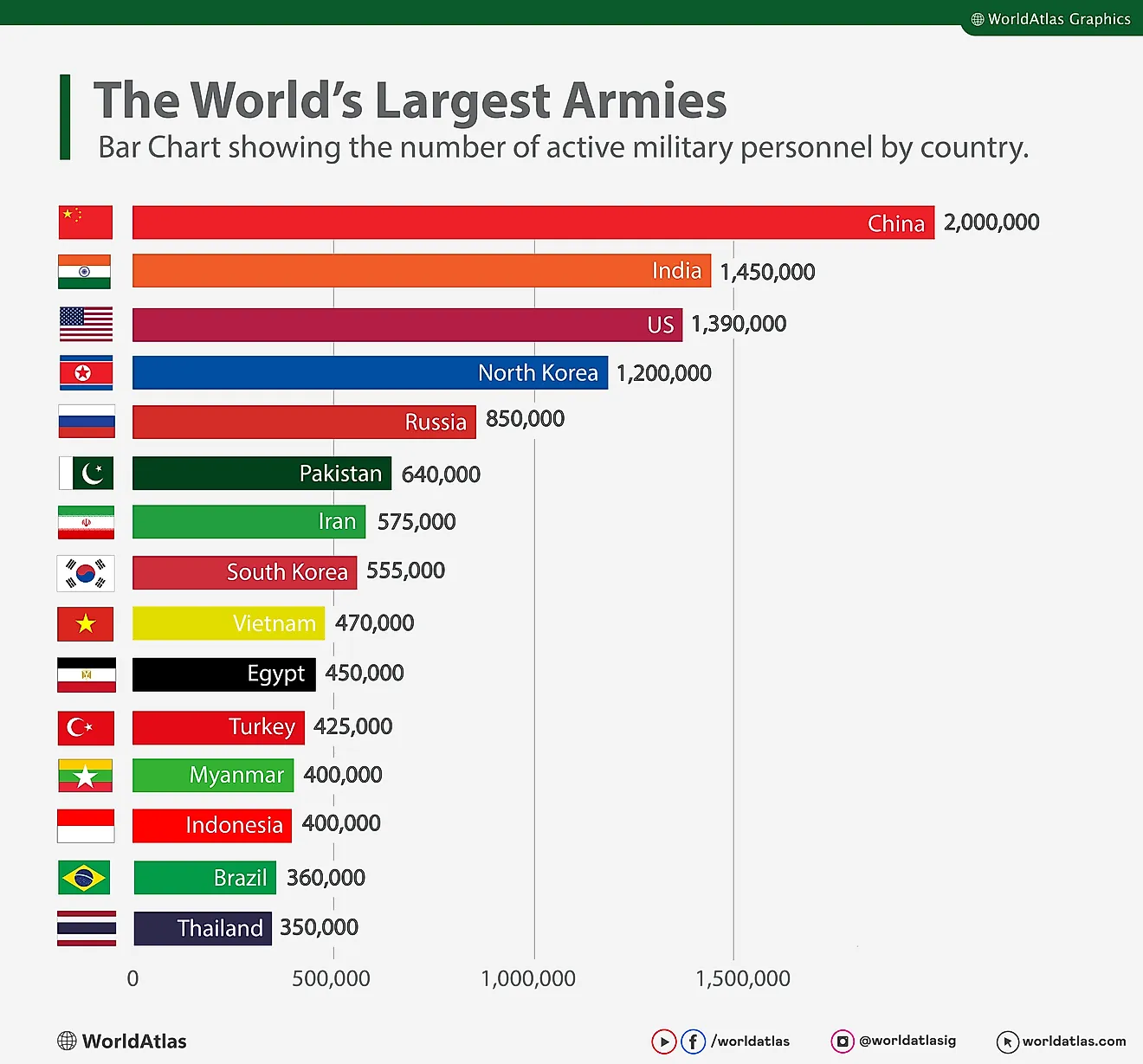
To visualize the distribution of military power in 2026, it is helpful to compare the largest standing armies. While 174 nations have militaries, the vast majority of global military personnel are concentrated in a few dozen countries.
| Country | Estimated Active Personnel (2026) | Primary Military Branches | Defense Status |
|---|---|---|---|
| China | 2,100,000 | Ground Force, Navy, Air Force, Rocket Force, Strategic Support | Standing Military |
| India | 1,450,000 | Army, Navy, Air Force | Standing Military |
| United States | 1,320,000 | Army, Navy, Air Force, Marine Corps, Space Force, Coast Guard | Standing Military |
| North Korea | 1,200,000 | Ground Force, Navy, Air Force, Strategic Rocket Force | Standing Military |
| Russia | 1,100,000 | Ground Forces, Navy, Aerospace Forces, Strategic Missile Forces | Standing Military |
| Switzerland | 140,000 (Militia-based) | Land Forces, Air Force | Armed Neutrality |
| Costa Rica | 0 | None (Public Force only) | No Standing Military |
| Iceland | 0 | Coast Guard only | NATO Member (No Army) |
The Role of Military Alliances
The number of "armies" does not necessarily equal the number of independent military actors. In 2026, collective defense agreements significantly influence how national militaries operate.
NATO (North Atlantic Treaty Organization)
With over 32 member states, NATO represents a massive consolidation of military power. While each member state (except Iceland) maintains its own national army, they function under a unified command structure during conflicts. This means that while there are 31 individual armies within NATO, they often act as a single geopolitical entity.
The European Union Defense Union
In recent years, leading up to 2026, the EU has moved toward greater military integration. While a "European Army" does not yet exist as a replacement for national forces, the PESCO (Permanent Structured Cooperation) framework has led to the synchronization of many European armies, making the distinction between individual national forces and a regional bloc more porous.
Challenges in Counting Non-State Actors
A significant complication in answering "how many armies are there" is the presence of non-state actors and private military companies (PMCs).
- Insurgent Armies: In regions of instability, rebel groups often maintain "armies" that are larger and better equipped than those of small recognized states. However, because they lack sovereign recognition, they are generally excluded from official counts.
- Private Military Companies: By 2026, the use of PMCs has expanded globally. Corporations now provide "security services" that include armored divisions and air support. While these are "armies" in a functional sense, they are private entities.
Summary of Global Trends in 2026
The number of national militaries has remained relatively stable over the last decade. While some nations have seen fluctuations in troop levels due to demographic shifts or the adoption of autonomous systems (AI and drones), the requirement for a national army remains a staple of the international system.
The primary trend observed in 2026 is not the creation of new armies, but the modernization of existing ones. Smaller nations are increasingly opting for "smart" defense—investing in drone swarms and cyber defense rather than maintaining large, expensive infantry divisions. This shift means that while the count of 174 militaries remains accurate, the physical appearance and operational methods of these "armies" are changing rapidly.
Frequently Asked Questions
Which country has the smallest army?
Among nations that maintain a standing military, Antigua and Barbuda often cites one of the smallest forces, with the Royal Antigua and Barbuda Defence Force consisting of approximately 250 active personnel. Their primary focus is on maritime patrol and internal security.
Does Iceland have an army?
No, Iceland is a unique case. It is a founding member of NATO but does not maintain a standing army. It does, however, maintain a highly capable Coast Guard and a specialized paramilitary police unit for international peacekeeping missions. Under a bilateral agreement, the United States and other NATO allies provide for Iceland's air defense.
How many countries have abolished their armies?
Approximately 21 countries currently have no standing military. The most notable are Costa Rica, Panama, and Mauritius. Most of these countries made the decision following historical periods of military coups or internal strife, choosing to prioritize civil institutional growth over military spending.
What is the difference between a "standing army" and a "militia"?
A standing army is a permanent, professional force of full-time soldiers. A militia (or reserve force) consists of citizens who maintain civilian jobs but are trained and available for mobilization during emergencies. Some countries, like Switzerland, rely heavily on a militia system where the "army" exists primarily as a ready-to-mobilize civilian force.
Is there a world army?
No, there is no "World Army." The United Nations Peacekeeping forces are often mistaken for a global army, but the UN does not own these troops. Peacekeepers are contributed by member states on a voluntary basis for specific missions and remain members of their respective national militaries.
Practical Recommendation for Researchers
If you are researching global military strength or the number of active forces for geopolitical analysis, avoid relying solely on "active personnel" counts. In 2026, military power is increasingly measured by technological parity and logistical reach rather than the raw number of soldiers. For the most accurate and up-to-date data, consult the annual Military Balance report by the International Institute for Strategic Studies (IISS) or the SIPRI Yearbook on armaments and international security.
Image Gallery