Understanding NC Workers' Compensation Light Duty: Definitions, Rules, and Practical Implications (2026)
In North Carolina, light duty refers to work tasks modified to accommodate medical restrictions set by a physician following a workplace injury. Legally termed "suitable employment," these roles allow injured workers to return to the w...
In North Carolina, light duty refers to work tasks modified to accommodate medical restrictions set by a physician following a workplace injury. Legally termed "suitable employment," these roles allow injured workers to return to the workforce while recovering, shifting their benefits from total disability to partial disability status.
Contents
Defining Light Duty and "Suitable Employment" in North Carolina
In the context of the North Carolina Workers’ Compensation Act, "light duty" is a colloquial term. The North Carolina Industrial Commission (NCIC) and state statutes primarily utilize the term suitable employment. As of 2026, the definition remains grounded in NC General Statute § 97-2(22), which defines suitable employment as work within the employee’s physical limitations and vocational capacity.
Suitable employment is not merely any job the employer provides; it must be a role that the employee is capable of performing considering their age, education, physical limitations, and experience. For an injury occurring after the 2011 legislative reforms, the definition of suitable employment varies depending on whether the employee has reached Maximum Medical Improvement (MMI).
Before MMI, a job is generally considered suitable if it is approved by the authorized treating physician. After MMI, the criteria become stricter, often requiring the job to be available in the general labor market and not a "make-work" position created solely to avoid paying disability benefits. Understanding this distinction is vital for both employers aiming to manage claim costs and employees seeking to protect their right to fair compensation.
The Role of the Treating Physician in Establishing Restrictions
The gateway to light duty is the medical provider. In North Carolina’s employer-directed medical system, the insurance carrier typically chooses the treating physician. This physician is responsible for evaluating the worker’s progress and issuing "Work Status" notes.
These notes define the specific physical boundaries the worker must respect. Common restrictions include:
- Lifting limits: For example, "no lifting over 10 pounds."
- Postural limits: Restrictions on bending, stooping, crawling, or overhead reaching.
- Temporal limits: Limiting the workday to 4 or 6 hours, or requiring frequent breaks for stretching or icing.
- Sedentary requirements: Requiring the worker to remain seated for the duration of the shift.
If the physician releases a worker to "light duty" with these restrictions, the employer is notified. If the employer can meet these specific limitations, they may offer the worker a modified position. It is important to note that the worker cannot unilaterally decide they are unable to perform light duty if the doctor has cleared them; conversely, the employer cannot legally force a worker to exceed the doctor's prescribed limits.
The Process of Offering and Accepting Light Duty
When an employer decides to offer a light-duty position, the process should be formalized to protect all parties. While a verbal offer is technically possible, documented written offers are the standard in 2026 to ensure clarity and compliance with NCIC rules.
The Formal Job Offer
A valid light-duty job offer should include:
- A detailed description of the job duties.
- The location and hours of the position.
- The rate of pay (which may be the same or less than the pre-injury wage).
- An explicit statement that the employer will honor all medical restrictions.
The Employee’s Duty to Report
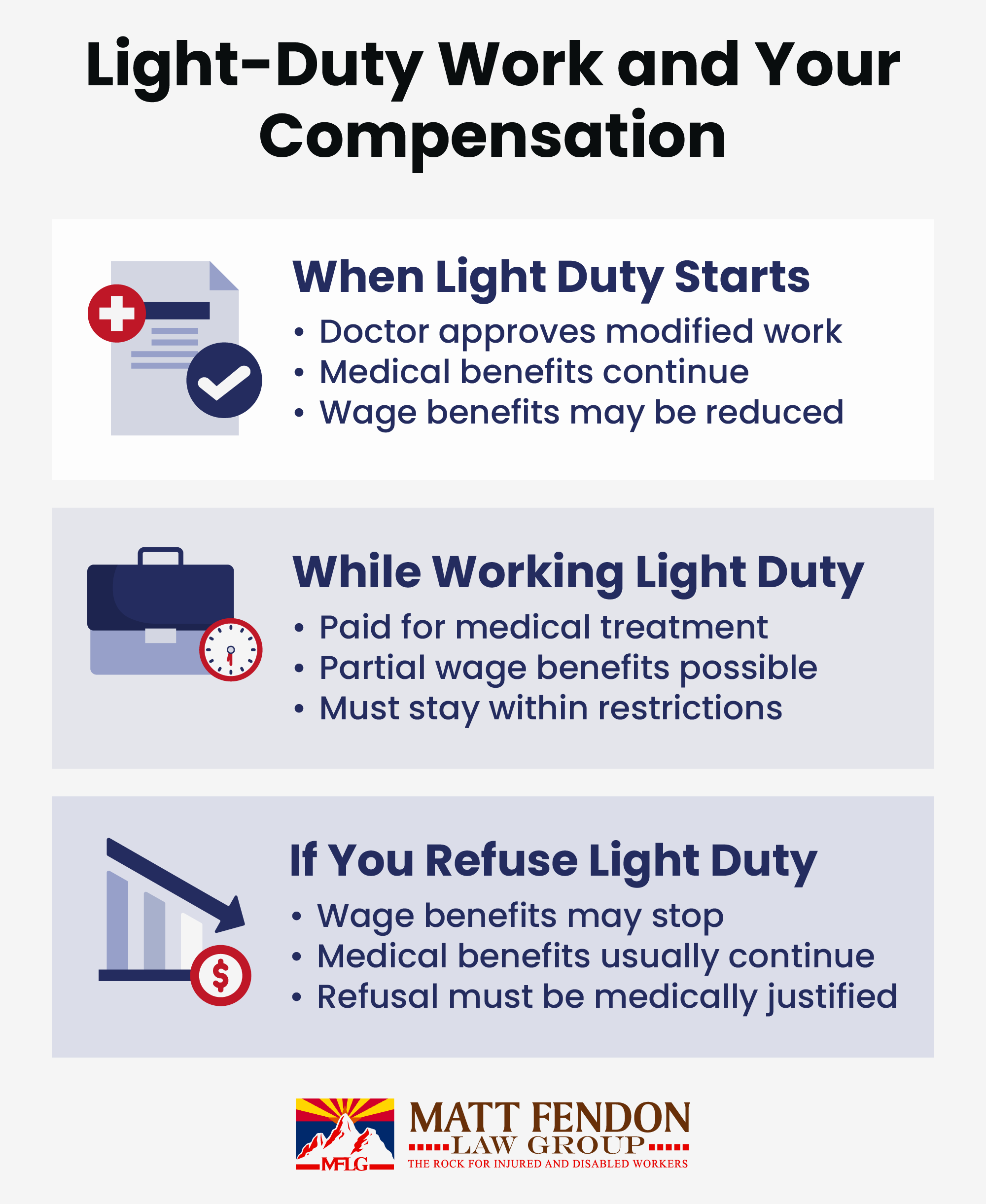
Once a suitable job is offered that aligns with the physician’s restrictions, the employee has a legal obligation to attempt the work. Under NCGS § 97-32, if an injured employee refuses suitable employment, they are generally not entitled to any compensation at any time during the continuance of such refusal, unless the Industrial Commission finds the refusal was justified.
The Financial Transition: From TTD to TPD
Returning to light duty changes the nature of the workers' compensation checks an employee receives. Most workers start on Temporary Total Disability (TTD), which pays two-thirds of their average weekly wage while they are completely out of work.
When a worker returns to light duty at a lower wage than they earned before the injury, they transition to Temporary Partial Disability (TPD). TPD benefits are calculated as two-thirds of the difference between the pre-injury average weekly wage and the new light-duty wage.
| Benefit Type | Status | Calculation Formula |
|---|---|---|
| TTD (Temporary Total Disability) | Out of work completely | 66.67% of Average Weekly Wage (AWW) |
| TPD (Temporary Partial Disability) | Working light duty at lower pay | 66.67% of (Pre-injury AWW - Current Light Duty Wage) |
| Medical Benefits | Ongoing treatment | 100% of authorized medical expenses paid by carrier |
| Permanent Partial (PPD) | Post-MMI with impairment | Based on the "Schedule of Injuries" and impairment rating |
TPD benefits are capped at 500 weeks from the date of the injury in most North Carolina cases, though there are rare exceptions for total and permanent disability.
Form 28T and the "Trial Return to Work"
One of the most critical protections for injured workers in North Carolina is the Trial Return to Work period. Under the North Carolina Workers' Compensation Act, a worker has a right to a trial return to work for a period of up to nine months.
When a worker returns to light duty, the insurance carrier often files Form 28T. This form notifies the Industrial Commission that the employee has returned to work. If the employee finds they are physically unable to perform the light-duty job within the first nine months, they can often resume their TTD benefits without having to go through a lengthy hearing process, provided they have medical evidence that the return to work was unsuccessful due to the injury.
This "safety net" is designed to encourage workers to attempt a return to the workforce without the fear that they will be permanently stuck in a job that causes them physical agony or further injury.
Consequences of Refusing "Suitable" Light Duty
Refusing an offer of light duty is a high-stakes decision. If the insurance carrier believes the refusal is unjustified, they will file a Form 24 Application to terminate or suspend benefits.
Justified vs. Unjustified Refusal
The Industrial Commission determines "justification" on a case-by-case basis.
- Justified Refusal: If the job requires a 2-hour commute that the worker cannot physically handle, or if the job description clearly violates medical restrictions, the refusal may be deemed justified.
- Unjustified Refusal: If the worker simply "doesn't like" the new tasks or the hours, the refusal is typically unjustified, and weekly checks will stop.
It is often advised that if a worker feels a light-duty job is unsuitable, they should still attempt the job for a short period while simultaneously documenting the physical difficulties and consulting with their physician and legal counsel. This "good faith effort" carries significant weight with the NCIC.
Practical Challenges in Light Duty Assignments
While the law provides a framework, the reality of light duty can be fraught with practical difficulties.
The "Make-Work" Trap
Sometimes, employers create positions that have no real economic value, such as sitting in a room watching safety videos for eight hours. While these may technically meet medical restrictions, they are often used to pressure the employee into quitting or to avoid paying disability benefits. North Carolina courts have historically frowned upon "make-work" that does not exist in the real labor market, especially after a worker has reached Maximum Medical Improvement.
Pressure to Exceed Restrictions
A frequent issue occurs when a supervisor, who may not be familiar with the details of the workers' compensation claim, asks an employee on light duty to perform a task that violates their restrictions (e.g., "Just help me lift this one box"). The employee must be diligent in refusing these requests to avoid re-injury. Documentation is key here; if a worker is being pressured to exceed their limits, they should report this to their attorney and the treating physician immediately.
Hostile Work Environments
Returning to work in a limited capacity can sometimes lead to friction with coworkers who may have to "pick up the slack." It is the employer's responsibility to maintain a professional environment, but workers should be prepared for the social dynamics of returning to a workplace while still physically recovering.
Vocational Rehabilitation and Light Duty
If the original employer cannot provide light duty, the insurance carrier may initiate vocational rehabilitation. This involves a vocational expert working with the injured employee to find light-duty work with a new employer.
In North Carolina, if you are participating in vocational rehab, you are still entitled to your weekly disability checks. The goal is to find a position that fits your "new normal." If the new job pays less than the old one, TPD benefits would still apply to make up a portion of the difference.
Frequently Asked Questions
What happens if my employer doesn't have any light-duty work available?
If your doctor releases you to light duty but your employer cannot accommodate those restrictions, you remain on Temporary Total Disability (TTD). You continue to receive your weekly checks as if you were completely out of work, provided you remain within the authorized medical treatment plan.
Can I be fired while on light duty in North Carolina?
North Carolina is an "at-will" employment state, meaning you can be fired for any reason that isn't illegal (like discrimination or retaliation). However, being fired while on light duty does not necessarily stop your workers' compensation benefits. If you are fired for a reason related to your injury or for a "no-fault" reason, the insurance carrier must generally continue paying disability benefits.
Does my light-duty pay have to be the same as my regular pay?
No. An employer can pay you less for light-duty work. However, if they do, the insurance company is responsible for paying you Temporary Partial Disability (TPD) benefits, which cover two-thirds of the difference between your old pay and your new light-duty pay.
Can I choose my own light-duty doctor?
Under North Carolina law, the employer or their insurance carrier generally has the right to direct medical treatment, which includes choosing the physician who sets your light-duty restrictions. You can petition the Industrial Commission for a change of physician, but you must show "good cause" for the change.
What if the light-duty job is too far away from my home?
The North Carolina Industrial Commission considers the distance of the commute when determining if a job is "suitable." Generally, if the commute is significantly longer than your pre-injury commute or exceeds your physical tolerance for sitting/driving, it may be deemed unsuitable.
Practical Recommendation for 2026
If you are navigating a light-duty release in North Carolina, meticulous documentation is your most important tool. Keep a daily log of the tasks you perform, the hours worked, and any physical symptoms you experience. Always keep a copy of your current "Work Status" note from your doctor on your person while at work. If an employer asks you to perform a task that exceeds your restrictions, politely decline and cite the doctor’s note. If problems persist, or if your benefits are threatened via a Form 24, consult with a board-certified North Carolina Workers' Compensation specialist to ensure your rights under the Act are protected.
Image Gallery