Why Auto Insurance Quotes Need Your SSN: Credit Scores, Risk, and Security
Auto insurance companies require your Social Security Number (SSN) primarily to access your credit-based insurance score, which is a significant predictor of actuarial risk. By using your SSN, insurers also verify your identity, preven...
Auto insurance companies require your Social Security Number (SSN) primarily to access your credit-based insurance score, which is a significant predictor of actuarial risk. By using your SSN, insurers also verify your identity, prevent fraudulent applications, and retrieve your comprehensive claims history from industry databases like the CLUE report to calculate an accurate premium.
Contents
The Primary Role of the Credit-Based Insurance Score (CBIS)
In the current 2026 insurance landscape, the most common reason a carrier requests your Social Security Number is to generate a credit-based insurance score (CBIS). While it sounds similar to a traditional FICO credit score used for loans or mortgages, a CBIS is a specialized metric designed specifically for the insurance industry. Actuarial data has consistently shown a high correlation between how an individual manages their finances and the likelihood of them filing an insurance claim.
When you provide your SSN, the insurer performs what is known as a soft credit pull. Unlike a "hard pull" used for credit card applications or car loans, a soft pull does not impact your credit score. The insurance company’s algorithm analyzes specific elements of your credit history—such as payment history, outstanding debt, and the length of your credit history—to assign a numerical risk value. Individuals with higher credit-based insurance scores are statistically less likely to file claims, leading to lower premium offers. Conversely, those with lower scores may be viewed as higher risk, resulting in higher quotes.
It is important to understand that the Fair Credit Reporting Act (FCRA) regulates how this information is used. Insurers are legally required to notify you if your credit history was used to take an "adverse action," such as denying coverage or charging a higher rate than a person with better credit would receive. By 2026, the refinement of these scoring models has become a cornerstone of "personalized pricing," making the SSN an essential data point for any competitive quote.
Identity Verification and Fraud Prevention
Beyond credit scoring, the Social Security Number serves as a unique identifier that ensures the insurance carrier is underwriting the correct person. In an era where digital identity theft is a persistent threat, verifying that "John Doe" at "123 Main St" is exactly who they claim to be is vital for the integrity of the insurance pool.
Using an SSN allows the insurer's system to sync with various state and federal databases to confirm your name, current and previous addresses, and date of birth. This verification process prevents "ghosting" or "double-dipping," where individuals might attempt to secure multiple policies under slightly different names to exploit introductory discounts or hide a poor driving record.
Furthermore, fraud prevention is a major cost-saving measure for insurance companies. According to the National Association of Insurance Commissioners (NAIC), insurance fraud costs the industry billions of dollars annually, which ultimately trickles down to higher premiums for all consumers. By requiring an SSN at the quote stage, carriers can filter out high-risk or fraudulent applications before a policy is even issued, maintaining more stable rates for the general public.
Accessing Your Claims History via the CLUE Report
When you apply for a quote, the insurer doesn't just take your word for it regarding your driving record. They need documented proof of your past behavior behind the wheel. The SSN is the "key" that unlocks your Comprehensive Loss Underwriting Exchange (CLUE) report.
The CLUE report is a claims history database generated by LexisNexis that contains up to seven years of personal auto and property claims information. When an insurer runs your SSN, they receive a detailed breakdown of:
- The date of any previous claims.
- The type of loss (collision, comprehensive, liability).
- The amount the insurance company paid out.
- Whether you were found at fault for the incident.
Without an SSN, a carrier might be unable to differentiate you from another driver with a similar name, leading to inaccuracies in your quote. If an insurer provides a quote without a CLUE report check and later discovers an undisclosed accident during the formal underwriting process, your premium could jump significantly—or your policy could be canceled for material misrepresentation. Using the SSN from the start ensures the quote you receive is as close to the final price as possible.
State-Specific Regulations and Legal Restrictions
While the use of SSNs for insurance quotes is standard in most of the United States, it is not universally permitted. Several states have passed legislation to limit or ban the use of credit-based insurance scores in determining auto insurance rates, arguing that the practice can be discriminatory.
In states where credit scoring is banned, insurers may still ask for your SSN for identity verification and claims history purposes, but they are legally prohibited from using your financial history to set your price. As of 2026, the following table outlines the status of SSN-related credit checks in key jurisdictions:
| State | Use of Credit Score for Rating | Can SSN Be Requested? | Regulatory Context |
|---|---|---|---|
| California | Prohibited | Yes (for ID only) | Proposition 103 limits factors to driving record and mileage. |
| Hawaii | Prohibited | Yes (for ID only) | State law bans credit as a factor for auto insurance. |
| Massachusetts | Prohibited | Yes (for ID only) | Prohibited under state consumer protection regulations. |
| Michigan | Restricted | Yes | Reforms have limited how credit is used, but not a total ban. |
| Washington | Restricted | Yes | Frequent legal battles over the use of credit in property/casualty. |
| Texas/Florida | Permitted | Yes | High reliance on CBIS for competitive rate modeling. |
If you live in a "no-credit" state, providing your SSN is generally safer from a pricing standpoint, as it won't lead to a higher premium based on your debt-to-income ratio or payment history. However, it remains a requirement for the administrative reasons of identity and claims verification.
Privacy and Data Security: How Carriers Protect Your SSN
Data privacy is a primary concern for consumers when sharing sensitive information like an SSN. In 2026, the insurance industry is subject to stringent data protection standards, including the Gramm-Leach-Bliley Act (GLBA), which mandates that financial institutions—including insurance companies—protect the confidentiality and security of customer information.
Most major carriers use end-to-end encryption for their online quote portals. When you type your SSN into a quote form, the data is typically "tokenized" or encrypted before it is transmitted. This means that even if a data breach occurred, the raw SSN would not be easily accessible to hackers. Furthermore, insurance companies often limit which employees can view full SSNs; in many cases, customer service agents only see the last four digits of the number on their internal screens.
If you are uncomfortable providing your SSN online, you can often call an agent directly. However, realize that the agent will still need to enter the number into the same secured underwriting system to generate an accurate quote.
Can You Get an Auto Insurance Quote Without an SSN?
It is possible to get an "estimated" quote without providing your SSN, but there are significant caveats. Some modern "insurtech" companies and comparison websites offer preliminary estimates based on your name, address, and self-reported driving history.
However, these "no-SSN" quotes are almost never guaranteed. They are essentially placeholders. To finalize the policy and bind coverage, the insurer will eventually require the SSN to run the mandatory reports mentioned above. If you refuse to provide it entirely, you may be pushed into "non-standard" insurance markets. These carriers specialize in high-risk drivers and often charge much higher premiums because they must account for the "unknown risk" of a driver whose credit and claims history cannot be verified.
Common downsides of avoiding an SSN during a quote include:
- Inaccurate Pricing: The quote may double or triple once the carrier finally pulls your records.
- Limited Discounts: Many discounts, such as "loyalty" or "good payer" discounts, are tied to the verified data associated with your SSN.
- Ineligibility for Preferred Tiers: Most top-tier insurers will not offer a policy at all without an SSN check.
Common Misconceptions About Insurance and Credit Pulls
A frequent concern among consumers is that shopping for insurance will ruin their credit score. This is a misconception based on a misunderstanding of how credit inquiries work.
When you apply for a credit card, the lender does a hard inquiry, which can lower your credit score by a few points. However, insurance quotes are classified as insurance inquiries or soft pulls. These appear on your credit report but are only visible to you. They are not visible to other lenders and have zero impact on your credit score, regardless of how many quotes you request in a short period. In 2026, most credit monitoring apps clearly distinguish between these two types of inquiries to provide peace of mind to shoppers.
Another misconception is that the insurer "owns" your SSN once you provide it. In reality, data retention laws specify how long an insurer can keep your data if you do not end up purchasing a policy. If you simply get a quote and walk away, the carrier is often required to purge or archive that sensitive data after a set period, depending on state-specific privacy laws like the California Consumer Privacy Act (CCPA).
Frequently Asked Questions
Will providing my SSN for a quote affect my credit score?
No. Insurance companies perform a "soft pull" of your credit information. This type of inquiry is used for informational purposes and does not impact your FICO score or any other credit rating. You can shop for multiple quotes without fear of damaging your credit.
Is it safe to give my SSN to an insurance comparison website?
It depends on the site. Use reputable, well-known comparison tools that clearly state their privacy policy and use HTTPS encryption. Look for security badges and ensure the site is an authorized partner of the insurance carriers it lists. Avoid sites that look unprofessional or have no clear "Terms of Service."
What if I don’t have a Social Security Number?
If you do not have an SSN (for example, if you are an international student or a non-citizen resident), you can sometimes use an Individual Taxpayer Identification Number (ITIN) to get a quote. Some specialized carriers also offer coverage based solely on a valid foreign or international driver’s license, though these policies are typically more expensive.
Can an insurer deny me a quote if I refuse to provide my SSN?
Technically, a company may not "deny" you, but their system may be unable to generate a price. Because their underwriting models are built around the data retrieved via the SSN, refusing to provide it usually results in the system being unable to complete the application process.
How does my credit history affect my car insurance rate?
In states where it is legal, drivers with "Excellent" credit often pay significantly less than those with "Poor" credit. Insurers have found that drivers with lower credit scores are statistically more likely to file claims that cost the company money. Improving your credit score can actually be one of the most effective ways to lower your car insurance premiums over time.
Practical Recommendation
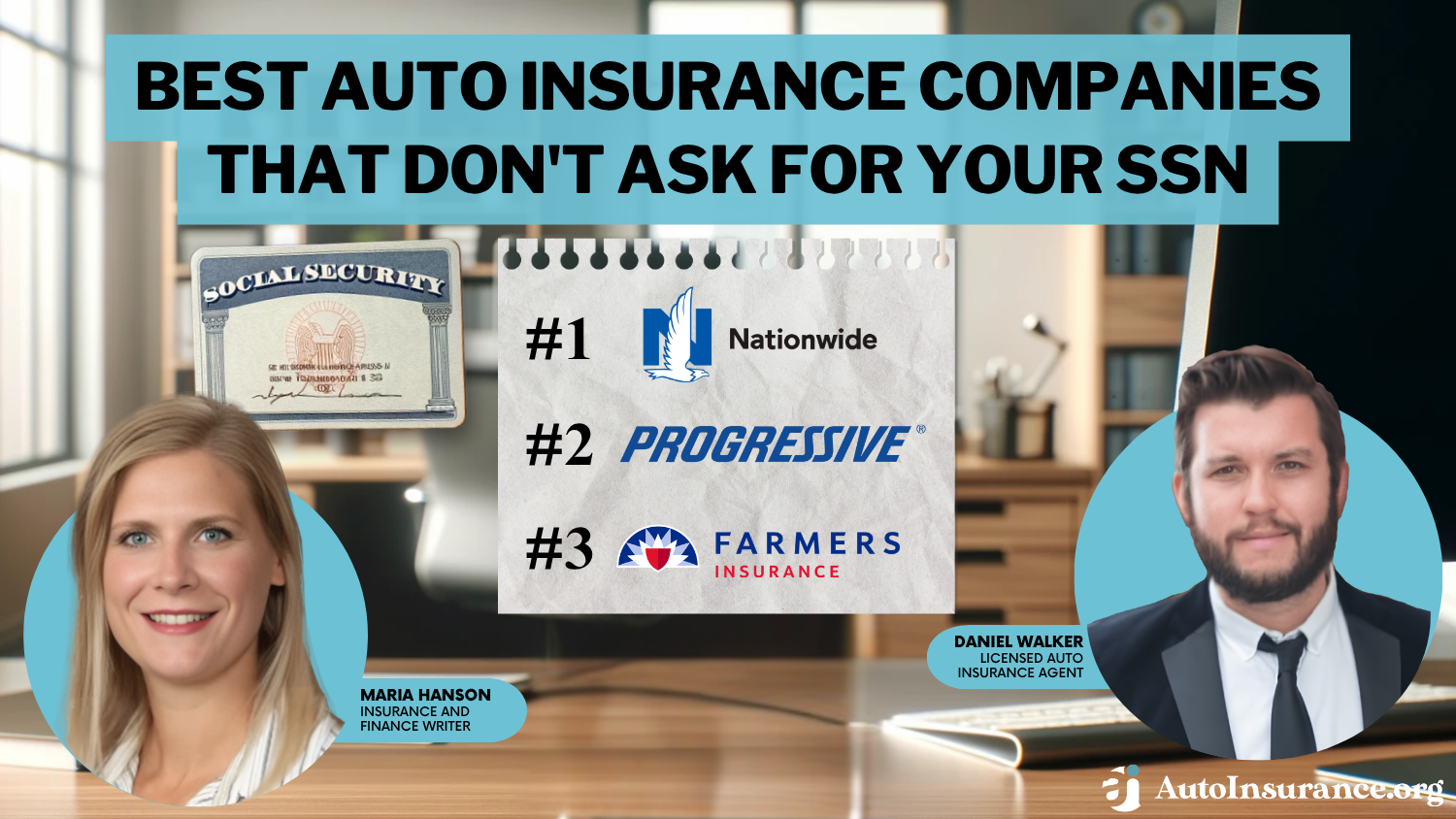
When shopping for auto insurance in 2026, the most efficient and cost-effective approach is to provide your Social Security Number upfront. This ensures that the quote you receive is accurate and includes all eligible discounts based on your financial responsibility and driving history. To protect your data, only provide your SSN through the official, encrypted websites of well-known insurance carriers or through a licensed, reputable insurance agent. If you are concerned about your credit score, remember that insurance inquiries do not hurt your credit rating, so feel free to compare at least three to five different carriers to find the best rate for your specific risk profile.
Image Gallery