Parsley Box Investor Overview: Business Model, Financial History, and Corporate Status
The Parsley Box investor overview outlines the operational strategy, market positioning, financial evolution, and corporate restructuring of Parsley Box Group plc (now Parsley Box Group Limited). Founded in 2017 and publicly traded on...
The Parsley Box investor overview outlines the operational strategy, market positioning, financial evolution, and corporate restructuring of Parsley Box Group plc (now Parsley Box Group Limited). Founded in 2017 and publicly traded on the London Stock Exchange’s AIM market from March 2021 to December 2022, Parsley Box specializes in direct-to-consumer (DTC) ambient ready meals targeted at the UK’s over-60 demographic.
Contents
Disclaimer: This overview is provided for informational and analytical purposes only and does not constitute financial, investment, or legal advice. Investors seeking advice on unlisted equity holdings should consult a qualified financial advisor regulated by the Financial Conduct Authority (FCA).
Company Overview and Value Proposition
Parsley Box was established in 2017 by Gordon and Adrienne MacAulay to address an underserved segment of the food delivery market: independent older adults who seek convenient, long-shelf-life meals without the requirement of freezer storage or complex preparation.
- Customer Order
- Ambient Meal Preparation — Retort Pouch Sterilization (No Freezing Required)
- Direct-to-Consumer Delivery — Standard Parcel Logistics across the UK
- Cupboard Storage — Store at Room Temp (Up to 12-Month Shelf Life)
Direct-to-Consumer Model for the Over-60 Demographic
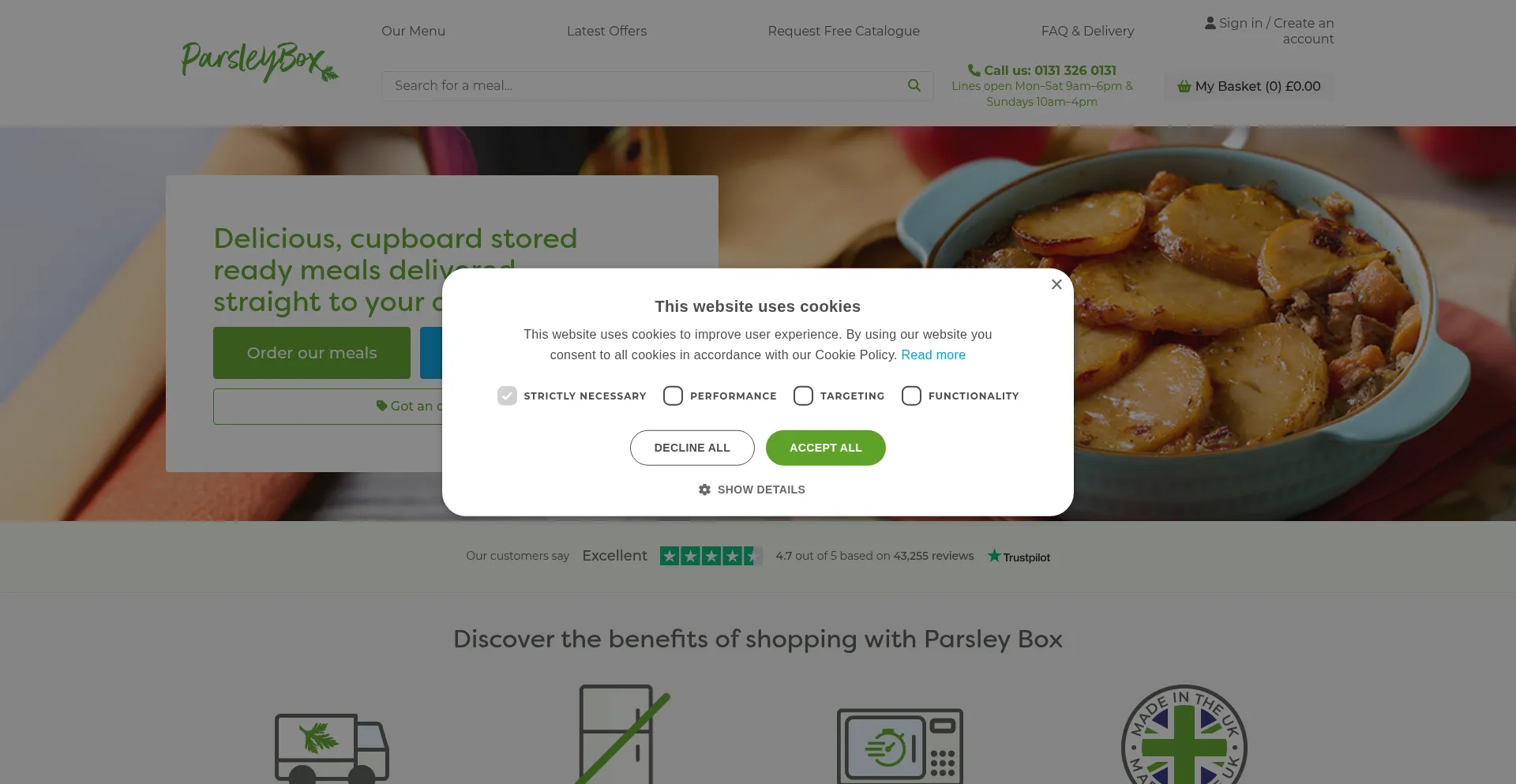
Unlike mainstream direct-to-consumer meal kit providers or frozen ready-meal services, Parsley Box explicitly focuses on consumers aged 60 and older. This demographic exhibits specific ordering habits, ordering predominantly via telephone customer service and physical mail-order catalogs alongside traditional e-commerce web channels.
The core value proposition relies on convenience and independence:
- No Frozen Storage Required: Meals are packaged using retort pouch technology (steam-sterilized under pressure), allowing them to be stored at room temperature in kitchen cupboards for up to 12 months.
- Simplified Delivery Logistics: Ambient food items do not require temperature-controlled cold-chain shipping (such as dry ice or insulated foil bags), which significantly reduces outer packaging weight and fulfillment complexity compared to chilled food operators.
- Targeted Customer Engagement: Marketing relies heavily on direct mailers, national newspaper advertising inserts, and dedicated outbound call centers to serve customers who may prefer off-line channels.
Capital Markets History and Public Listing (2021–2022)
Parsley Box achieved rapid top-line growth during the early stages of the COVID-19 pandemic, as stay-at-home mandates led to increased adoption of delivery services among vulnerable and older populations. On the back of this rapid expansion, the company pursued an initial public offering (IPO) on the Alternative Investment Market (AIM) of the London Stock Exchange.
The March 2021 IPO
In March 2021, Parsley Box Group plc completed its admission to trading on AIM under the ticker MEAL.
- Placing Price: 200 pence per ordinary share.
- Market Capitalization at Admission: Approximately £83.8 million.
- Gross Proceeds Raised: £17 million, comprising £5 million for the company to fund growth initiatives and operational expansion, and £12 million for selling shareholders.
The capital raised during the IPO was earmarked for expanding the product lineup, enhancing technological infrastructure, investing in digital customer acquisition, and scaling marketing initiatives across national media channels.
Operational Trajectory and Financial Performance
Following its public listing, Parsley Box encountered significant operational and macroeconomic headwinds that eroded profitability and compressed market valuation.
- March 2021: IPO at 200p per share (£83.8M Valuation)
- Post-Lockdown Demand Normalization
- Escalating Customer Acquisition Costs (CAC)
- Supply Chain Inflation & Margin Compression
- March 2022: Emergency Placing at 20p per share (£5.9M Raised)
- Declining Active Customer Counts
- Ongoing AIM Compliance Overhead
- Dec 2022: Shareholder Approval to Cancel AIM Listing -> Private Entity Status
Post-IPO Headwinds and Margin Pressures
As COVID-19 restrictions eased across the UK throughout late 2021, consumer behavior normalized, leading to a decline in online food delivery volumes industry-wide. Parsley Box faced several compounding structural challenges:
- Customer Acquisition Costs (CAC): The cost of acquiring new customers increased sharply across digital and print media channels. Because the company relied heavily on repeat orders from a core cohort of older customers, rising acquisition costs eroded the lifetime value (LTV) relative to customer acquisition expenditure.
- Supply Chain and Freight Inflation: Rising ingredient prices, packaging cost increases, and general inflationary pressure across UK freight and delivery networks compressed gross profit margins.
- Product Mix Rationalization: Attempts to diversify beyond core ambient meals—into categories like ambient bakery, chilled goods, and wine—introduced fulfillment complexity without yielding sustained revenue lift.
March 2022 Capital Raise
To strengthen liquidity following a widening operating loss in 2021, Parsley Box executed a recapitalization in March 2022. The company raised £5.9 million (gross) through a placing and open offer at 20 pence per share—representing a 90% discount to its 2021 IPO offer price. The proceeds were targeted toward funding a revised business plan focused on customer retention, product innovation, and reaching cash flow breakeven.
Parsley Box Financial & Capital Milestones Summary
The table below summarizes key corporate, financial, and capital market milestones for Parsley Box Group plc during its period as a public entity:
| Event / Metric | Date / Period | Financial Value / Indicator | Strategic Context |
|---|---|---|---|
| AIM Initial Public Offering | March 2021 | 200p / share (£83.8m Market Cap) | Listed under ticker MEAL; raised £17m gross. |
| Peak Revenue Period | FY 2020 – FY 2021 | ~£24.4m Annual Revenue (FY 2020) | Revenue surged due to lockdown-driven online demand. |
| Emergent Financial Strain | H2 2021 | Net Loss Expansion | High CAC and rising order fulfillment costs depressed EBITDA. |
| Equity Capital Placement | March 2022 | 20p / share (£5.9m Gross Raised) | Emergency funding round to stabilize balance sheet liquidity. |
| Delisting Proposal | November 2022 | Shareholder Circular Issued | Board recommended cancelling AIM admission to cut costs. |
| AIM Cancellation Effective | 22 December 2022 | 0p (Delisted from LSE) | Stock trading ceased; re-registered as a private company. |
Rationale for AIM Delisting and Transition to Private Status
In November 2022, the board of directors of Parsley Box Group plc announced a proposal to cancel the admission of its ordinary shares to trading on AIM and re-register the business as a private limited company. Shareholders approved the resolutions at a General Meeting on 14 December 2022, and the AIM listing was formally cancelled on 22 December 2022.
Primary Drivers for Delisting
The board cited several strategic and financial reasons for taking the business private:
- Disproportionate Costs of Public Status: Managing an AIM listing requires substantial financial and administrative overhead, including director fees, legal retainers, audit fees, public relations costs, nomad fees, and exchange fees. For a micro-cap company, these fixed costs represented a significant drag on cash resources.
- Equity Market Illiquidity: The share price had fallen substantially below the initial placing price, leading to reduced trading liquidity. Low trading volume limited institutional investor interest and restricted the company’s ability to raise further equity capital effectively through public equity markets.
- Strategic Flexibility: Operating as an unquoted private limited company allows executive management to execute operational restructuring, cost-reduction programs, and product repositioning without the quarterly earnings scrutiny and public compliance demands of open equity markets.
Following the cancellation of the AIM quote, Parsley Box Group plc re-registered as a private limited entity, operating as Parsley Box Group Limited.
Corporate Governance and Executive Leadership
During its operation as a public entity, Parsley Box operated under a standard UK corporate governance framework for AIM-quoted companies, aligning with the Quoted Companies Alliance (QCA) Corporate Governance Code.
Key Executive and Board Members
- Kevin Dorren (Chief Executive Officer): Took over executive management to lead operational restructuring, streamline product lines, and drive the efficiency strategy following early growth phases.
- Chris van der Kuyl (Non-Executive Chairman): Provided strategic oversight across tech investments and capital structuring.
- Gordon and Adrienne MacAulay (Co-Founders): Founded the enterprise in 2017 to serve the ambient food niche, maintaining significant shareholdings throughout the public and private transitions.
Operational Adjustments Post-Delisting
After returning to private ownership, Parsley Box shifted strategic priorities away from high-cost broad customer acquisition toward core operational efficiency:
- Product Line Streamlining: Concentrating catalog offerings on core, top-performing ambient recipes to lower inventory holding costs and reduce stock write-offs.
- Focus on Repeat Cohorts: Prioritizing retention and average order value (AOV) among long-standing, high-loyalty customer segments rather than buying lower-margin digital traffic.
- Fulfillment Overhead Reductions: Optimizing warehouse operations and shipping contracts to improve unit economics.
Investment Analysis: Direct-to-Consumer Food Dynamics
The performance trajectory of Parsley Box offers practical insights for financial analysts and DTC sector investors evaluating specialized consumer goods providers.
- Customer Acquisition — Costs elevated via traditional/digital media
- First Purchase Order — Margin compressed by initial promotional discount
- Drop Off (High Churn Risk)
- Repeat Buyer (Drives Long-Term Customer Value)
Unit Economics and Customer Lifetime Value (LTV)
In the DTC food industry, long-term business viability depends on keeping Customer Acquisition Costs (CAC) significantly lower than the net margin generated over the customer’s active purchasing life (LTV).
When CAC rises due to increased ad competition across TV, print, and search platforms, the pay-back period lengthens. For companies catering to an older demographic, physical catalogue mailings introduce non-digital costs (paper, printing, postage) that must be offset by strong repeat order frequency and high basket sizes.
Ambient vs. Cold-Chain Supply Chains
From a financial structure perspective, ambient distribution has distinct capital expenditure (CapEx) and operational expenditure (OpEx) characteristics:
- Storage and Logistics Efficiency: Ambient goods do not require refrigerated warehouses or cold-chain courier transport, protecting margins against specialized freight surcharges.
- Perishability Risk: With a 12-month shelf life, ambient inventory experiences lower write-down rates compared to fresh or meal-kit businesses dealing with short shelf-life items.
- Consumer Perception Barriers: Ambient meals must overcome consumer perceptions regarding taste, texture, and nutritional value compared to fresh or frozen food options, requiring ongoing menu innovation and product quality investment.
Shareholder Information and Private Equity Trading
With the cancellation of Parsley Box's AIM listing in December 2022, ordinary shares are no longer quoted or traded on any public stock exchange.
Information Access for Unlisted Shareholders
Holders of shares in Parsley Box Group Limited are subject to the standard provisions of the UK Companies Act 2006 and the company's private articles of association:
- Public Filings: Financial reports, annual accounts, and confirmation statements are filed periodically with the UK corporate registry at Companies House.
- Off-Market Trading: Because unlisted private shares cannot be executed through regular retail brokerage platforms, shareholders wishing to trade unquoted shares must rely on matched-bargain platforms (if appointed by the company) or private private transactions governed by transfer restrictions in the company's articles.
- Shareholder Communications: Notices regarding annual general meetings (AGMs) and private company reporting are distributed directly to registered shareholders by the company secretary or share registrar.
Frequently Asked Questions
Is Parsley Box still listed on the London Stock Exchange?
No. Parsley Box Group plc formally cancelled its admission to trading on the LSE AIM market on 22 December 2022 following shareholder approval at a general meeting.
What happened to Parsley Box shares after delisting?
Upon delisting, the company re-registered as a private limited company (Parsley Box Group Limited). Existing shareholders retained their ownership equity, but the shares became unquoted and can no longer be bought or sold on open stock markets or standard retail trading apps.
How can investors track the financial performance of Parsley Box?
As a private limited entity registered in Scotland, Parsley Box files its mandatory annual financial statements, director reports, and confirmation statements publicly via Companies House.
What was Parsley Box’s IPO price in 2021?
Parsley Box listed on the AIM market in March 2021 at an IPO placing price of 200 pence per share, giving the business an initial equity market capitalization of approximately £83.8 million.
Why did Parsley Box decide to go private?
The board determined that the high administrative and compliance costs of maintaining a public listing were disproportionate to the company's diminished market valuation. Operating as a private business allowed the management team to conserve cash, cut overhead, and restructure operations without public market pressures.
Practical Recommendations for Investors
Investors reviewing unlisted holdings or assessing turnaround micro-cap opportunities in the direct-to-consumer sector should consider the following actions:
- Review Official Corporate Filings: For ongoing operational verification of private UK entities, regularly review public statutory accounts submitted directly to Companies House.
- Understand Unquoted Equity Risk: Unlisted private equity investments carry substantial liquidity risks. Shares cannot be sold quickly on open markets, and secondary valuation mechanisms may vary significantly from historic public exchange prices.
- Analyze Unit Economics Over Revenue Growth: When evaluating direct-to-consumer businesses, prioritize underlying retention rates, repeat order contribution margins, and CAC stability over top-line growth figures.
- Consult Professional Guidance: Shareholders holding delisted equity inside Tax-Advantaged Accounts (such as UK Stocks and Shares ISAs) should consult a qualified tax professional or financial advisor to confirm eligibility rules for holding unquoted private shares within their portfolio structures.
Image Gallery