AI in SaaS: Definition, Architectural Integration, and Business Impact
AI in SaaS (Software as a Service) refers to the integration of artificial intelligence technologies—such as machine learning, natural language processing, generative models, and predictive analytics—directly into cloud-hosted software...
AI in SaaS (Software as a Service) refers to the integration of artificial intelligence technologies—such as machine learning, natural language processing, generative models, and predictive analytics—directly into cloud-hosted software applications. This evolutionary shift transforms static, rule-based software into adaptive, intelligent systems that automate complex workflows, personalize user experiences, and generate predictive insights directly within daily operational software.
Contents
Defining AI in SaaS: Beyond Rule-Based Automation
To understand AI in SaaS, one must distinguish between traditional cloud software and modern intelligent applications. Traditional SaaS platforms deliver software over the internet via subscription models, relying heavily on hardcoded conditional logic, manual data entry, and static workflow rules. While traditional SaaS revolutionized software distribution and reduced IT overhead, it required human operators to analyze data, make decisions, and execute routine actions.
AI in SaaS embeds machine learning (ML) models, large language models (LLMs), small language models (SLMs), and computer vision engines directly into cloud infrastructure. Rather than merely processing user inputs according to preprogrammed logic, AI-powered SaaS continuously analyzes unstructured and structured data, learns from operational patterns, predicts outcomes, and autonomously executes complex task sequences.
The integration of artificial intelligence into SaaS operates across three functional paradigms:
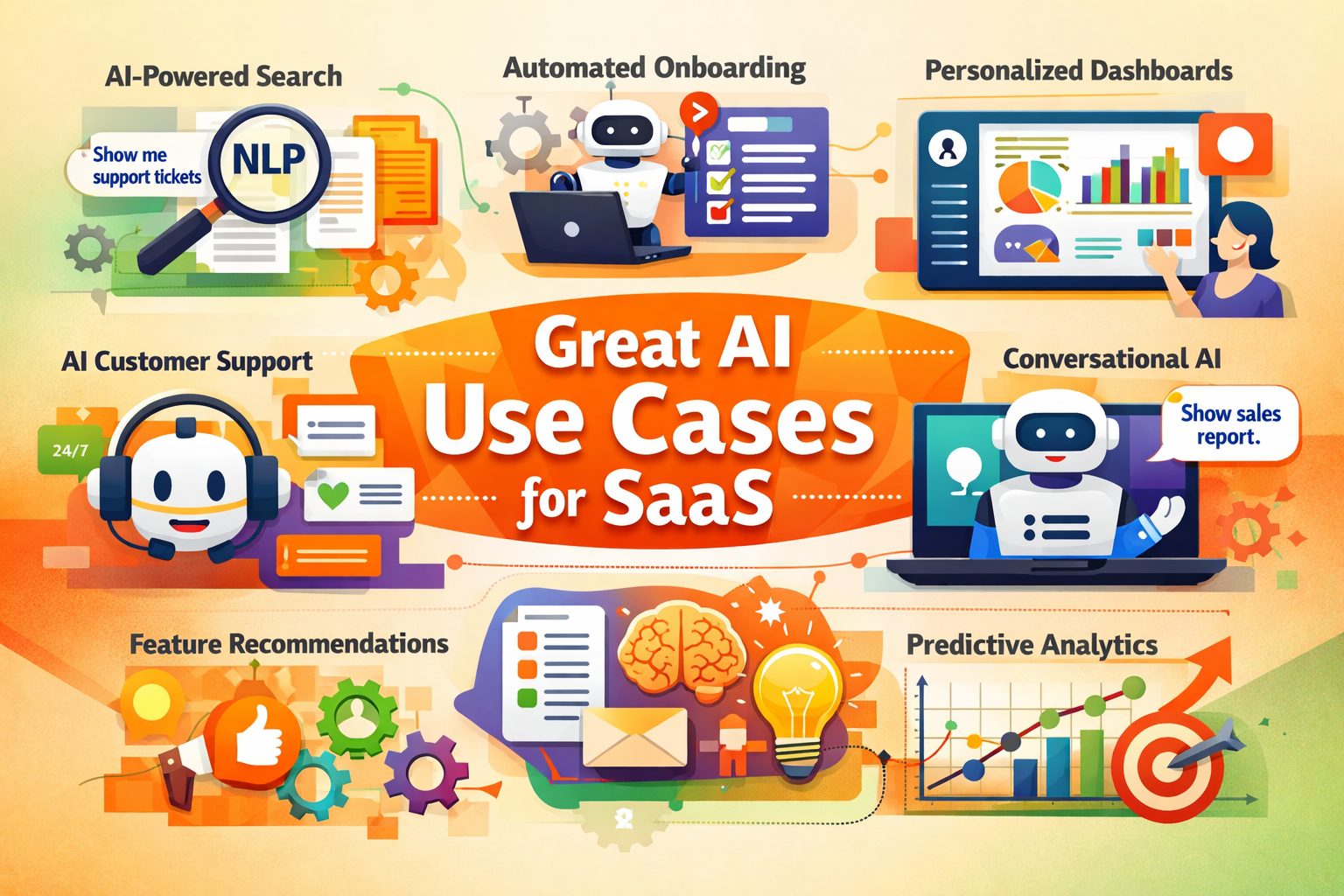
- Embedded AI Features: Traditional SaaS platforms integrate discrete AI modules into existing workflows. Examples include predictive lead scoring in customer relationship management (CRM) software or automated transcript summarization in video conferencing platforms.
- AI-Assisted Copilots: Interactive, conversational interfaces overlay standard software, allowing users to query databases, generate complex reports, build custom automation, and draft documents using natural language commands.
- AI-Native SaaS Applications: Cloud software designed from the ground up around AI models. These systems replace manual multi-step interfaces with autonomous AI agents that perform end-to-end business operations with human supervision reserved for exception handling.
Technical Architecture of Intelligent SaaS Platforms
Integrating artificial intelligence into multi-tenant cloud architecture requires significant structural modifications across the application layer, data pipeline, and compute stack. Unlike static applications that process deterministic database queries, AI-enabled SaaS must handle non-deterministic probabilistic operations, high-latency inference workflows, and massive vector storage requirements.
- User Presentation Layer
- (Conversational Interfaces, Predictive UI, Automated Dashboards)
- Application Logic & Orchestration
- (Retrieval-Augmented Generation [RAG], Autonomous AI Agents)
- Model & Data Ingestion Layer
- (Fine-Tuned LLMs, Open-Source SLMs, Vector Databases, Data Isolation)
- Multi-Tenant Cloud Infrastructure
- (GPU/NPU Compute Clusters, Cloud Storage, Privacy Controls)
Data Pipeline and Retrieval-Augmented Generation (RAG)
For AI models to deliver contextual enterprise value, they must query tenant-specific operational data without violating data boundaries. Cloud software platforms employ Retrieval-Augmented Generation (RAG) architectures to achieve this. When a user executes a query or triggers an action, the SaaS engine retrieves relevant data vectors from a dedicated vector database, injects that business context into the prompt, and passes it to the underlying language model. This technique ensures high contextual accuracy without requiring the master base model to be retrained on sensitive customer data.
Multi-Tenant Isolation and Data Governance
A foundational requirement of SaaS is strict multi-tenant isolation, ensuring that Customer A cannot view or access Customer B's data. In an AI-powered SaaS architecture, multi-tenancy rules extend directly to inference pipelines and vector indexes. Enterprise SaaS vendors deploy dedicated tenant vector namespaces, encryption key management services, and strict opt-out parameters to guarantee that customer data is never used to train global, multi-tenant foundational models.
Model Hosting and Compute Orchestration
AI compute demands differ fundamentally from traditional cloud workloads. SaaS providers utilize hybrid model orchestration strategies to manage performance and cost. Routine low-complexity tasks (e.g., text categorization, sentiment analysis) are routed to fine-tuned, localized Small Language Models (SLMs) hosted on cost-effective micro-services. Complex reasoning, creative generation, and dynamic software code synthesis are offloaded to specialized foundation model APIs or dedicated enterprise GPU clusters.
Transformational Impact on SaaS Vendors and End Users
The incorporation of artificial intelligence into software-as-a-service yields distinct operational and economic consequences for both enterprise software buyers and software vendors.
Impact on SaaS Buyers and Enterprise Operations
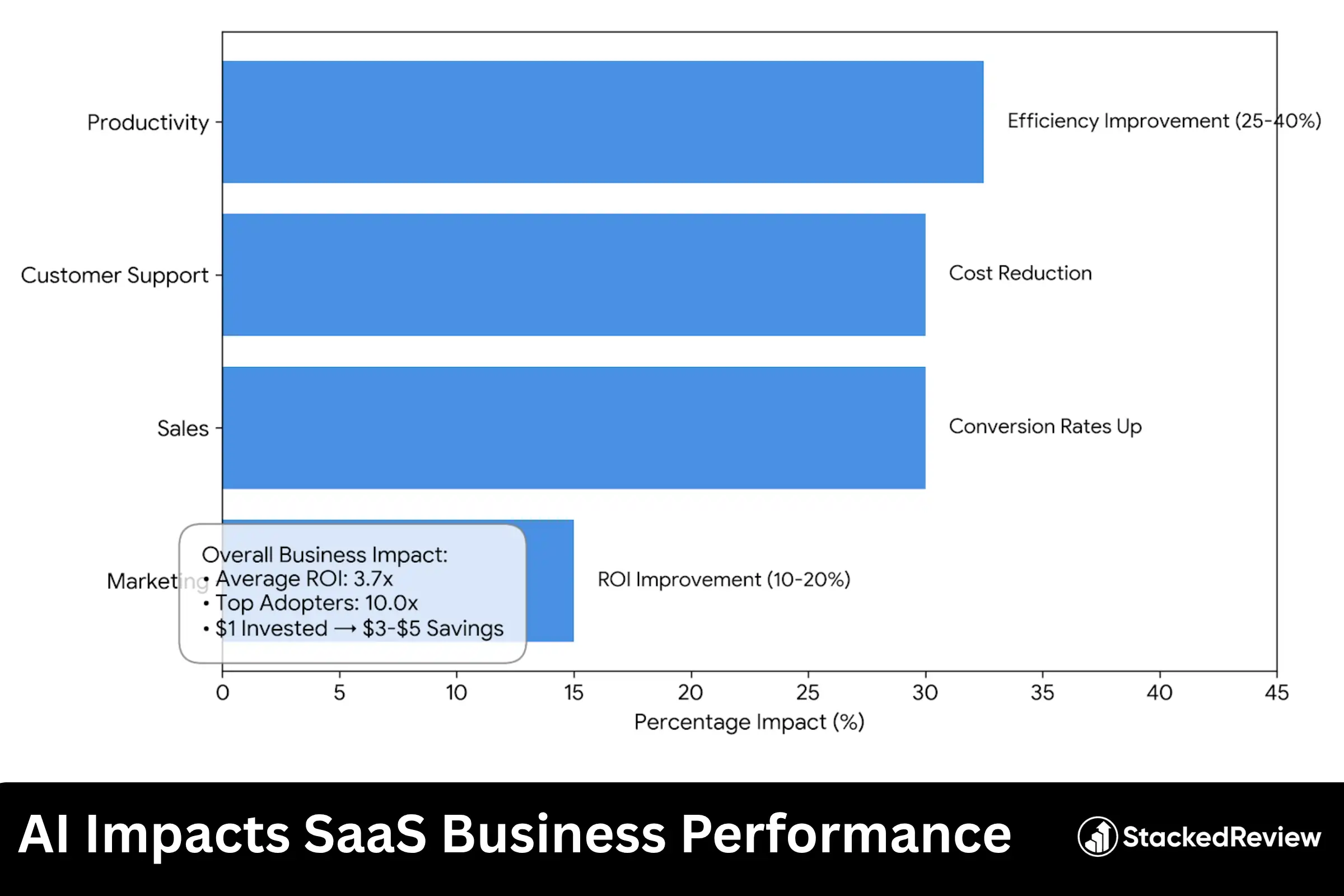
- Dramatic Productivity Escalation: By automating cognitive, repetitive tasks—such as invoice processing, data reconciliation, contract review, and code drafting—AI-driven SaaS dramatically reduces manual effort. Enterprise teams move from executing low-level operational inputs to supervising autonomous systems.
- Shift from Reactive Data to Proactive Execution: Traditional SaaS required business intelligence teams to extract data, build dashboards, and manually interpret historical performance. AI SaaS shifts software from descriptive reporting to predictive and prescriptive execution. For example, AI-enabled supply chain SaaS does not merely report low inventory; it projects demand spikes, identifies alternative suppliers, and prepares purchase orders automatically.
- Hyper-Personalization at Scale: Modern enterprise software tailors user experiences based on individual user behavior, role dynamics, and historical actions. Interfaces dynamically surface the exact features, reports, and workflow shortcuts a user requires at a specific moment.
Impact on SaaS Vendors and Business Models
- Evolution of Pricing Structures: The traditional seat-based licensing model (per-user/per-month) is undergoing significant restructuring. Because AI capabilities allow smaller teams to execute work previously requiring dozens of employees, seat-based revenue can penalize software vendor success. Consequently, vendors are implementing hybrid models combining base subscription fees with usage-based, token-based, or value-outcome pricing.
- Average Revenue Per User (ARPU) Expansion: Software providers that introduce high-value AI capabilities, such as automated intelligence agents or specialized predictive tools, successfully upsell existing accounts, driving higher expansion revenue and increasing net revenue retention (NRR).
- Defensibility and Data Flywheels: In cloud software, features are easily replicated by competitors. However, proprietary AI models trained on aggregated, anonymized workflow patterns create defensible competitive moats. As users interact with the application, the software becomes smarter, continuously improving performance and lowering customer churn.
Architectural and Operational Comparison
Evaluating how software platform architecture and operations evolve from legacy cloud models to intelligent software systems highlights critical trade-offs across cost, data isolation, and user experience.
| Feature / Dimension | Traditional SaaS | AI-Enhanced SaaS | AI-Native SaaS |
|---|---|---|---|
| Primary Logic Engine | Hardcoded logic, rule-based workflows, SQL queries | Rule-based core software with embedded ML/LLM API features | Foundation models, dynamic agentic workflows, vector indexes |
| User Interface Paradigm | Graphical User Interface (GUI), forms, manual navigation | GUI combined with sidebar AI copilots and conversational bots | Intent-driven UI, natural language prompts, adaptive workspace |
| Data Requirements | Structured relational databases (RDBMS, NoSQL) | Relational databases paired with vector search indexes | Vector databases, real-time unstructured data streams, knowledge graphs |
| Pricing Models | Per-user, per-month standard subscriptions | Tiered seat subscriptions with add-on AI feature packages | Outcome-based, token usage, dynamic credit consumption models |
| Primary Value Metric | Digitization of workflows and centralized record storage | Task acceleration and automated draft generation | Autonomous operational execution and decision synthesis |
| Margin & Cost Profile | High gross margins (~75%–85%); predictable server costs | Variable gross margins (~65%–75%); elevated cloud API expenses | Dynamic gross margins (~50%–70%); high inference GPU overhead |
Critical Challenges, Risks, and Operational Limitations
While the impact of AI in SaaS is transformative, organizations faces severe technical, legal, and operational hurdles during deployment.
Gross Margin Compression and Inference Cost Management
For software vendors, traditional cloud compute costs are relatively low and predictable. However, AI inference—especially involving large language models—requires substantial compute power. Unmonitored API calls or poorly optimized model routing can shrink a vendor's gross margins dramatically. To mitigate this risk, engineering teams must deploy caching layers, model distillation, and strict compute usage limits within enterprise contracts.
Data Privacy, Sovereignty, and Regulatory Compliance
Enterprise buyers subject to strict regulatory regimes (such as GDPR in Europe, HIPAA in healthcare, or SOC 2 Type II compliance standards) must carefully evaluate AI SaaS vendors. Key regulatory and compliance risks include:
- Model Contamination: The risk of confidential business data inadvertently leaking into shared public models.
- Jurisdictional Sovereignty: Cross-border data transmission during inference processing on foreign GPU data centers.
- Auditability and Transparency: The "black box" challenge where AI software makes operational decisions (e.g., credit underwriting, hiring screenings) without a clear audit trail explaining the logic.
Hallucinations and Operational Drift
Non-deterministic models occasionally produce inaccurate statements, hallucinate false metrics, or experience performance drift following backend model updates. In mission-critical environments—such as financial accounting, healthcare diagnostics, or legal documentation—unverified AI outputs introduce severe operational liabilities. SaaS architectures must incorporate validation guardrails, automated deterministic verification checks, and mandatory human-in-the-loop workflows for sensitive operations.
Strategic Evaluation Framework for Buying AI SaaS
Enterprise software buyers should follow a structured three-stage evaluation framework prior to procuring or expanding AI-driven software applications within their operational stack.
- Stage 1: Architectural & Security Audit
- Verify data isolation models and tenant privacy guarantees.
- Confirm explicit vendor policies prohibiting customer data for model training.
- Inspect compliance attestations (SOC 2 Type II, ISO 27001, HIPAA).
- Stage 2: Total Cost of Ownership (TCO) & Contract Analysis
- Audit base subscription tiers vs. token/usage-based variable fees.
- Evaluate potential API rate limits, dynamic throttling, and concurrency caps.
- Model 3-year projected cost scaled against enterprise utilization volume.
- Stage 3: Operational Impact & Verification Proof
- Run isolated Proof of Concept (PoC) using real historical benchmark datasets.
- Measure strict accuracy metrics, hallucination frequencies, and latency.
- Assess human-in-the-loop governance and operational validation requirements.
1. Data Governance and Security Audit
Enterprise procurement teams must verify how customer data is isolated, processed, and stored by the software provider. Demand explicit contractual guarantees stating that tenant data will not be used to train base foundation models accessible by other buyers. Review vendor architecture documents to ensure vector database queries maintain tenant-level encryption key segregation.
2. Variable Cost and Usage Structure Analysis
Evaluate the vendor’s pricing model for hidden scaling costs. Assess whether the subscription relies on capped tokens, consumption credits, or per-execution charges. Model the application's enterprise adoption scenarios to project dynamic variable costs accurately as usage expands across departments.
3. Accuracy and Human-in-the-Loop Safeguards
Assess the platform’s administrative safety tools. Check whether the software offers configurable approval gates, confidence scores, and audit logging for autonomous actions. Test the software during a vendor pilot phase using real operational scenarios to measure output accuracy, model latency, and exception handling.
Frequently Asked Questions
What is the primary difference between traditional SaaS and AI SaaS?
Traditional SaaS uses static databases and preprogrammed, rule-based logic to automate manual data entry and workflow processes. AI SaaS integrates machine learning, natural language processing, and generative capabilities directly into the application, enabling the software to analyze unstructured data, make predictive recommendations, and execute autonomous actions.
How do AI SaaS platforms keep customer data secure?
Reputable AI SaaS platforms enforce strict multi-tenant data isolation using dedicated vector namespaces, enterprise-grade encryption keys, and localized Retrieval-Augmented Generation (RAG) architectures. They explicitly contract that customer operational data is never used to retrain public or shared foundation models.
Why are SaaS companies moving away from simple per-seat pricing?
AI capabilities allow smaller teams to execute workloads that previously required larger headcount, rendering per-user licensing counterproductive for software vendor growth. Vendors are adopting hybrid models combining base subscription tiers with usage-based token models or value-driven outcome metrics.
What is Retrieval-Augmented Generation (RAG) in AI SaaS?
RAG is an architectural framework that connects pre-trained large language models to a company’s private database. When a user asks a question, the software retrieves precise internal business documents, passes them as context to the language model, and returns highly accurate, context-specific answers without exposing sensitive enterprise data to external model training pipelines.
How does embedded AI differ from an AI native application?
Embedded AI adds discrete intelligent features—such as text summaries or predictive lead scoring—into an existing software application built on standard relational logic. An AI-native application is designed from scratch around artificial intelligence models, utilizing dynamic interfaces, vector search databases, and autonomous task agents as its core foundation.
Practical Action Plan for IT Leaders
To maximize returns from AI-enabled cloud software while protecting enterprise security, technical decision-makers should take these next steps:
- Inventory Existing SaaS Stack: Audit current software subscriptions to identify native AI capabilities already included in existing license tiers before purchasing net-new point solutions.
- Establish Enterprise AI Procurement Guardrails: Create mandatory security checklists requiring vendors to sign strict data privacy agreements, guarantee zero-model-retraining policies, and provide SOC 2 Type II compliance reports.
- Execute High-Impact Pilots: Select focused operational bottlenecks—such as automated customer support routing or invoice processing—and execute 60-day pilot projects to quantify concrete ROI and operational accuracy before enterprise-wide deployment.
Image Gallery