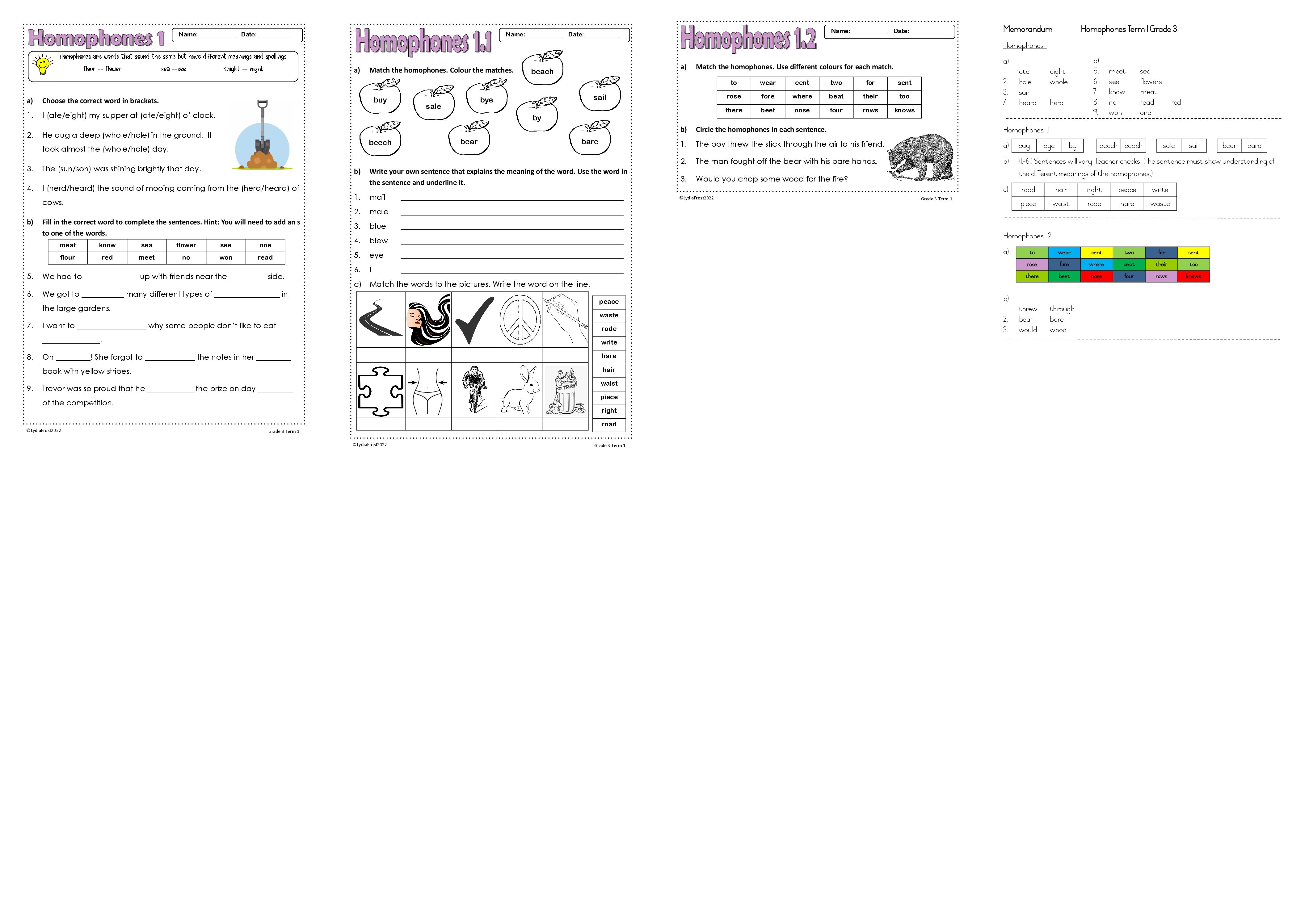
Why the Right Homophones Worksheet Matters for Learning
The right homophones worksheet matters because sound-alike words create severe cognitive interference during literacy acquisition. Rather than relying on isolated matching drills, high-quality worksheets integrate semantic context, syn...
The right homophones worksheet matters because sound-alike words create severe cognitive interference during literacy acquisition. Rather than relying on isolated matching drills, high-quality worksheets integrate semantic context, syntactic cues, and orthographic mapping. This structured approach prevents students from confusing word pairs like affect/effect or their/there, building lasting reading fluency and writing precision.
Contents
The Cognitive Challenge of Homophones in Literacy Development
Homophones—words that share the exact same pronunciation but differ in spelling, origin, and meaning—present a unique bottleneck in literacy instruction. From an auditory perspective, the brain processes the phonemes of sound-alike words identically. When a reader encounters the auditory signal /teər/, the brain must choose between their, there, and they're based entirely on contextual, syntactic, and orthographical cues.
For developing readers, this process requires rapid coordination between the brain’s phonological loop and orthographic mapping pathways. According to cognitive models of reading, orthographic mapping is the process by which readers bond speech sounds (phonemes) to printed letter sequences (graphemes) and store them in permanent memory. Because homophones share identical phonological structures, standard auditory decoding strategies fall short.
When worksheets fail to account for this cognitive reality, they inadvertently reinforce confusion. Presenting sound-alike words side-by-side in isolated matching exercises frequently induces proactive and retroactive interference. Proactive interference occurs when an old memory blocks the retrieval of a new one, while retroactive interference happens when newly introduced words distort the recall of previously learned ones.
High-quality worksheets mitigate this issue by grounding homophones in distinct semantic networks. Instead of teaching sound-alike words as arbitrary pairs to memorize, effective instructional materials leverage syntactic function, visual imagery, and context-rich sentence frameworks to build distinct mental entries for each word.
Common Pitfalls of Low-Impact Homophone Worksheets
Many commercially available worksheets for homophones rely on outdated drill-and-practice formats that hinder learning rather than support it. Understanding why these traditional designs fail helps educators select materials grounded in evidence-based literacy research.
- Low-Impact Worksheet Design (Decontextualized)
- Word List: write / right
- Match to isolated definitions
- High Error Rate & Confusion
- Evidence-Based Worksheet Design (Context-Driven)
- Syntax Focus: Part of Speech
- Cloze Passages with Context
- Self-Correction
- Long-term Orthographic Retention
1. Isolated Matching Columns
Worksheets that ask students to draw a line from a target word to its definition out of context force learners to memorize definitions in a vacuum. A student might correctly match cite, site, and sight during the activity, but because no grammatical or narrative framework anchors the words, the knowledge fails to transfer to authentic writing assignments.
2. Concurrent Introduction of Confusing Pairs
Introducing two or three unfamiliar homophones simultaneously—without prior mastery of at least one—causes severe mental overlap. If a student has not firmly anchored the spelling and usage of principal (school administrator/chief), introducing principle (fundamental truth) at the exact same moment creates a high probability of persistent spelling substitution errors.
3. Lack of Syntactic Cues
Homophones often belong to different parts of speech. For example, hear is a verb, while here functions as an adverb or noun. Inferior worksheets neglect part-of-speech identification, focusing solely on definition matching. Skipping syntactic analysis deprives students of one of the most reliable cues for identifying correct usage in sentence construction.
Key Features of an Evidence-Based Homophones Worksheet
Selecting the right instructional materials requires looking beyond visual appeal and evaluating the pedagogical structure of the practice items. Effective homophone worksheets combine explicit instruction with scaffolded application.
Contextual Sentence Framing (Cloze Activities)
Rather than displaying words in isolation, high-yield worksheets embed target terms within multi-sentence narratives or complex sentences. Rich context forces the reader to evaluate the surrounding words for semantic clues before selecting the correct spelling. For instance:
- Weak Prompt: Choose the right word: I went (to / two / too) the store.
- Strong Prompt: Analyze the context of the passage below. Select the word that functions as a preposition indicating direction: "After finishing her homework, Maya walked _____ the public library to return her books."
Explicit Part-of-Speech Categorization
The best worksheets prompt students to label the grammatical role of each homophone before making a selection. Recognizing that passed is the past-tense verb form of pass, while past functions as a noun, adjective, or preposition, gives students a structural framework for decision-making.
Self-Correction and Metacognitive Explanations
Instead of simple multiple-choice formats, robust worksheets require students to justify their choices in writing. Asking a student why they chose stationary over stationery activates higher-order thinking, consolidating the visual orthography of the word in long-term memory.
Comparing Homophone Worksheet Approaches
The structural differences between traditional, drill-style worksheets and modern, Science of Reading (SoR)-aligned materials determine how effectively students retain word meanings and spellings.
| Evaluation Metric | Low-Impact / Traditional Worksheets | Evidence-Based / SoR-Aligned Worksheets |
|---|---|---|
| Primary Method | Isolated matching, rote spelling lists, visual word searches. | Embedded cloze passages, syntactic categorization, error analysis. |
| Cognitive Focus | Auditory recall and short-term memory retrieval. | Syntactic awareness, semantic mapping, orthographic mapping. |
| Treatment of Word Pairs | Introduced simultaneously in direct contrast. | Introduced sequentially or differentiated by grammatical function. |
| Contextual Support | Low (single sentences or standalone words). | High (connected text, paragraph-level narratives, multi-clause sentences). |
| Student Engagement | Passive selection (circling, matching lines). | Active construction (writing sentences, explaining selection rationale). |
| Long-Term Transfer | Poor transfer to original, unprompted student writing. | Strong transfer to spelling accuracy in spontaneous writing. |
Differentiating Homophone Practice Across Development Levels
A homophones worksheet designed for early elementary students will lead to frustration if applied incorrectly, just as middle school students will derive little benefit from basic visual matching. Tailoring worksheet complexity to literacy stages ensures optimal learning outcomes.
Early Elementary (Grades K–2)
In early literacy development, homophones should be introduced using high-frequency, concrete terms paired with strong visual anchors.
- Focus Words: to/two/too, hear/here, sun/son, be/bee.
- Worksheet Design: Utilize image-supported sentence frames. Early worksheets should emphasize the visual differentiation of graphemes, helping students connect the double "e" in bee to an illustration of an insect, while connecting be to state-of-being sentence structures.
Intermediate Elementary (Grades 3–5)
At this stage, students possess foundational decoding skills but struggle with high-frequency possessives, contractions, and adverbs that sound identical.
- Focus Words: their/there/they're, its/it's, your/you're, wear/where.
- Worksheet Design: Worksheets must emphasize morphological breakdown and grammatical substitution rules. For example, worksheets targeting they're should feature exercises where students explicitly test whether "they are" can be substituted into the sentence without breaking grammatical rules.
Middle and High School (Grades 6–12)
Secondary students encounter academic and domain-specific homophones that impact formal writing, academic research, and standardized testing performance.
- Focus Words: affect/effect, principal/principle, complement/compliment, cite/site/sight.
- Worksheet Design: Exercises should incorporate academic vocabulary, domain-specific reading passages, and editing activities where students identify and correct homophone errors within unedited draft essays.
How to Integrate Homophone Worksheets into Lesson Planning
A worksheet should never serve as an isolated babysitting tool; it is most effective when integrated into a structured, explicit instruction cycle. To maximize the impact of a homophones worksheet, educators should implement the following multi-step instructional sequence:
Step 1: Direct Instruction & Etymology Focus
Step 2: Guided Auditory Dictation & Contrast
Step 3: Scaffolded Worksheet Practice (Cloze & Syntax)
Step 4: Peer Review & Written Explanation
Direct Pre-Teaching: Before handing out practice sheets, explicitly teach the definitions, parts of speech, and visual mnemonics for the target homophone set. Explore the root words or etymology where applicable (e.g., tele-phone vs. homo-phone).
Auditory Dictation: Read sentences aloud that contain the target words. Ask students to write down the correct spelling based entirely on the oral context provided, training their ears to map semantic meaning to specific spellings.
Targeted Worksheet Completion: Have students complete a contextual, scaffolded worksheet independently or in pairs. Ensure the worksheet requires students to highlight or underline the context clues that led to their spelling choice.
Peer Review and Error Analysis: Have students exchange worksheets to evaluate each other’s choices. If an error occurs, the reviewing student must write a brief note explaining why the alternative spelling is grammatically required.
Frequently Asked Questions
Why do traditional homophone matching worksheets often fail?
Traditional matching worksheets present sound-alike words in isolation without grammatical or narrative context. This approach causes cognitive interference, making it difficult for students to build clear visual and semantic entries for each distinct spelling in their long-term memory.
Should homophones be introduced together or separately?
Literacy research suggests introducing one word of a homophone pair first until a student achieves firm mastery over its spelling and meaning. Introducing both terms simultaneously to a struggling reader often leads to persistent confusion and spelling substitution errors.
How do context-rich worksheets improve reading comprehension?
Context-rich worksheets force students to analyze sentence syntax, parts of speech, and surrounding vocabulary before selecting a word. This practice strengthens general reading comprehension by training students to actively monitor meaning while reading.
What is the difference between homophones, homographs, and homonyms?
Homophones sound identical but have different spellings and meanings (their/there). Homographs are spelled identically but have different meanings and sometimes different pronunciations (lead the way vs. a lead pipe). Homonyms act as an umbrella term, often referring to words that are both homophones and homographs (bark of a tree vs. dog's bark).
How can teachers adapt homophone worksheets for English Language Learners (ELLs)?
For ELL students, worksheets should include visual visual cues, explicit part-of-speech definitions, and bilingual translation supports where necessary. Incorporating sentence frames that highlight target prepositions and verbs helps build overall syntactic awareness alongside spelling accuracy.
Final Recommendations for Selecting Quality Worksheets
Choosing the right homophones worksheet requires evaluating the cognitive demands placed on the learner. To ensure selected materials build genuine reading and writing mastery, prioritize resources that meet key pedagogical standards:
- Eliminate Isolated Lists: Reject sheets featuring simple matching columns or uncontextualized word banks.
- Prioritize Connected Text: Select materials that utilize paragraph-level stories, cloze passages, and authentic sentence construction prompts.
- Require Justification: Look for practice activities that require students to label parts of speech or write out the rationale behind their spelling choice.
- Match Developmental Needs: Reserve complex academic word pairs (affect/effect) for secondary students, while focusing early elementary practice on visual and high-frequency terms (to/two/too).
By aligning instructional materials with the cognitive mechanisms of orthographic mapping and syntactic analysis, educators can turn routine homophone practice into a powerful engine for long-term literacy growth.
Image Gallery