Understanding the Duramax 6.6L V8 Turbodiesel Engine: A Comprehensive Guide
The Duramax 6.6L V8 turbodiesel is a heavy-duty engine produced by DMAX, a joint venture between General Motors and Isuzu. Since its 2001 debut, it has powered Chevrolet Silverado and GMC Sierra HD trucks, evolving through several iter...
The Duramax 6.6L V8 turbodiesel is a heavy-duty engine produced by DMAX, a joint venture between General Motors and Isuzu. Since its 2001 debut, it has powered Chevrolet Silverado and GMC Sierra HD trucks, evolving through several iterations—from the LB7 to the current L5P—to balance high-torque towing performance with increasingly strict emissions standards.
Contents
The Origins and Partnership of the Duramax Diesel
To truly understand the Duramax 6.6L V8, one must look back at the late 1990s. At that time, General Motors was struggling to compete in the heavy-duty truck market with its aging 6.5L Detroit Diesel engine. While reliable for light tasks, the 6.5L lacked the raw power and torque required to match the Cummins engines found in Dodge trucks or the Power Stroke engines in Fords.
In 1998, GM formed a joint venture with Isuzu Motors Ltd., known as DMAX, Ltd. The goal was to design a clean-sheet diesel engine specifically for the North American 2500HD and 3500 series pickups. The result was the 6.6-liter Duramax V8, which launched in 2001. Unlike the cast-iron-headed competition of the era, the Duramax featured aluminum cylinder heads and a high-pressure common-rail fuel injection system, setting a new technical standard for the industry. This partnership proved so successful that as of 2026, the DMAX facility in Moraine, Ohio, remains the primary production hub for these powerplants.
The Evolution of the 6.6L Platform: Model-by-Model Breakdown
The Duramax engine is not a single, static design; it has undergone six major revisions to improve power, cooling, and emissions compliance. Each version is identified by a three-digit RPO (Regular Production Option) code.
LB7 (2001–2004)
The LB7 was the original Duramax. It lacked a Diesel Particulate Filter (DPF) and Exhaust Gas Recirculation (EGR) in its early forms, making it highly efficient and sought after by enthusiasts. It introduced the Bosch high-pressure common-rail system to the GM lineup. However, it is infamous for injector failures because the injectors were located underneath the valve covers, making replacement a labor-intensive and expensive task.
LLY (2004.5–2005)
The LLY was a transitional engine designed to meet updated emissions standards. It was the first to feature a Variable Geometry Turbocharger (VGT), which improved throttle response and provided better engine braking. GM also moved the injectors outside the valve covers, greatly simplifying maintenance. The primary drawback of the LLY was its tendency to overheat under heavy loads due to a restrictive turbo inlet and radiator design.
LBZ (2006–2007)
Among diesel enthusiasts, the LBZ is often called the "Holy Grail" of Duramax engines. Produced for a short window, it featured a significantly strengthened block and thicker connecting rods. It produced 360 horsepower and 650 lb-ft of torque right from the factory. Most importantly, it lacked the complex DPF emissions equipment that would be required in subsequent years, leading to exceptional reliability and longevity.
LMM (2007.5–2010)
The LMM was mechanically similar to the LBZ but was the first to incorporate a DPF to meet EPA 2007 emissions regulations. This addition slightly reduced fuel economy and introduced the "regeneration" cycle, where the engine burns off trapped soot in the filter. Despite the extra emissions gear, the LMM remained a robust platform for heavy towing.
LML (2011–2016)
The LML represented a massive shift toward "clean diesel." It introduced Selective Catalytic Reduction (SCR), which requires Diesel Exhaust Fluid (DEF) to reduce nitrogen oxide emissions. While it was the most powerful Duramax to date at its launch (397 hp / 765 lb-ft), it used the Bosch CP4.2 high-pressure fuel pump. This pump has a known failure rate when exposed to low-lubricity fuel or contamination, which can lead to catastrophic fuel system damage.
L5P (2017–Present/2026)
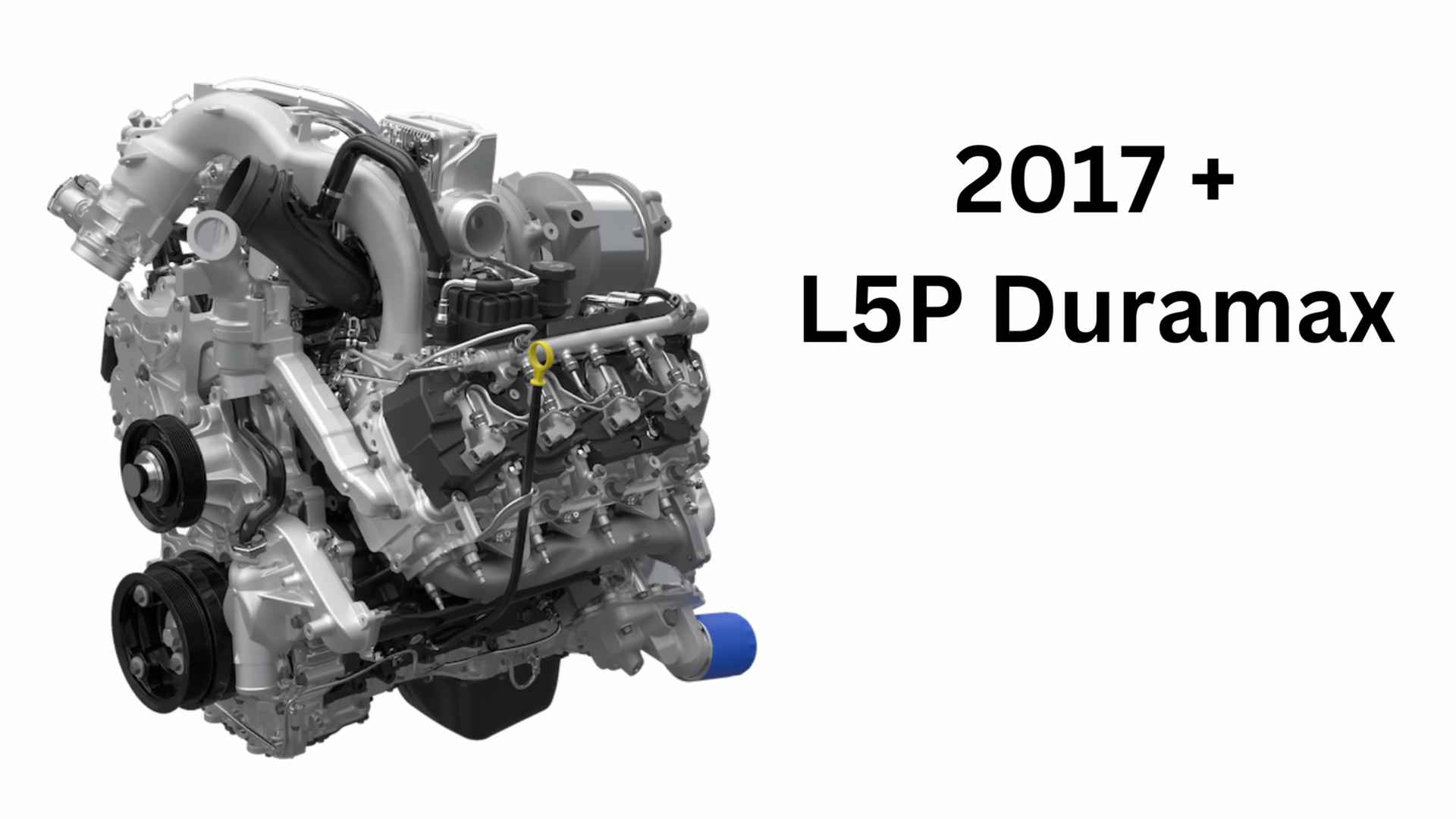
The L5P is a total redesign of the 6.6L architecture. GM moved away from Bosch fuel systems in favor of a Denso system and a more robust lift pump to solve the CP4 issues. It also featured a prominent hood scoop for improved air induction. In the current 2026 landscape, the L5P remains the flagship, producing upwards of 470 horsepower and 975 lb-ft of torque, making it one of the most capable towing engines ever produced by General Motors.
Key Technical Specifications and Engineering Architecture
The Duramax 6.6L V8 is built on a foundation of heavy-duty materials designed to withstand the high cylinder pressures of a turbocharged diesel engine.
- Block Material: The engine uses a deep-skirt cast-iron block with induction-hardened cylinder bores. This provides the rigidity necessary to handle nearly 1,000 lb-ft of torque.
- Cylinder Heads: All 6.6L Duramax engines utilize cast aluminum cylinder heads with four valves per cylinder. Aluminum reduces weight and improves heat dissipation compared to traditional iron heads.
- Valvetrain: It uses a cam-in-block, overhead valve (OHV) design with 32 valves. This simplified valvetrain is durable and easier to package within the engine bay.
- Fuel System: High-pressure common-rail injection is standard. Modern iterations (L5P) utilize solenoid-style injectors that can fire multiple times per combustion cycle to reduce noise and optimize efficiency.
- Induction: A variable-geometry turbocharger (VGT) is used to provide boost across the entire RPM range, acting like a small turbo at low speeds and a large turbo at high speeds.
| Feature | LB7 (2001) | LBZ (2006) | LML (2011) | L5P (2024-2026) |
|---|---|---|---|---|
| Horsepower | 300 hp | 360 hp | 397 hp | 470 hp |
| Torque | 520 lb-ft | 650 lb-ft | 765 lb-ft | 975 lb-ft |
| Emissions Tech | None/EGR (CA) | EGR | DPF + SCR | Advanced DPF + SCR |
| Fuel Pump | Bosch CP3 | Bosch CP3 | Bosch CP4.2 | Denso HPFR |
| Transmission | Allison 5-Speed | Allison 6-Speed | Allison 6-Speed | Allison 10-Speed |
The Allison Transmission Connection
You cannot discuss the Duramax without mentioning the Allison transmission. From the beginning, GM paired the 6.6L V8 with an Allison 1000 series automatic transmission. In the early 2000s, this was a revolutionary move, as Allison was primarily known for medium and heavy-duty commercial gearboxes.
The partnership provided GM trucks with features like "Tow/Haul" mode and grade braking, which automatically downshifts to help slow the vehicle on steep descents. The transmission evolved from a 5-speed to a 6-speed in 2006, and eventually to a 10-speed (the 10L1000) for the L5P generation. This 10-speed unit allows the engine to stay in its peak torque band longer, significantly improving towing efficiency and smoothness under load.
Reliability, Common Issues, and Maintenance
While the Duramax is a million-mile-capable engine, it is not without its specific maintenance requirements and known vulnerabilities.
Common Issues
- Injectors (LB7): As mentioned, these are prone to failure and are difficult to access. Symptoms include white smoke at idle and fuel diluting the engine oil.
- Overheating (LLY): The restricted air intake can cause high temperatures when towing. Many owners resolve this with aftermarket intake mouthpieces.
- CP4 Pump Failure (LML): If the high-pressure pump fails, it sends metal shavings through the entire fuel system, often requiring a $10,000+ repair.
- DEF/Emissions Sensors: On later models (LML and L5P), sensors in the exhaust system (NOx sensors, DEF heaters) can fail, occasionally putting the truck into "Limp Mode" until repaired.
Maintenance Best Practices
To reach the 300,000-mile mark and beyond, owners must adhere to a strict maintenance schedule. This includes:
- Fuel Filter Changes: The Duramax is sensitive to fuel quality. Replacing the fuel filter every 15,000 to 22,500 miles is critical.
- Oil Quality: Using a high-quality 15W-40 or 5W-40 synthetic oil designed for diesel engines is essential to protect the turbocharger bearings.
- Cooling System Care: Because the heads are aluminum and the block is iron, maintaining the correct pH and concentration of Dex-Cool coolant is vital to prevent electrolysis and corrosion.
Choosing the Right Duramax for Your Needs
Selecting a Duramax depends heavily on your budget and how you plan to use the truck.
- For the Enthusiast/Tuner: The LBZ (2006–2007) remains the favorite because it offers high power potential without the headache of modern emissions equipment.
- For the Budget Buyer: The LB7 or LLY can be found at lower prices. However, buyers should ensure the injectors have been replaced (LB7) or the cooling system has been addressed (LLY).
- For Heavy Towing and Warranty: The L5P (2020–2026) is the undisputed king. With nearly 1,000 lb-ft of torque and the 10-speed Allison transmission, it is designed to pull loads exceeding 30,000 pounds with ease while remaining under factory warranty.
Frequently Asked Questions
Which Duramax engine is the most reliable?
The LBZ (2006–2007) is widely considered the most reliable due to its lack of complex emissions systems (DPF/DEF) and its strengthened internal components. However, for a modern truck, the L5P (2017+) has proven to be extremely dependable, especially regarding its fuel system.
Does the 6.6L Duramax require DEF?
Only models produced from 2011 to the present (LML and L5P) require Diesel Exhaust Fluid (DEF). Engines produced between 2001 and 2010 (LB7, LLY, LBZ, LMM) do not use DEF, though the LMM does have a Diesel Particulate Filter.
What is the life expectancy of a Duramax 6.6L?
With proper maintenance, a Duramax 6.6L can easily last 300,000 to 500,000 miles. The core engine components are designed for high-mileage commercial use, though peripheral components like sensors, turbos, and injectors may need service along the way.
How does the Duramax compare to the Cummins or Power Stroke?
The Duramax is often praised for its "car-like" refinement and smoothness, thanks to its V8 design and independent front suspension (on most GM trucks). While the inline-6 Cummins is known for simplicity and low-end torque, the Duramax and Power Stroke V8s typically offer better high-RPM horsepower and acceleration.
What is "Limp Mode" in a Duramax truck?
Limp Mode is a protective software state where the engine's power is severely limited to prevent damage. This is most commonly triggered by emissions system failures (like a clogged DPF or empty DEF tank) or significant transmission slipping.
Final Recommendation
If you are in the market for a heavy-duty truck in 2026, the Duramax 6.6L V8 remains a top-tier choice for its blend of power and refined driving dynamics. For those buying used, prioritize a well-documented service history, particularly concerning fuel system maintenance. For those buying new, the L5P paired with the Allison 10-speed provides a towing experience that is difficult to match in the current heavy-duty segment.
Image Gallery