Tesla's 7-Seat Option for the Model Y: Specs, Dimensions, Pricing, and Practical Usability
Tesla's 7-seat option for the Model Y adds a compact third row with two fold-flat seats, creating a three-row layout tailored for growing families. Available primarily on the Long Range All-Wheel Drive trim, this $2,000 interior upgrad...
Tesla's 7-seat option for the Model Y adds a compact third row with two fold-flat seats, creating a three-row layout tailored for growing families. Available primarily on the Long Range All-Wheel Drive trim, this $2,000 interior upgrade includes a sliding second row, dual USB-C charging ports in the rear, and electronic folding mechanisms to balance passenger capacity with cargo flexibility.
Contents
What Is the Model Y 7-Seat Option?
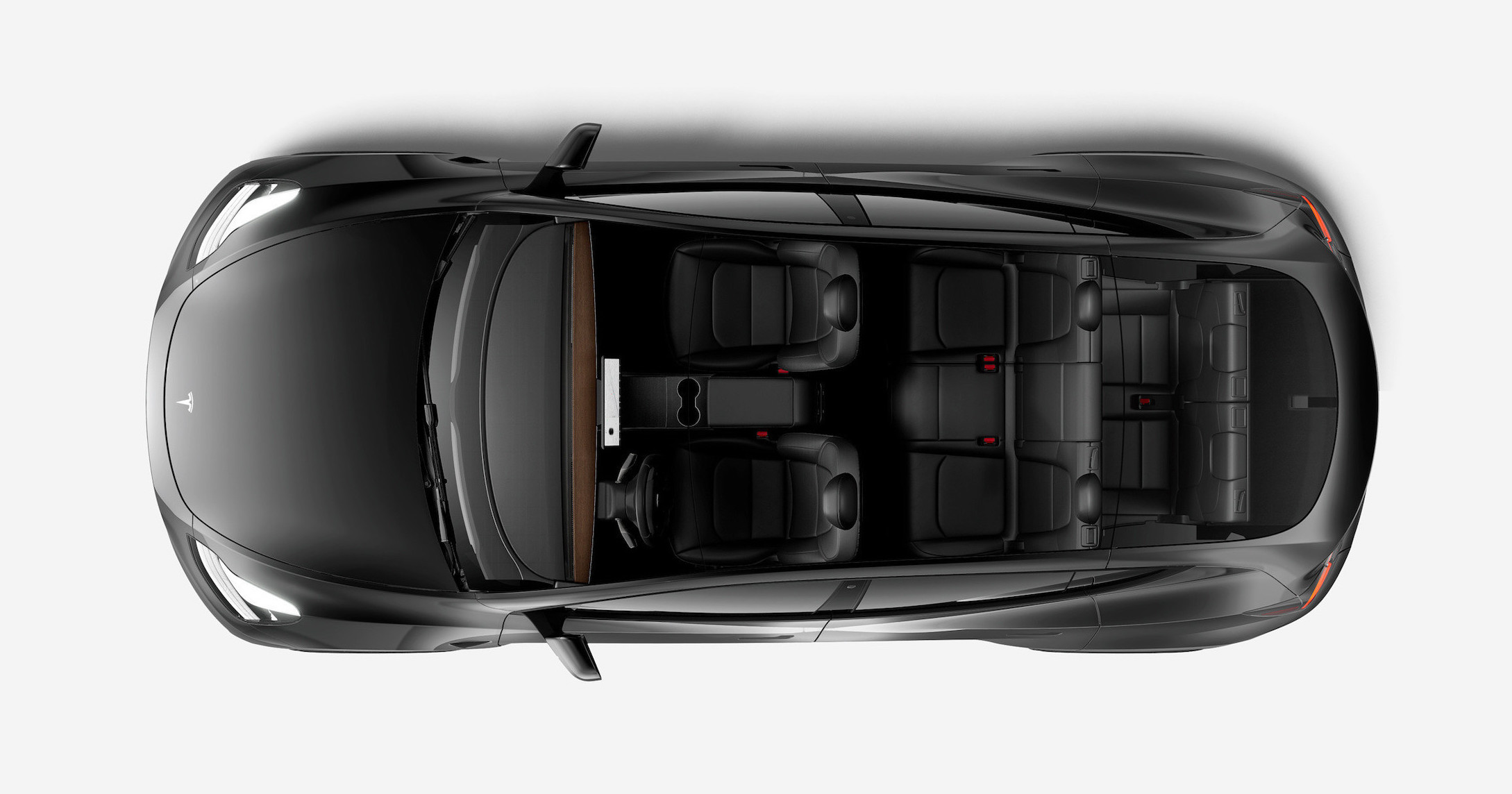
The 7-seat interior layout transforms Tesla’s popular midsize crossover from a standard two-row, five-passenger vehicle into a three-row crossover capable of carrying up to seven occupants. Referred to by Tesla as the Three-Row Interior, this layout adds two small, forward-facing seats in the cargo area behind the standard second row.
Rather than simply bolting two extra seats into the boot, Tesla integrates several functional hardware adjustments throughout the cabin:
- Sliding and Tilting Second Row: The second-row bench is placed on sliding tracks, allowing it to move forward and backward by roughly five inches to balance legroom between second- and third-row occupants.
- One-Touch Entry Controls: Buttons mounted on the second-row seatbacks electronically tilt and slide the seats forward for third-row access.
- Third-Row USB-C Ports: Two high-speed USB-C ports are installed between the third-row seats for device charging.
- Flat-Folding Third Row: Both third-row seatbacks fold completely flat into the trunk floor via manual release buttons, maintaining a level cargo floor when maximum luggage space is needed.
Trim Availability and Restrictions
The 7-seat option is not available across every Model Y trim. Historically and in current ordering configurations:
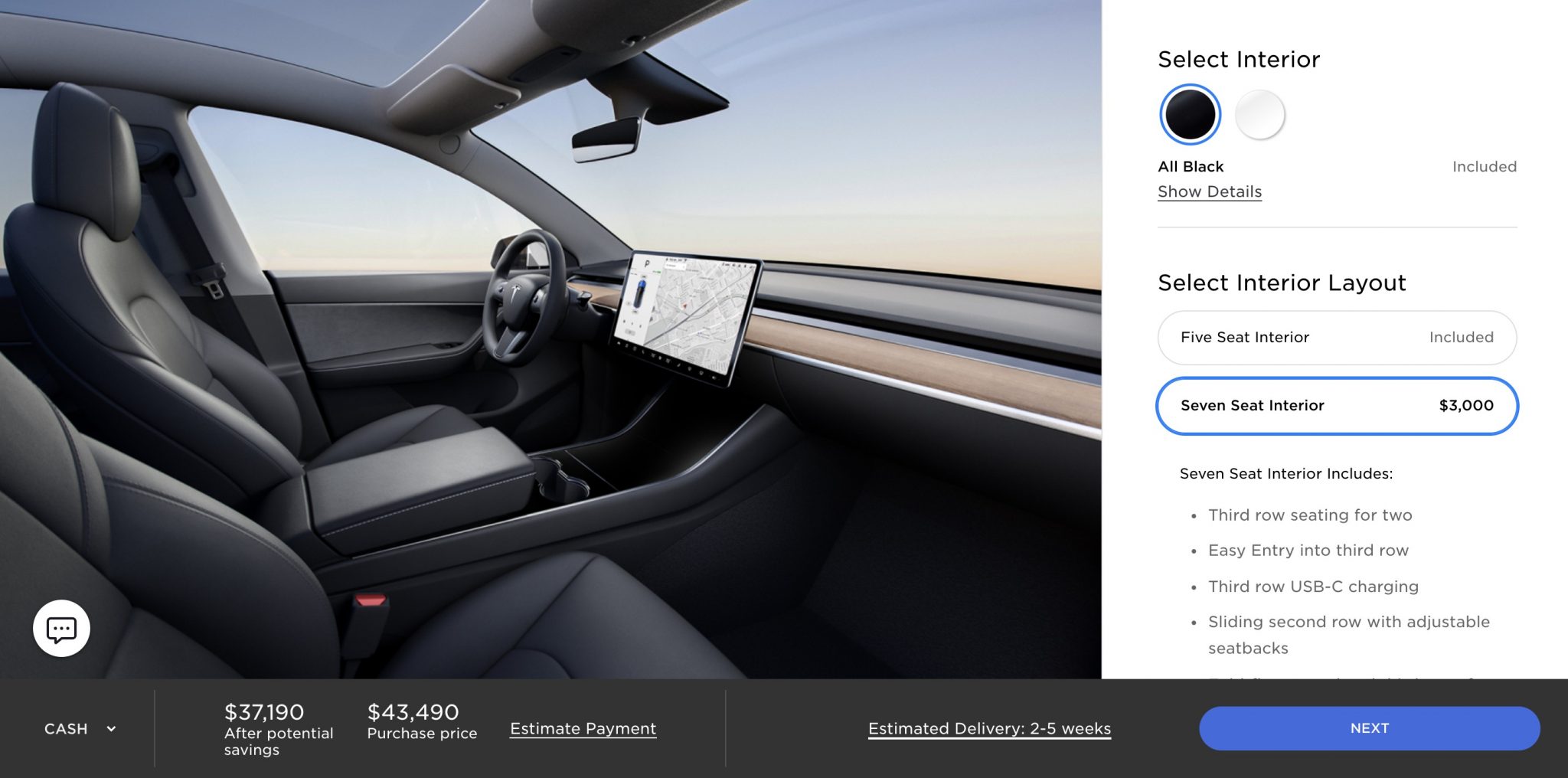
- Long Range All-Wheel Drive (AWD): The 7-seat layout is available as an optional $2,000 upgrade on Long Range AWD models.
- Performance Trim: The 7-seat interior is not available. The Performance variant comes exclusively as a 5-seater due to rear suspension tuning, lower ride height, and structural layout.
- Rear-Wheel Drive (Standard Range): In most markets, the entry-level Rear-Wheel Drive variant is sold strictly as a 5-seater, though regional availability has occasionally varied depending on production hub updates.
Third-Row Dimensions, Legroom, and Comfort Reality
While the capability to carry seven people sounds ideal on paper, the physical dimensions of the Model Y’s crossover chassis impose clear space constraints on the third row.
Spatial Measurements
| Dimension | First Row | Second Row | Third Row |
|---|---|---|---|
| Headroom | 41.0 in (1,041 mm) | 39.4 in (1,001 mm) | 34.6 in (879 mm) |
| Legroom | 41.8 in (1,062 mm) | 40.5 in (1,029 mm)* | 26.5 in (673 mm)* |
| Shoulder Room | 56.4 in (1,433 mm) | 54.0 in (1,372 mm) | 36.3 in (922 mm) |
*Note: Second-row and third-row legroom vary based on the position of the sliding second-row seat track.
Headroom and Roofline Impact
Because the Model Y features a sloping rear glass roofline designed for aerodynamic efficiency, third-row headroom is substantially restricted. Occupants taller than 5 feet 6 inches (168 cm) will likely find their heads making contact with the glass roof or the padded crossbar that frames the rear hatch structure.
Additionally, on bright or hot days, passengers sitting in the third row sit directly beneath the rear glass pane. While Tesla’s glass is heavily tinted and UV-treated, radiant heat from prolonged sun exposure is noticeably more prominent in the rearmost seats than in the front two rows.
Legroom and Footwell Space
The 26.5 inches of third-row legroom is only attainable when the second row is pushed forward along its tracks. Doing so distributes legroom evenly between rows two and three, allowing average-sized adults to fit comfortably in the second row while providing adequate knee clearance for kids in the back.
However, foot space under the second-row seats remains tight. If the second-row seats are set to their lowest height position, third-row passengers will struggle to slide their feet underneath, requiring communication between passengers to find an agreeable seating angle.
Ingress and Egress Mechanics
Getting into and out of the third row requires a degree of agility:
- Press the electronic release button on top of the second-row outer seatback.
- The second-row seat tilts and slides forward on its rails, creating an entry passageway.
- Passengers step over the side sill and duck under the door arch to sit down.
While children and teenagers can slide into the back row with ease, elderly passengers or adults with limited mobility will find entering and exiting the third row challenging.
Cargo Capacity and Interior Storage Space
Adding two seats to the luggage area inevitably alters storage configurations. Tesla engineers designed the third row to fold flush with the trunk floor, minimizing the loss of usable cargo space when the extra seats are not in use.
- FRUNK STORAGE
- 4.1 cu. ft. / 116 L
- CABIN LAYOUT
- Driver / Front Pass
- 3-Position Sliding Row
- 2-Seat 3rd Row
- REAR TRUNK & SUB-TRUNK
- Seats Folded Flat: 72.1 cu. ft. total usable space
- Seats Upright: 4.2 cu. ft. behind 3rd row
- Deep Sub-Trunk: Preserved beneath floor
Storage Volume Comparisons
- Behind Third Row (Seats Up): When all seven seats are in use, cargo space behind the third row is reduced to roughly 4.2 cubic feet. This provides enough space for a couple of soft carry-on bags, groceries, or a compact folded stroller.
- Third Row Folded Flat: Lowering the third-row seatbacks opens up over 30 cubic feet of rear cargo space, making it virtually identical in daily utility to the standard 5-seat Model Y floor plan.
- All Rear Seats Folded: Folding both the second and third rows provides a maximum rear storage capacity of up to 72.1 cubic feet, complemented by the front trunk (frunk), which offers an additional 4.1 cubic feet of weather-sealed storage.
The Sub-Trunk Difference
A major advantage of the Model Y design is the retention of the deep sub-trunk storage well. In the 7-seat configuration, the primary trunk floor drops into a deep lower basin where charging cables, tire repair kits, or small luggage items can be stowed entirely out of sight, even when the third-row seats are occupied.
5-Seater vs. 7-Seater Model Y: Direct Comparison
Choosing between the standard 5-seat layout and the optional 7-seat arrangement involves trade-offs in passenger capacity, vehicle weight, equipment costs, and day-to-day interior functionality.
| Feature / Metric | Model Y (5-Seat Layout) | Model Y (7-Seat Layout) |
|---|---|---|
| Base Price Differential | Standard configuration included in base vehicle price | +$2,000 optional upgrade cost |
| Max Passenger Capacity | 5 Occupants | 7 Occupants |
| Second-Row Adjustability | 60/40 split fold with reclining seatbacks | 60/40 split with sliding rails, recline, and tilt-fold |
| Third-Row USB Ports | None | Dual USB-C ports in center console |
| Maximum Rear Cargo Volume | 76.2 cu. ft. (seats down) | 72.1 cu. ft. (seats down) |
| Cargo Space Behind Rearmost Row | 30.2 cu. ft. | 4.2 cu. ft. (with 3rd row upright) |
| LATCH/ISOFIX Anchor Count | 2 pairs (outer 2nd-row seats) | 2 pairs (outer 2nd-row seats) + Top Tethers |
| Available Trims | RWD, Long Range AWD, Performance | Long Range AWD only |
Child Safety Seats and Air Conditioning Distribution
For families considering the 7-seater as a primary carpooling or child-transport vehicle, safety hardware and climate management are essential considerations.
Car Seat Anchors (LATCH / ISOFIX)
- Second Row: Equipped with two full sets of lower LATCH anchors on the outer seats, alongside three top tether anchors across all three positions.
- Third Row: The third row does not contain lower LATCH anchors. It features top tether anchors behind each seat cushion, meaning child safety seats installed in the third row must be secured using the vehicle’s three-point seat belts combined with the top tether strap.
- Booster Seats: The third row works best with belt-positioning booster seats for older children who have outgrown harness systems but still require proper belt alignment.
Climate Control Performance
A common concern with three-row vehicles is whether heating and air conditioning adequately reach the back row.
The Model Y does not have dedicated ceiling or side-pillar air vents for the third row. Instead, climate control relies on:
- Center Console Vents: Rear vents mounted at the back of the front-center armrest push air back between the second-row seats.
- Under-Seat Floor Vents: Air channels beneath the front and second-row seats channel warm or cool air toward the footwells.
On extremely hot summer days, cooling down the third row takes longer than the front two rows. Pre-conditioning the cabin via the Tesla mobile app five to ten minutes before driving effectively mitigates this delay.
Driving Dynamics, Weight, and Range Impact
Adding the third-row seat assembly, sliding seat rails, and additional seat belt hardware adds approximately 80 to 100 pounds (36 to 45 kg) to the total curb weight of the vehicle.
- Range: The weight difference of the 7-seat package has an almost imperceptible impact on EPA-estimated range—typically amounting to less than a 1–2 mile difference under identical driving conditions.
- Handling: Because the additional seat hardware sits low in the vehicle structure right over the rear suspension subframe, the low center of gravity characteristic of electric vehicles is fully preserved. Handling, acceleration, and braking remain virtually identical to the 5-seat Long Range variant.
Frequently Asked Questions
Can adults fit in the third row of a Tesla Model Y?
Adults up to roughly 5 feet 5 inches (165 cm) can sit in the third row for short trips across town, provided the second-row seats are slid forward. However, due to limited headroom and thigh support, the third row is not recommended for full-sized adults on long highway trips.
Is the 7-seat option available on the Model Y Performance trim?
No. Tesla limits the 7-seat layout to the Long Range All-Wheel Drive variant. The Performance trim features lowered suspension, larger wheels, and distinct chassis tuning that is not compatible with the 7-seat interior option.
Do the third-row seats in the Model Y fold completely flat?
Yes. The third-row seatbacks fold flat into the trunk floor when not in use. This creates a flat load floor for cargo that closely matches the storage capacity of the standard 5-seat model.
Does the third row have lower LATCH child seat anchors?
No. The third-row seats do not have lower LATCH (ISOFIX) anchor bars embedded in the seat joints. Child seats in the third row must be secured using the adult seat belts in combination with the top tether anchors located behind the seats.
How do passengers access the third row?
Access is provided through the rear side passenger doors. Pressing a button on top of the second-row seatback causes the second-row seat to tilt and slide forward, opening a gap between the door frame and the seat for passengers to step into the back row.
Final Recommendation: Should You Buy the 7-Seat Model Y?
The $2,000 7-seat option transforms the Tesla Model Y into a highly adaptable compact multi-purpose vehicle, but it is not a direct replacement for a full-sized three-row SUV or minivan.
The 7-seat option is ideal for:
- Families with two or three children who frequently transport extra friends, teammates, or grandparents on local trips.
- Buyers who want occasional 7-passenger capability without upgrading to a larger, more expensive vehicle like the Tesla Model X or a full-size electric SUV.
- Drivers who prioritize a flat-folding cargo space for daily routines but value having two auxiliary seats hidden under the floor for unexpected group trips.
Consider sticking with the standard 5-seat layout if:
- You regularly transport full-sized adults or tall teenagers in the rear seats.
- You plan to install multiple rear-facing baby seats simultaneously, which restricts how far back the front seats can sit when the second row slides forward.
- You prefer maximum under-floor storage depth and lower upfront vehicle pricing.
For families seeking periodic, flexible passenger utility without sacrificing the daily efficiency and performance of a midsize crossover, the Model Y 7-seat upgrade remains one of the most practical options in its class.
Image Gallery