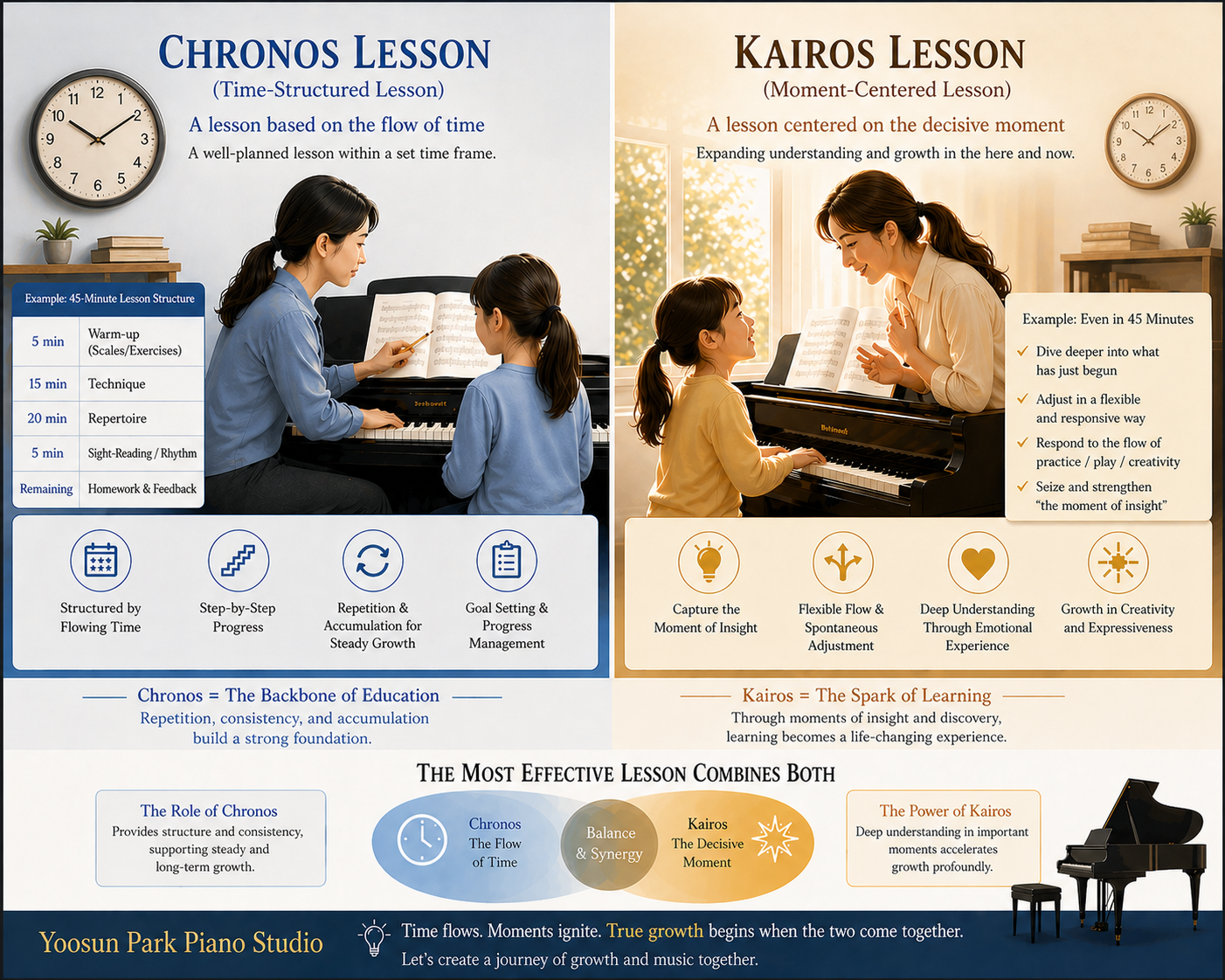
Understanding Kairos and Chronos Time: Navigating Quantitative and Qualitative Temporality
Understanding kairos and chronos time involves exploring two distinct ancient Greek concepts that describe how humans experience time: sequential, quantitative clock time and opportune, qualitative moments of significance. By examining...
Understanding kairos and chronos time involves exploring two distinct ancient Greek concepts that describe how humans experience time: sequential, quantitative clock time and opportune, qualitative moments of significance. By examining these concepts, individuals and organizations can better balance rigid scheduling with the intuition needed for timely, high-impact decision-making.
Contents
Introduction to the Dual Nature of Time
Throughout human history, how we conceptualize the passage of moments has defined our cultures, structured our societies, and shaped our personal philosophies. While modern industrialized civilization relies almost exclusively on a rigid, uniform, and relentless progression of hours and minutes, ancient Greek thinkers recognized a profound duality in temporality. They did not see time as a single, monolithic stream; instead, they split it into two distinct forces: Chronos and Kairos.
Understanding kairos and chronos time goes far beyond etymological curiosity or classical philosophy. It addresses a fundamental modern tension: the conflict between the tyranny of the calendar and the intuition of the right moment. In our hyper-scheduled environments, we often optimize for Chronos—maximizing efficiency, tracking metrics, and scheduling every minute. Yet, personal fulfillment, creative breakthroughs, and strategic business triumphs frequently depend on mastering Kairos—recognizing the precise, fleeting window when action will yield maximum effect.
This comprehensive exploration examines the philosophical origins, practical differences, and psychological impacts of both temporal dimensions. By analyzing how they intersect in daily life, professional leadership, and personal growth, we can move past a purely mechanical existence and cultivate a more holistic, effective relationship with time.
The Foundations of Chronos: Quantitative and Linear Time
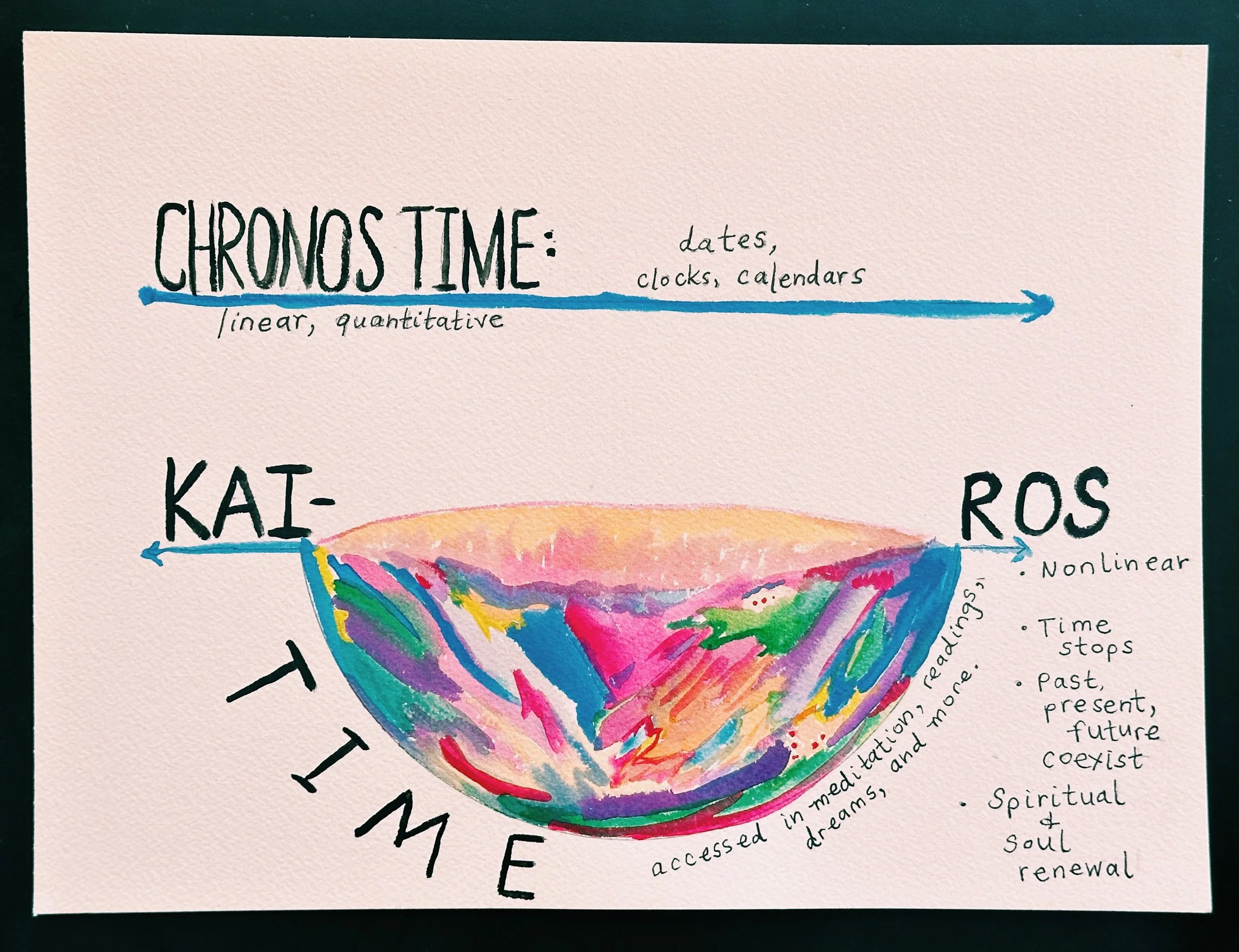
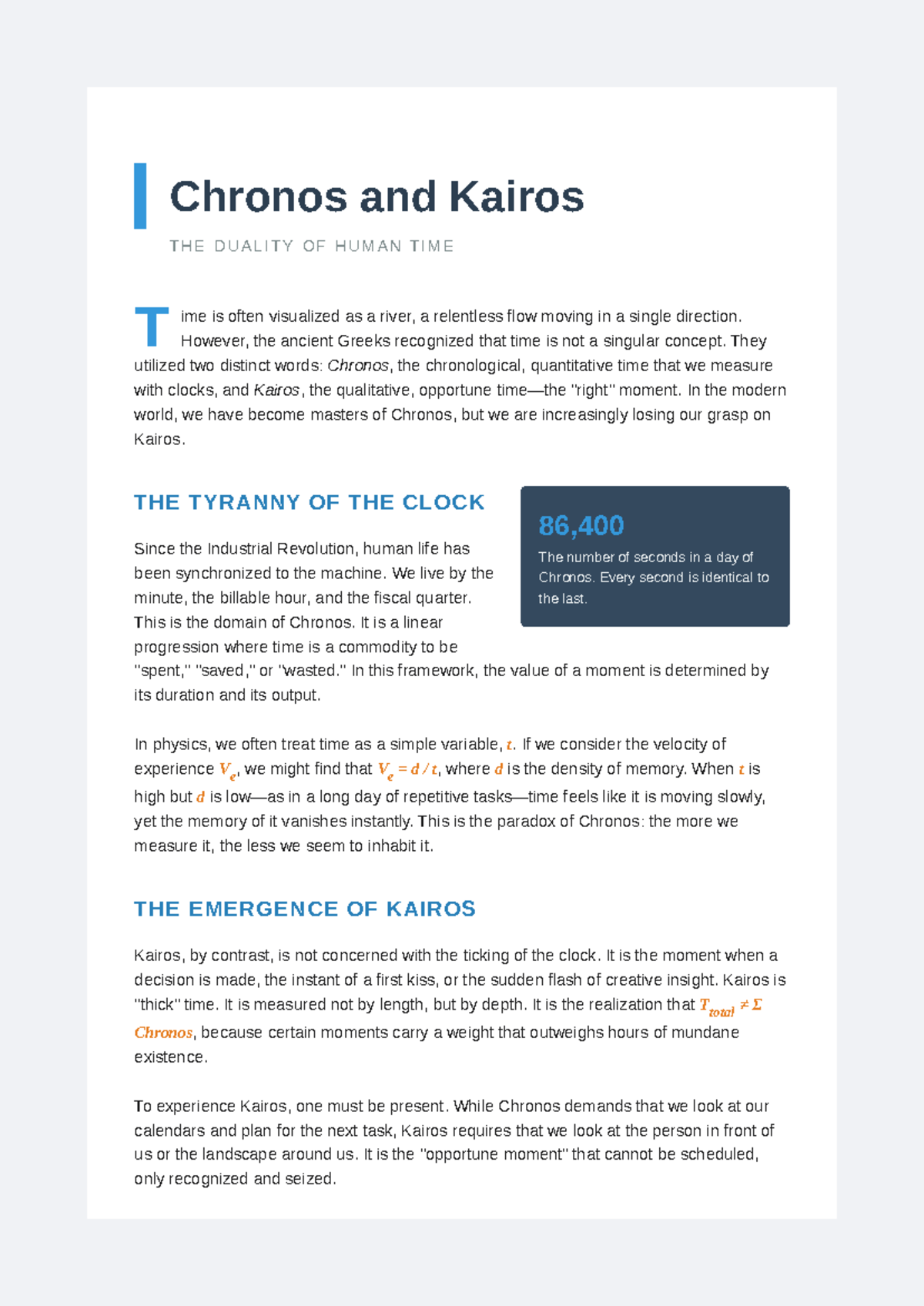
Derived from the personification of time in Greek mythology, Chronos (often associated with the Titan Cronus, though historically distinct in etymology) represents quantitative, sequential, and linear time. This is the time measured by our wristwatches, digital displays, atomic clocks, and calendars. It is relentless, impartial, and indifferent to human emotion, achievements, or struggles.
Characteristics of Chronos Time
Chronos possesses several definitive qualities that make it essential for modern industrial and digital infrastructure:
- Linearity: Chronos flows in a strict, irreversible direction from the past, through the present, into the future. You cannot retrieve a lost hour or reverse a sequence.
- Uniformity: Every minute is mathematically identical to the next. Sixty seconds constitute a minute, sixty minutes constitute an hour, regardless of whether you are experiencing profound joy or tedious waiting.
- Quantifiability: Chronos can be measured, divided, budgeted, spent, and wasted. It forms the backbone of project management, hourly wages, and logistical scheduling.
The Role of Chronos in Modern Society
Without Chronos, contemporary civilization would collapse into logistical chaos. Global supply chains, financial markets, aviation schedules, and professional work hours depend entirely on the shared, standardized framework of Chronos time. It provides the necessary baseline for coordination among billions of people who need to agree on when a meeting starts, when a flight departs, or when a tax return is due.
However, over-reliance on Chronos creates systemic pathologies. The modern obsession with optimization—squeezing more tasks into smaller time blocks—frequently leads to chronic stress, burnout, and a mechanical view of human productivity. When life is viewed exclusively through the lens of Chronos, human beings are reduced to mere units of output operating against arbitrary deadlines.
The Nature of Kairos: Qualitative and Opportune Time
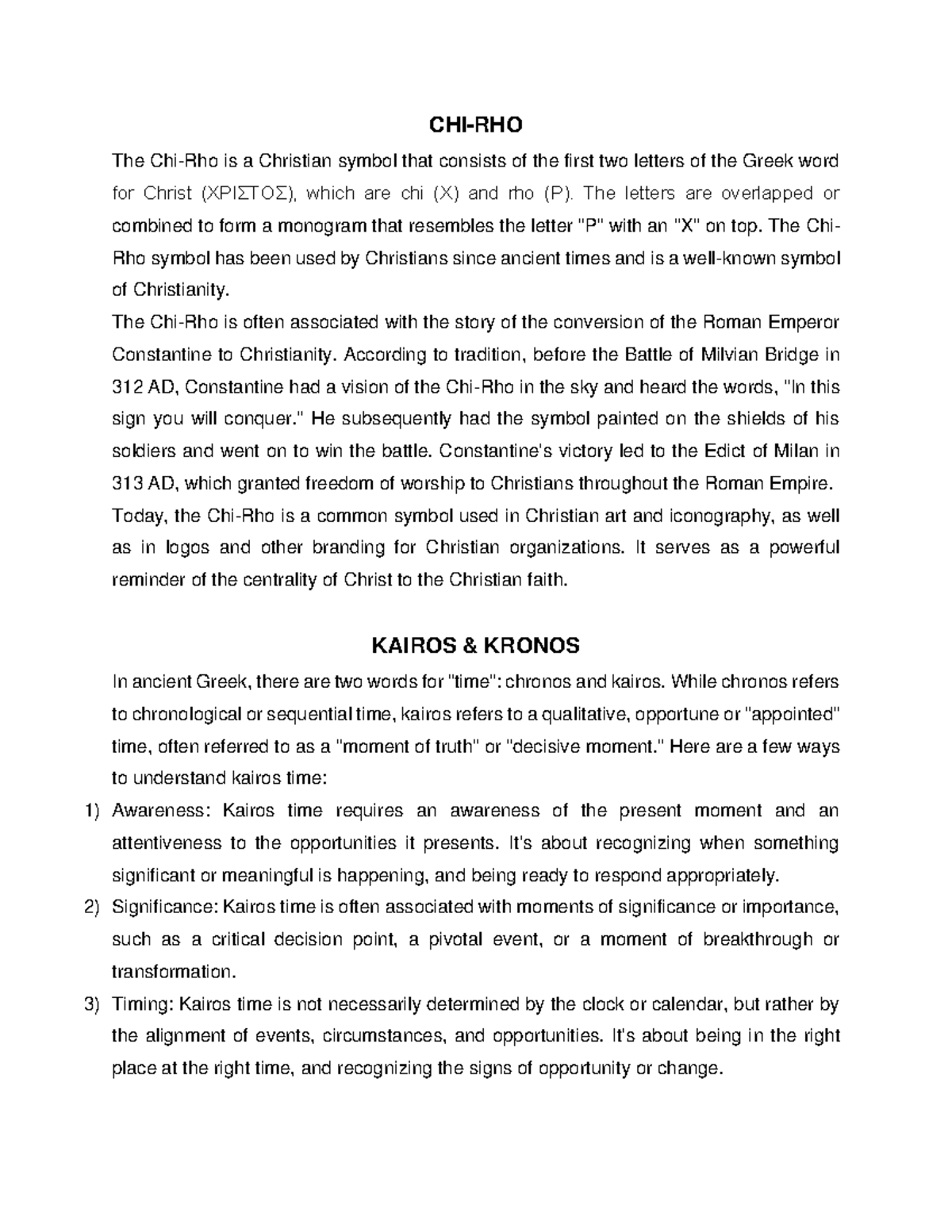
In sharp contrast to the quantitative rigidity of Chronos stands Kairos (Καιρός). In ancient Greek thought, Kairos represents the qualitative, opportune, or critical moment. It does not ask what time is it? but rather is this the right time?
Etymology and Mythological Representation
Originally an archery term referring to an opening or aperture through which an arrow must pass to pierce a target, Kairos evolved into a rich philosophical concept. In classical art, Kairos was often depicted as a fleeting, youthful figure running on tiptoe, balanced on the edge of a razor with wings on his feet and a single lock of hair on his forehead (signifying that he can be grabbed by the forelock as he approaches, but once he passes, even bald-headed fate cannot catch him from behind).
Characteristics of Kairos Time
Kairos operates under entirely different rules than Chronos:
- Qualitative Value: Kairos is defined by the significance, context, and emotional or strategic weight of an event, rather than its duration. A five-minute conversation can embody more Kairos than a five-hour conference.
- Subjectivity: While Chronos is objective and universal, Kairos is subjective and situational. What represents an opportune moment for an entrepreneur launching a product may be entirely the wrong moment for a competitor.
- Fleeting Opportunity: Kairos demands attentiveness and readiness. It cannot be scheduled, stockpiled, or forced. If ignored, the specific opportunity vanishes.
Examples of Kairos in Action
In rhetoric, Kairos refers to speaking or writing at precisely the right psychological moment to persuade an audience. In military strategy, it is the moment a commander recognizes a gap in enemy lines and orders an immediate assault. In personal life, Kairos appears when two people drop their defenses during a casual walk and finally speak an unspoken truth, shifting the trajectory of their relationship.
Comparing Chronos and Kairos
To fully grasp these two dimensions, it is helpful to contrast their operational mechanics across various dimensions of human experience. The following table highlights the core differences between Chronos and quantitative scheduling versus Kairos and qualitative decision-making.
| Dimension | Chronos (Quantitative Time) | Kairos (Qualitative Time) |
|---|---|---|
| Primary Question | What time is it? How long did it take? | Is this the right moment? When should we act? |
| Measurement | Clocks, calendars, digital timers, metrics | Context, readiness, intuition, opportunity |
| Nature | Linear, uniform, divisible, relentless | Non-linear, fleeting, pivotal, dense |
| Primary Utility | Logistics, scheduling, efficiency, coordination | Strategy, creativity, persuasion, transformation |
| Risk of Mismanagement | Inefficiency, missed deadlines, administrative chaos | Missed opportunities, premature action, inertia |
| Modern Application | Time-blocking, agile sprints, project timelines | Pivoting a business, deep relational breakthroughs, artistic inspiration |
The Interplay Between Chronos and Kairos in Daily Life
Viewing Chronos and Kairos as adversaries is a false dichotomy. Healthy personal and professional functioning requires both. Chronos provides the container, while Kairos provides the content. Chronos builds the vessel; Kairos determines the voyage.
The Danger of Chronos Without Kairos
When an individual or organization operates solely within a Chronos framework, life becomes sterile and reactive. This manifests as back-to-back meetings where nothing meaningful is decided, rigid adherence to project plans that have become obsolete due to market shifts, and personal exhaustion born of trying to optimize every waking minute. People caught exclusively in Chronos feel perpetually behind, enslaved by a ticking clock that offers no sanctuary.
The Danger of Kairos Without Chronos
Conversely, living entirely in Kairos without regard for Chronos leads to chaos, unreliability, and paralysis. An artist or entrepreneur waiting perpetually for absolute inspiration (Kairos) without establishing daily working habits (Chronos) will likely produce very little. Society cannot function if individuals ignore schedules, fail to honor commitments, or arrive arbitrarily whenever "the moment feels right."
Achieving Synergy
Effective living requires using Chronos to prepare the ground for Kairos. By maintaining orderly schedules and disciplined routines (Chronos), we build the competence and availability required to recognize and seize critical opportunities (Kairos) when they emerge. Routine creates the stability that allows spontaneity to be effective.
Practical Applications for Leadership and Personal Growth
Integrating the wisdom of Kairos and Chronos into modern workflows requires deliberate shifts in mindset and operational habits.
1. Reclaiming Margin in Calendars
Many professionals pack their calendars tightly with Chronos blocks, leaving zero breathing room. If every minute is accounted for, there is no psychological space to notice Kairos. Effective leaders intentionally build "white space" or unstructured time into their schedules to allow for unexpected insights, deep reflection, and nimble responses to emerging challenges.
2. Differentiating Urgent from Important
Dwight D. Eisenhower’s famous distinction between urgency and importance maps closely onto our two concepts. Urgent tasks are usually driven by Chronos pressures (deadlines, notifications, demands from others). Important tasks often align with Kairos—actions that carry long-term transformative weight, even if they lack an immediate ticking clock. Balancing life requires protecting time for important, qualitative pursuits against the constant noise of urgent, quantitative demands.
3. Cultivating Situational Awareness
Recognizing Kairos requires high levels of mindfulness and emotional intelligence. It demands that we look up from our screens and performance dashboards to read the room, assess market sentiment, or gauge personal energy levels. Developing this sensitivity involves asking not just "Can I finish this task today?" but "Is this the right strategic moment to push forward, or should I wait?"
Frequently Asked Questions
What is the simplest way to remember the difference between kairos and chronos?
Chronos refers to quantitative, clock-based time (hours, minutes, schedules), while kairos refers to qualitative, opportune time (the right moment for action, significance, or breakthrough).
Can kairos time be measured?
No. Unlike chronos, which is measured by standard increments like seconds and years, kairos is measured by contextual depth, psychological readiness, and the impact of an event rather than its duration.
Why did the ancient Greeks have two words for time?
Ancient Greek culture recognized that human experience cannot be fully captured by a single mechanical metric. They needed one word for the objective, flowing nature of physical time and another for the subjective, transformative moments that alter human lives.
How can I apply kairos in a high-pressure corporate job?
You can apply kairos by refusing to let rigid scheduling crowd out strategic thinking. Set aside unstructured periods for deep work, wait for optimal psychological moments to pitch ideas or deliver difficult feedback, and remain flexible when unexpected opportunities arise that supersede current project checklists.
Is one form of time superior to the other?
Neither is superior; they are complementary. Chronos is necessary for operational coordination and survival, while kairos provides meaning, creativity, and strategic advantage. The goal is integration, not replacement.
Conclusion and Next Actions
Understanding kairos and chronos time transforms how we navigate our days, balance our workloads, and make pivotal decisions. While Chronos keeps the world moving through standardized schedules and reliable measurement, Kairos reminds us that true progress, deep connection, and transformative success depend on recognizing and seizing the right moment.
To put these insights into practice, audit your current weekly schedule. Identify one block of time currently choked by rigid Chronos obligations and convert it into unstructured "white space." Use this newly created margin to practice noticing contextual cues, reflecting on strategic priorities, and waiting for the right moment to act decisively rather than reacting blindly to the clock.
Image Gallery