The Definitive Guide to Calculus Made Easy PDF: Why This Classic Still Wins in 2026
Calculus Made Easy by Silvanus P. Thompson is a legendary introductory text that simplifies complex mathematical concepts through an intuitive, jargon-free approach. Because the original 1910 and 1914 editions are in the public domain,...
Calculus Made Easy by Silvanus P. Thompson is a legendary introductory text that simplifies complex mathematical concepts through an intuitive, jargon-free approach. Because the original 1910 and 1914 editions are in the public domain, you can legally download a Calculus Made Easy PDF for free from repositories like Project Gutenberg and the Internet Archive to master calculus independently.
Contents
Understanding Silvanus P. Thompson’s Philosophy
Silvanus P. Thompson, a physicist and engineer, published Calculus Made Easy in 1910 under the pseudonym "F.R.S." (Fellow of the Royal Society). His motivation was simple: he was frustrated by how mathematicians of his era intentionally made the subject appear more difficult and mysterious than it actually was. In 2026, his work remains the gold standard for conceptual clarity in a field often bogged down by dense notation.
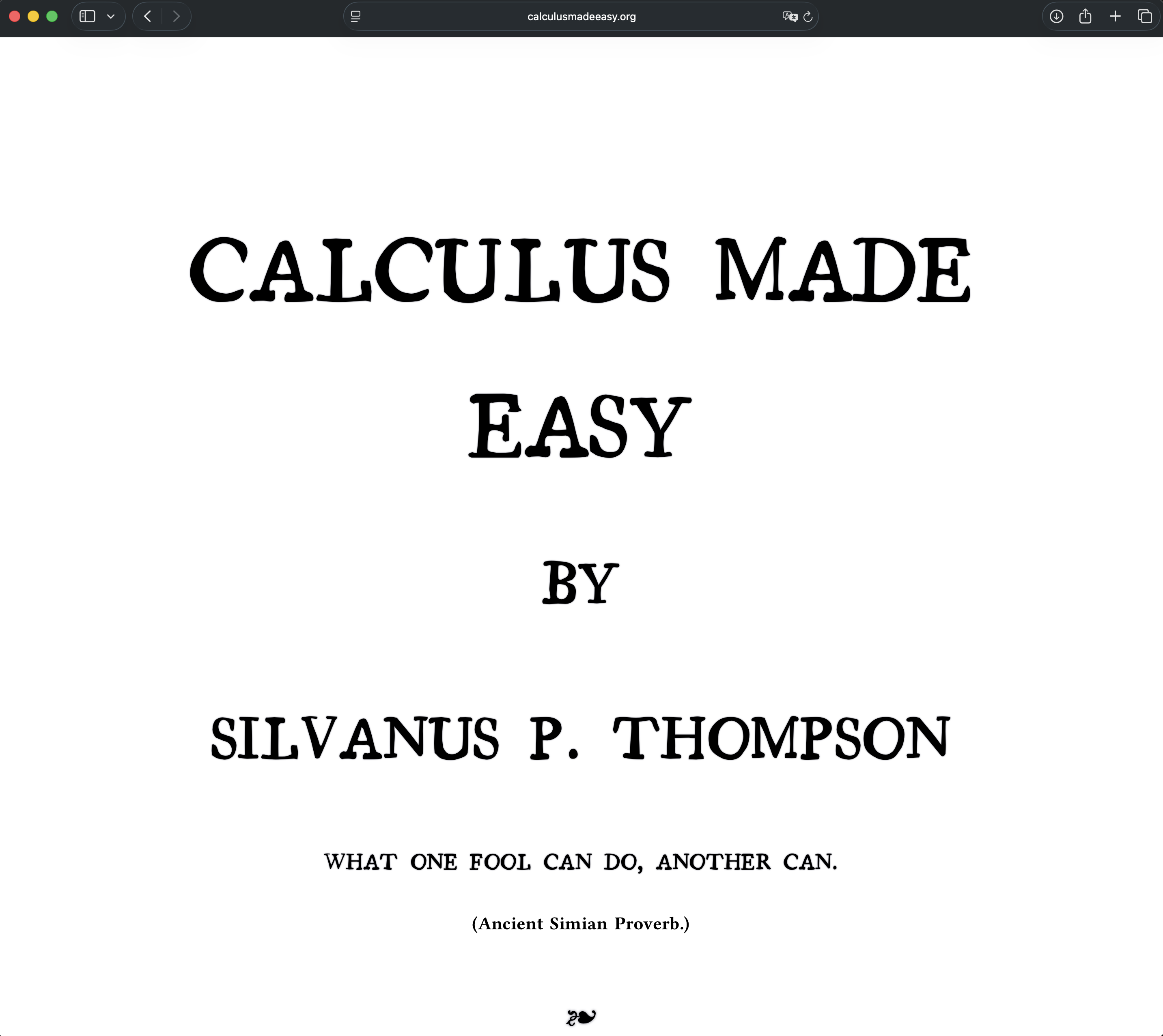
The book is famous for its opening epigram: "What one fool can do, another can." This sentiment sets the tone for the entire text. Thompson strips away the intimidating "mysticism" of the differential and integral calculus, treating the symbols not as abstract entities, but as practical tools for measuring change. By focusing on the "smallness" of things, he makes the concept of a derivative accessible to anyone with a basic grasp of algebra.
Thompson’s approach is fundamentally different from the rigorous, "epsilon-delta" definition of limits found in modern university textbooks. He prioritizes the mechanics and intuition of calculus. For a student or professional in 2026 looking to refresh their skills or build a foundation from scratch, this intuitive leap is often more valuable than a dozen formal proofs.
Where to Legally Download a Calculus Made Easy PDF
Because the original text was published over a century ago, it has long since entered the public domain in the United States and many other jurisdictions. This means you do not need to rely on "piracy" sites or unverified file-sharing services to find a high-quality copy. Several reputable organizations provide clean, scanned, or transcribed versions of the book.
1. Project Gutenberg
Project Gutenberg offers a variety of formats, including a reflowable EPUB and a fixed-layout PDF. The advantage of the Gutenberg version is that it has been meticulously proofread by volunteers to ensure that the mathematical formulas are rendered correctly.
- Source: Project Gutenberg Ebook #33283
2. Internet Archive
The Internet Archive hosts several high-resolution scans of the 1910 first edition and the 1914 second edition. These scans are excellent if you prefer to see the original typography and layout, which many find charming and less distracting than modern, multi-colored textbooks.
3. Calculusmadeeasy.org
This is a dedicated web-based project that provides a modernized HTML version along with a downloadable PDF. The editors of this site have updated some of the archaic punctuation while preserving Thompson's original explanations and diagrams.
Key Concepts Covered in the Text
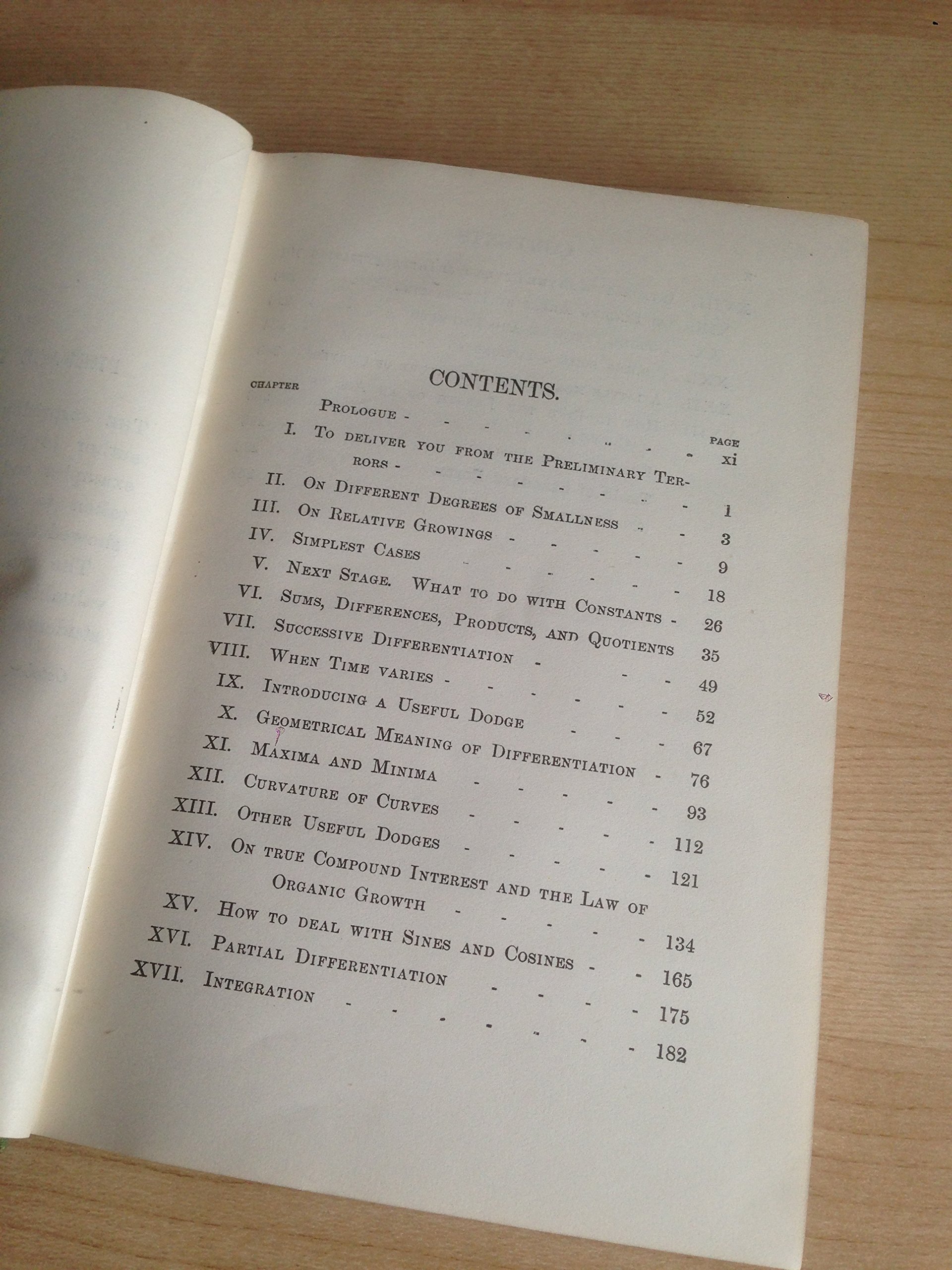
The book is structured to guide a complete novice through the "differential" and then into the "integral" calculus. Unlike modern texts that start with a heavy section on limits, Thompson jumps straight into the "preliminary terror."
The Meaning of the Symbols
Thompson explains that $dx$ simply means "a little bit of $x$." He uses the analogy of a clock or a growing tree to show that everything in nature changes in small increments. This removes the fear of the $d/dx$ notation, treating it as a simple ratio of two very small quantities.
Differentiation from First Principles
The text covers the fundamental rules of differentiation, including:
- The Power Rule: How to handle $x^n$.
- Product and Quotient Rules: Managing complex expressions.
- Functions of Functions: What we now call the Chain Rule, explained through a series of logical steps.
- Maxima and Minima: Using derivatives to find the highest and lowest points of a curve, which is essential for optimization problems in physics and economics.
The Art of Integrating
Thompson describes integration as the process of "summing up." He introduces the integral sign ($\int$) as a long "S," standing for "sum." He covers:
- Standard Integrals: Building a mental library of basic forms.
- Integration by Parts: A technique for integrating products of functions.
- The "Dodges": Thompson includes a famous chapter on "useful dodges," which are essentially the clever substitutions and tricks that mathematicians use to solve difficult integrals.
Calculus Made Easy vs. Modern Textbooks: A Detailed Comparison
When you download a Calculus Made Easy PDF, you are choosing a pedagogical style that has largely disappeared from modern academia. While modern books are more "rigorous," they are often less "teachable" for self-learners.
| Feature | Thompson’s Calculus Made Easy | Standard 2026 Academic Textbooks |
|---|---|---|
| Primary Goal | Conceptual Intuition & Utility | Formal Rigor & Theoretical Proofs |
| Tone | Humorous, Personal, Encouraging | Neutral, Detached, Academic |
| Prerequisites | Basic Algebra and Geometry | Pre-Calculus, Trigonometry, Limits |
| Length | Approx. 200–250 pages | 1,000+ pages (often split into volumes) |
| Cost | Free (Public Domain PDF) | $150 – $350 |
| Notation | Leibniz notation ($dy/dx$) | Mixed (Leibniz, Lagrange, Newton) |
| Visuals | Simple black-and-white diagrams | High-definition, multi-color 3D renders |
Modern textbooks are often designed for year-long university courses and include thousands of repetitive exercises. Thompson’s book, by contrast, is designed to be read from cover to cover. It focuses on the "why" behind the "how," ensuring that the reader understands what a derivative actually is before asking them to calculate fifty of them.
Practical Tips for Self-Studying from a 100-Year-Old PDF
Using a PDF from 1914 presents a few unique challenges. While the math hasn't changed, the presentation might feel different compared to what you see on a modern calculator or in a YouTube tutorial.
1. Master the Notation
Thompson uses the Leibniz notation ($dy/dx$) almost exclusively. He rarely uses the prime notation ($f'(x)$) common in modern American schools. If you are using this book to supplement a modern course, keep a "notation translation" sheet nearby.
2. Work Every Example
The "Calculus Made Easy PDF" is relatively short, which means every example provided is crucial. Do not just read the text; work through the calculations on a separate tablet or piece of paper. Thompson provides the answers to his exercises at the back of the book, which is perfect for self-assessment.
3. Use Modern Tools for Visualization
While Thompson’s diagrams are excellent, they are static. In 2026, you can pair your reading with graphing software like Desmos or GeoGebra. When Thompson describes a curve reaching a "maximum," plot that function in a modern app to see the visual confirmation of his algebraic work.
4. Be Patient with 19th-Century Language
You may encounter phrases like "let us take a case" or slightly archaic spellings. Do not let the formal British English distract you from the clarity of the math. Thompson wrote for "the fool," meaning the average person, so the language is actually much simpler than the high-academic prose of his contemporaries.
Prerequisites and Readiness
Before diving into the Calculus Made Easy PDF, ensure your algebraic foundation is solid. You do not need to be a math genius, but you should be comfortable with:
- Rearranging Equations: Isolating variables.
- Basic Fractions: Understanding ratios.
- Exponents: Handling $x^2$, $x^3$, and negative powers.
- Geometry: The basics of areas and slopes (rise over run).
Thompson famously bypasses the need for advanced trigonometry in the early chapters, introducing sine and cosine only when necessary. This makes it an ideal starting point for high school students or adult learners who may have been out of school for many years.
Troubleshooting Common Hurdles
Even with Thompson’s help, calculus has its sticking points. If you get stuck while reading the PDF, consider these common issues:
- The Concept of "Nothingness": Many students struggle with the idea of $dx$ being "almost zero" but not quite. Thompson explains this by comparing $dx$ to a single grain of sand compared to a desert. It is so small it can be ignored when added to a large quantity, but it still exists as a ratio.
- Implicit Differentiation: This is often the first "wall" students hit. If the PDF version you are using has a difficult-to-read diagram in this section, refer to the modernized versions at calculusmadeeasy.org for a cleaner layout.
- The Gardner Update: Note that in 1998, Martin Gardner released an updated version of the book. While the Gardner version is excellent and clarifies some of the more dated physics examples, it is not in the public domain. If you are looking for a free PDF, you must stick to the 1910/1914 editions.
Frequently Asked Questions
Is the Calculus Made Easy PDF actually free?
Yes. The original 1910 and 1914 editions are in the public domain because their copyright has expired. You can download, print, and share these versions legally without paying any fees.
Is this book enough to pass a modern AP Calculus or University exam?
It is a perfect conceptual foundation, but it may not be "enough" on its own for a modern exam. Modern exams often require specific calculator skills and familiarity with certain types of complex word problems that were not common in 1910. Use this book to understand the subject, then use a modern workbook to practice for your specific test.
Why is it called "Made Easy"? Is it actually easy?
It is "made easy" relative to the dense, rigorous textbooks of the early 20th century. Calculus is still a mentally demanding subject, but Thompson removes the unnecessary barriers to entry. You will still need to apply effort and practice.
Does the book cover multivariable calculus?
No. Calculus Made Easy focuses on single-variable differential and integral calculus (roughly equivalent to Calculus I and some of Calculus II in the American system).
Can I use this PDF on a Kindle or tablet?
Yes. The PDF format works well on all modern tablets. If you are using a Kindle (E-ink), the EPUB version from Project Gutenberg is usually a better choice as it allows you to adjust the font size, though the mathematical formulas sometimes display better in the fixed PDF format.
Final Recommendation
If you are looking for the most efficient way to understand the core logic of calculus, downloading a Calculus Made Easy PDF is the best first step you can take. Start with the 1914 second edition, as it contains extra exercises and clarifications added by Thompson after the initial success of the first edition. By following the "Fool's Motto" and working through the text systematically, you will find that the "mountain" of calculus is actually a series of manageable hills.
Image Gallery