5 Real Miranda Rights Examples and Their Legal Implications
Miranda rights stem from landmark United States Supreme Court decisions that enforce Fifth Amendment protections against compelled self-incrimination and Sixth Amendment rights to counsel. These practical legal examples illustrate when...
Miranda rights stem from landmark United States Supreme Court decisions that enforce Fifth Amendment protections against compelled self-incrimination and Sixth Amendment rights to counsel. These practical legal examples illustrate when warnings are legally required, how officers may question suspects, how rights must be declared, and what remedies exist when rules are breached.
Contents
Disclaimer: This article provides general educational information regarding legal history and constitutional law. It does not constitute formal legal advice. Individuals facing criminal investigations or charges should consult a qualified legal professional.
The Foundation of Miranda Warnings: Custody and Interrogation
To understand how Miranda warnings operate in practical law enforcement, one must first recognize the two mandatory conditions that trigger them: custody and interrogation.
- Custody occurs when a reasonable person would feel their freedom of movement is restricted to a degree associated with a formal arrest. This is an objective standard that does not depend on whether the officer or suspect subjectively believes an arrest has occurred.
- Interrogation refers not only to direct, express questioning by law enforcement officers, but also to any words or actions that police should know are reasonably likely to elicit an incriminating response.
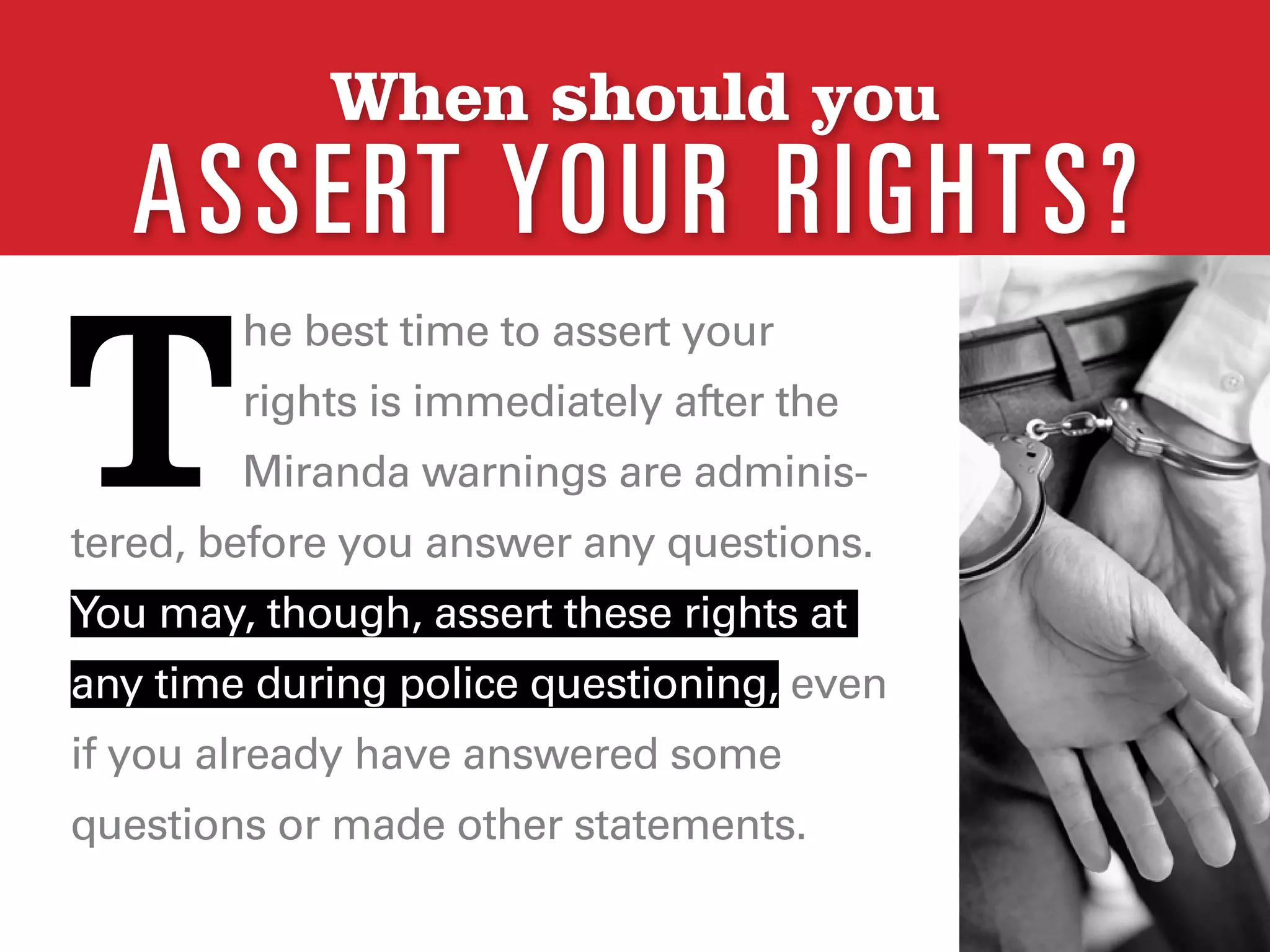
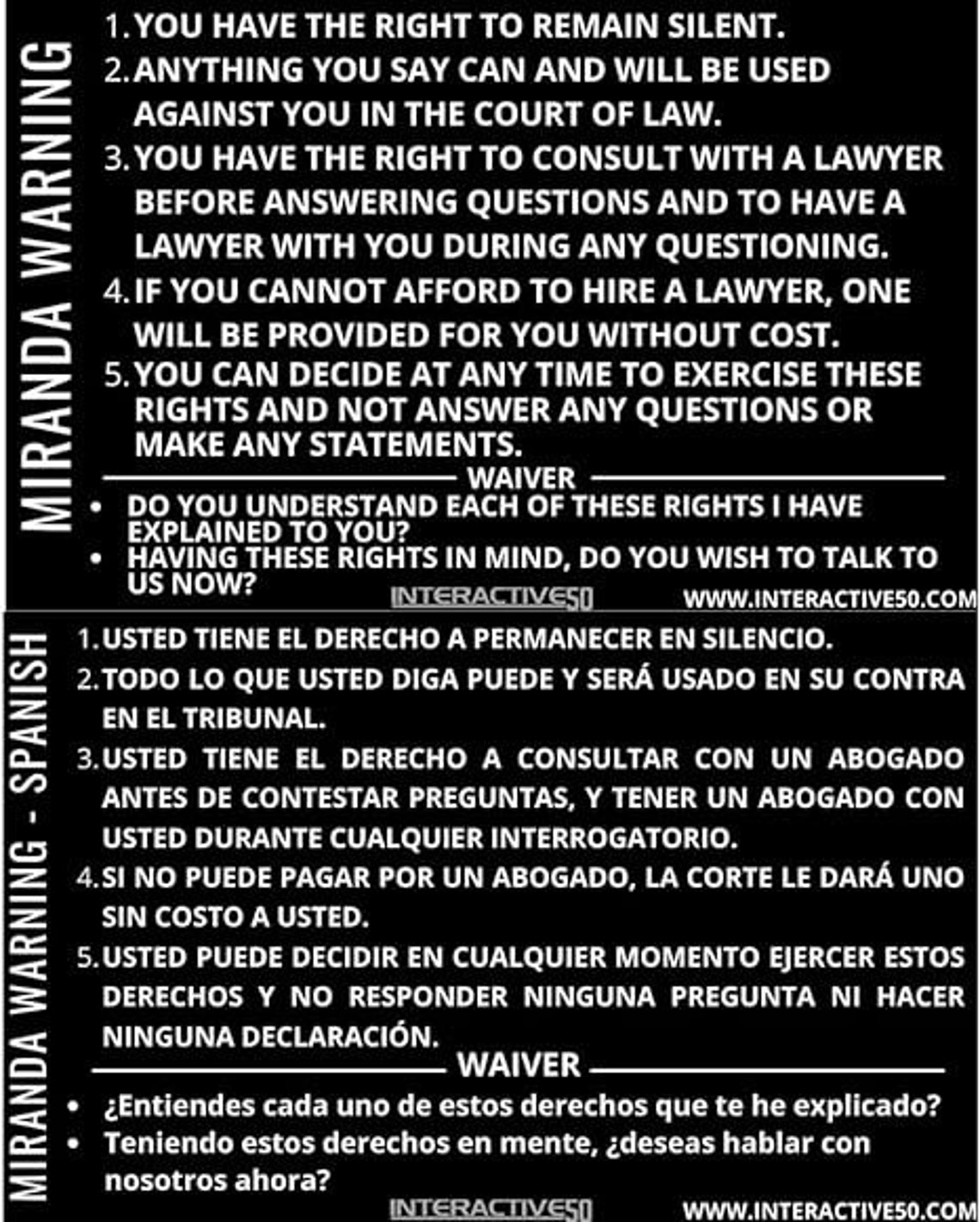
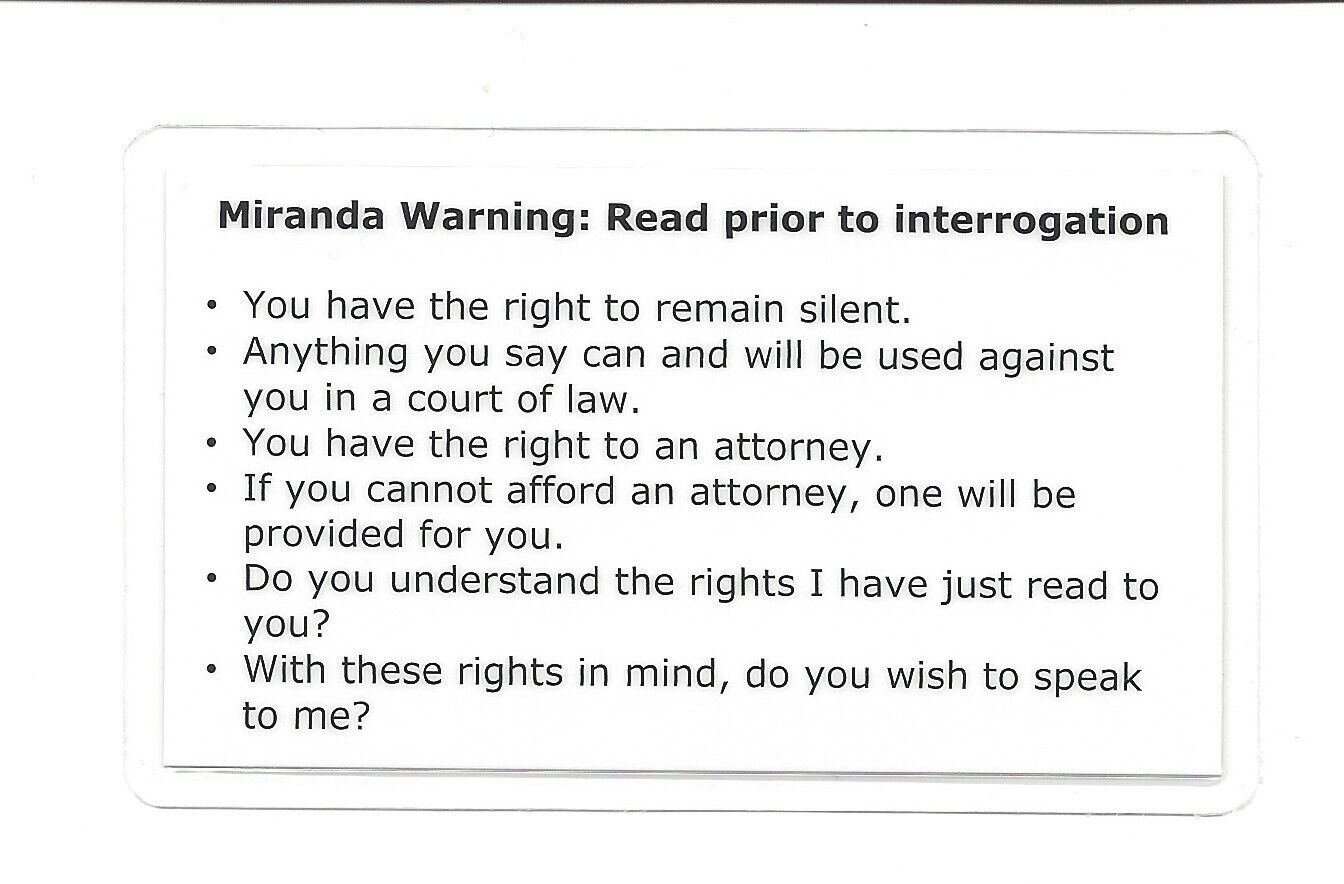
If either custody or interrogation is absent, law enforcement officers are not required under federal constitutional law to read a suspect their rights. When both factors coincide, police must deliver a clear procedural warning—informing suspects of their right to remain silent, the potential use of their statements in court, the right to an attorney, and the right to court-appointed counsel if indigent.
Over the decades, real legal disputes have reached the U.S. Supreme Court to refine these boundaries, creating critical exceptions, procedural rules, and evidentiary limits.
5 Real Miranda Rights Examples and Their Legal Implications
Example 1: Miranda v. Arizona (1966) — Establishing the Mandatory Warning Requirement
Context and Case Facts
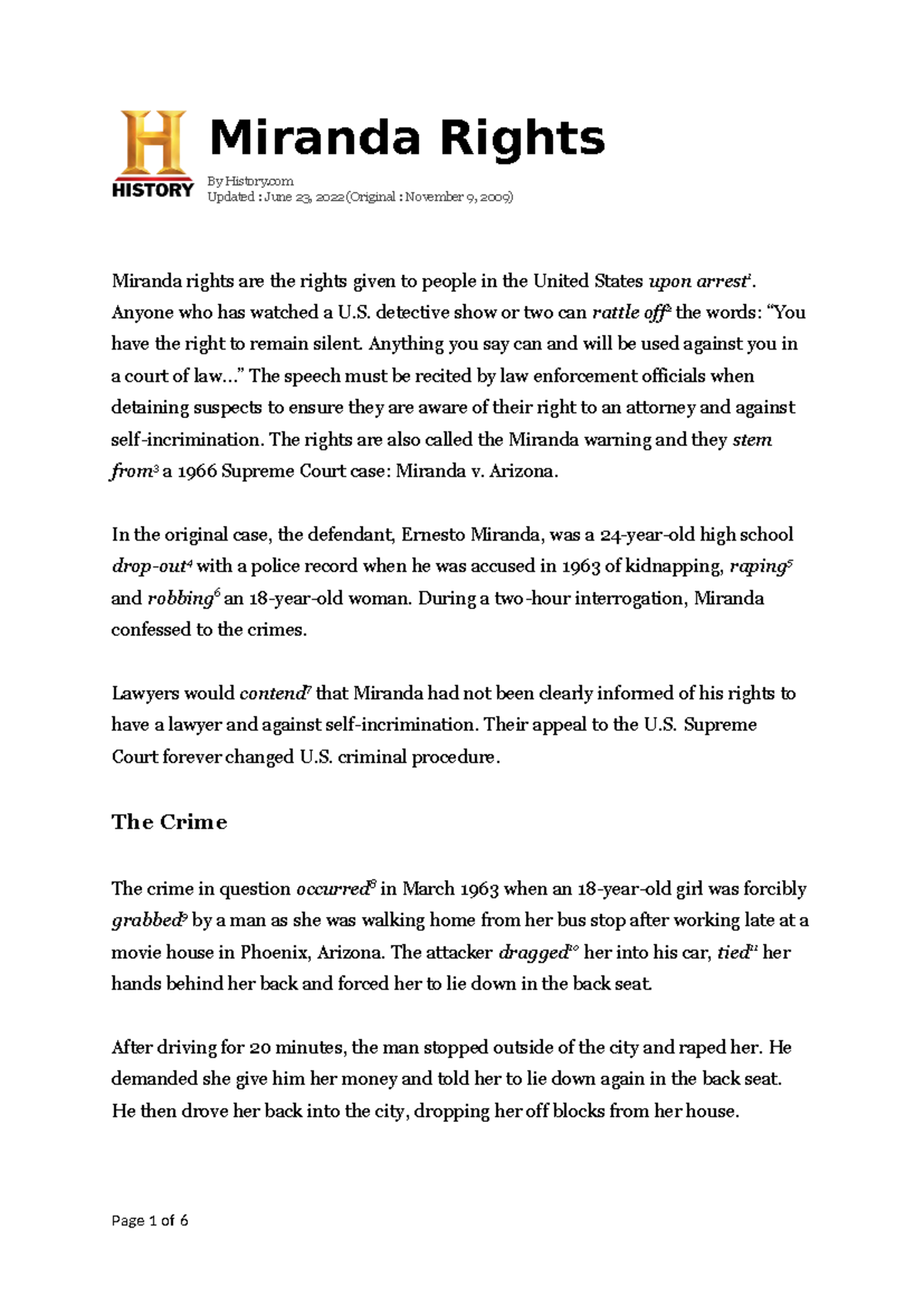
In March 1963, Phoenix police arrested Ernesto Miranda based on circumstantial evidence connecting him to a kidnapping and rape. Officers detained Miranda and questioned him in an interrogation room for two hours without informing him of his Fifth Amendment right against self-incrimination or his Sixth Amendment right to consult legal counsel. During the questioning, Miranda signed a written confession that included a pre-printed statement acknowledging his confession was made voluntarily and with full knowledge of his legal rights.
The Supreme Court Ruling
The Supreme Court ruled 5-4 in favor of Miranda. Writing for the majority, Chief Justice Earl Warren stated that the custodial environment created by law enforcement is inherently coercive. To offset this coercive atmosphere and preserve constitutional rights, police officers must explicitly advise suspects of their rights prior to commencing custodial interrogation.
Legal Implications
- Creation of Standard Miranda Warnings: Established the obligation for police to explicitly inform detained suspects of four core protections before questioning.
- The Exclusionary Rule Application: Confessions or incriminating statements obtained during custodial interrogation without prior warnings (or an explicit waiver) are inadmissible in prosecution arguments at trial.
- Procedural Safeguard Shift: Shifted the legal standard from merely assessing whether a confession was physically or psychologically "coerced" to requiring verifiable procedural safeguards.
Example 2: Rhode Island v. Innis (1980) — Defining the "Functional Equivalent" of Interrogation
Context and Case Facts
Following a robbery involving a sawed-off shotgun, Providence police arrested Thomas Innis. Officers read Innis his Miranda rights, and Innis stated he wished to speak with a lawyer. While transporting Innis to the police station, two officers engaged in a conversation between themselves. One officer expressed concern that a nearby school for children with disabilities might find the concealed shotgun and get hurt. Hearing this, Innis interrupted the officers and instructed them to turn the patrol car around so he could show them where the weapon was hidden.
The Supreme Court Ruling
The Supreme Court held that no interrogation occurred under these specific facts. The Court established that "interrogation" under Miranda extends beyond formal questioning to include any words or actions by police that they should know are reasonably likely to elicit an incriminating response from the suspect. However, because the officers were speaking to each other without evidence that Innis was particularly susceptible to an appeal regarding vulnerable children, the Court found the conversation did not constitute the functional equivalent of questioning.
Legal Implications
- Broadened Definition of Interrogation: Defined interrogation to include psychological tactics, subtle pressures, and off-hand remarks if an officer should reasonably foresee they will trigger an admission.
- Objective Assessment: Courts must objectively evaluate whether police actions were designed or likely to provoke a statement from a suspect in custody.
- Limits on Casual Police Dialogue: Law enforcement officers are prohibited from using indirect conversations or engineered scenarios as an end-run around an invoked right to counsel.
Example 3: New York v. Quarles (1984) — The Public Safety Exception
Context and Case Facts
A woman reported to police officers that she had just been raped by an armed man who entered a nearby supermarket. Officers located Benjamin Quarles inside the store, ordered him to stop, and frisked him. Finding an empty shoulder holster, an officer handcuffed Quarles and immediately asked him where the gun was located before reciting Miranda rights. Quarles gestured toward empty cartons and said, "The gun is over there." Officers retrieved the loaded revolver, formally arrested Quarles, and read him his Miranda warnings.
The Supreme Court Ruling
The Supreme Court established a narrow "public safety exception" to the Miranda rule. The majority held that police officers face immediate choices when public safety is threatened, and the requirement to give Miranda warnings must yield to the pressing necessity of neutralizing an active danger—such as an abandoned firearm in a public space.
Legal Implications
- Admissibility of Un-Mirandized Statements: Incriminating statements obtained to address an immediate threat to public safety are admissible in court, along with physical evidence derived from them.
- Balancing Test: Prioritizes immediate physical safety and hazard containment over constitutional procedural warnings in acute crisis situations.
- Defined Scope: The exception is limited to questions necessary for police to secure an unsafe scene or locate immediate hazards (e.g., weapons, bombs, active accomplices); general criminal questioning remains subject to standard Miranda rules.
Example 4: Berghuis v. Thompkins (2010) — The Requirement of Unambiguous Invocation
Context and Case Facts
Van Chester Thompkins was arrested in connection with a fatal shooting. Detectives placed Thompkins in an interrogation room and read him his Miranda rights. Thompkins acknowledged he understood his rights but refused to sign a written waiver form. Throughout a three-hour interrogation, Thompkins remained largely silent, occasionally nodding or giving brief one-word answers to non-incriminating questions. Near the end of the session, an officer asked, "Do you pray to God to forgive you for shooting that boy down?" Thompkins answered, "Yes." He later sought to suppress this response, arguing that his sustained silence constituted an invocation of his right to remain silent.
The Supreme Court Ruling
In a 5-4 decision, the Supreme Court ruled against Thompkins. The Court held that a suspect who wants to invoke their right to remain silent must do so unambiguously. Simply staying silent during questioning does not invoke the right. Furthermore, the Court ruled that by making an uncoerced statement after understanding his rights, Thompkins implicitly waived his Miranda rights.
Legal Implications
- Requirement for Explicit Declarations: Suspects must clearly state they are invoking their rights (e.g., stating verbally, "I am choosing to remain silent" or "I demand an attorney").
- Implicit Waiver Doctrine: If a suspect understands their rights and eventually makes a voluntary statement without explicitly invoking them, courts will construe that statement as an implicit waiver.
- Interrogation Duration: Officers are not legally required to cease questioning merely because a suspect sits silently without explicitly demanding an end to the interview or requesting counsel.
Example 5: Vega v. Tekoh (2022) — Limits on Federal Civil Remedies
Context and Case Facts
Terrence Tekoh, a hospital worker, was accused of sexually assaulting a patient. Deputy Carlos Vega questioned Tekoh at his workplace without first providing Miranda warnings. Tekoh signed a written confession during the interview. The confession was admitted into evidence at Tekoh's criminal trial, but the jury acquitted him. Tekoh subsequently filed a federal civil rights lawsuit against Deputy Vega under 42 U.S.C. § 1983, claiming the officer violated his Fifth Amendment rights by failing to administer Miranda warnings prior to obtaining the statement.
The Supreme Court Ruling
The Supreme Court held 6-3 that a violation of Miranda rules does not provide grounds for a civil rights lawsuit under Section 1983. Justice Samuel Alito explained that Miranda rules are prophylactic safeguards designed to protect Fifth Amendment rights, rather than constitutional rights in and of themselves. Therefore, taking an un-Mirandized statement does not automatically constitute a civil violation of the Constitution that permits a damage claim against an individual officer.
Legal Implications
- No Civil Monetary Damages: Individuals cannot sue law enforcement officers in federal court for damages solely because the officer failed to read Miranda warnings.
- Primary Legal Remedy Preserved: The primary legal remedy for a Miranda violation remains the exclusion of evidence in criminal court proceedings.
- Clarification of Constitutional Architecture: Reaffirmed that while Miranda rules carry binding legal force in evidentiary matters, they function as procedural remedies rather than freestanding constitutional guarantees.
Comparative Overview of Real Miranda Precedents
The following matrix compares these five foundational cases, highlighting their legal issues, core rulings, and procedural impacts on criminal justice:
| Case Name & Citation | Primary Legal Issue | Core Supreme Court Ruling | Practical Legal Impact |
|---|---|---|---|
| Miranda v. Arizona(1966) | Custodial interrogation without prior warning of constitutional rights. | Police must inform suspects in custody of core Fifth and Sixth Amendment rights before questioning. | Unadvised statements taken during custodial interrogation are suppressed from prosecution's case-in-chief. |
| Rhode Island v. Innis(1980) | Scope of police conduct that constitutes "interrogation." | Interrogation includes express questioning and actions reasonably likely to elicit an incriminating answer. | Prevents police from using subtle psychological maneuvers or staged discussions to extract admissions. |
| New York v. Quarles(1984) | Unadvised questioning conducted during an urgent threat to public safety. | Questions aimed at neutralizing immediate public dangers are exempt from strict Miranda warning rules. | Statements and physical evidence regarding immediate threats (e.g., discarded weapons) are admissible. |
| Berghuis v. Thompkins(2010) | Whether prolonged silence invokes the right to remain silent. | Invocation of Miranda rights must be clear and unambiguous; silence alone is insufficient. | Suspects must explicitly speak up to claim their constitutional right to remain silent or demand an attorney. |
| Vega v. Tekoh(2022) | Whether a Miranda failure allows civil damage claims under 42 U.S.C. § 1983. | Miranda rules are protective procedural safeguards, not independent constitutional rights authorizing civil lawsuits. | Limits remedies for Miranda non-compliance to evidentiary exclusion in criminal cases rather than monetary damages. |
Procedural Workflow: How Miranda Applies in Criminal Investigations
Determining whether a Miranda violation occurred requires systematic evaluation of officer actions and suspect responses during law enforcement interactions.
- Police Encounter
- Is the suspect in legal CUSTODY?
- NO: Miranda warnings NOT required — Voluntary statements admissible
- YES: Is law enforcement conducting INTERROGATION (or its functional equivalent)?
- NO: Miranda warnings NOT required — Unsolicited statements admissible
- YES: Does an emergency PUBLIC SAFETY exception apply?
- YES: Warnings deferred — Safety-focused responses admissible
- NO: Were complete MIRANDA WARNINGS administered prior to questioning?
- NO: Constitutional violation — Statements suppressed at trial
- YES: Did the suspect UNAMBIGUOUSLY invoke rights or execute a voluntary WAIVER?
- Invoked unambiguously: Questioning must stop immediately
- Voluntary waiver: Suspect statements are fully admissible
- Is the suspect in legal CUSTODY?
Frequently Asked Questions
Does a failure to read Miranda rights automatically cause a case to be dismissed?
No. A failure to read Miranda rights does not automatically result in dropped charges or case dismissal. The legal consequence of a Miranda violation is the suppression of evidence—meaning the prosecution cannot use the un-Mirandized custodial statements against the defendant in its case-in-chief. If the state possesses sufficient independent evidence (such as physical evidence, eyewitness testimony, or surveillance footage), the criminal case can proceed to trial without the excluded statements.
What exact phrasing must police officers use when reading Miranda rights?
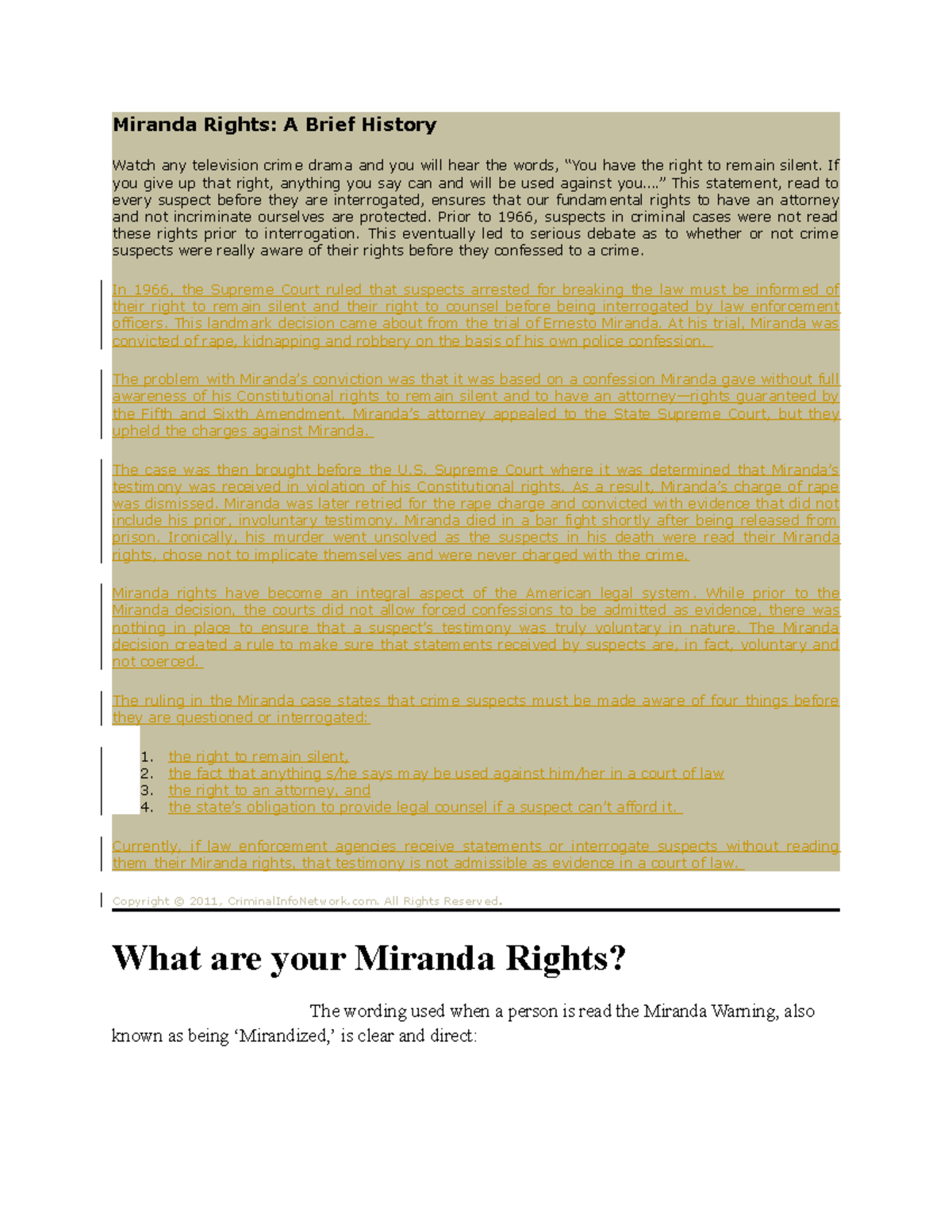
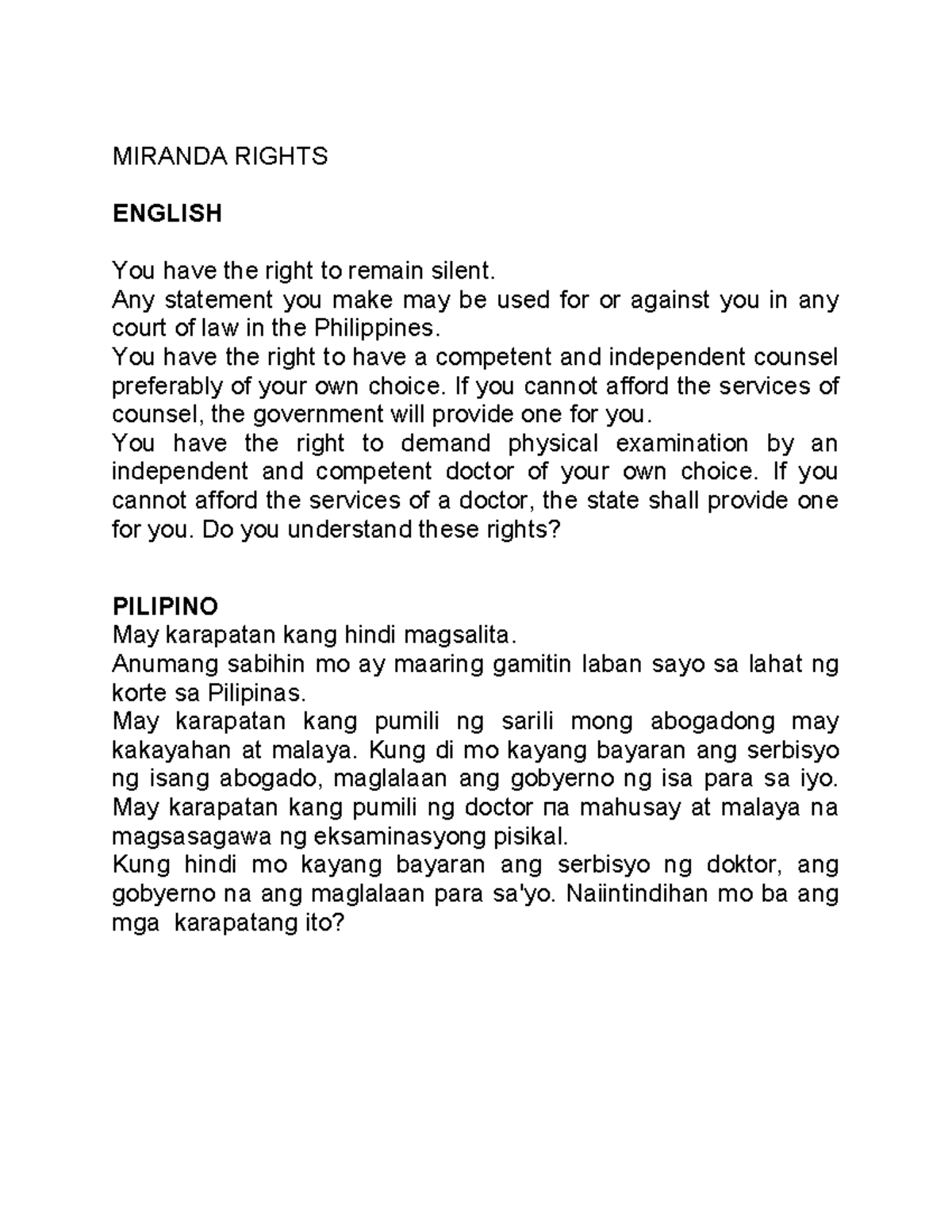
The Supreme Court has not mandated a single, rigid verbatim script. However, the substance of the warnings must clearly communicate four mandatory elements:
- The right to remain silent.
- That anything said can and will be used against the individual in court.
- The right to consult with an attorney and have legal counsel present during questioning.
- The right to have an attorney appointed by the court at no cost if the individual cannot afford one.
Can police question someone who voluntarily speaks without being placed under arrest?
Yes. If an individual is not in custody (meaning they are free to leave or terminate the interaction) or if they initiate communication voluntarily without prompt, Miranda warnings are not legally required. Voluntarily made statements outside custodial interrogation can generally be admitted as evidence in court.
How should a suspect properly invoke their right to remain silent or to have an attorney?
Under Berghuis v. Thompkins and related precedents, an invocation must be clear, unequivocal, and unambiguous. Simply ignoring questions or staying silent is insufficient. A suspect must state clearly: "I am invoking my right to remain silent" or "I will not answer questions without an attorney present." Once a suspect clearly requests an attorney, all questioning must cease until legal counsel is provided or the suspect independently reinitiates communication.
Protecting Constitutional Rights During Police Encounters
Understanding how courts evaluate Miranda precedents provides valuable perspective on personal rights and legal remedies. If you or someone you know is involved in a criminal law enforcement interaction, consider these legal principles:
- State Your Intentions Clearly: If you wish to exercise Fifth or Sixth Amendment rights, state your choice clearly and unequivocally (e.g., "I am exercising my right to remain silent and I request an attorney").
- Avoid Relying on Passive Silence: Passive non-responsiveness does not trigger the legal obligation for officers to stop questioning.
- Document Interrogations: Following any custodial detention, document all details regarding when warnings were provided, what questions were asked, and how officers responded to requests for counsel.
- Consult Legal Counsel: Criminal defense attorneys can file formal evidentiary motions—such as a Motion to Suppress Evidence—if law enforcement officers obtained admissions through unconstitutional custodial interrogation.
Image Gallery