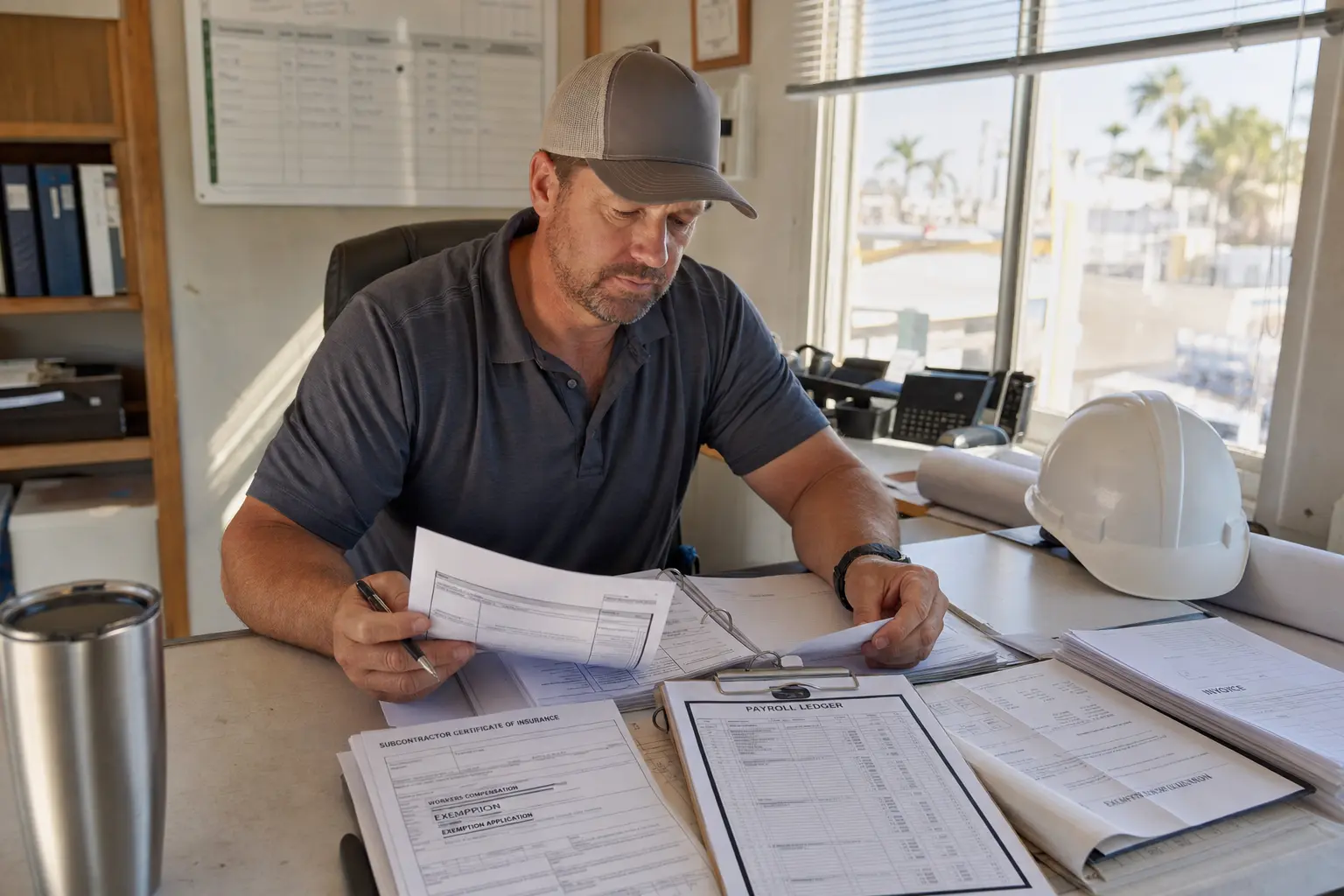
What Happens if a Florida Subcontractor is Injured and is Exempt from Workers' Comp?
In Florida, an exempt subcontractor who suffers a work-related injury is ineligible to receive workers' compensation benefits, including medical expense coverage and disability payments. However, because the exemption removes them from...
In Florida, an exempt subcontractor who suffers a work-related injury is ineligible to receive workers' compensation benefits, including medical expense coverage and disability payments. However, because the exemption removes them from the workers' compensation system, they are not barred by the "exclusive remedy" doctrine and may pursue a personal injury lawsuit against the general contractor or a third party if negligence contributed to the injury.
Contents
The interplay between Florida’s workers’ compensation laws and the construction industry is complex, particularly concerning exemptions. Under Florida Statute Chapter 440, business owners and officers in the construction industry can elect to be exempt from workers’ compensation coverage. While this reduces overhead costs, it creates a significant shift in legal liability and financial risk when an accident occurs on a job site in 2026.
Understanding the Workers' Compensation Exemption in Florida
To understand what happens during an injury, one must first define the legal status of an "exempt" subcontractor. In Florida, only corporate officers or members of a Limited Liability Company (LLC) in the construction industry can apply for a Certificate of Election to be Exempt.
This certificate, issued by the Florida Department of Financial Services (DFS), Division of Workers' Compensation, legally declares that the individual is not an employee for the purposes of workers' compensation coverage. Consequently, the business entity does not have to pay premiums for that specific individual, and the individual cannot file a claim against their own company’s policy or the general contractor's (GC) policy.
The Construction Industry Requirement
In the construction industry, a subcontractor must own at least 10% of the company to qualify for an exemption. As of 2026, the state continues to limit the number of exemptions per corporation to three officers. This limitation prevents companies from misclassifying an entire workforce as "exempt officers" to avoid insurance costs. For the exempt individual, this status is a trade-off: they save money on premiums but forfeit the "no-fault" safety net that pays for medical bills regardless of who caused the accident.
Immediate Consequences of an Injury to an Exempt Subcontractor
When a subcontractor with a valid exemption is injured on a job site, the standard workers' compensation workflow is bypassed. Under normal circumstances, an injured worker would report the injury, and the insurance carrier would begin paying for authorized medical treatment. For the exempt sub, the following occurs:
- Denial of Workers’ Comp Benefits: The insurance carrier for the general contractor will verify the exemption status through the Florida CFO’s searchable database. Once the exemption is confirmed, the carrier will formally deny the claim because the subcontractor is legally not an "employee."
- Personal Financial Responsibility: The injured subcontractor becomes immediately responsible for their own medical bills. Hospital visits, surgeries, and rehabilitation costs must be paid out-of-pocket or through private health insurance.
- Loss of Wage Replacement: Workers' compensation typically provides indemnity benefits (usually 66.6% of average weekly wages). An exempt subcontractor receives zero wage replacement from the workers' compensation system, leading to immediate financial strain if they cannot return to work.
The Shift to Tort Liability: Suing for Negligence
The most significant legal shift involving an exempt subcontractor is the loss of "Immunity from Liability" for the general contractor. In a standard employment relationship, workers' compensation is the exclusive remedy. This means an employee gets benefits but loses the right to sue their employer for negligence.
Because an exempt subcontractor is not an "employee" under the act, the general contractor does not enjoy this immunity. If the injury was caused by the general contractor’s failure to maintain a safe job site, faulty equipment provided by the GC, or the negligence of the GC’s other employees, the exempt subcontractor has the right to file a personal injury lawsuit.
Potential Damages in a Lawsuit
Unlike workers' compensation, which is limited to medical bills and a portion of lost wages, a personal injury lawsuit allows the exempt subcontractor to seek:
- Full Medical Expenses: Both past and future costs.
- Total Lost Wages: Including the full value of lost earning capacity.
- Pain and Suffering: Non-economic damages that are never available in workers' compensation.
- Punitive Damages: If the negligence was particularly egregious or willful.
While the potential payout in a lawsuit is much higher, the burden of proof is also higher. The subcontractor must prove that the GC or another party was actually at fault. If the subcontractor caused their own injury, they may recover nothing.
The Role of the General Contractor as a "Statutory Employer"
Florida Statute 440.10 establishes the concept of the "Statutory Employer." This law dictates that a contractor who sublets a portion of their work to a subcontractor is responsible for ensuring that all employees on the job site are covered by workers' compensation.
If a subcontractor is not exempt and does not have insurance, the GC’s insurance policy automatically covers the sub’s employees, and the GC is billed for the premium. However, the exemption certificate acts as a legal "stop sign." It tells the GC and their insurer that this specific individual has opted out of the system. This protects the GC from paying premiums for the sub but exposes the GC to the aforementioned negligence lawsuits.
Verification and Compliance
General contractors in 2026 are highly diligent about verifying exemptions. If an exemption is expired or invalid at the moment of injury, the subcontractor may be re-classified as an "uninsured employee." In that case, the GC becomes the statutory employer, and the injured sub would be covered by the GC's workers' comp, but the GC would likely face heavy penalties and premium hikes from their insurer.
Private Health Insurance Gaps
A common mistake made by exempt subcontractors is assuming that their private health insurance (such as an individual PPO or HMO) will cover them if they are hurt on the job.
Many health insurance policies in 2026 contain specific "work-related injury" exclusions. If a health insurer discovers that an injury occurred on a commercial job site, they may deny the claim, stating that the injury should have been covered by workers' compensation. Since the subcontractor chose to be exempt, they find themselves in a "coverage gap" where neither workers' comp nor private health insurance will pay for their care. Subcontractors should specifically review their health policy's "Coordination of Benefits" and "Exclusions" sections to see if "Occupational Injuries" are covered.
Comparison: Exempt vs. Covered Subcontractors in Florida
The following table outlines the differences in outcomes for an injured subcontractor based on their coverage status.
| Feature | Exempt Subcontractor | Covered Subcontractor (Insured) |
|---|---|---|
| Medical Benefits | None through workers' comp; out-of-pocket or private insurance. | 100% of authorized medical care paid by insurer. |
| Wage Replacement | None. | ~66.6% of average weekly wages (up to state cap). |
| Right to Sue GC | Yes, if the GC was negligent. | No, barred by "exclusive remedy" doctrine. |
| Burden of Proof | Must prove negligence/fault of another party. | No-fault system; only must prove injury occurred at work. |
| Pain & Suffering | Eligible for recovery in a lawsuit. | Not eligible. |
| Permanent Disability | Recoverable only through a successful lawsuit. | Statutory payments based on impairment rating. |
Third-Party Liability Claims
Even if the general contractor was not negligent, an exempt subcontractor may have a claim against a third party. On a 2026 construction site, multiple entities interact daily. Potential third-party defendants include:
- Manufacturers: If a tool, scaffold, or piece of heavy machinery malfunctioned due to a design or manufacturing defect.
- Other Subcontractors: If an employee of a different company (e.g., an electrician or plumber) created a hazard that caused the injury.
- Property Owners: If the injury was caused by a pre-existing dangerous condition on the premises that the owner failed to disclose.
These third-party claims are handled in civil court. For an exempt subcontractor, these claims represent the only viable path to financial recovery after a catastrophic injury.
Strategic Recommendations for Subcontractors and GCs
For Subcontractors
- Evaluate the Risk: If you are an exempt officer, ensure you have a robust disability insurance policy and a health insurance policy that does not exclude work-related injuries.
- Maintain Records: Keep your exemption certificate current. An expired certificate at the time of an accident creates a legal nightmare regarding who is responsible for the claim.
- Safety Protocols: Since you lack the "no-fault" safety net, your personal adherence to OSHA standards is your primary financial defense.
For General Contractors
- Strict Documentation: Collect and verify all subcontractor exemptions through the Florida Division of Workers' Compensation before anyone steps on the job site.
- Contractual Indemnity: Include language in your subcontracts where the exempt subcontractor acknowledges they are waiving workers' comp benefits and agrees to indemnify the GC for certain risks, though this has limits in personal injury law.
- Safety Oversight: Because exempt subs can sue you for negligence, your site safety inspections must be impeccable. Treat every exempt sub as a high-liability entity.
Frequently Asked Questions
Can an exempt subcontractor "un-exempt" themselves after an injury?
No. The status of the subcontractor is determined at the exact moment the injury occurs. If a valid exemption is on file with the State of Florida at the time of the accident, the subcontractor cannot retroactively cancel it to seek workers' compensation benefits from the general contractor's policy.
Does an exemption cover the subcontractor's employees?
No. An exemption only applies to the specific individual named on the certificate (the officer or member). If an exempt subcontractor has employees, those employees must be covered by a workers' compensation policy. The subcontractor cannot "share" their exempt status with their crew.
What happens if the GC forced the subcontractor to be exempt?
Under Florida law, it is illegal for a contractor to require a subcontractor or employee to become exempt as a condition of employment. If a subcontractor can prove they were coerced into an exemption, the GC may face significant legal penalties and may be held liable for workers' compensation benefits as if the exemption never existed.
Is an exempt subcontractor still eligible for Social Security Disability (SSDI)?
Yes. If the injury is severe enough to prevent the individual from working for at least 12 months (or is expected to result in death), they may apply for SSDI. However, the SSDI application process is lengthy, often taking years, and does not provide the immediate medical coverage that workers' compensation offers.
Does the exemption apply if I am working on a residential project?
Yes. Florida’s workers' compensation laws apply to both commercial and residential construction. If you are a subcontractor on a home build and you are exempt, the same rules apply: no workers' comp benefits, but you retain the right to sue for negligence.
Final Steps for the Injured Subcontractor
If you are an exempt subcontractor injured on a Florida job site in 2026, your first action should be to secure medical care, regardless of the cost. Secondly, you should consult with a personal injury attorney immediately. Because you are outside the workers' compensation system, your only path to recovery is proving negligence. You must preserve evidence from the job site, such as photos of the hazard and witness contact information, before the site conditions change.
Image Gallery