Classical vs. Keynesian Economics: Key Differences and Theoretical Foundations
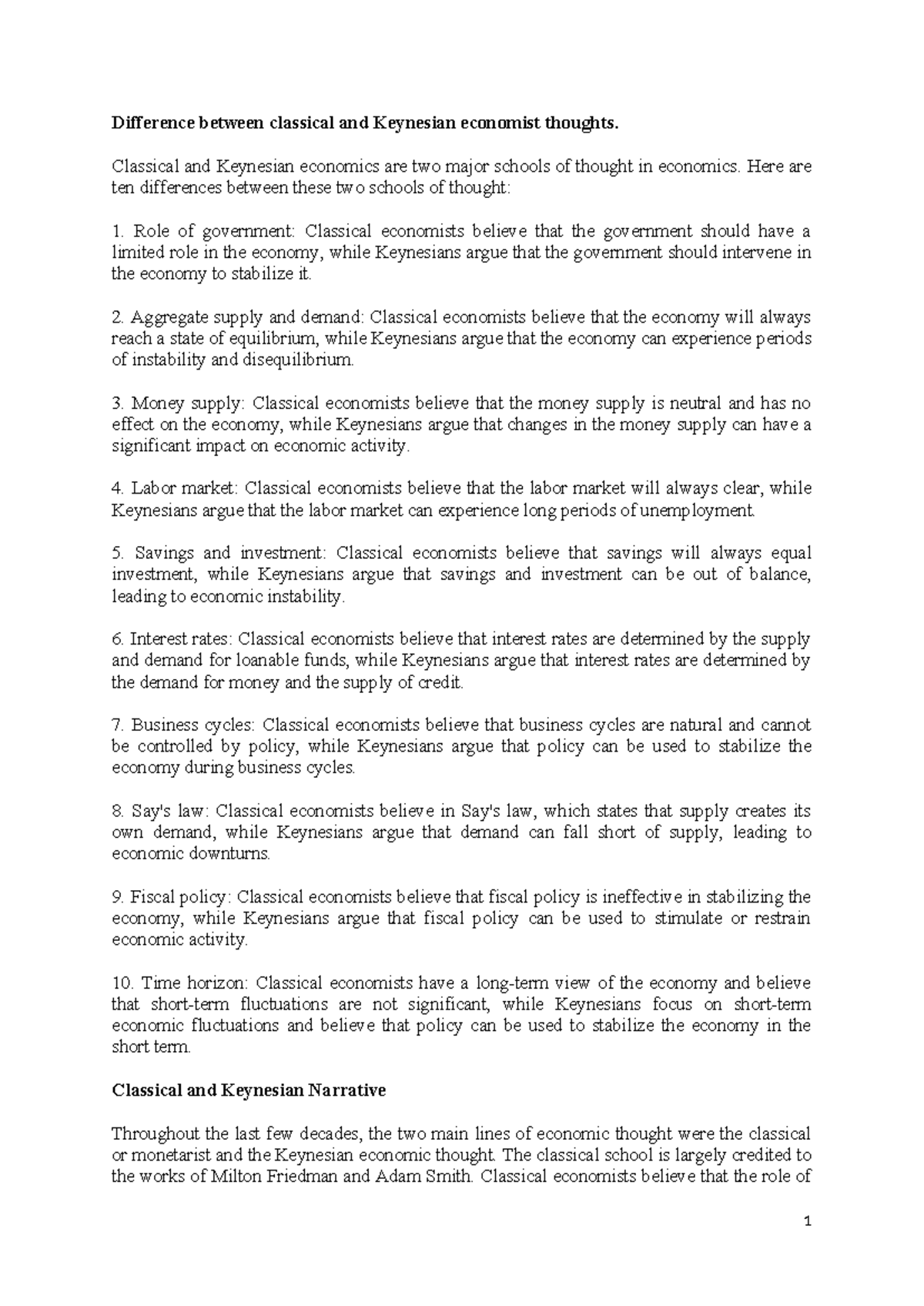
Classical economics posits that free markets are inherently self-regulating and reach equilibrium through flexible prices and wages, focusing on long-term supply. Conversely, Keynesian economics argues that aggregate demand drives the...
Classical economics posits that free markets are inherently self-regulating and reach equilibrium through flexible prices and wages, focusing on long-term supply. Conversely, Keynesian economics argues that aggregate demand drives the economy and that markets can remain in prolonged periods of unemployment without active government intervention and fiscal stimulus.
Contents
The debate between classical and Keynesian schools of thought has shaped global fiscal and monetary policies for over a century. While the classical school emerged during the Enlightenment to explain the growth of industrial nations, the Keynesian school rose from the failures of the Great Depression. Understanding these frameworks is essential for interpreting modern economic data, central bank decisions, and government spending priorities in 2026.
The Foundations of Classical Economic Thought
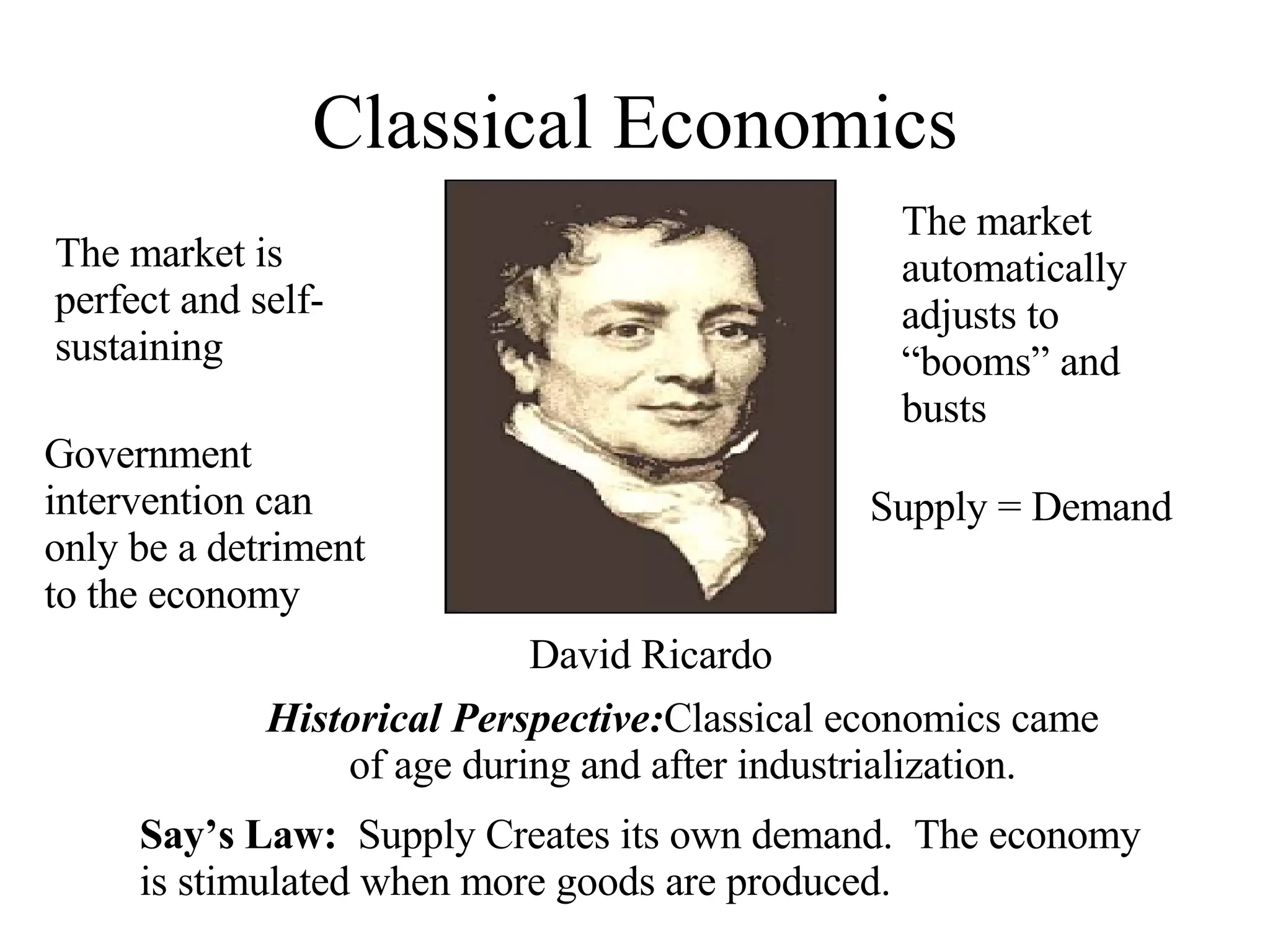
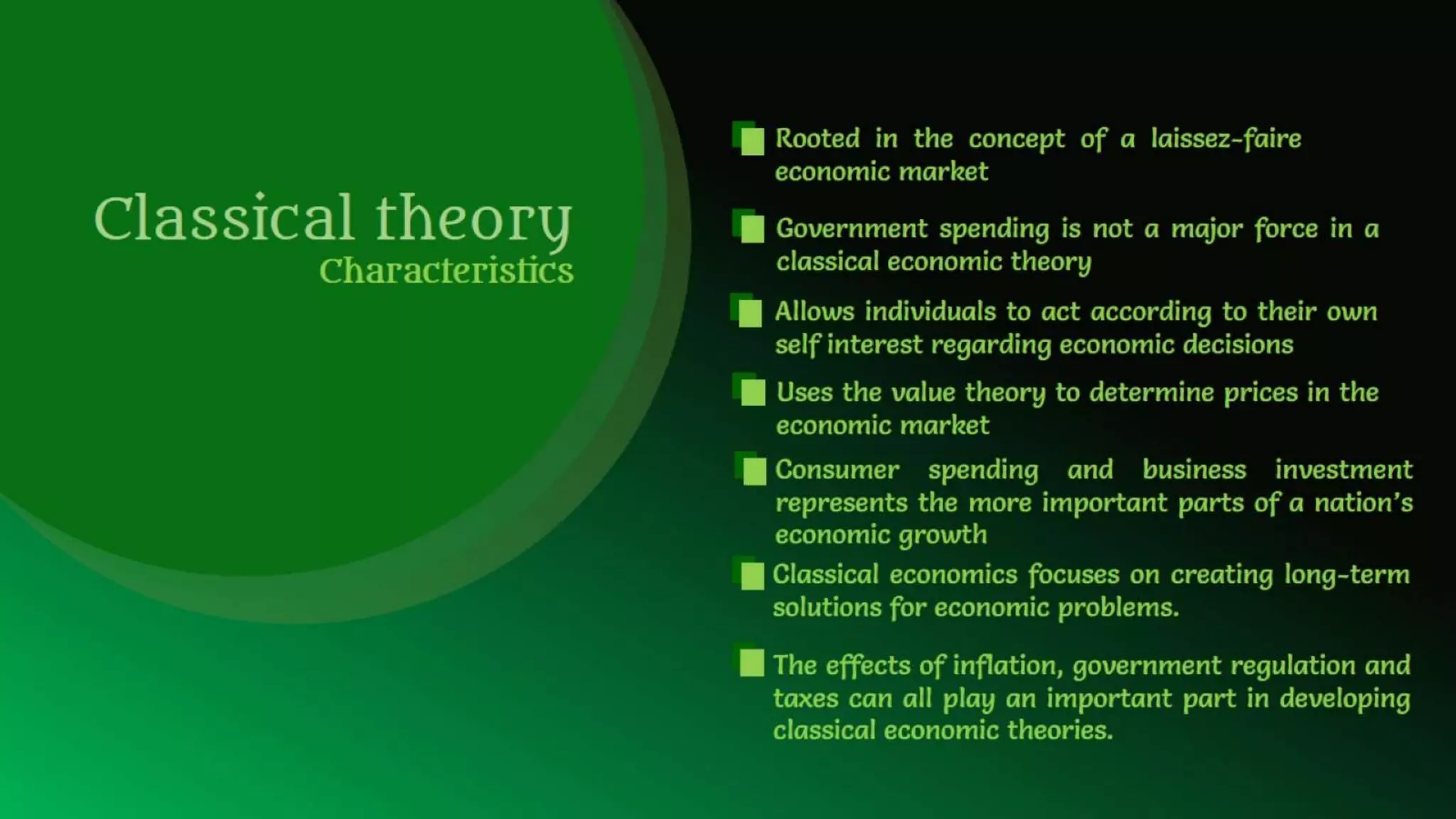
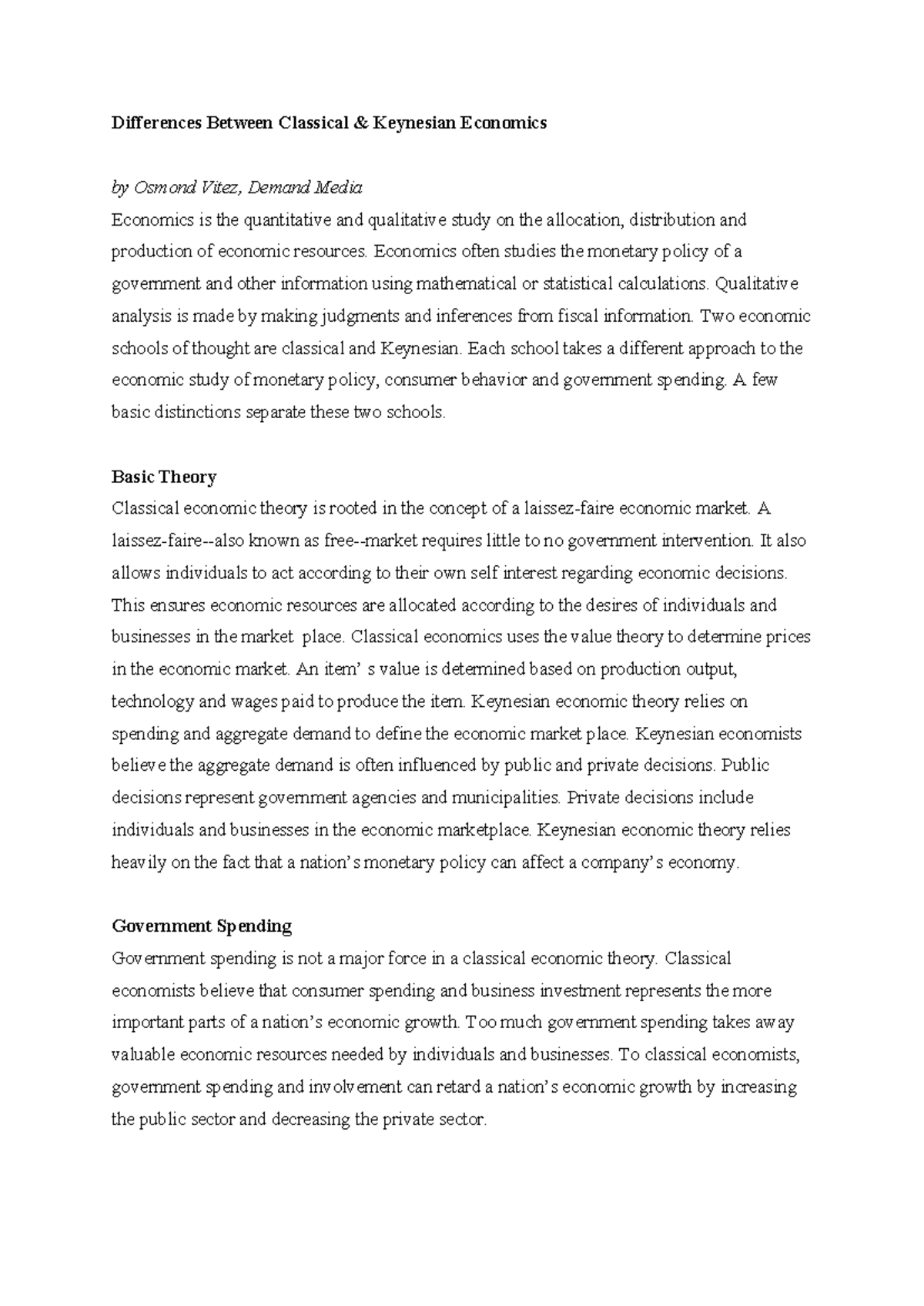
Classical economics emerged in the late 18th and early 19th centuries, spearheaded by figures such as Adam Smith, David Ricardo, and Jean-Baptiste Say. At its core, this school of thought is built on the belief in "Laissez-faire"—the idea that the economy functions best when the government refrains from interference.
Say’s Law and the Supply-Side Focus
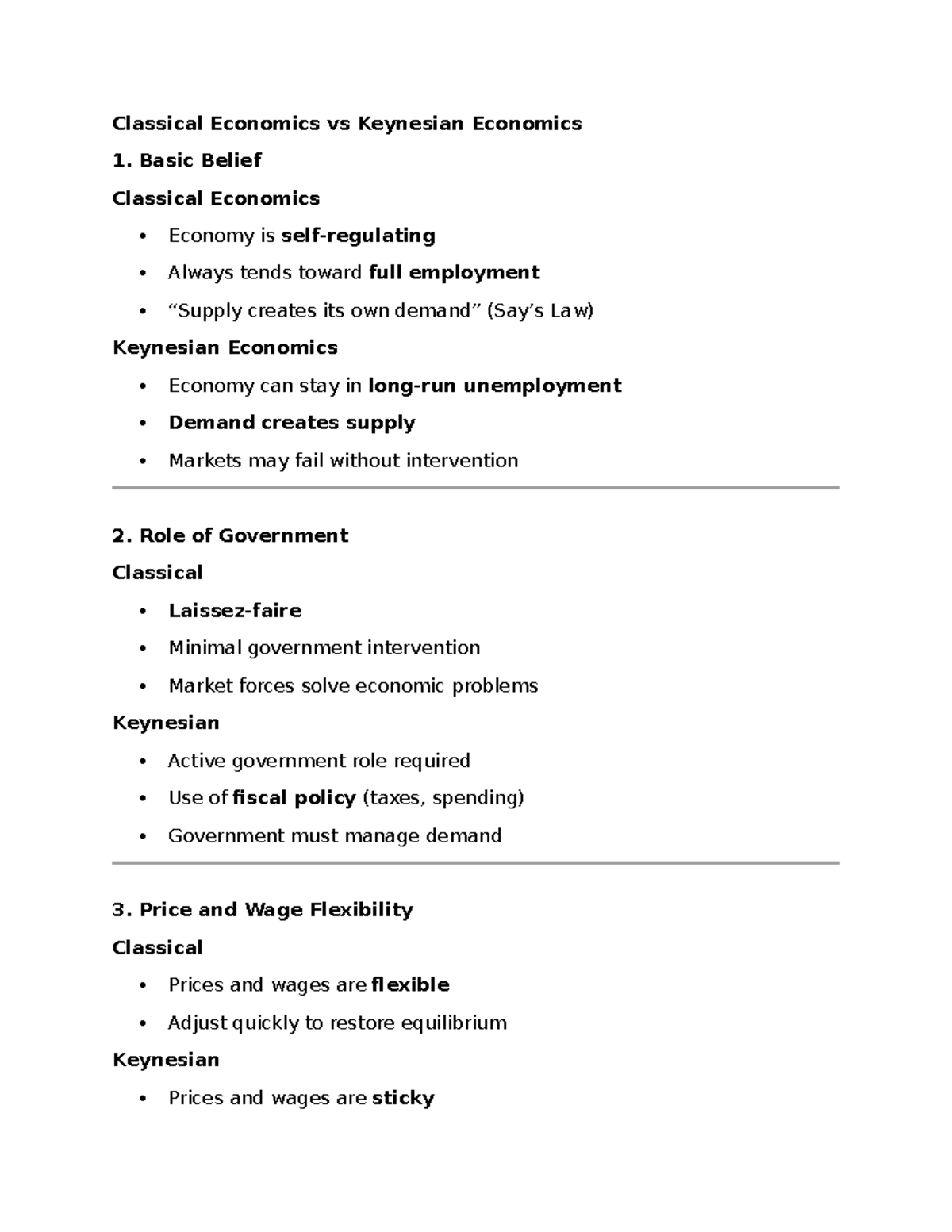
A cornerstone of classical theory is Say’s Law, named after Jean-Baptiste Say, which states that "supply creates its own demand." Classical economists argue that the act of producing goods generates enough income for workers and owners to purchase those goods. Therefore, a general overproduction or "glut" in the market is impossible in the long run. Any temporary imbalance between supply and demand is corrected by the price mechanism; if there is too much of a product, its price falls until the market clears.
The Role of Rationality and Equilibrium
Classical theory assumes that individuals are rational actors who seek to maximize their utility. In this framework, markets are highly competitive and prices are perfectly flexible. If unemployment exists, it is viewed as a temporary phenomenon. Classical economists argue that workers will eventually accept lower wages to gain employment, which reduces production costs for businesses and leads to increased hiring until full employment is restored.
The Keynesian Revolution: A Response to Market Failure
The Great Depression of the 1930s challenged the classical assumption that markets always self-correct. Despite massive unemployment and collapsing output, the "invisible hand" failed to restore prosperity. In 1936, John Maynard Keynes published The General Theory of Employment, Interest and Money, fundamentally altering the landscape of macroeconomics.
The Primacy of Aggregate Demand
Keynes famously inverted Say’s Law, suggesting that demand creates its own supply. He argued that the total spending in the economy—comprising consumption, investment, government spending, and net exports—determines the level of economic activity. If aggregate demand is insufficient, firms will not produce goods, even if they have the capacity to do so. This leads to a "demand-deficient" recession where the economy can remain stuck below full capacity indefinitely.
The Multiplier Effect
Keynes introduced the concept of the multiplier, which suggests that an initial change in spending leads to a larger final change in national income. For example, when the government spends money on infrastructure, the construction workers earn income, which they then spend on groceries and services, creating further income for others. This cycle amplifies the impact of the initial expenditure, providing a justification for deficit spending during economic downturns.
Crucial Point of Divergence: Price and Wage Stickiness
One of the most significant technical differences between the two schools is their view on how quickly prices and wages adjust to changes in the economy.
Classical Flexibility
In the classical model, prices and wages are considered perfectly flexible. If the demand for labor drops, wages fall immediately. This decrease in the cost of labor makes it profitable for firms to hire more people, keeping the economy at the "natural rate of unemployment." Because of this flexibility, the economy is always gravitating toward full employment, making government intervention unnecessary and potentially harmful.
Keynesian "Stickiness"
Keynesians argue that in the real world, prices and wages are "sticky"—they do not move downward easily. Several factors contribute to this:
- Labor Contracts: Wages are often set for a year or more.
- Minimum Wage Laws: Legal floors prevent wages from falling below a certain point.
- Efficiency Wages: Employers may keep wages high to maintain worker morale and productivity.
- Menu Costs: Businesses face costs when changing prices, leading them to delay adjustments.
Because wages and prices are sticky, the economy cannot quickly self-correct. Instead of wages falling during a recession, firms simply lay off workers, leading to persistent, involuntary unemployment that requires an external "jolt" from the government to resolve.
Policy Implications: Laissez-Faire vs. Intervention
The differing views on market stability lead to diametrically opposed policy recommendations.
Classical Policy: Stability Through Hands-Off Management
Classical economists advocate for a balanced budget and a limited role for the state. They believe that government spending "crowds out" private investment by driving up interest rates. From a classical perspective, the best way to encourage growth is to focus on the supply side:
- Reducing regulations to lower production costs.
- Cutting taxes on corporations and high earners to stimulate investment.
- Maintaining a stable, predictable money supply to prevent inflation.
Keynesian Policy: Active Fiscal Management
Keynesians advocate for discretionary fiscal policy. During a recession, they argue the government should run a budget deficit by increasing spending or cutting taxes to boost aggregate demand. Conversely, when the economy is overheating and inflation is rising, the government should reduce spending or increase taxes to "cool" the market.
This counter-cyclical approach is designed to smooth out the business cycle, preventing the "boom and bust" extremes that can devastate societies. The use of "automatic stabilizers," such as unemployment insurance, is a key Keynesian legacy that provides a floor for demand during downturns.
Time Horizons: Short Run vs. Long Run
The timeframe of analysis is perhaps the most quoted distinction between these theories. Classical economics is primarily a long-run theory. It focuses on the factors that determine the growth of potential output over decades, such as technological progress and capital accumulation.
Keynes, however, famously remarked, "In the long run, we are all dead." He argued that economists set themselves too easy and useless a task if they can only tell us that when the storm is long past, the ocean is flat again. Keynesian economics is a short-run theory, focusing on how to manage the economy during the immediate fluctuations of the business cycle.
Comparison Summary: Classical vs. Keynesian Models
The following table outlines the fundamental differences between the two schools across key economic indicators.
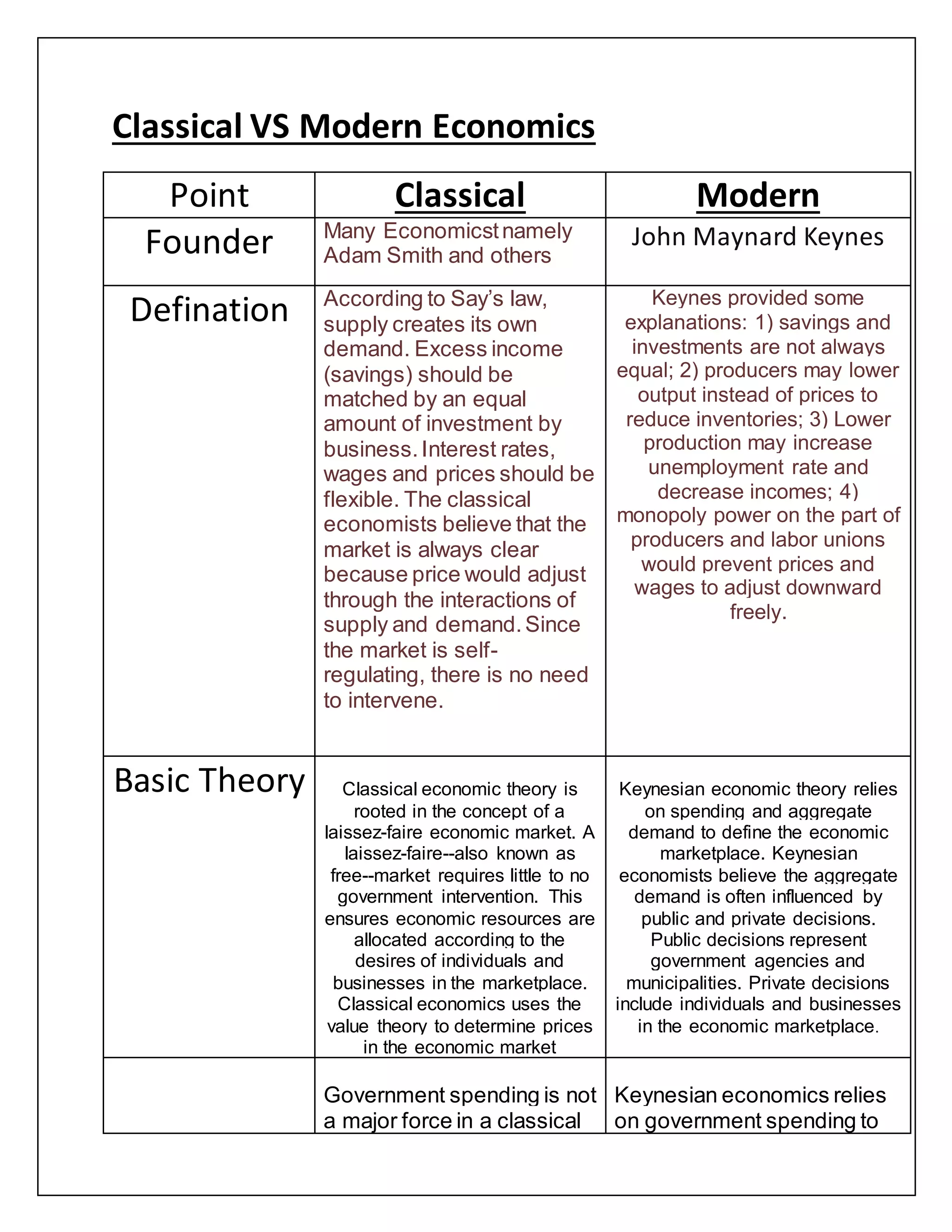
| Feature | Classical Economics | Keynesian Economics |
|---|---|---|
| Primary Driver | Supply (Say's Law) | Aggregate Demand |
| Price/Wage Behavior | Perfectly Flexible | "Sticky" (Slow to adjust) |
| Market Stability | Inherently self-correcting | Inherently unstable; prone to failure |
| Time Horizon | Long-run growth | Short-run fluctuations |
| Unemployment | Voluntary or temporary | Can be involuntary and persistent |
| Savings | A source of investment and growth | Can lead to reduced demand (Paradox of Thrift) |
| Government Role | Laissez-faire (Minimal) | Active management (Fiscal/Monetary) |
| Focus of Analysis | Productivity and capacity | Spending and consumption |
The Modern Synthesis and 2026 Context
As we navigate the economic landscape of 2026, the rigid divide between these two schools has largely softened into what economists call the New Neoclassical Synthesis. This modern framework recognizes that while Keynesian demand management is crucial in the short run—especially during shocks like the global supply chain disruptions of the early 2020s—the classical focus on supply and incentives is essential for long-term prosperity.
In the current environment, central banks like the Federal Reserve use Keynesian tools (adjusting interest rates) to manage inflation and employment, while governments often debate classical supply-side reforms (tax structures and deregulation) to address long-term productivity stagnation. The "Great Moderation" and the subsequent "Great Volatility" of the 21st century have proven that neither theory holds all the answers in isolation.
Frequently Asked Questions
Which theory is better for controlling inflation?
Classical economics generally offers a stronger framework for controlling long-term inflation by focusing on the money supply and supply-side capacity. Keynesian policy can sometimes lead to inflation if government spending overstimulates demand beyond what the economy can produce. However, Keynesianism provides tools to reduce demand (contractionary policy) when inflation is driven by an overheating economy.
Why did Keynesian economics become popular?
It became the dominant economic paradigm because classical economics could not explain or solve the persistent 25% unemployment rates seen during the Great Depression. Keynes provided a theoretical framework that justified government action to put people back to work, which proved highly effective in the post-WWII era.
Do classical economists believe in any government role?
Yes. Even the most ardent classical economists believe the government should provide a legal framework, protect property rights, maintain a stable currency, and provide public goods that the market cannot efficiently produce, such as national defense and basic infrastructure.
What is the "Paradox of Thrift"?
This is a Keynesian concept stating that while saving is good for an individual, if everyone tries to save more at the same time during a recession, total demand falls. This leads to lower national income and can actually result in lower total savings in the economy. It highlights the Keynesian emphasis on the dangers of inadequate spending.
Is modern monetary policy Classical or Keynesian?
It is a hybrid. Modern central banking often uses Keynesian logic to manage the short-term business cycle through interest rate adjustments, but it adheres to the classical principle that in the long run, inflation is a monetary phenomenon.
Recommendation for Further Action
For those looking to apply these concepts to investment or policy analysis, it is recommended to monitor the output gap—the difference between the economy's actual output and its potential capacity. If the output gap is large (high unemployment, idle factories), Keynesian demand-side stimulus is often the most effective remedy. If the economy is at full capacity but inflation is rising, classical supply-side improvements and monetary tightening are typically the prioritized actions. Understanding which "lens" policymakers are using at any given moment is the key to anticipating market movements and legislative changes in 2026.
Image Gallery