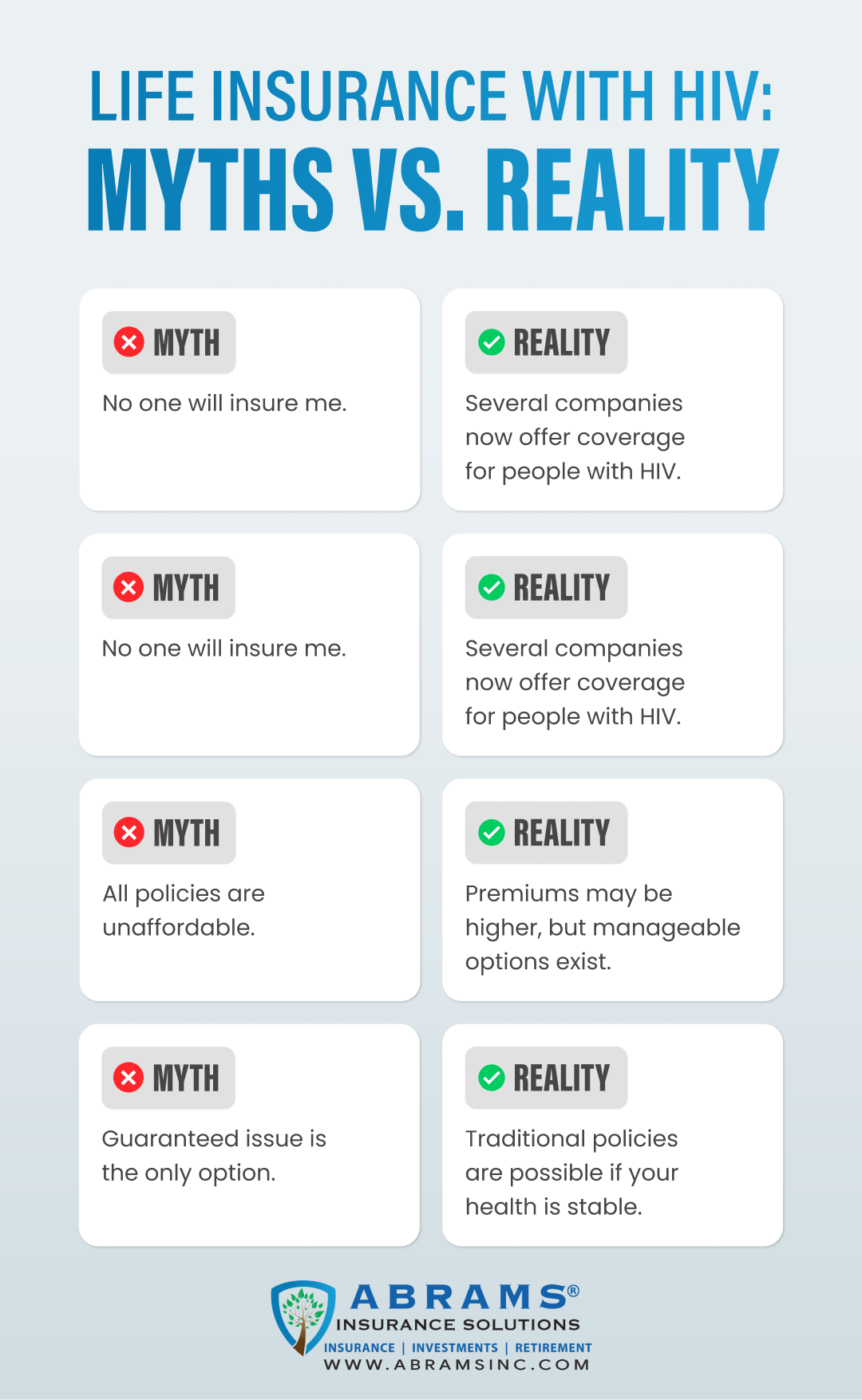
Understanding No Exam Life Insurance for HIV: Options, Coverage, and Costs
People living with HIV can obtain no exam life insurance through simplified issue or guaranteed issue policies that skip traditional physical blood tests and urine samples. Eligibility depends on medical history, antiretroviral therapy...
People living with HIV can obtain no exam life insurance through simplified issue or guaranteed issue policies that skip traditional physical blood tests and urine samples. Eligibility depends on medical history, antiretroviral therapy adherence, and viral load suppression, allowing applicants to secure financial protection for their beneficiaries without undergoing a paramedical examination.
Contents
How Life Insurance Underwriting for HIV Has Evolved
Historically, an HIV diagnosis meant an automatic decline from life insurance underwriters across the industry. During the early decades of the epidemic, life insurance carriers viewed HIV as an uninsurable risk due to limited treatment options and low life expectancy projections.
The widespread adoption and success of combination antiretroviral therapy (ART) fundamentally transformed HIV from an acute, terminal condition into a manageable chronic health condition. Clinical studies routinely show that individuals living with HIV who achieve and maintain viral suppression have life expectancies approaching those of the general population.
In response to these clinical developments, life insurance companies updated their underwriting guidelines. Today, many major carriers offer individual life insurance coverage to people living with HIV. Furthermore, the expansion of modern digital underwriting technology has made "no exam" life insurance—policies that do not require an in-person paramedical exam, blood draw, or urine sample—an accessible option for qualified applicants.
Disclaimer: Life insurance underwriting rules, eligibility criteria, and state regulations vary. This guide is provided for educational purposes and does not constitute formal medical, financial, or legal advice. Applicants should consult with a licensed life insurance agent specializing in impaired-risk underwriting to discuss individual circumstances.
Types of No Exam Life Insurance Policies for HIV
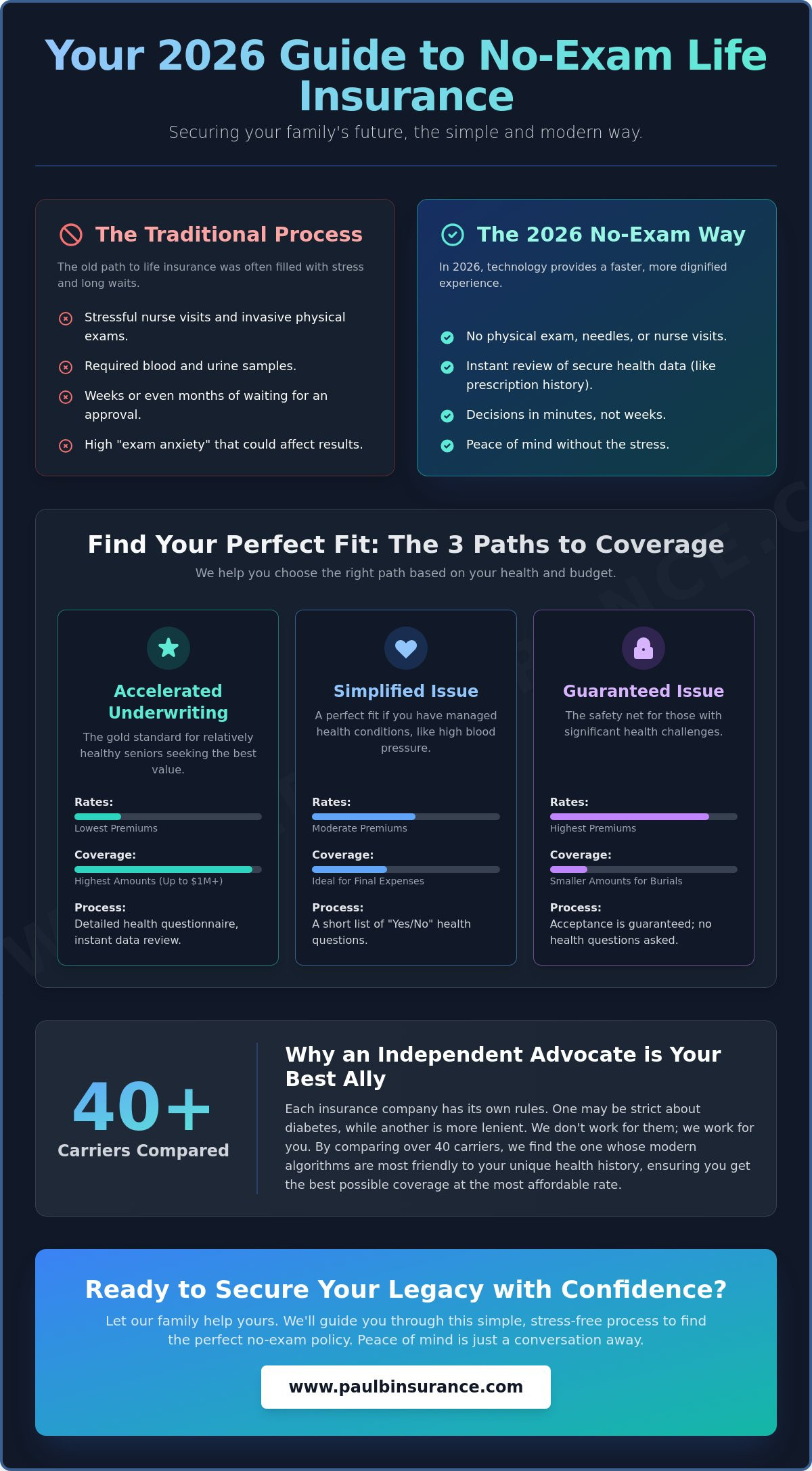
When seeking life insurance without a physical medical examination, applicants living with HIV generally evaluate three distinct product categories. Each policy type balances ease of application against coverage limits, pricing, and medical qualification rules.
1. Simplified Issue Life Insurance
Simplified issue life insurance bypasses the physical medical examination, but it does not bypass medical screening. Instead of sending a medical examiner to collect blood and urine samples, the insurer evaluates risk using:
- A detailed health questionnaire on the application.
- Authorization to query the Medical Information Bureau (MIB) database.
- Prescription drug history databases (Rx checks).
- Electronic Health Records (EHR) or an Attending Physician Statement (APS) from your primary care provider.
For individuals with HIV, simplified issue policies may be available if medical records demonstrate continuous antiretroviral therapy, an undetectable viral load, adequate CD4 cell counts, and an absence of AIDS-defining illnesses. Because the insurer still screens your medical background, simplified issue coverage offers higher maximum death benefits and lower monthly premiums than guaranteed acceptance options.
2. Guaranteed Issue Life Insurance
Guaranteed issue life insurance (also called guaranteed acceptance) requires no medical exam and no health questions. Insurers cannot decline applicants based on pre-existing medical conditions, including HIV, stage of infection, or co-occurring health issues.
Key features of guaranteed issue policies include:
- Automatic Approval: If you meet the age requirements (typically ages 40 to 85, depending on the carrier), your acceptance is guaranteed.
- Lower Coverage Caps: Maximum death benefits usually range from $5,000 to $25,000, making these policies primarily useful for final expenses, burial costs, or small debt settlement.
- Graded Death Benefit Period: Most guaranteed issue policies enforce a two-year waiting period. If the insured dies of natural causes within the first two years of policy issuance, the beneficiary receives a refund of paid premiums plus a small interest percentage (typically 10%) rather than the full face amount. Death resulting from accidental causes during this initial period usually pays the full death benefit immediately.
3. Accelerated Underwriting Term Life Insurance
Accelerated underwriting utilizes algorithmic data analysis to streamline traditional term life insurance. By leveraging real-time data from credit bureaus, motor vehicle records, public data, and prescription history, carriers can issue policy decisions within days or hours without requiring a paramedical exam.
While accelerated underwriting historically excluded individuals with chronic conditions, select carriers now route well-managed HIV cases through accelerated or semi-automated channels. If an applicant's digital medical profile shows long-term viral suppression and no secondary risk factors, the carrier may waive the physical exam while still offering standard term life insurance coverage up to $500,000 or more.
Key Medical Metrics Insurers Evaluate
When applying for no-exam life insurance policies that include health questionnaires (such as simplified issue or accelerated term insurance), underwriters focus on specific medical benchmarks established by clinical guidelines, such as those maintained by the U.S. Centers for Disease Control and Prevention (CDC).
CRITICAL UNDERWRITING BENCHMARKS
- Viral Load: Undetectable / Suppressed (<20 to <50 copies/mL)
- CD4 Cell Count: Stable levels (typically >200 to >500 cells/mm³)
- ART Compliance: Consistent prescription refill history
- Co-infections: Absence of active Hepatitis B or Hepatitis C
- Health History: No prior AIDS-defining opportunistic infections
Viral Load Suppression
Insurers prioritize viral load measurements. An undetectable viral load (typically defined as fewer than 20 to 50 copies of HIV RNA per milliliter of blood) indicates that antiretroviral medication is effectively controlling viral replication. Underwriters view sustained viral suppression over 6 to 12 consecutive months as a primary indicator of long-term health stability.
CD4 Cell Count
The CD4 count reflects the strength of the immune system. Insurance guidelines generally look for stable CD4 counts above specific thresholds—most commonly above 200 cells/mm³, with many carriers preferring counts above 350 or 500 cells/mm³. A higher, stable CD4 count demonstrates that the immune system remains robust.
Adherence to Antiretroviral Therapy (ART)
Carriers check prescription records to verify consistent medication adherence. Gaps in filling prescriptions or frequent unapproved changes in medication regimens can raise flags during underwriting, as treatment adherence is essential for maintaining viral suppression.
Co-Infections and Comorbidities
Underwriters evaluate secondary health factors alongside HIV management. Co-infections such as active Hepatitis B or Hepatitis C, chronic kidney disease, uncontrolled diabetes, or cardiovascular conditions can impact eligibility or increase premium rates. Applicants who have successfully treated and cleared Hepatitis C with direct-acting antivirals generally receive more favorable underwriting outcomes.
Absence of Opportunistic Infections
A history of opportunistic infections or AIDS-defining illnesses—such as Pneumocystis pneumonia (PCP), Kaposi's sarcoma, or cryptococcal meningitis—will typically result in a decline for simplified issue term policies, directing the applicant toward guaranteed issue options instead.
Comparing No-Exam Life Insurance Options for HIV
The following table summarizes the core differences among the primary no-exam life insurance categories available to individuals living with HIV:
| Feature / Metric | Simplified Issue Life Insurance | Guaranteed Issue Life Insurance | Accelerated Underwriting Term |
|---|---|---|---|
| Medical Exam Required? | No | No | No |
| Health Questionnaire? | Yes (Detailed medical questions) | No health questions asked | Yes (Digital background check) |
| Typical Coverage Limits | $25,000 – $500,000 | $5,000 – $25,000 | $100,000 – $1,000,000+ |
| Waiting Period / Graded Benefit | Usually None (Immediate full coverage) | 2-Year Graded Death Benefit | None (Immediate full coverage) |
| Underwriting Speed | 1 to 14 Business Days | Immediate / Same-Day Approval | 24 Hours to 7 Days |
| Primary Target Applicant | Stable HIV management, undetectable viral load, seeking moderate-to-high coverage | Older adults, individuals with co-occurring health issues or recent diagnosis | Applicants with flawless medical records and long-term viral suppression |
| Relative Cost Level | Moderate | High (per dollar of coverage) | Low to Moderate |
Cost Factors and Premium Drivers
Pricing for life insurance without a medical exam reflects the level of risk the insurance company assumes. Because the carrier waives physical laboratory testing, underwriting risk pools are structured differently than fully underwritten policies.
Risk Pooling in No-Exam Policies
In standard fully underwritten policies, blood and urine analyses provide precise clinical data, allowing insurers to offer the lowest available rates (Preferred Best or Standard tiers). In simplified issue and guaranteed issue products, the insurer operates with less clinical certainty. To offset potential adverse selection, premiums for no-exam coverage are higher per dollar of benefit compared to fully underwritten coverage.
Key Drivers of Insurance Rates
- Age and Gender: Like all life insurance products, rates increase with age. Statistically, female applicants pay lower rates than male applicants due to higher average life expectancies.
- Tobacco and Nicotine Use: Tobacco use significantly increases premiums. For individuals living with HIV, smoking adds compound health risks (such as elevated cardiovascular risk), leading to higher rate table adjustments.
- Policy Type and Face Amount: Guaranteed issue policies cost significantly more per $1,000 of coverage than simplified issue policies because the carrier accepts all applicants regardless of health condition.
- Substandard Rating Tables: Simplified issue policies for chronic conditions are often issued with "table ratings" (e.g., Table 2/B or Table 4/D). A table rating adds a percentage surcharge (typically 25% to 100%) to the standard premium rate to accommodate the higher health risk profile.
Step-by-Step Guide to Applying for Coverage
Navigating the application process effectively helps ensure you obtain optimal terms and avoid unnecessary policy declines.
APPLICATION PROCESS STEPS
- Step 1: Gather Medical Documentation (CD4 history, viral load counts, ART)
- Step 2: Determine Required Death Benefit and Budget Limits
- Step 3: Work with an Independent Impaired-Risk Broker
- Step 4: Compare Simplified Issue vs. Guaranteed Acceptance Quotes
- Step 5: Complete Application and Submit Attending Physician Records
Step 1: Gather Complete Medical Records
Before applying for simplified issue or accelerated coverage, compile your recent lab results and medical history:
- Copies of your last 2 to 3 viral load tests and CD4 cell count results.
- A complete list of current antiretroviral medications and dosages.
- Contact information for your primary care physician or infectious disease specialist.
- Dates of your initial HIV diagnosis and treatment initiation.
Step 2: Determine Coverage Needs
Calculate your financial obligations to decide how much coverage you require:
- Final Expenses: $10,000 to $25,000 for funeral, burial, or cremation costs.
- Income Replacement: 5 to 10 times your annual income to support dependents.
- Debt Obligations: Remaining mortgage balances, personal loans, or credit card debt.
Step 3: Work with an Independent Impaired-Risk Broker
Life insurance underwriting guidelines for HIV vary significantly between insurance carriers. Captive agents (who work for a single insurance company) can only offer products from their specific firm. Independent brokers work with dozens of carriers and understand which companies maintain favorable underwriting niches for HIV-positive applicants.
Step 4: Submit Application Accurate and Honestly
Complete the application fully. When applying for simplified issue insurance, answer all medical queries accurately. If the carrier requests an Attending Physician Statement (APS), sign the medical release form promptly to allow your doctor's office to share lab history directly with the underwriting department.
Common Pitfalls and Mistakes to Avoid
- Misrepresenting Medical History on Applications: Never conceal an HIV diagnosis or misstate lab numbers on an application that asks health questions. Life insurance policies contain a standard two-year incontestability clause. If an applicant misstates health information and dies within the first two years, the carrier can investigate the original application, deny the claim, and rescind coverage.
- Buying Guaranteed Issue Prematurely: Some applicants assume that having HIV automatically excludes them from simplified issue coverage, leading them to purchase expensive guaranteed issue policies with low benefit limits. If your viral load is undetectable and your CD4 count is healthy, you may qualify for simplified issue coverage, which provides higher death benefits at lower comparative rates.
- Overlooking the Graded Death Benefit: Ensure you understand the waiting period associated with guaranteed acceptance plans. If you require immediate full coverage for natural causes of death, guaranteed issue policies will not provide it during the first two policy years.
- Allowing Coverage to Lapse: Canceling an existing policy before a new policy is formally approved and in force creates a gap in protection. Always wait until the new policy is issued and premium payments are confirmed before surrendering existing coverage.
Frequently Asked Questions
Can you get life insurance if you have HIV without taking a blood test?
Yes. Both simplified issue life insurance and guaranteed issue life insurance provide options that do not require physical medical exams, blood draws, or urine samples. Simplified issue relies on medical records and health questionnaires, while guaranteed issue requires no medical questions at all.
What is the waiting period for guaranteed issue life insurance?
Guaranteed issue life insurance policies typically feature a two-year graded death benefit period. If the policyholder dies from natural causes within the first two years, beneficiaries receive a return of premiums paid plus interest (usually around 10%). Full face-value payouts for natural death begin after the two-year period ends, though accidental deaths are generally covered for the full amount from day one.
How does an undetectable viral load impact life insurance approval?
An undetectable viral load demonstrates that antiretroviral therapy is effective and that the applicant maintains low viral activity. For simplified issue and accelerated underwriting policies, sustained viral suppression (typically for at least 6 months) is often a mandatory prerequisite for approval.
Is simplified issue life insurance more expensive for someone living with HIV?
Simplified issue insurance generally costs more than standard fully underwritten insurance because the carrier takes on more risk by omitting physical medical exams. However, for an applicant living with HIV, simplified issue insurance is considerably less expensive per dollar of coverage than guaranteed issue insurance, provided the applicant meets clinical health benchmarks.
What happens if an applicant does not disclose their HIV status?
If an applicant applies for a policy that asks health questions and fails to disclose their HIV status, it constitutes material misrepresentation. Under the policy's two-year contestability clause, the insurer has the legal right to review medical records upon the insured's death. If material misrepresentation is found, the insurer can deny the death claim and void the policy.
Next Steps for Securing Coverage
Securing no-exam life insurance with an HIV diagnosis is straightforward when approached with accurate information and medical documentation.
To achieve the best policy outcomes:
- Verify Your Current Clinical Status: Request your latest lab reports from your physician to confirm your viral load and CD4 levels.
- Consult an Independent Specialist: Partner with an independent insurance broker experienced in impaired-risk underwriting to evaluate options across multiple carriers.
- Compare Policy Structure and Terms: Evaluate total policy costs, waiting period terms, and coverage limits across simplified issue and guaranteed acceptance products before committing to a policy.
For additional information on consumer protections, state insurance laws, and policy guidelines, consult your state's Insurance Commissioner through the National Association of Insurance Commissioners (NAIC).
Image Gallery