Consequences of a MEC Designation on a Life Insurance Policy: Tax Implications and Rules
When a cash-value life insurance policy is designated as a Modified Endowment Contract (MEC), it permanently loses its favorable First-In, First-Out (FIFO) tax treatment for lifetime cash distributions. Withdrawals, policy loans, and c...
When a cash-value life insurance policy is designated as a Modified Endowment Contract (MEC), it permanently loses its favorable First-In, First-Out (FIFO) tax treatment for lifetime cash distributions. Withdrawals, policy loans, and collateral assignments are subsequently taxed as ordinary income to the extent of gains under Last-In, First-Out (LIFO) accounting rules, and taxable distributions taken prior to age 59½ incur an additional 10% IRS penalty.
Contents
What Is a Modified Endowment Contract (MEC)?
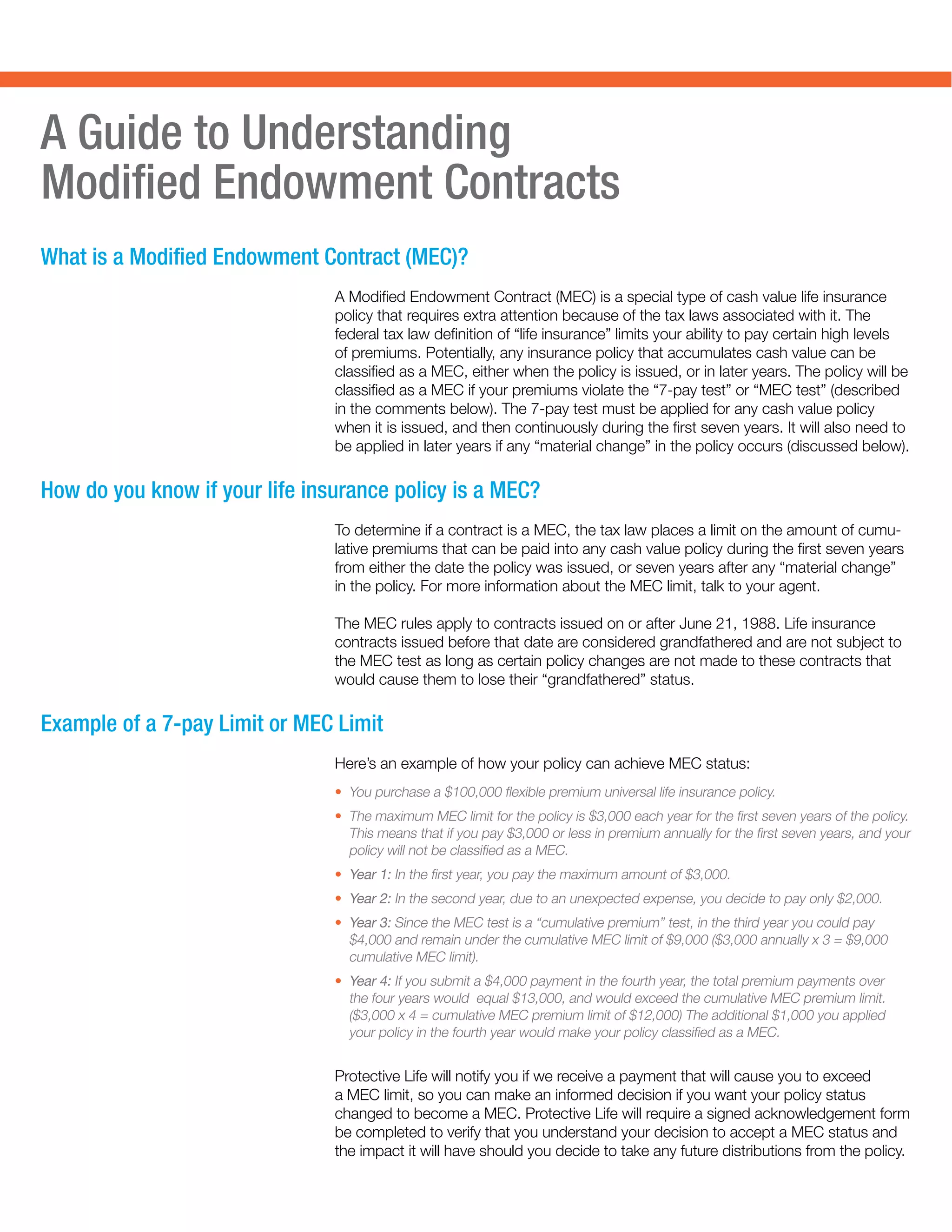
A Modified Endowment Contract (MEC) is a formal classification assigned by the Internal Revenue Service (IRS) to a permanent life insurance policy that has been funded with more money than allowed under federal tax law limits.
Congress created the MEC classification under the Technical and Miscellaneous Revenue Act of 1988 (TAMRA), codified under Internal Revenue Code (IRC) Section 7702A. During the 1970s and 1980s, financial institutions marketed single-premium and heavily front-loaded life insurance policies primarily as tax-sheltered investment vehicles. Policyholders could deposit substantial capital, enjoy tax-deferred accumulation, and extract money tax-free via policy loans without any real intention of using the policy for traditional death benefit protection.
To curb this tax shelter, Congress established a funding threshold known as the 7-pay test. If the cumulative premiums paid into a life insurance contract during any seven-year window exceed the total amount required to pay up the policy's death benefits in seven equal annual payments, the policy irrevocably transforms into a MEC.
The Core Consequences of a MEC Designation
Transforming a life insurance policy into a MEC alters how the policy owner can access accumulated cash value during their lifetime. While the internal growth of the policy remains tax-deferred, accessing those funds triggers significant tax liabilities and potential penalties.
1. Shift from FIFO to LIFO Accounting
Under standard life insurance rules governed by IRC Section 72, cash distributions operate on a First-In, First-Out (FIFO) basis. This means policy owners can withdraw money tax-free up to their total cost basis—the cumulative amount of premiums paid into the contract—before paying taxes on accumulated earnings.
Once a policy becomes a MEC, the accounting mechanism flips to Last-In, First-Out (LIFO) pursuant to IRC Section 72(e). Under LIFO rules:
- Every dollar withdrawn is treated as coming from investment earnings first.
- Earnings are taxed at the policyholder's current ordinary income tax rate.
- Only after all policy earnings have been completely withdrawn can the owner access their original basis tax-free.
2. Policy Loans Become Taxable Events
In a standard life insurance contract, taking out a policy loan is not considered a taxable event because a loan is legally structured as a borrowing against the policy's collateral, not a distribution of income.
In a MEC, however, policy loans are treated as cash distributions. If the policy contains accumulated gains, any loan taken against the cash value—up to the amount of the gain—is treated as taxable ordinary income. This applies equally to automatic premium loans, where the insurance company automatically borrows against cash value to cover unpaid premiums.
3. The 10% IRS Early Withdrawal Penalty
If a policyholder takes a taxable distribution (a withdrawal or loan) from a MEC before reaching age 59½, the IRS assesses a 10% federal penalty tax on the taxable portion of the distribution. This penalty is modeled after early withdrawal penalties applied to traditional IRAs and 401(k) plans.
There are limited statutory exceptions to the 10% penalty, such as distributions made due to the policyholder becoming totally and permanently disabled, or distributions structured as a series of substantially equal periodic payments over the owner's life expectancy.
4. Collateral Assignments Trigger Tax Liability
If a policyholder pledges a MEC as collateral for a third-party loan (such as a commercial bank loan), the IRS treats the assigned portion of the cash value as a taxable distribution. If the policy has gains, the amount assigned up to the gain is subject to ordinary income tax and, if applicable, the 10% early withdrawal penalty.
5. Irreversibility of MEC Status
Once a life insurance policy fails the 7-pay test and receives a MEC designation, the status is permanent. The policy cannot be converted back into a standard life insurance contract in subsequent years, even if funding levels are reduced or no further premiums are paid. Furthermore, if a MEC is exchanged for another life insurance policy via a tax-free IRC Section 1035 exchange, the recipient policy automatically carries over the MEC status.
What Does Not Change Under MEC Status?
Despite the stringent tax rules governing lifetime distributions, a MEC designation does not strip away all of a life insurance policy's core benefits.
- Tax-Free Death Benefit: The primary death benefit paid to named beneficiaries upon the insured's death remains entirely exempt from federal income taxation under IRC Section 101(a). Beneficiaries receive the full payout without paying ordinary income tax, regardless of MEC status.
- Tax-Deferred Cash Value Growth: Earnings within the policy continue to grow on a tax-deferred basis. As long as funds remain inside the contract and are never withdrawn, borrowed, or assigned, no annual income tax is owed on interest, dividends, or market gains.
Side-by-Side Comparison: Non-MEC vs. MEC Policy
The following table summarizes the operational and tax differences between a standard non-MEC life insurance policy and a policy designated as a MEC:
| Policy Characteristic | Standard Non-MEC Policy | Modified Endowment Contract (MEC) |
|---|---|---|
| Primary Statutory Code | IRC Section 7702 | IRC Section 7702A |
| Cash Value Growth | Tax-deferred | Tax-deferred |
| Death Benefit Taxation | Generally income-tax-free | Income-tax-free |
| Withdrawal Accounting | FIFO (Basis comes out tax-free first) | LIFO (Earnings come out taxable first) |
| Policy Loans | Non-taxable borrowing | Taxable distribution to the extent of gain |
| 10% Penalty Before Age 59½ | Does not apply | Applies to taxable portion of distributions |
| Collateral Assignment | Non-taxable | Taxable event to the extent of gain |
| 1035 Exchange Treatment | Can be exchanged tax-free for Non-MEC | Transfers MEC status to new policy |
How the 7-Pay Test Triggers a MEC
Understanding how a policy becomes a MEC requires analyzing the 7-pay test. The 7-pay test measures the cumulative premiums paid into a contract during its first seven policy years against the net single premium required to fully fund the contract's guaranteed future benefits over seven years.
Policy Year 1 Premium Paid ---> Compared to Year 1 Cumulative 7-Pay Limit Policy Year 2 Premium Paid ---> Compared to Year 2 Cumulative 7-Pay Limit ... Policy Year 7 Premium Paid ---> Compared to Year 7 Cumulative 7-Pay Limit
If at any point during the initial seven years the total premiums paid exceed the cumulative 7-pay premium limit calculated by the actuary, the policy fails the test.
Triggers That Cause a Policy to Fail the 7-Pay Test
- Unstructured Premium Dumps: Depositing large lump sums into whole life or universal life policies to boost early cash value growth.
- Reductions in Death Benefit: Decreasing the policy's face amount reduces the maximum allowable 7-pay premium ceiling. If the face amount drops, the policy must be re-tested based on the lower coverage level, which can retroactively trigger a MEC failure.
- Material Policy Changes: Adding standard riders, altering internal policy guarantees, or increasing face amounts can trigger a new 7-pay test window. This resets the clock, requiring the policy to undergo another seven-year monitoring period under updated funding caps.
Remedies and Prevention Strategies
Because a MEC designation can disrupt financial plans intended to generate tax-free supplemental retirement income, life insurance companies and financial advisors employ specific safeguards to prevent accidental failures.
The 60-Day Premium Refund (Curing a MEC)
Insurance companies track 7-pay limits automatically through policy administration software. If a policyholder submits a payment that pushes the contract over its 7-pay limit, the carrier will notify the policyholder and issue a refund of excess premium (plus interest).
Under IRC Section 7702A(e)(1)(C), insurers have 60 days after the end of the contract year to return the excess premium to the policyholder. As long as the excess funding is refunded within this window, the MEC designation is avoided, and the policy maintains its standard non-MEC status.
Policy Design Approaches
When designing cash-value policies—such as Indexed Universal Life (IUL) or Variable Universal Life (VUL)—for cash accumulation, insurance specialists use specific strategies to prevent MEC status:
- Increasing Death Benefit Option: Selecting an increasing death benefit option during early policy years keeps the 7-pay ceiling higher as cash value builds.
- Minimum Death Benefit for Desired Premium: Structuring the policy with the minimum required death benefit necessary to absorb the planned premium inputs without violating the 7-pay limit.
Intentionally Creating a MEC
In certain wealth transfer scenarios, financial planners deliberately structure a policy as a MEC. If a client has a lump sum, prioritizes maximum death benefit growth, and has no intention of ever borrowing or withdrawing cash value during their lifetime, a single-premium life insurance policy (which is automatically a MEC) can maximize the tax-free wealth transfer to heirs while maintaining tax-deferred growth internally.
Frequently Asked Questions
Can a policy become a MEC after the first seven years?
Yes. Although the standard 7-pay test evaluates the first seven contract years, a material change to the policy (such as a reduction in death benefit or addition of certain riders) resets the 7-pay test. This initiates a new seven-year testing period regardless of how long the policy has been in force.
Does a MEC designation affect the tax status of policy dividends?
In a participating whole life policy designated as a MEC, dividends paid in cash, used to pay policy loans, or used to pay premiums are generally treated as taxable distributions to the extent the policy has accumulated gains. However, dividends used directly to purchase paid-up additions (additional paid-up life insurance coverage) generally do not trigger immediate taxation.
How are partial surrenders taxed in a MEC?
Partial surrenders from a MEC follow LIFO rules. The carrier calculates the difference between the total cash value and the owner's investment in the contract (basis). The surrender amount is treated as taxable ordinary income up to the amount of that difference. Any remaining surrender amount above the earnings is treated as a tax-free return of basis.
Can I exchange a MEC for a non-MEC policy via a 1035 exchange?
No. Under IRC Section 1035, exchanging a MEC for a new life insurance policy transfers the MEC status to the replacement contract. You cannot eliminate a MEC designation by rolling the funds into a new policy. However, you can exchange a standard non-MEC policy into a new policy, provided the new policy is properly structured to comply with 7-pay limits.
What should I do if I receive a MEC notification letter from my insurer?
Contact your insurance carrier and financial advisor immediately. If you are within the 60-day window following the policy year-end, instruct the carrier to refund the excess premium amount. If the window has closed, consult a qualified tax professional to evaluate your lifetime distribution options and tax mitigation strategies.
Strategic Recommendations
Managing cash-value life insurance requires active oversight to preserve favorable tax status. If your goal is to utilize your policy for supplemental tax-free income in retirement:
- Review Annual Premium Caps: Always confirm your policy's annual 7-pay premium threshold with your insurer before making additional, unscheduled premium payments.
- Monitor Policy Changes: Before requesting a reduction in face amount or making structural adjustments, request an illustration from the insurer demonstrating that the change will not trigger a MEC designation.
- Act Quickly on Carrier Warnings: Pay immediate attention to warning notices from insurance carriers regarding premium overfunding to take advantage of the 60-day refund cure period.
Disclaimer: Tax laws, including IRC Sections 72 and 7702A, are complex and subject to legislative changes. This guide provides technical educational information. Policyholders should consult a qualified tax advisor or estate planning attorney regarding their specific financial situation.
Image Gallery