A History of Virtual Reality Technology: From Concept to Modern Integration
The history of virtual reality (VR) spans over six decades, evolving from massive, mechanical simulators designed for government and military use into the sophisticated, high-fidelity consumer hardware available in 2026. This technolog...
The history of virtual reality (VR) spans over six decades, evolving from massive, mechanical simulators designed for government and military use into the sophisticated, high-fidelity consumer hardware available in 2026. This technological trajectory tracks the miniaturization of optics, the advancement of low-latency tracking, and the integration of high-resolution displays that enable immersive, computer-generated environments.
Contents
The Experimental Foundations: 1950s to 1970s
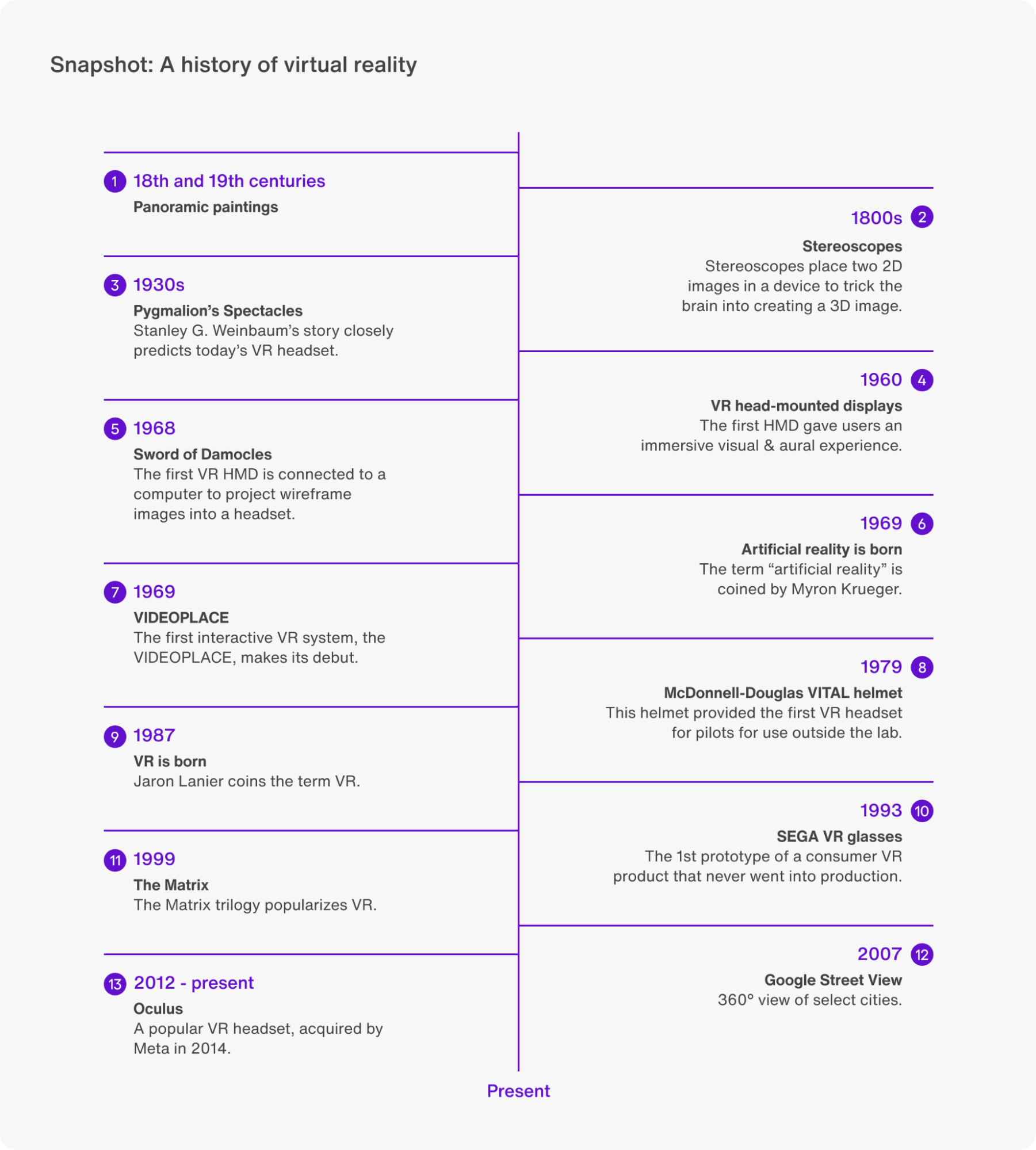
The conceptual origins of virtual reality reside in the mid-20th century, long before the term "virtual reality" became a standard in the consumer lexicon. Morton Heilig, a cinematographer, developed the Sensorama in 1962. This mechanical device was a precursor to modern multisensory VR, featuring a 3D display, vibrating chair, wind, and odors to simulate a motorcycle ride through New York City. While impressive, it lacked interactivity and computer integration.
In 1968, computer scientist Ivan Sutherland created the Sword of Damocles, the first head-mounted display (HMD) connected to a computer. Because of its weight, it had to be suspended from the ceiling, hence the name. Sutherland’s system was the first to demonstrate head tracking—the ability of the display to update the visual perspective as the user moved their head—which remains the cornerstone of all VR technology today.
The Rise of Research and Industrial Application: 1980s to 1990s
The 1980s saw the formalization of the term "Virtual Reality," credited largely to Jaron Lanier. Lanier founded VPL Research, which developed the DataGlove and the EyePhone, marking the first time VR equipment was sold as a commercial product, albeit at prohibitive costs to the public. NASA also played a pivotal role during this era, utilizing VR in their VIEW (Virtual Interactive Environment Workstation) project to train astronauts.
The 1990s represented a period of immense hype followed by a significant "VR winter." Companies like Virtuality launched arcade machines that allowed users to experience 3D gaming, and Nintendo attempted the consumer market with the Virtual Boy in 1995. The Virtual Boy failed commercially due to its monochromatic display, lack of true head tracking, and user reports of discomfort. These failures caused both investors and developers to retreat from the field for nearly a decade, viewing VR as an unattainable dream.
The Modern Renaissance: 2010 to 2025
The modern era of VR began in 2012 when Palmer Luckey launched a Kickstarter campaign for the Oculus Rift. By utilizing advancements in smartphone screen technology (high-resolution, low-persistence OLED displays) and refined inertial measurement units (IMUs), the Rift demonstrated that high-quality VR could be achieved at a consumer price point.
Following Facebook’s acquisition of Oculus in 2014, the industry saw an explosion of competition. HTC and Valve collaborated on the Vive, introducing "room-scale" VR, which allowed users to walk around a physical space tracked by external laser base stations. By 2020, the standalone headset category—pioneered by devices that did not require a tethered PC—began to dominate the market. These systems integrated mobile processing chips and inside-out tracking cameras, removing the friction of complex physical setups.
Comparison of Core VR Evolution Stages
| Era | Primary Tech | Accessibility | Main Limitation |
|---|---|---|---|
| 1960s-70s | Mechanical/Static | Laboratory Only | Massive weight; no tracking |
| 1980s-90s | Early Digital | Niche Professional | High latency; high cost |
| 2010-2015 | PC-Tethered | Enthusiast Market | External sensors; cables |
| 2016-Present | All-in-One HMD | Mass Consumer | Battery life; thermal limits |
Current Technical Requirements and Considerations
In 2026, the barrier to entry for virtual reality is significantly lower than in previous decades, but users must still consider several technical requirements.
Hardware Specifications Modern standalone headsets require internal processing capable of rendering dual-lens stereoscopic video at high frame rates (typically 90Hz to 120Hz). Users opting for PC-VR must ensure their desktop or laptop meets the specific minimum GPU requirements to prevent motion sickness caused by "dropped frames" or input lag.
Physical and Environmental Setup Unlike legacy systems that required external sensors or tripods, contemporary headsets use simultaneous localization and mapping (SLAM) algorithms. These systems track the physical space using cameras built into the headset. However, optimal performance still requires adequate lighting and the absence of highly reflective surfaces (such as mirrors or floor-to-ceiling windows) that can confuse infrared tracking systems.
Health and Safety Extended use of VR can lead to eye strain and vestibular conflict (motion sickness). It is recommended that users start with short, 15-to-20-minute sessions to allow the inner ear to adjust to synthetic motion. Furthermore, users should maintain a cleared physical "guardian zone" to prevent accidental collisions with walls or furniture.
Frequently Asked Questions
Why did early VR attempts fail to achieve mass adoption? Early attempts struggled primarily with technical latency. If the image in the headset does not update within 20 milliseconds of a head movement, the brain perceives a disconnect, resulting in nausea. Technology in the 1990s lacked the processing power to maintain these low-latency thresholds.
What is the difference between tethered and standalone VR? Tethered VR relies on a physical cable to a high-powered computer, allowing for complex graphical fidelity. Standalone VR carries its own CPU, GPU, and battery, providing greater portability at the cost of reduced graphical complexity compared to high-end PCs.
Can virtual reality be used for professional training? Yes. Industries including medicine, aviation, and construction use VR for "simulated high-consequence training." This allows professionals to practice dangerous procedures in a controlled, risk-free environment repeatedly until mastery is achieved.
Does VR require specific internet speeds? If you are playing standalone content, internet is only required for downloads and multi-user services. However, if you are streaming high-fidelity VR from a cloud service, high-speed, low-latency broadband is essential to prevent visual stuttering.
What is the future direction of VR hardware? Current development trends focus on "pancake" optics to reduce the size of the headset, increased pixel density to eliminate the "screen-door effect" (visible pixels), and improved haptic feedback devices to simulate tactile sensations.
Next Steps for Users
If you are considering entering the virtual reality space, begin by assessing your intended use case. If you require high-end simulation or complex gaming, a PC-tethered system remains the gold standard. For the majority of users, current-generation standalone headsets provide the best balance of ease-of-use and graphical capability. Before purchase, ensure your physical living space allows for a safe, cleared area of at least 6 by 6 feet to maximize your range of motion during immersive experiences.
Image Gallery