Insurance Quotes by VIN Number: How to Get Accurate Rates and Fast Coverage
Requesting insurance quotes by VIN number provides the most accurate rate estimates possible by unlocking your vehicle’s exact factory specifications, installed safety features, trim level, and history. Using a 17-character Vehicle Ide...
Requesting insurance quotes by VIN number provides the most accurate rate estimates possible by unlocking your vehicle’s exact factory specifications, installed safety features, trim level, and history. Using a 17-character Vehicle Identification Number allows insurance carriers to eliminate guesswork, auto-populate vehicle details, apply accurate safety discounts, and streamline policy binding.
Contents
What Is a Vehicle Identification Number (VIN) and Why Do Insurers Use It?
A Vehicle Identification Number (VIN) is a unique 17-character alphanumeric code assigned to every motorized vehicle manufactured for road use since the standard was finalized. Much like a human fingerprint or Social Security number, no two vehicles in operation share the exact same VIN.
Insurance underwriters rely on the VIN because broad details like "2022 Honda Civic" do not tell the full financial and risk story of a vehicle. A base trim level with a standard engine carries significantly different repair costs, safety ratings, and theft risks than a high-performance trim equipped with modern advanced driver-assistance systems (ADAS) or turbocharged powertrains.
Sample 17-Digit VIN Structure:
- 1HG: World Manufacturer Identifier (WMI)
- CR2F8: Vehicle Description Section (VDS)
- 3: Check Digit
- C: Model Year
- H: Assembly Plant
- 123456: Serial Number
Decoding the 17-Character Code
Standardized by the National Highway Traffic Safety Administration (NHTSA) in 1981, the 17-character structure breaks down into distinct informational blocks:
- World Manufacturer Identifier (WMI) (Positions 1–3): Identifies the country of origin, manufacturer, and vehicle division. For instance, a VIN beginning with '1', '4', or '5' indicates US manufacture, while '2' denotes Canada, '3' denotes Mexico, and 'J' denotes Japan.
- Vehicle Descriptor Section (VDS) (Positions 4–8): Specifies the vehicle brand, body style, engine size, brake system, and model series.
- Check Digit (Position 9): A mathematically calculated character used to detect fraudulent or mistyped VINs using a formula established by the U.S. Department of Transportation.
- Model Year (Position 10): A standardized letter or number representing the vehicle's production model year.
- Plant Code (Position 11): Indicates the specific assembly facility where the vehicle was constructed.
- Vehicle Identification Section (VIS) (Positions 12–17): The unique production sequence number assigned as the vehicle rolls off the assembly line.
Why Make, Model, and Year Are Not Enough
When you request an auto insurance quote using only the year, make, and model, insurance rating algorithms must make generalized assumptions. An insurer might average the risk profiles across all trim levels of that vehicle family.
By contrast, supplying the full VIN reveals exact factory-installed options. If your vehicle features factory-installed lane departure warnings, automatic emergency braking, adaptive headlights, or advanced anti-theft immobilizers, entering the VIN ensures the rating software applies appropriate discount structures immediately. Conversely, if your car includes high-cost options like carbon-ceramic brakes or custom trim, the VIN alerts the insurer to reflect true replacement cost values accurately.
Key Advantages of Getting Auto Insurance Quotes by VIN
Obtaining auto insurance quotes using a VIN benefits both the consumer and the insurer. It reduces friction during application, speeds up policy generation, and ensures pricing stability.
- Enter 17-Digit VIN
- Automated VIN Decoder
- Safety Features
- Engine & Trim
- Vehicle History
- Precise Premium Quote
Specificity in Safety Equipment and Driver-Assist Tech
Modern vehicles feature varying levels of active and passive safety features. Standard airbags are universal, but advanced driver-assist systems—such as forward-collision warnings, blind-spot monitoring, and rear cross-traffic alert systems—differ between packages.
Because safety packages are encoded into the Vehicle Descriptor Section of the VIN, entering the number auto-fills these parameters. Insurers frequently offer discounts ranging from 5% to 15% on specific coverage lines (such as Medical Payments or Personal Injury Protection) for vehicles equipped with proven collision-mitigation systems.
Precise Engine Options and Performance Classifications
A single car model line may offer engine variants ranging from an economical 1.5-liter four-cylinder to a 3.0-liter turbocharged engine. Performance output correlates directly with historical claims frequency and accident severity statistics.
Without a VIN, an quote tool might quote you for the highest-performing trim by default or underquote you, only to raise your premium after underwriters inspect the registration. Using a VIN prevents quote shock by establishing the precise powertrain profile up front.
Instant Vehicle History and Title Verification
When you submit a VIN, insurance rating systems instantly query national vehicle databases. These checks confirm whether the vehicle holds a clean title, a salvage certificate, a rebuilt title, or a flood damage designation.
Knowing the title status early prevents scenarios where a policy is written on a car that the company refuses to cover under Comprehensive or Collision policies due to prior total-loss history.
Eliminating Rate Adjustments at Policy Binding
A common complaint among auto insurance shoppers is receiving an initial quote online, only to see the monthly payment rise by $20 to $50 after purchasing the policy. This price jump usually occurs because the carrier run a final VIN check right before binding, discovering missing details like a higher trim level or additional safety equipment. Providing your VIN during the initial estimate guarantees that the rate you are quoted is the rate you pay.
Where to Find Your Vehicle Identification Number
If you are shopping for coverage on a vehicle you already own or are actively inspecting at a dealership, finding the VIN takes only a few seconds.
- Windshield: Driver Side Dash (visible from outside)
- 1HGCR2F83CH123456
- Door Frame: Driver Door Jamb (inner door pillar sticker)
- 1HGCR2F83CH123456
Physical Locations on the Vehicle
- Dashboard (Driver's Side): Look through the lower driver's side corner of the front windshield from outside the vehicle. The VIN is stamped on a metal plate secured to the dash panel.
- Driver’s Side Door Pillar: Open the driver's door and inspect the door jamb (the post where the door latches when closed). A federal safety certification sticker containing the VIN, tire inflation ratings, and weight limits is affixed here.
- Engine Block: Under the hood, some manufacturers stamp the VIN onto the front of the engine block or the firewall dividing the engine compartment from the passenger cabin.
- Spare Tire Well or Frame Rail: On older pickup trucks or body-on-frame SUVs, the VIN may be stamped directly onto the rear frame rail or inside the trunk under the spare tire compartment carpet.
Official Documents and Paperwork
If you do not have physical access to the vehicle, you can locate the VIN on official records, including:
- Vehicle Title Certificate (Certificate of Title)
- State Registration Card or License Plate Renewal Notice
- Current or Expiring Insurance Declarations Page
- Auto Financing Contract or Vehicle Sales Agreement
- Vehicle History Reports (such as Carfax or AutoCheck)
Step-by-Step: How to Get an Insurance Quote Using a VIN
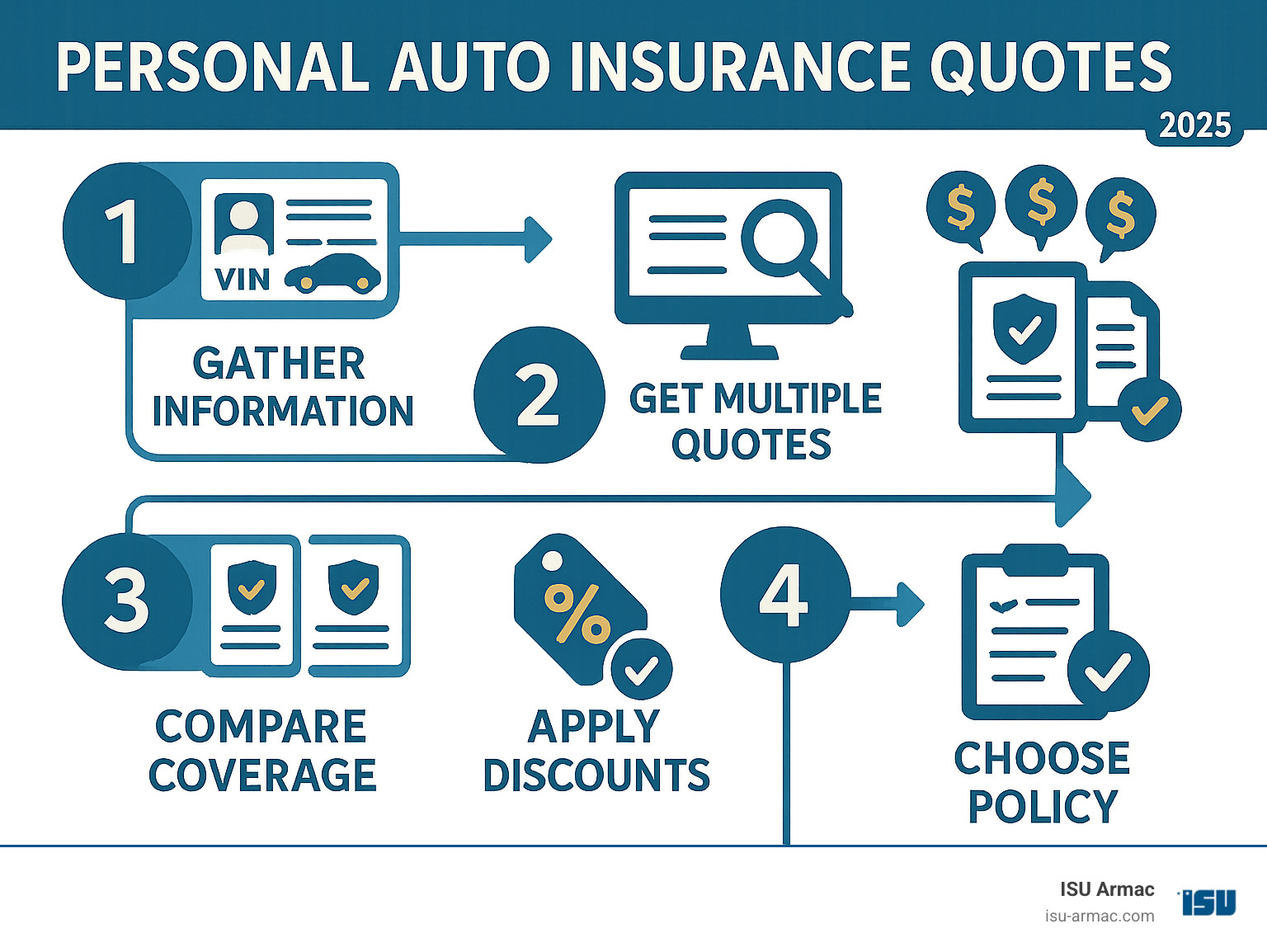
Getting an insurance quote with a VIN follows a straightforward workflow whether completed online, through a digital app, or over the phone with an independent agent.
- Step 1: Gather VIN, Driver License Number, and Address
- Step 2: Input 17-Digit VIN into Insurer's Rate Engine
- Step 3: Verify Auto-Populated Trim, Engine, and Safety Features
- Step 4: Select Coverage Limits, Deductibles, and Add-ons
- Step 5: Finalize Underwriting Checks and Bind Policy
Step 1: Gather Driver and Vehicle Information
Collect your 17-character VIN along with basic driver profile details, including your driver's license number, current residential address, primary vehicle use (commuting, pleasure, or business), and estimated annual mileage.
Step 2: Input the VIN into Rate Quote Tools
Navigate to the insurer’s quote platform or provide the code to your insurance broker. Type or speak all 17 characters carefully. Remember that standard VINs never contain the letters I, O, or Q to avoid confusion with the numbers 1 and 0.
Step 3: Verify the Auto-Populated Details
Once entered, the insurer's system will query its internal database and automatically populate fields such as Year, Make, Model, Trim Package, Body Type, and Engine Size. Review these fields to ensure the system correctly identified your vehicle variant.
Step 4: Select Coverage Limits and Deductibles
Choose your desired coverage structure. This includes mandatory state Liability limits (Body Injury and Property Damage), plus optional coverages:
- Collision Coverage: Pays to repair your car following an accident, subject to your deductible.
- Comprehensive Coverage: Protects against non-collision damage such as theft, vandalism, weather, fallen trees, or striking an animal.
- Uninsured/Underinsured Motorist: Covers medical expenses and physical damage if hit by an uninsured driver.
- Roadside Assistance and Rental Reimbursement: Optional riders for transportation relief during covered repairs.
Step 5: Finalize and Bind the Policy
Because you entered a valid VIN up front, the insurer can run real-time background checks, verify ownership or lienholder records, and generate a final policy contract. Once payment is made, your coverage is active (bound), and your official insurance card is issued containing the verified VIN.
Comparison: VIN vs. Non-VIN Auto Insurance Quotes
The table below highlights the practical differences between requesting an insurance quote with a full 17-character VIN versus relying on general Year, Make, and Model selections:
| Comparison Metric | Quote Without VIN (Year / Make / Model) | Quote With 17-Digit VIN Number |
|---|---|---|
| Pricing Accuracy | Estimated baseline; subject to change before policy binding. | Fully binding and accurate to factory specifications. |
| Trim & Option Recognition | Broad defaults used; optional trim packages missed. | Pinpoints exact trim levels, engine sizes, and factory options. |
| Safety Discount Application | Requires manual selection of safety features by user. | Automatically detects ADAS, anti-theft, and airbag systems. |
| Title Status Detection | Undetected until full underwriting check is run. | Flagged immediately (e.g., Salvage, Rebuilt, Clean). |
| Time to Bind Policy | Slower; requires VIN entry and recalculation at checkout. | Instant binding capability; immediate binder issuance. |
| Risk of Rate Shock | High; final rate often increases by 5%–20% after VIN entry. | Minimal; price quoted matches final policy charge. |
How Insurance Carriers Use VIN Data to Calculate Rates
Insurance pricing models do not treat vehicles in isolation; they evaluate your specific car against vast statistical datasets. The VIN serves as the primary key to query these database metrics.
- 17-Character VIN Number
- ISO Loss Rating System
- NICB Stolen Vehicle Database
- NHTSA Safety & Crash Testing Data
- Final Insurance Premium
The ISO Vehicle Rating System
Most U.S. insurers use rating schedules maintained by organizations like Insurance Services Office (ISO). ISO assigns symbols (numerical values) to every vehicle trim level based on historical claims data.
These symbols represent two risk categories:
- Damageability and Repair Costs: How easily the vehicle sustains damage and how expensive replacement parts and specialized labor are. High-end aluminum body panels or specialized sensor-laden bumpers yield higher ISO collision numbers.
- Liability and Injury Risk: The extent of injuries sustained by occupants of other vehicles when struck by your model. Large SUVs may carry higher liability symbols due to the damage they can inflict on smaller sedans.
Anti-Theft Databases and NICB Tracking
Insurers cross-reference VINs with databases managed by the National Insurance Crime Bureau (NICB) to track vehicle theft trends. If a VIN indicates an anti-theft engine immobilizer, active GPS tracking, or smart keys, underwriters discount the Comprehensive coverage premium.
If the vehicle appears in the NICB database as an unrecovered stolen vehicle, the underwriting system immediately flags the policy application to block fraudulent filings.
Getting a VIN Insurance Quote Before Buying a Used or New Car
Shopping for insurance before finalizing a car purchase is a smart financial strategy. It ensures that insurance costs fit within your total household vehicle budget.
- Shopping for a Vehicle
- New Car at Dealership
- Get Window Sticker/VIN
- Request Instant Quote
- Bind Coverage before drive
- Used Car from Private/Dealer
- Copy VIN from online listing
- Run VIN quote & check title
- Confirm full coverage eligibility
- New Car at Dealership
Shopping Used Cars via Online Listings
When browsing pre-owned vehicles on digital marketplaces, reputable sellers list the full 17-character VIN directly in the posting details. Copy this code into an online insurance quote generator to evaluate how switching to that vehicle affects your monthly bill before making an offer.
Dealing with Dealership Sales
Automotive dealerships require proof of active insurance covering the new vehicle before allowing you to drive off the lot. You can request a VIN quote while working with the finance manager. Once you agree on sales terms, contact your insurer, provide the VIN, and add the car to your policy immediately.
What to Do If You Don't Have the VIN Yet
If you are deciding between multiple vehicles and do not have a specific VIN:
- Run preliminary quotes using the exact year, make, model, and trim line.
- Ask the dealership or seller to text or email a photo of the VIN door sticker.
- Understand that while preliminary quotes offer a baseline, your final payment amount will lock in only after the exact VIN is processed.
Special Cases and Troubleshooting VIN Quotes
While most VIN quotes proceed seamlessly, certain vehicle types and documentation anomalies require extra attention.
Classic Cars and Pre-1981 Vehicles
Vehicles manufactured prior to 1981 do not adhere to the modern 17-character standard. These older cars use chassis numbers or VIN formats ranging from 5 to 14 characters. Standard online insurance quote engines often throw an "Invalid VIN" error when these codes are entered.
Solution: If you are insuring a classic or vintage vehicle, request a quote through specialized classic auto insurance carriers (such as Hagerty or Grundy) or call a traditional carrier's underwriting desk directly so an representative can input the custom identifier manually.
Salvage and Rebuilt Titles
If a vehicle was declared a total loss by an insurance company and subsequently repaired, it receives a Salvage or Rebuilt title status.
- Vehicle Totaled by Insurer
- Issued Salvage Title
- Vehicle Repaired & Inspected
- Issued Rebuilt Title
- Insurable: Liability Only (Collision/Comp usually blocked)
Entering a rebuilt vehicle’s VIN will alert the carrier’s system. While most standard carriers offer state-mandated Liability coverage for rebuilt title vehicles, many refuse to write Comprehensive and Collision coverage due to uncertain structural integrity or pre-existing damage issues.
Imported and Gray-Market Vehicles
Vehicles manufactured for international markets (such as Japanese Domestic Market or European spec imports) may lack standard U.S. DOT-compliant VIN structures or might not be indexed in domestic insurance rating software. Insuring these vehicles usually requires specialized imported-car coverage or direct manual underwriting approval.
Frequently Asked Questions
Can I get an accurate auto insurance quote without a VIN?
You can receive a helpful estimate without a VIN by specifying the year, make, model, and trim level. However, this estimate is not guaranteed. The final premium can change when you submit the 17-digit VIN at policy binding, as the VIN reveals exact factory-installed options, safety gear, and title history.
Is it safe to share my VIN number when getting an insurance quote?
Yes, sharing your VIN is entirely safe. A VIN is public information displayed on your vehicle’s dashboard and recorded on public state motor vehicle registries. It cannot be used by unauthorized individuals to access your personal identity, financial details, or bank accounts.
Why did my insurance price change after I entered the VIN?
Price adjustments occur because the VIN unlocks precise details missing from basic year-make-model selections. If the VIN reveals a higher-performance engine, expensive option packages, missing safety tech, or a history of title brands (such as a rebuilt designation), the rating system updates the premium to match that specific risk profile.
Does running a VIN insurance quote affect my credit score?
No. Requesting an insurance quote requires only a soft credit inquiry (soft pull) to check your insurance-based credit score where permitted by law. Soft inquiries do not lower or impact your hard credit score in any way.
What should I do if an insurance system says my VIN is invalid?
First, check for common transcription errors: verify that you have not typed the letters I, O, or Q, which are never used in standard VINs. If the number is typed correctly, the vehicle may be a pre-1981 model, a grey-market import, or a brand-new model year that has not yet been updated in the carrier's VIN decoding database. Contact customer service to complete the quote manually.
Practical Next Steps for Securing Your Policy
To get the best rate on your auto insurance with a VIN, follow these practical steps:
- Locate the Exact VIN: Inspect the driver's side dashboard, door jamb sticker, or registration paperwork to confirm all 17 characters.
- Gather Multiple Quotes: Use the same 17-digit VIN across at least three different insurance carriers or consult an independent broker to compare coverage offerings accurately.
- Review Auto-Populated Features: Double-check that all factory safety equipment—such as passive restraints, anti-theft alarms, and driver-assist sensors—is correctly detected by the insurer's software to claim all eligible discounts.
- Confirm Title Eligibility: If shopping for a used vehicle, ensure the VIN check confirms a clean title before relying on quotes for full Comprehensive and Collision coverage.
- Bind Coverage Early: Lock in your quote by binding the policy with the confirmed VIN before finalizing a car purchase or driving off the dealer lot.
Disclaimer: Insurance regulations, policy terms, and underwriting guidelines vary by state and carrier. This article provides educational information and does not constitute formal financial or legal advice. Consult a licensed insurance agent or broker for guidance tailored to your specific vehicle and coverage needs.
Image Gallery