How to Choose an Auto Scrubber Floor Machine
Choosing the right auto scrubber requires evaluating your facility's total square footage, floor surface textures, aisle widths, and daily cleaning windows. By matching the machine's drive type, deck style, battery technology, and tank...
Choosing the right auto scrubber requires evaluating your facility's total square footage, floor surface textures, aisle widths, and daily cleaning windows. By matching the machine's drive type, deck style, battery technology, and tank capacity to your specific operational environment, commercial facility managers can maximize cleaning efficiency while significantly reducing overall labor and equipment maintenance costs.
Contents
Auto Scrubber Operating Principles and Machine Classes
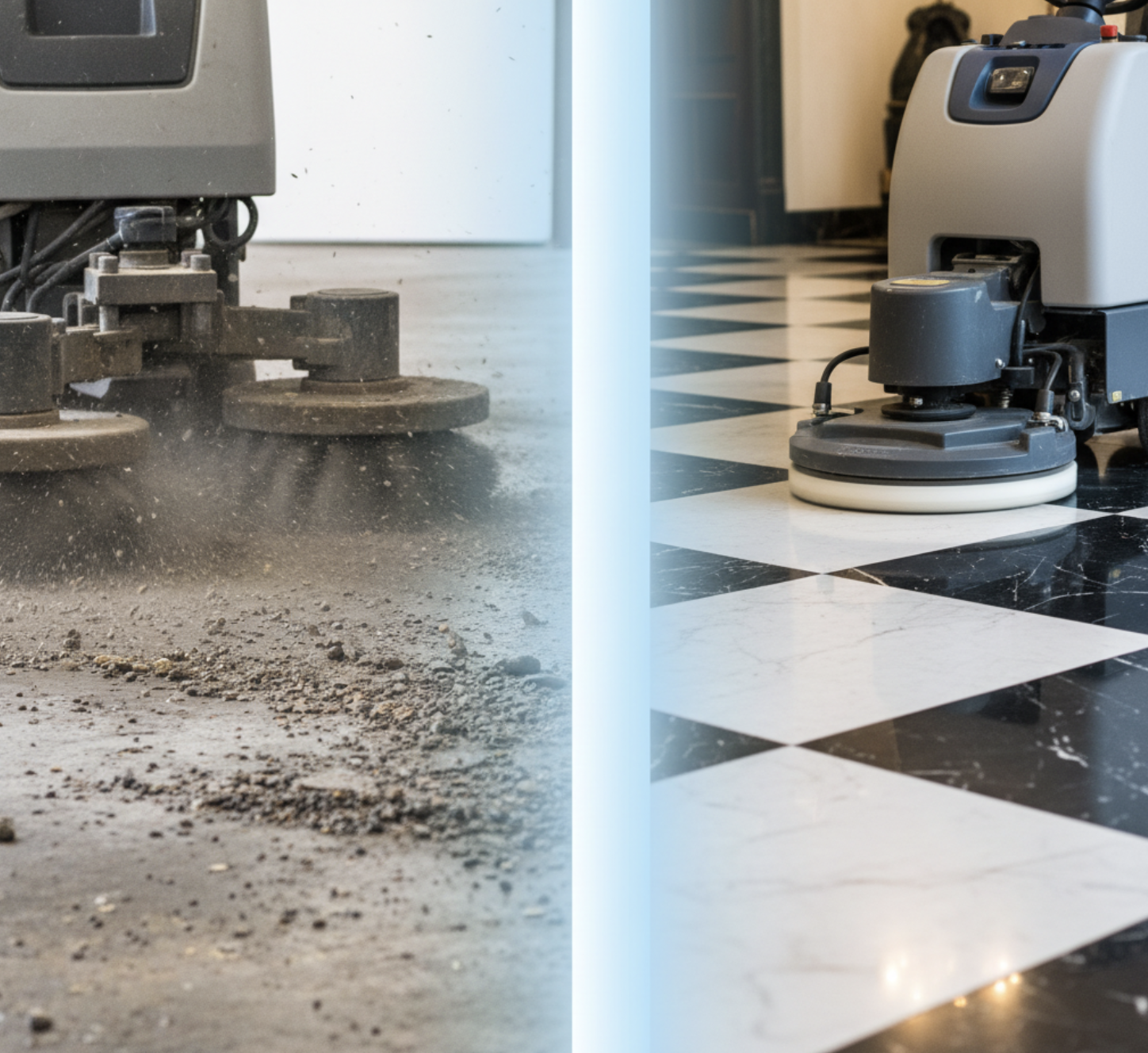
An automatic floor scrubber (or auto scrubber) consolidates three distinct janitorial tasks into a single pass: dispensing water and cleaning detergent, mechanically agitating the floor to loosen soil, and vacuuming the dirty slurry into a recovery tank via a rear squeegee assembly. Replacing manual mop-and-bucket systems with an automated unit drastically improves floor hygiene, reduces drying time, and lowers slip-and-fall hazards in commercial and industrial settings.
Selecting the proper machine category depends primarily on the square footage of the space, architectural layout, and obstacle density. Auto scrubbers generally fall into four operational categories:
Micro and Compact Walk-Behind Scrubbers
Designed for tight quarters, narrow aisles, and spaces previously accessible only with manual mops. Micro scrubbers typically feature scrubbing paths between 13 and 20 inches and tank capacities under 10 gallons. They offer maximum maneuverability around restroom fixtures, retail displays, and office furniture.
Mid-Size to Large Walk-Behind Scrubbers
Featuring scrub paths ranging from 20 to 32 inches and tank capacities from 10 to 30 gallons, these units serve as workhorses for medium-sized facilities like schools, healthcare clinics, and grocery stores. They are available in traction-drive (motor propelled) or pad-assist models (where the rotation of the cleaning pad pulls the machine forward).
Ride-On Floor Scrubbers
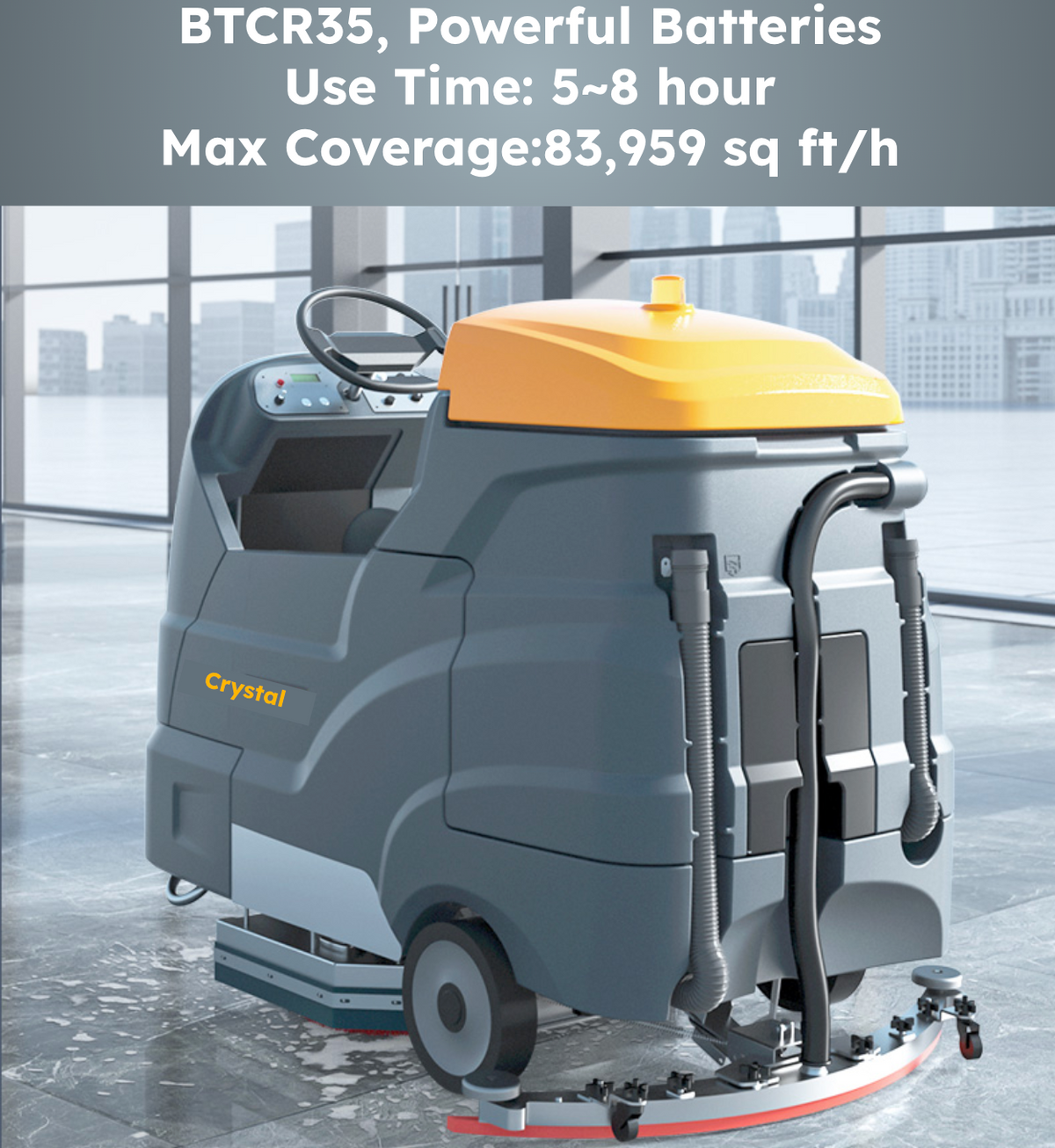
Built for large-scale operations such as warehouses, distribution centers, airports, and large retail centers. Ride-on models feature scrubbing paths from 26 to 48 inches and tank capacities exceeding 30 to 75 gallons. By replacing operator walking speed with motorized transport (up to 4–5 mph), ride-on scrubbers dramatically increase theoretical productivity rates per hour.
Autonomous Mobile Robot (AMR) Scrubbers
Equipped with LiDAR, optical cameras, and sensor arrays, robotic auto scrubbers execute pre-mapped cleaning routes without continuous operator intervention. While requiring higher initial capital investment, AMR units allow facilities staff to reallocate labor hours toward detail cleaning, sanitization, and maintenance tasks.
Deck Types: Disc, Cylindrical, and Orbital
The scrubbing deck houses the drive motor and agitating attachments. Choosing the correct deck configuration depends directly on your facility's floor materials and dirty load conditions.
- DISC DECK: Smooth floors (VCT, Polished Concrete)
- CYLINDRICAL DECK: Rough/Textured floors (Eliminates sweeping)
- ORBITAL DECK: Chemical-free stripping & low water use
Disc Decks
Disc decks utilize flat, rotating circular pads or brushes (spinning at approximately 150 to 300 RPM). They are the most common and cost-effective choice for smooth, level surfaces such as vinyl composition tile (VCT), smooth finished concrete, and linoleum.
- Strengths: Low replacement accessory costs, high down-pressure for deep cleaning, and wide versatility in pad aggressiveness (from soft polishing pads to aggressive stripping pads).
- Limitations: Require pre-sweeping to prevent solid debris from clogging the squeegee assembly or dragging across polished surfaces.
Cylindrical Decks
Cylindrical decks use two counter-rotating tube-shaped brushes that spin at significantly higher speeds (typically 600 to 1,500 RPM).
- Strengths: Integrated wet-sweeping functionality. The counter-rotating movement channels light solid debris (such as small screws, wood chips, paper scraps, or gravel) into an internal tray while scrubbing. This eliminates the need for separate pre-sweeping, making cylindrical decks ideal for manufacturing plants, grouted tile corridors, and rough textured concrete.
- Limitations: Brush replacements are generally more expensive than disc pads, and down-pressure is distributed over a narrower contact strip.
Orbital Decks
Orbital (or rectangular vibrating) decks combine high-speed micro-oscillations (around 2,000 to 2,250 RPM) with a small orbital stroke radius.
- Strengths: Exceptional water and chemical efficiency. The rapid orbital motion holds cleaning solution under the pad rather than slinging it outward. Furthermore, when fitted with top-prep pads, orbital scrubbers can strip acrylic floor finish using only water, eliminating the need for hazardous chemical strippers.
- Limitations: Higher initial machine cost and specialized pad requirements.
Power Source Selection: Corded, Lead-Acid, and Lithium-Ion
Power source selection dictates run time, charging logistics, maintenance overhead, and total cost of ownership.
Corded Electric (AC Power)
- Best for: Small, open footprint facilities with continuous access to power outlets.
- Pros: Unlimited run time, lowest initial purchase cost, no battery maintenance or replacement expenses.
- Cons: Operation limited by cord length (typically 50–75 feet), tripping hazard, difficult to maneuver around complex obstacles.
Flooded Lead-Acid (FLA) Batteries
- Best for: Budget-conscious operations with established maintenance routines.
- Pros: Economical upfront cost, proven reliability across decades of industrial use.
- Cons: Requires regular watering (distilled water topped off post-charging), off-gas venting during charging (requiring dedicated charging stations), and vulnerable to premature failure if discharged below 20% capacity or left uncharged. Typical lifespan: 500–800 charge cycles.
Sealed AGM / Gel Batteries
- Best for: Facilities seeking maintenance-free operation without off-gassing concerns.
- Pros: Zero fluid maintenance, no liquid spill risks, safe for use around food processing and healthcare environments.
- Cons: Moderate upfront cost, lower energy density compared to lithium, vulnerable to damage if improperly charged. Typical lifespan: 600–1,000 charge cycles.
Lithium-Iron Phosphate (LiFePO4) Batteries
- Best for: Multi-shift operations, high-use industrial plants, and facilities targeting lowest lifetime cost.
- Pros: Supports opportunity charging (fast partial charges during employee breaks) without battery memory degradation, zero maintenance, constant voltage output throughout the discharge cycle, and exceptionally long service life (2,000–3,500+ cycles).
- Cons: Significantly higher initial purchase price, requiring specialized onboard or external smart chargers.
Performance Metrics and Sizing Guidelines
To select the correct size, calculate your facility's net scrubbable square footage (total footprint minus built-in fixtures, racking, and furniture) and establish your allocated daily cleaning timeframe.
Theoretical coverage rates provided by manufacturers measure continuous straight-line operation. Real-world (practical) productivity is typically 40% to 60% lower due to turns, obstacle navigation, operator training, and time spent filling and draining tanks.
$$\text{Theoretical Productivity Rate (sq ft/hr)} = \frac{\text{Scrub Width (inches)} \times \text{Speed (mph)} \times 5,280}{12}$$
Machine Class Specification Comparison
| Machine Category | Scrub Path Width (Inches) | Tank Capacity (Gallons) | Avg. Practical Coverage (Sq Ft/Hr) | Primary Power Options | Ideal Facility Size (Sq Ft) |
|---|---|---|---|---|---|
| Micro Walk-Behind | 13" – 17" | 3 – 8 Gal | 4,000 – 8,000 | Corded / Compact Li-ion | Under 10,000 |
| Mid-Size Walk-Behind | 20" – 26" | 10 – 20 Gal | 12,000 – 22,000 | AGM / Lead-Acid / Li-ion | 10,000 – 40,000 |
| Large Walk-Behind | 28" – 32" | 22 – 30 Gal | 20,000 – 30,000 | AGM / Lead-Acid / Li-ion | 30,000 – 70,000 |
| Compact Ride-On | 26" – 32" | 25 – 40 Gal | 30,000 – 45,000 | Lead-Acid / Li-ion | 50,000 – 120,000 |
| Industrial Ride-On | 36" – 48" | 50 – 85+ Gal | 50,000 – 90,000+ | Heavy-Duty Li-ion / Industrial FLA | 100,000+ |
| Robotic (AMR) | 20" – 32" | 15 – 35 Gal | 10,000 – 25,000 (Autonomous) | High-Capacity Li-ion | 30,000 – 150,000+ |
Essential Features and Components to Evaluate
When comparing specific auto scrubber models, evaluate the quality and serviceability of the following critical subsystems:
- Squeegee Assembly
- Parabolic shape
- Toolless removal
- Linatex/Gum rubber
- Tank/Slurry Management
- Drain hoses
- Debris tray
- Smooth interiors
- Motor & Noise Controls
- Low dBA rating
- Eco-modes
- Sealed motors
1. Squeegee Assembly and Vacuum Recovery
The squeegee mechanism determines how dry the floor remains post-scrubbing.
- Shape: Parabolic or L-shaped squeegees encircle the scrubbing deck better than straight squeegees, preventing water trails during sharp turns.
- Blade Material: Gum rubber offers excellent suction on smooth indoor surfaces but wears quickly on rough concrete; Linatex provides superior tear resistance and chemical tolerance; Urethane is best for oily industrial environments.
- Toolless Replacement: Look for squeegees designed with quick-release latches so operators can flip or replace blades without shop tools.
2. Detergent Dosing and Water Control Systems
Modern scrubbers feature automatic chemical dilution systems that inject detergent directly into the solution line based on water flow rate. This prevents over-use of cleaning chemicals, eliminates residue buildup on floors, and saves money. Eco-mode settings reduce water and power output during light maintenance cleaning.
3. Tank Design and Serviceability
Dirty slurry contains bacteria, grit, and organic matter. Ensure both solution and recovery tanks are accessible for cleaning:
- Drain Hoses: High-mounted, pinch-flow drain hoses allow operators to control discharge rate into drain sinks or floor drains.
- Debris Shut-Off: Float shut-off screens or electronic sensors prevent dirty foam and water from entering the vacuum fan motor.
- Clean-out Accessibility: Recovery tanks should have large opening lids or tilt-out designs for thorough flushing to eliminate odors and sludge buildup.
4. Sound Levels (dBA)
For environments operating during business hours—such as hospitals, libraries, and schools—select machines with operating noise levels below 65 dBA (or units offering a dedicated quiet mode operating under 60 dBA).
Step-by-Step Selection Workflow
To select the ideal floor scrubber, follow this systematic evaluation process:
- Step 1: Audit Facility Floor
- Step 2: Calculate Doorways/Aisles
- Step 3: Determine Duty Cycle
- Step 4: TCO Calculation
Step 1: Audit Floor Surface Types and Soil Levels
Classify your facility's flooring types (e.g., polished concrete, textured epoxy, terrazzo, VCT, or ceramic tile). Select a disc deck for smooth surfaces, a cylindrical deck for rough surfaces with loose light debris, or an orbital deck if chemical-free finish removal is desired.
Step 2: Measure Clearances and Elevator Capacities
Measure the narrowest doorways, checkout lanes, elevator door clearances, and ramp inclines. Ensure the machine’s total width (note that the rear squeegee is wider than the scrub path) can safely pass through all access corridors and fit onto service elevators.
Step 3: Determine Operational Duty Cycle and Power Needs
Calculate how many continuous hours the machine will run each day. If scrubbing across multiple shifts without long downtime intervals for charging, prioritize Lithium-ion power with fast chargers to support opportunity charging during shift breaks.
Step 4: Calculate Total Cost of Ownership (TCO)
Do not base your decision solely on initial machine purchase price. Calculate TCO over a 5-year operational window:
$$\text{TCO} = \text{Purchase Price} + \text{Battery Servicing/Replacement} + \text{Consumables (Pads, Squeegees, Detergent)} + \text{Maintenance Labor} - \text{Saved Cleaning Labor}$$
Because labor accounts for approximately 80% to 85% of total commercial floor maintenance expenses, investing in a wider walk-behind, ride-on, or autonomous scrubber that drastically cuts labor hours typically yields a rapid return on investment (ROI).
Frequently Asked Questions
What is the main difference between a disc scrubber and a cylindrical scrubber?
Disc scrubbers use flat pad drivers or round brushes rotating parallel to the floor, making them ideal for smooth surfaces and high down-pressure stripping. Cylindrical scrubbers use horizontal tube brushes spinning at high speeds in opposite directions; they wet-sweep small solid debris into an internal tray while scrubbing, eliminating the need to pre-sweep textured or dirty industrial floors.
How do I calculate the right size auto scrubber for my facility?
Determine your total scrubbable square footage (excluding fixed equipment and walls) and divide it by your target cleaning window (in hours). Compare this required square-foot-per-hour rate against the practical productivity ratings of scrubbers, ensuring you select a model whose clear passage width fits through your narrowest doorways and aisles.
Are lithium-ion batteries worth the higher upfront cost in floor scrubbers?
For multi-shift operations, high-frequency cleaning schedules, or facilities without dedicated battery watering staff, lithium-ion batteries are generally worth the investment. They eliminate daily watering maintenance, support fast opportunity charging during worker breaks, maintain consistent motor power throughout the charge cycle, and offer up to three to four times the total cycle lifespan of traditional lead-acid batteries.
How often do squeegee blades and scrubbing pads need to be replaced?
Floor scrubbing pads typically require replacement after 50,000 to 100,000 square feet of use, depending on floor roughness and down-pressure. Squeegee blades can typically be rotated to use all four edges before replacement; gum rubber blades usually last 60 to 90 days under daily use, while durable Linatex or urethane blades can last 6 to 12 months under standard conditions.
Can an auto scrubber strip floor finish without using chemicals?
Yes, when equipped with a high-speed orbital deck and specialized surface preparation pads (SPP), an auto scrubber can strip layers of acrylic floor finish using only clean water. This process eliminates chemical fumes, reduces slip hazards for operators, lowers supply costs, and shortens project completion times.
Strategic Recommendation and Next Steps
To make an optimal equipment purchase:
- Schedule On-Site Demonstrations: Invite regional distributors to bring candidate machines to your site. Test the scrubber on your worst-case floor surfaces, ramps, and narrow bottlenecks.
- Verify Water Recovery: Inspect floor dryness immediately behind the squeegee during turns. A high-quality machine should leave the path dry enough for safe foot traffic within seconds.
- Review Service and Spare Parts Availability: Confirm local technician response times, planned maintenance agreement costs, and component availability for critical consumables like vacuum motors, squeegees, and drive belts.
Image Gallery