A Comprehensive Guide to Renting a Car in Munich, Germany in 2026
Renting a car in Munich provides the ultimate freedom to explore the Bavarian capital and the nearby Alps. To secure a vehicle in 2026, you must present a valid driver’s license, a credit card for the security deposit, and typically an...
Renting a car in Munich provides the ultimate freedom to explore the Bavarian capital and the nearby Alps. To secure a vehicle in 2026, you must present a valid driver’s license, a credit card for the security deposit, and typically an International Driving Permit if you are a non-EU resident. Booking in advance at Munich Airport or the Central Station ensures the best rates and vehicle availability.
Contents
Munich serves as the premier gateway to Southern Germany. Whether you are visiting for the world-renowned Oktoberfest, traveling for business at the Messe München, or planning a scenic drive toward Neuschwanstein Castle, a rental car offers a level of flexibility that public transport cannot match. However, navigating the German rental market requires an understanding of specific legal requirements, insurance nuances, and local driving etiquette that differs significantly from North American or other European standards.
Primary Rental Hubs in Munich
When planning your arrival in Munich, selecting the right pickup location is the first step in optimizing your budget and itinerary. Munich offers several high-volume rental hubs, each with distinct advantages.
Munich Airport (MUC)
As of 2026, Munich Airport remains one of the most efficient rental locations in Europe. The Car Rental Center (Mietwagenzentrum) is centrally located just outside Terminal 1 and a short walk from Terminal 2 via the MAC (Munich Airport Center). Nearly all major international brands—including Sixt, Europcar, Hertz, and Avis—operate desks here.
The primary benefit of an airport pickup is the massive inventory. You are more likely to find specific vehicle classes, such as premium German sedans or electric vehicles (EVs) with high-capacity batteries. However, be aware that rentals originating at the airport are subject to a "Premium Location Supplement" (Servicegebühr), which can add roughly 20% to the base rental price.
Munich Central Station (Hauptbahnhof)
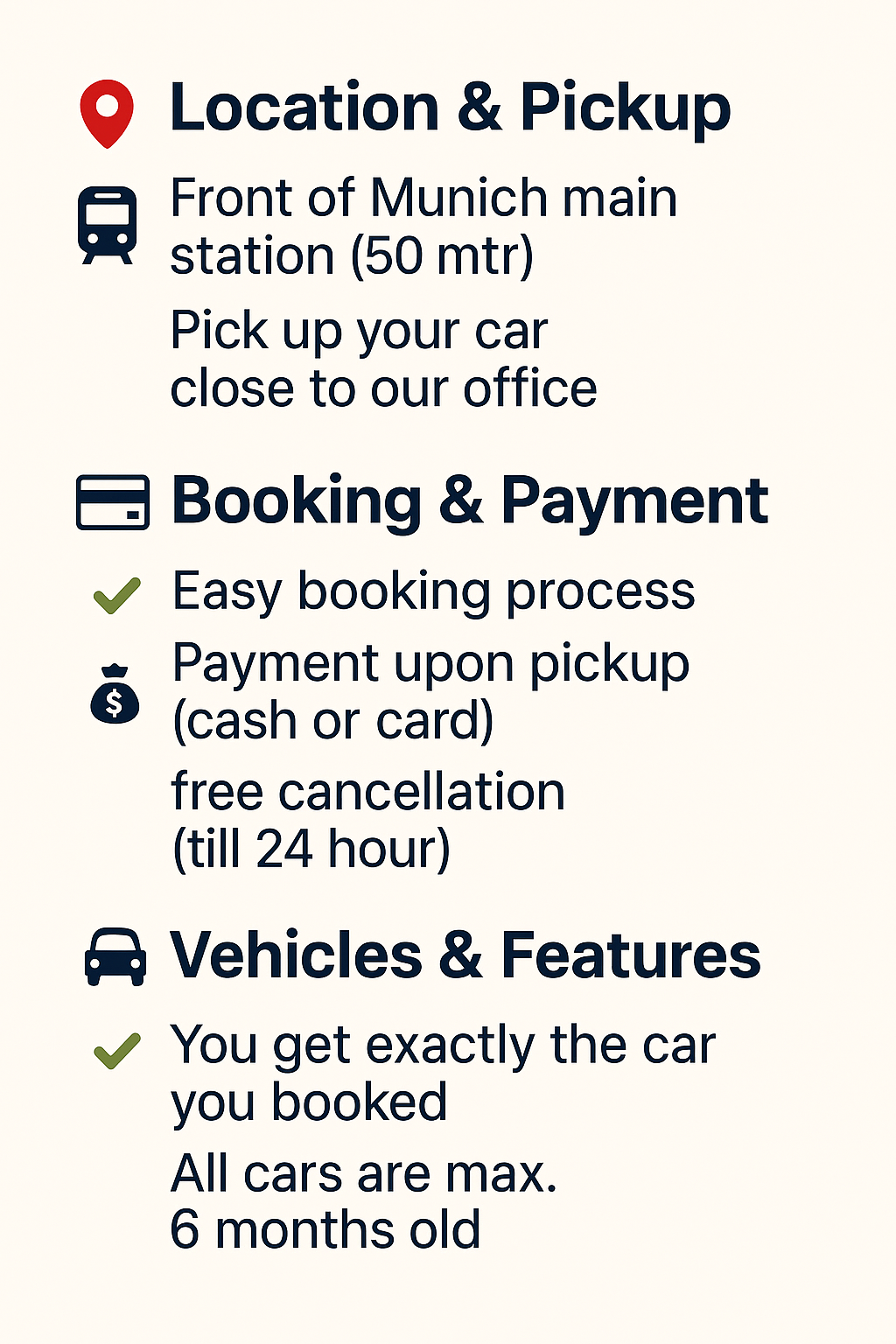
For those arriving by ICE high-speed train, the Munich Central Station is the most logical pickup point. The rental desks are located in the main concourse and the mezzanine levels. Picking up a car here allows you to bypass airport surcharges, though you must navigate the dense traffic of Munich’s inner city immediately upon departure. In 2026, construction around the Hauptbahnhof area continues to impact traffic flow, so ensure your rental includes an updated GPS system to navigate road closures.
Neighborhood and Downtown Offices
If you are already staying in the city, consider renting from a neighborhood branch in areas like Schwabing, Laim, or near the Ostbahnhof. These locations often offer the lowest daily rates because they lack the premium facility fees associated with airports and train stations. They are ideal for travelers who only need a car for a day trip to the mountains rather than their entire stay.
Essential Legal Requirements and Documentation
Germany maintains strict standards for vehicle operation. Failing to provide the correct documentation at the rental counter will result in a denied rental without a refund.
Driver’s License and International Driving Permit (IDP)
If you hold a driver’s license issued by an EU or EEA member state, your physical license is sufficient. For travelers from the United States, Canada, Australia, and other non-EU countries, the legal requirement is more nuanced. While some rental agents may only ask for your domestic license, German law technically requires an International Driving Permit (IDP) alongside your original license. The IDP serves as a certified translation of your credentials. In the event of a police stop or an accident, failure to produce an IDP can lead to fines or complications with insurance claims.
Minimum Age and Young Driver Surcharges
In 2026, the legal driving age in Germany remains 18, but rental companies set their own thresholds. Most providers require drivers to be at least 21 years old for economy models and 25 or even 30 for high-performance luxury vehicles (such as BMW M-series or Porsche models). Drivers under the age of 25 should expect a "Young Driver Surcharge," which can range from €10 to €25 per day.
Credit Card Requirements
A physical credit card in the primary driver’s name is mandatory. Rental companies use this to "block" a security deposit, which typically ranges from €500 to €2,000 depending on the vehicle class. Debit cards are increasingly accepted by some budget brands, but they often require the purchase of the rental company’s most expensive "Super Cover" insurance to waive the deposit requirement. Always verify the specific card policy of your chosen provider before arrival.
Understanding Insurance and Coverage Options
Navigating German insurance terminology is critical to avoiding unexpected costs at the end of your trip.
Third-Party Liability (Haftpflichtversicherung)
In Germany, basic third-party liability insurance is mandatory by law and is always included in the quoted rental price. This covers damage to other people’s property or injuries to third parties.
Collision Damage Waiver (CDW) and Theft Protection
Most standard quotes include a Collision Damage Waiver (CDW) with a high deductible (Selbstbeteiligung). In 2026, standard deductibles for an economy car often start at €900. If the car is damaged, you are responsible for costs up to that amount.
To reduce this risk, you can opt for "Excess Reduction" or "Zero Excess" coverage. While purchasing this directly from the rental counter is the most convenient—allowing you to walk away from any damage—it is also the most expensive option. Many premium credit cards (such as those from American Express or Chase) provide primary or secondary rental insurance that covers the deductible. However, if you rely on credit card insurance, you must decline the rental company's CDW, and the rental company will likely block a significantly higher deposit on your card.
Vehicle Categories and Comparison
Choosing the right car for Munich depends on whether you are staying within city limits or heading to the winding roads of the Bavarian Forest.
| Vehicle Category | Best For | Typical Features | Estimated Daily Cost (2026) |
|---|---|---|---|
| Economy/Compact | City driving and solo travelers | VW Polo, Opel Corsa; Manual/Auto | €45 – €70 |
| Intermediate/Sedan | Families and Autobahn cruising | BMW 3 Series, Audi A4; Automatic | €85 – €130 |
| Luxury/Sport | High-speed long-distance travel | Porsche 911, Mercedes S-Class | €200+ |
| SUV/Crossover | Winter trips to the Alps | VW Tiguan, BMW X3; AWD available | €95 – €150 |
| Electric (EV) | Eco-conscious city exploration | Tesla Model 3, Hyundai Ioniq 6 | €60 – €110 |
Rules of the Road in Germany
Driving in Munich and on the surrounding Autobahn requires adherence to specific German traffic laws that are strictly enforced via automated cameras.
The Autobahn Myth and Reality
While parts of the German Autobahn system lack a permanent speed limit, this does not apply everywhere. Within the Munich metropolitan area (the A9, A8, and A99 ring road), speed limits are strictly controlled and often set at 100 km/h or 120 km/h. Look for the "Recommended Speed" sign (a blue square with "130" in white), which suggests 130 km/h as the safe maximum. If you exceed this and are involved in an accident, you can be held partially liable even if you weren't "at fault."
The "Rechtsfahrgebot" (Stay Right)
One of the most important rules is to keep to the right lane unless you are actively overtaking another vehicle. Undertaking (passing on the right) is strictly forbidden and carries heavy fines. If you are in the left lane and a car approaches from behind with its left blinker on, they are signaling their intent to pass; you should move to the right as soon as it is safe to do so.
Right-Before-Left (Rechts vor Links)
In residential areas of Munich where there are no "priority" signs or traffic lights, the vehicle coming from the right always has the right of way. This is a common point of confusion for international drivers and is a frequent cause of minor collisions in neighborhoods like Maxvorstadt or Haidhausen.
Environmental Zones (Umweltzone)
The center of Munich is a designated "Green Zone." All rental cars registered in Germany will already have a small green sticker (Feinstaubplakette) in the windshield indicating they meet emission standards. If you are renting a car outside of Germany and driving into Munich, you must purchase this sticker at a gas station or TÜV station for approximately €5-€15 to avoid a €100+ fine.
Winter Driving and Seasonal Regulations
If you are renting a car in Munich between October and April, you must be aware of the "situational" winter tire law. Germany requires vehicles to be equipped with winter tires (marked with the Alpine symbol or M+S) when weather conditions are wintry (snow, slush, ice).
Most reputable rental companies in Munich automatically equip their fleet with winter tires during the colder months. However, they often charge a "Winter Fee" of €4 to €10 per day. When booking for a ski trip to Garmisch-Partenkirchen or Innsbruck, always confirm that winter tires are included in the price rather than listed as an "optional extra" to avoid surprise charges at the counter.
Fuel and Charging in 2026
Germany is rapidly transitioning to electric mobility. If you rent an EV in Munich, you will find an extensive network of fast chargers (DC) at motorway service stations (Tank & Rast) and numerous AC charging points throughout the city operated by SWM (Stadtwerke München).
For internal combustion engines, be careful at the pump. "Benzin" refers to gasoline, while "Diesel" is self-explanatory. Ensure you do not put "E10" (a 10% ethanol blend) into a car that is not rated for it, though most modern rentals handle it fine. The most common fuel is Super 95. Most rental agreements operate on a "Full-to-Full" basis; return the car with a full tank to avoid the exorbitant refueling fees charged by the rental agency.
Frequently Asked Questions
Can I drive my Munich rental car into neighboring countries like Austria or Switzerland?
Yes, most rental companies allow cross-border travel within the EU, but you must inform them at the time of booking or pickup. A "Cross Border Fee" may apply. Additionally, remember that both Austria and Switzerland require a physical or digital highway vignette (toll sticker) to use their motorways. You can purchase these at gas stations near the border.
Are automatic transmission cars common in Munich?
While manual transmissions were the standard for decades, as of 2026, the majority of the German rental fleet—especially in the intermediate, luxury, and EV categories—is automatic. However, the cheapest economy models may still be manual. If you cannot drive a manual, ensure you specifically select an automatic during the booking process.
What should I do if I get a speeding ticket?
German traffic fines (Blitzer) are often captured by automated cameras. The ticket will be sent to the rental company, which will then charge your credit card an administrative fee (typically €25–€50) just for processing the driver identification. The actual fine from the German authorities will arrive later by mail to your home address. It is highly recommended to pay these promptly to avoid issues during future entries into the Schengen Area.
Is it difficult to find parking in Munich?
Parking in central Munich is challenging and expensive. Look for "Parkhaus" (parking garage) signs, which indicate the number of available spots in real-time. Expect to pay €20–€35 per day for central parking. If your hotel does not offer parking, consider using "Park & Ride" (P+R) lots on the city's outskirts and taking the S-Bahn into the center.
Final Recommendation
For the best experience renting a car in Munich in 2026, book your vehicle at least three to four weeks in advance using a reputable aggregator to compare rates between Sixt (often the best for premium German cars) and Europcar (often the best for utility and value). Always opt for the "Full-to-Full" fuel policy and double-check that your rental includes a "Umweltplakette" for city driving. If you plan to head into the Alps, verify the presence of winter tires during the booking phase to ensure a safe and legal journey through the Bavarian highlands.
Image Gallery